


Your supplier just pushed back delivery on those Shimano brake pads from Thursday to "sometime next week." Meanwhile, you've got three bikes on stands waiting for them, two more scheduled tomorrow needing the same part, and customers who were promised their bikes would be ready for the weekend group ride.
This isn't about better supplier relationships or finding new vendors. Those are long-term plays. This is about what you do right now, today, when parts don't arrive and you need to keep service moving without losing customers or eating massive rush shipping costs.
Why Standard Ordering Creates Service Bottlenecks
Most bike shops place orders the same way: accumulate needs throughout the week, submit one PO to each supplier, wait for delivery. Makes sense for efficiency, except when that single shipment gets delayed, you've got multiple repair tickets frozen.
The problem compounds because shops typically order exact quantities needed. When eight bikes need the same cassette and you order exactly eight, one delayed shipment stops eight repairs. No buffer, no alternatives planned, just eight unhappy conversations with customers.
The service manager scrambles to find substitutes, calls other suppliers for rush orders, or worst case, starts calling customers to reschedule. Each option burns time, costs money, or damages reputation.
What makes supplier lead times particularly brutal is the timing cascade. A part that's three days late might mean a customer misses their weekend ride, which means they're upset for a week, which means they tell their riding group about the delay. One late shipment creates ripple effects that last weeks.
Purchase Order Splitting Rules That Actually Work
Instead of one weekly order per supplier, split critical service parts across multiple POs with staggered delivery dates. Not everything - just the parts that regularly stop repairs when they're out of stock.
Never miss a sale or service appointment again.
Bicyclly helps you manage every sale, repair, and booking with ease and accuracy.
- Unified inventory and sales tracking
- Automated customer notifications
- Service appointment scheduling
No credit card required
High-rotation consumables (brake pads, chains, cables, tubes): Split orders 60/40 across two delivery days, minimum three days apart. If you need 20 sets of brake pads weekly, order 12 for Tuesday delivery, 8 for Friday. When Tuesday's shipment delays, you've still got Friday's coming.
Common replacement parts (cassettes, bottom brackets, headsets): Order primary quantity for standard delivery, plus 20% overflow on separate PO scheduled one week later. Those extra units become your buffer stock for the next cycle.
Seasonal service items (tire sealant in spring, trainer parts in fall): Triple-split orders across two weeks. First 50% arrives early for prep, next 30% mid-cycle for main demand, final 20% as backstop for late-season rush.
Count how many repair tickets would stall if your next incoming shipment disappeared.
The key metric: no single delayed PO should affect more than 40% of pending repairs for any part category. Track this weekly. Count how many repair tickets would stall if your next incoming shipment disappeared. Keep that number under 40% by adjusting split ratios.
This creates some receiving overhead, sure. But receiving two smaller shipments beats explaining to eight customers why their bikes aren't ready. The labor math always favors keeping repairs moving.
Minimum Viable Substitution Policies
Every delayed part needs a pre-planned substitute, but not every substitute works for every customer. Build substitution tiers based on what actually matters to riders.
Tier 1 - Direct swaps (customer won't notice or care):
-
105 brake pads for Ultegra when appearance matches
-
KMC chains for Shimano on bikes under $2,000
-
Generic cables for branded ones on commuter builds
Document these as automatic substitutions. Service writers can approve without calling customers. Mark up accordingly - if you're subbing a pricier part, charge the original quote.
Tier 2 - Performance equivalent (customer might notice, won't affect ride):
-
11-30 cassette when 11-28 was ordered but unavailable
-
170mm cranks when 172.5mm out of stock for casual riders
-
Different brand same-spec bottom bracket
These need a quick customer notification, not permission. Text or email: "Small change to keep your repair on schedule - swapping X for equivalent Y. Same performance, slightly different look. Let me know if any concerns."
Tier 3 - Functional compromise (affects experience, needs approval):
-
9-speed chain on 10-speed drivetrain temporarily
-
Mechanical disc pads on hydraulic system short-term
-
Lower-spec derailleur when exact match unavailable
Always present these with timeline context: "Can install available alternative today and ride this weekend, or wait 5-7 days for exact part."
| Out of Stock Part | Approved Substitute | Customer Message Required |
|---|---|---|
| Ultegra brake pads | 105 brake pads (matching appearance) | None - automatic substitution |
| 11-28 cassette | 11-30 cassette | Quick notification |
| Shimano chain | KMC chain (bikes under $2k) | None - automatic substitution |
| 172.5mm cranks | 170mm cranks | Quick notification |
| High-spec derailleur | Lower-spec alternative | Full approval required |
Update this chart monthly based on what actually runs out and what substitutes customers accept.
Expected Lead-Time SLAs Worth Negotiating
Forget the standard "3-5 business days" suppliers quote. Negotiate specific SLAs for different part categories based on how delays affect your operation.
Critical service items should have 48-hour fulfillment guarantees. These are your brake pads, common chains, shift cables - parts that stop multiple repairs when unavailable. Push for penalty credits when these items miss deadline. Even 5% credits add up and motivate suppliers to prioritize.
Warranty parts need different treatment. Negotiate 72-hour expedited processing once warranty claim approves. The customer already waited for approval; they shouldn't wait another week for shipping.
Seasonal items deserve planned flexibility. Accept longer lead times November through January for summer items, but lock in guaranteed delivery windows for February/March when season prep starts.
Track actual versus promised delivery performance monthly. When a supplier consistently misses their SLA, you've got data for negotiation or finding alternatives. Most shops never track this, so they can't push back effectively when patterns emerge.
One shop that started tracking found QBP hit their 2-day express window 89% of the time, J&B hit 76%, direct Shimano orders hit 61%. Guess which supplier lost volume the next quarter?
Customer Communication Scripts for Service Delays
The conversation about delays determines whether customers stay frustrated or become understanding. Most shops wing these calls, creating inconsistent experiences and often making promises they can't keep.
Initial delay notification (within 2 hours of learning about delay):
"Hey [Name], quick update on your bike. The [specific part] we ordered is running a few days behind from our supplier. Here's what I can do: [Option 1] We've got a comparable [substitute part] in stock that'll work great - could have you riding by [day]. Or [Option 2] we wait for the exact part, looking at [realistic date] for completion. What works better for your schedule?"
Never lead with apologies. Lead with solutions. Apologies make delays feel like failures. Solutions make them feel like minor logistics issues.
Follow-up if choosing to wait:
"Thanks for your patience on this. I've marked your ticket as priority for when parts arrive [day]. Quick question - if something similar happens to arrive sooner, want me to call you? Sometimes we get surprise shipments or returns that could work."
This plants the seed for substitution while making the customer feel prioritized.
Pre-weekend reality check (Thursday for delayed Saturday pickups):
"Hi [Name], wanted to confirm your bike timing. That part is confirmed for Monday delivery, so Tuesday afternoon pickup looks solid. If you absolutely need something rideable this weekend, we could do [specific alternative solution - rental, quick fix with temporary part, etc.]. Otherwise, Tuesday still good?"
Completion notification with acknowledgment:
"Your bike's ready! Ended up using [exact resolution - original part, substitute, etc.]. Appreciate your flexibility on the timing - added a free chain clean to thank you for working with us on the delay."
That free service costs you nothing but changes the entire memory of the interaction.
What This Looks Like in Daily Operations
Tuesday morning, service writer checks the delivery manifest against repair tickets. Three bikes need SRAM chains, shipment shows two arrived, one backordered.
Without a system: Panic. Call SRAM. Call other suppliers. Eat overnight shipping. Maybe substitute without asking.
With these templates active: Check substitution chart - KMC chain approved for Tier 1 swap on bikes under $2k. Two of three bikes qualify. Install substitutes immediately. Third bike (high-end build) gets customer call with options.
Thursday, Shimano order pushed to Monday. Four brakes jobs affected.
Response: Split-order rule means Friday's smaller Shimano delivery still coming with two sets of pads. Substitution policy shows Jagwire pads work for two bikes. Customer script handles the other two conversations. Maximum one-day delay for any customer instead of four-day delay for all.
The compound effect builds over months. Shops using structured substitution and split-ordering typically see 15-20% reduction in average repair time, mostly from eliminating parts-related delays. Customer complaints about timing drop by roughly half because expectations get set properly upfront.
Integration Points for Operational Software
Managing these templates manually means someone's constantly cross-referencing repair tickets, inventory levels, and supplier lead times. Modern AI-powered operational software changes the equation by flagging situations before they become problems.
These platforms track which parts frequently delay repairs, automatically suggest when to split orders based on historical supplier performance, and even draft customer messages when delays occur. The system learns your substitution patterns and reminds staff when approved alternatives exist.
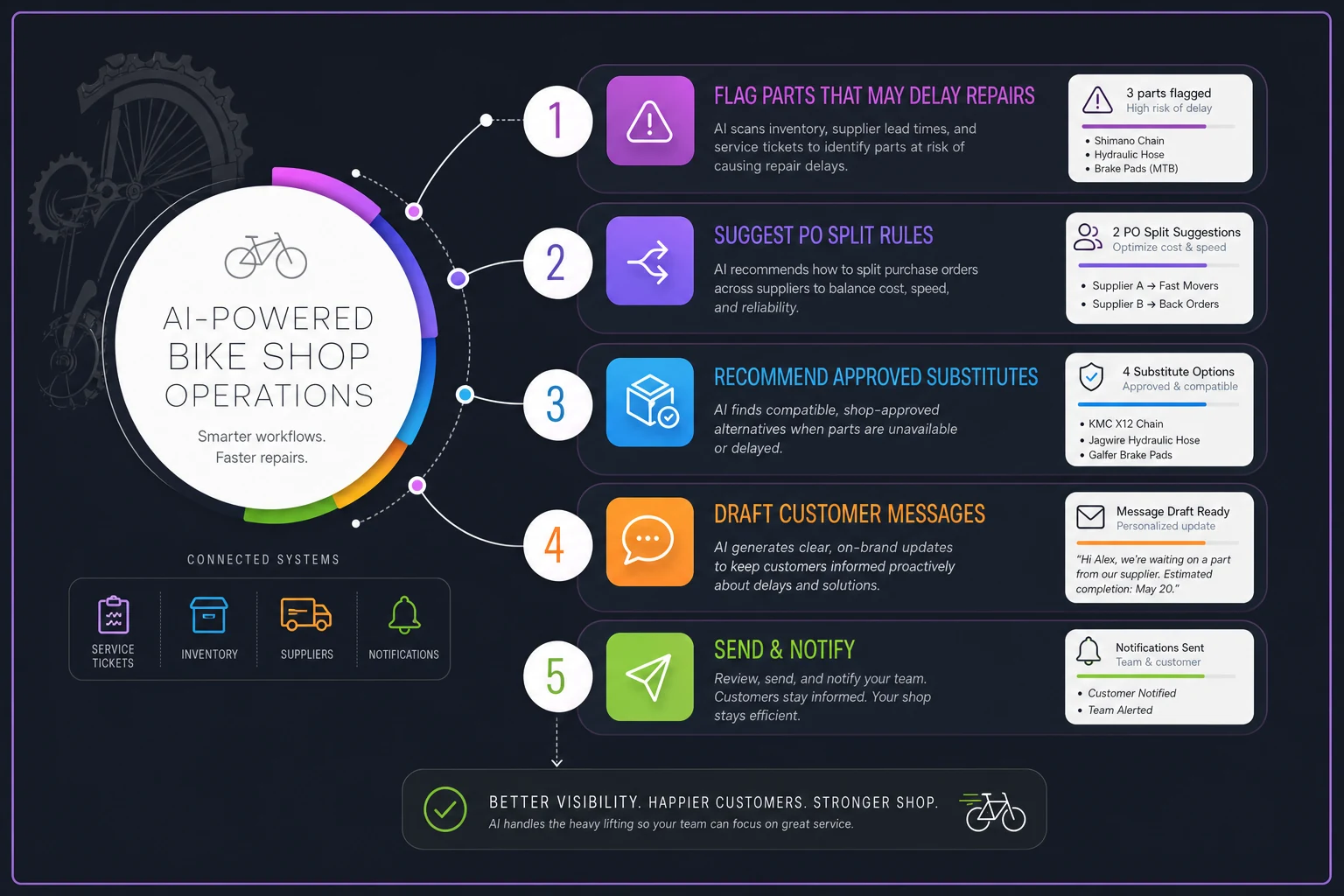
More importantly, this kind of software builds institutional memory. When your experienced service manager goes on vacation, the system remembers that you always substitute X for Y, that supplier A consistently delays on Fridays, that customer B always prefers to wait for exact parts.
The real value shows up in prevention. When software notices you're about to order all twenty brake pads on one PO, it suggests splitting. When it sees five repairs queued for the same part, it flags substitution options before the part even goes out of stock.
Making These Templates Stick
Start with one category - probably brake pads since they're high-volume and substitution-friendly. Build your split-ordering rule, document three approved substitutes, draft your customer message template. Run this for a month before adding complexity.
Track two numbers weekly: repairs delayed for parts and customers who complained about timing. Both should trend down within the first month. If not, your templates need adjustment - probably your substitution approvals are too conservative or your split ratios are off.
Around month three, staff stops seeing delays as crises and starts seeing them as normal variations with standard responses. Customers stop being surprised by delays because communication comes early with options. Suppliers might even start improving performance when they realize you're tracking and documenting their failures.
Your service department transforms from reactive scrambling to proactive management. Not because delays stop happening - they won't. But because delays stop causing chaos. Every delay has a documented response, every substitution has pre-approval, every customer gets consistent communication.
Parts will still run late, suppliers will still frustrate you, some customers will still complain. But you'll handle these situations at 20% of the previous stress level while keeping significantly more repairs moving through the shop.
The shops that implement these templates typically report the biggest change isn't financial - though service revenue does stabilize. The biggest change is that service managers stop dreading their morning email, knowing that whatever supplier problems await, they've got a system to handle them.
Ready to revolutionize your bike shop operations?
Join hundreds of bike shops using Bicyclly to save time, increase revenue, and deliver exceptional customer service.