

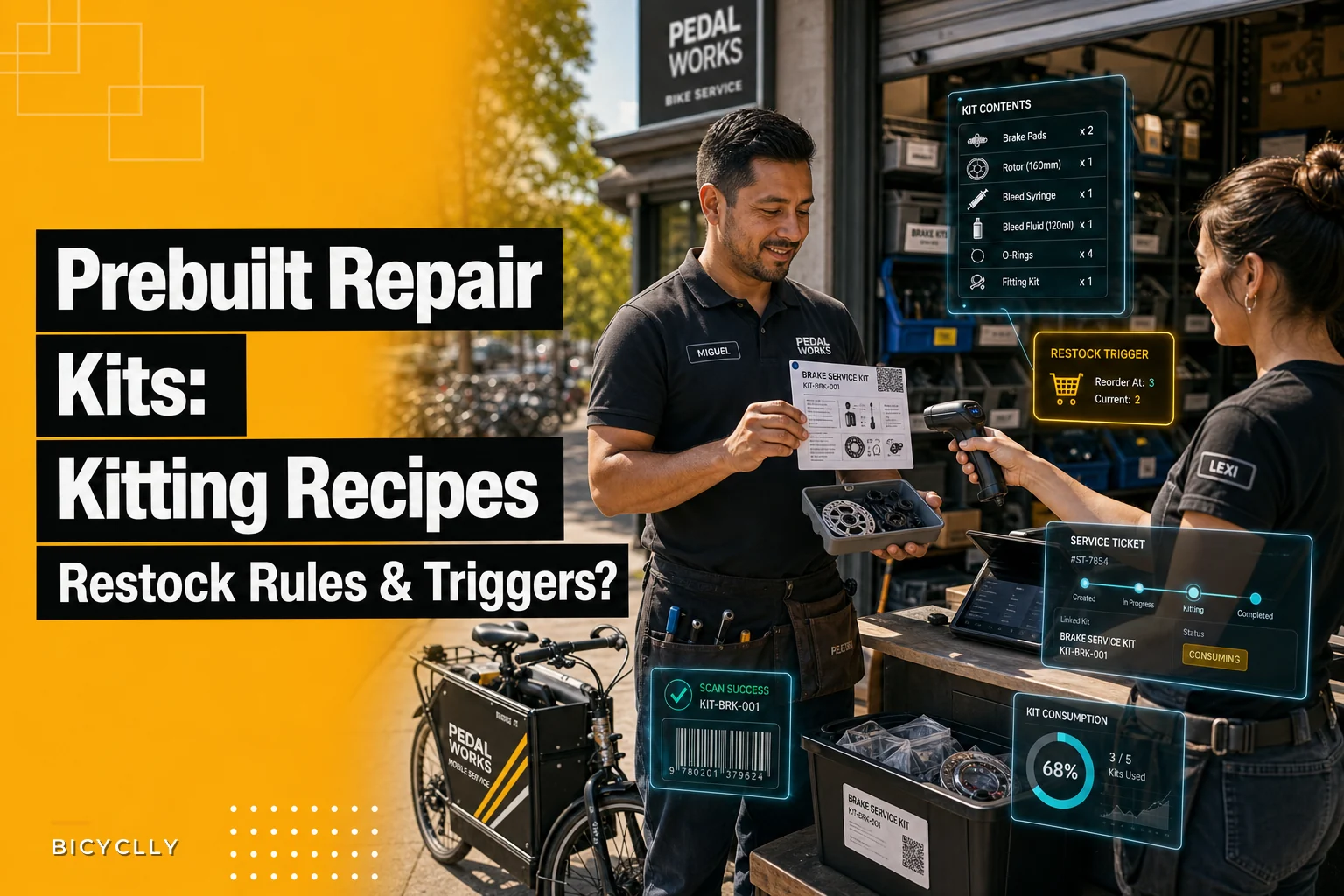

Your mechanics spend a surprising chunk of their day not actually turning wrenches. They're wandering the shop floor, digging through parts bins, borrowing tools from other bays, and hunting for that one specific cable housing ferrule that's supposedly somewhere in the back.
Meanwhile, your parts inventory looks fine on paper but somehow you're always missing the exact combination of items needed for basic repairs. Two hundred brake pads in stock but no matching hardware kits. Plenty of chains but quick links are backordered. Tubes everywhere but your floor pumps keep migrating between stations.
The fix isn't buying more inventory or installing better bin labels. It's building preassembled repair kits for your most common service tickets, then tracking consumption to trigger restocks before you run dry.
Why Individual Parts Management Falls Apart in Service Shops
Most bike shops track parts like a retail operation—individual SKUs, min/max levels, reorder points based on sales velocity. That makes sense for selling products off the shelf. It falls apart completely for service work.
A brake bleed isn't just DOT fluid. It's two syringes, specific bleed blocks for that brake model, isopropyl alcohol, shop towels, nitrile gloves, and potentially new olives and barbs. Track the fluid all you want—if you're missing bleed blocks when a customer drops off their bike, that ticket sits dead.
The traditional approach creates three persistent problems. Mechanics waste enormous amounts of productive time gathering materials. Watch your service bay for an hour and count how many trips each tech makes to various storage areas. Then you get partial stockouts, where having 90% of required items means 0% ability to complete the job. And consumption tracking becomes nearly impossible since parts get pulled individually rather than as logical groups.
This gets worse as shops grow. A single-mechanic operation can keep everything in their head. Once you've got three or four techs working simultaneously, the system breaks. Tools migrate between stations. Consumables get borrowed without being recorded. That specialty tool everyone needs somehow ends up in someone's personal toolbox.
Reverse-Engineering Kits from Your Actual Ticket Data
Instead of guessing what belongs in each kit, pull your last 90 days of closed service tickets. Group them by service type—basic tune-up, brake bleed, derailleur adjustment, flat repair, cable replacement, whatever your common jobs are.
Never miss a sale or service appointment again.
Bicyclly helps you manage every sale, repair, and booking with ease and accuracy.
- Unified inventory and sales tracking
- Automated customer notifications
- Service appointment scheduling
No credit card required
For each service type, list every single item that appeared on those tickets. Not just the major parts, but every consumable, every specialized tool, every random small bit mechanics had to track down. Pay special attention to delayed tickets. It's usually a missing $2 item, not an expensive component, that held things up.
Brake Bleed Kit Contents:
-
DOT 5.1 fluid (120ml bottle)
-
Two bleed syringes with tubing
-
Shimano bleed blocks (2 sets)
-
SRAM bleed blocks (1 set)
-
Isopropyl alcohol (small bottle)
-
Blue shop towels (10 count)
-
Nitrile gloves (4 pairs M, 4 pairs L)
-
Olive/barb replacement set
-
Torx T10, T25 bits
-
7mm box wrench
-
Bleed port adapters (common sizes)
-
Small parts tray
-
Laminated process card
Notice what's not in there—actual brake levers or calipers. Kits contain consumables and specialized tools, not the primary replacement parts that vary by customer bike.
Flat Repair Kit Contents:
-
Tire levers (3 plastic, 1 metal)
-
Patch kit with sandpaper
-
Spare valve cores (Presta/Schrader)
-
Valve core tool
-
Mini pump or CO2 inflator
-
Rim tape (multiple widths)
-
Sealant syringe (for tubeless)
-
Alcohol wipes
-
Disposable gloves
-
Chalk or marker for hole marking
-
Small bucket for wheel soaking
-
Process checklist card
The key insight: kits aren't just about parts. They're complete job packages that eliminate hunting and standardize your service quality.
Physical Kit Storage and Bay Organization
Prebuilt kits need dedicated storage that's both accessible and trackable. Plastic bins with clear lids work better than bags—easier to verify contents at a glance, they stack efficiently, and they survive shop abuse.
Label each bin with large text visible from across the bay. Include the service name, a unique kit number, and a color code that matches your ticket system. When a mechanic grabs Kit #7 (Brake Bleed - Yellow), anyone can see what's in use and what's available.
Mount a simple pegboard or slot system near each service bay. Full kits on the left, empties on the right. Five brake bleed kits on the left means five brake bleeds can start immediately. Three empties on the right means three kits need rebuilding. No system check required.
For shops under 1,200 square feet, a rolling cart works well. Each cart holds six to eight service kits and moves between bays as needed. Bigger shops might dedicate specific kit types to specific bays—all wheel-related kits near the truing stands, all drivetrain kits near the repair stands.
Some shops resist the space investment. "We don't have room for duplicate tools in every kit." But the tools are already being duplicated—they're just scattered randomly across the shop in toolboxes, drawers, and jacket pockets. Centralized kit storage actually reduces overall space needs while improving efficiency.
Building Consumption Triggers from Service Patterns
Traditional reorder points assume steady, predictable consumption. Your Tuesday might see twelve flat repairs while Wednesday sees none. Seasonal patterns make it worse—brake bleeds spike in March, wheel builds cluster in May.
Instead of fixed reorder points, tie restocking to service ticket patterns. Track kit consumption over rolling 30-day windows and set triggers based on service booking trends.
The basic formula: take your average daily kit usage, multiply by your typical supplier lead time plus two days buffer, then round up. If you use 1.5 brake bleed kits daily and your supplier delivers in three days, you need at least 7-8 kits minimum. That's the baseline.
Layer in booking data on top. When three brake services get scheduled for next Tuesday, your system should flag it if you only have two kits ready. When April historically shows 40% more flat repairs, bump your flat kit quantities in late March.
The real power comes from linking kit consumption to upcoming bookings. Operational platforms with AI-assisted scheduling can scan next week's appointments, calculate required kits, and generate pick lists for assembly. No more discovering Wednesday morning that you need four derailleur adjustment kits but only prepped two.
Kit Assembly Workflow
Service Ticket Created → Kit Type Identified → Kit Checked Out → Job Completed → Kit Returned Empty → Restock Triggered
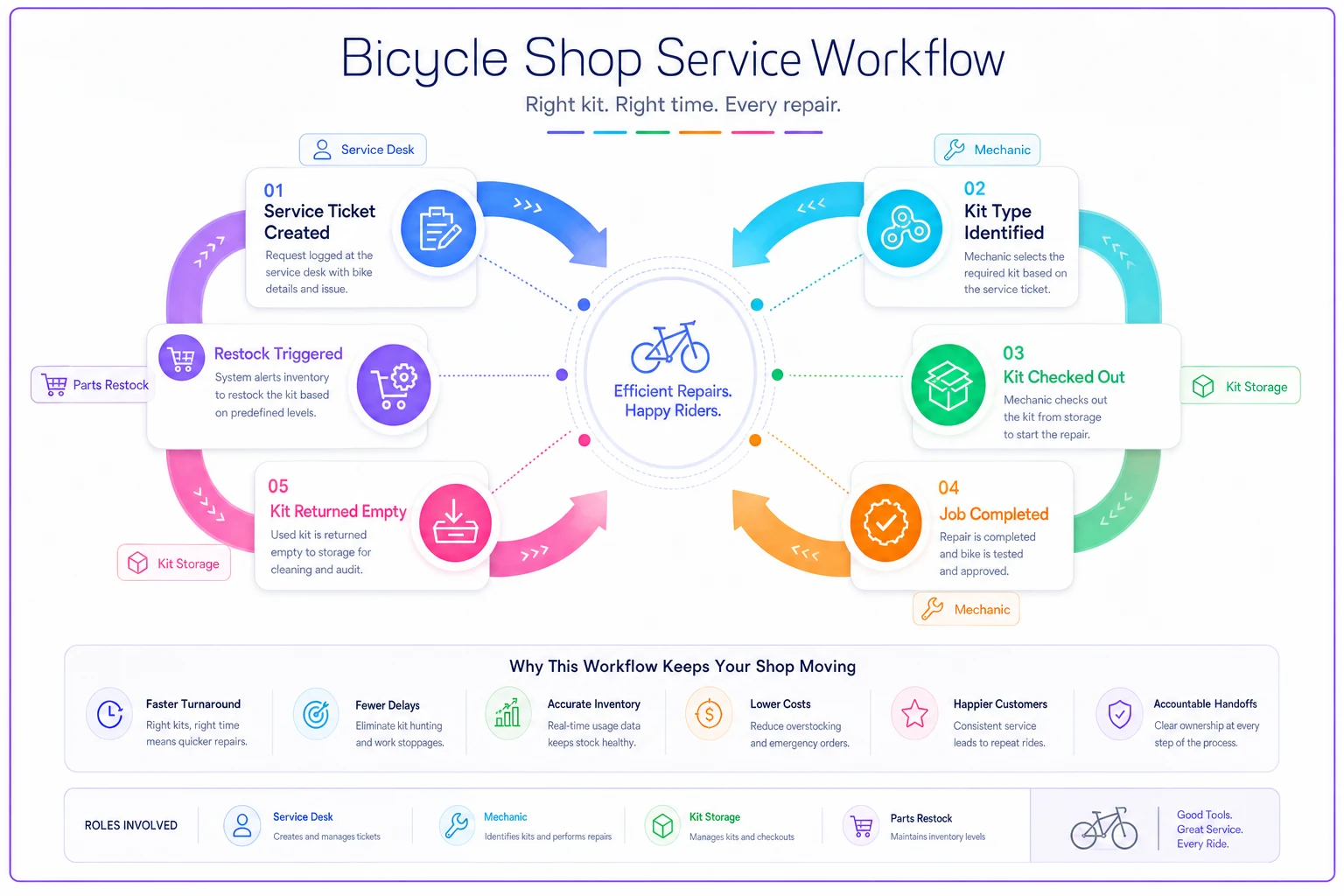
Scan kits out at checkout using a simple barcode or QR scan to keep consumption data accurate without extra steps.
Each step in this flow is a handoff. When handoffs are clean, jobs move fast. When they're not—mechanic grabs the wrong kit, kit goes back to the wrong shelf, restock doesn't get logged—the system quietly degrades until someone notices kits are never ready.
The checkout step matters more than most shops realize. If mechanics aren't recording which kit went to which ticket, you lose the consumption data that makes restocking predictable. A simple whiteboard log or a scan at checkout is enough. It doesn't need to be complicated.
Printable Kit Cards and Assembly Instructions
Every kit needs a laminated card that lives inside the container. Not just a contents list—a complete job blueprint that standardizes your service delivery.
The card's front side shows the kit name and number, a complete contents list with quantities, a visual diagram of tool placement, a QR code linking to a process video, expiration dates for any chemicals, and a "last inspected" signature line.
The back side contains the actual service process. Not a detailed repair manual, but the specific steps your shop follows for quality and consistency. Include torque specs, adjustment ranges, and customer communication checkpoints.
-
Initial safety check (brakes, QR, headset play)
-
Wheel true check (3mm lateral, 2mm radial tolerance)
-
Brake adjustment (1mm pad clearance, even pull)
-
Derailleur adjustment (all gears, no chain rub)
-
Torque check (stem 5Nm, seatpost 6Nm)
-
Test ride checklist (shifting, braking, noise)
-
Customer notes section
These cards serve three purposes: new mechanics get consistent training, experienced mechanics don't skip steps during rushes, and customers get standardized service regardless of who works on their bike.
Print cards on waterproof paper or laminate them heavily. They'll get soaked in chain cleaner, covered in grease, and dropped constantly. Make them indestructible and they'll actually get used.
Connecting Kit Usage to Inventory Systems
Most bike shops run parts inventory and service tickets in separate systems, or worse, separate spreadsheets. Kits bridge that gap by creating trackable consumption units.
When a mechanic starts a brake bleed, they grab Kit #7. The system records that kit as in use, associated with ticket #2847. When the job completes, the kit returns empty. That single transaction tells you how many complete sets of brake bleed supplies were consumed, the actual job duration from kit out to kit back, which mechanic used which tools, and precise restock requirements.
This beats hoping mechanics remember to mark down every cable ferrule and zip tie they pull from bulk bins. With kits, consumption tracking happens automatically at a useful resolution.
For shops running modern operational platforms, kit tracking feeds directly into purchase orders. When six flat kits return empty on Thursday, your system can automatically add tubes, patches, and tire levers to Friday's supplier order. No manual counts, no guessing.
The data also reveals profit leaks. If brake bleeds consistently burn through two bottles of DOT fluid instead of one, either the kit recipe needs adjusting or mechanics need guidance on fluid waste. If tool replacement spikes in certain kits, you've identified either a quality issue or a process problem worth digging into.
The Seasonal Kit Rotation Problem
Spring tune-up kits look nothing like winter overhaul kits. Your March flat repair kit needs different tube sizes than July's. Maintaining universal kits year-round means carrying inventory you won't touch for months.
Build your kit recipes with seasonal variations. "Summer Flat Kit" and "Winter Flat Kit" with different tube distributions. Summer heavy on road sizes (23-28c), winter heavy on commuter and gravel (32-42c). Same kit structure, different contents based on actual ticket data from previous years.
Rotate kit types based on service booking patterns, not calendar dates. When tune-up bookings spike above 15 per week, phase out overhaul kits and triple tune-up kit quantities. When custom builds drop below two per week, reduce wheel building kits to free up tools for other uses.
This matters especially for chemical consumables. Tubeless sealant expires. Grease separates. Loctite hardens. Having 20 winter kits prepped in October means throwing away expired chemicals in March. Better to prep five kits at a time based on next week's actual bookings.
Track which kit variations actually get used. That "vintage restoration kit" might seem like a good idea but sit untouched for eight months. The "e-bike service kit" might get grabbed daily despite initial skepticism. Let usage data drive your kit portfolio, not a theoretical service menu.
Making Mechanics Actually Use the System
The best kit system fails if mechanics bypass it. They'll grab individual parts "just this once" until the whole thing collapses back into chaos.
Success requires three things: convenience, accountability, and benefit visibility.
Convenience means kits have to be easier than the current approach. If walking to kit storage takes longer than digging through bins, mechanics will dig through bins. Position kits closer to bays than bulk storage. Make kit checkout faster than gathering individual items.
Accountability comes from simple tracking. A whiteboard showing kit status works fine—green magnets for available, red for in use, yellow for needs restocking. When everyone sees that Tom has four kits checked out while struggling to complete tickets, peer pressure solves the problem faster than any management conversation.
Benefit visibility means showing mechanics how kits help them personally. Track billable hours before and after implementation. Most techs see noticeably more wrench time once they stop hunting for parts. Sharing those numbers lands better than "please follow the new system."
Eliminate the hoarding instinct too. When mechanics trust that kits will be available, they stop maintaining personal tool stashes. But this requires consistent restocking. Better to overstock initially than have mechanics lose faith in the system.
Small Shop Adjustments and Scaling Considerations
A two-bay shop can't justify fifty prebuilt kits. A twelve-bay shop can't function without them.
| Shop Size | Kit Types | Kits Per Type | Storage Approach |
|---|---|---|---|
| Under 4 bays | 5 service types | 2-3 kits each | Single rolling cart |
| 4-8 bays | 8-10 service types | 3-5 kits each | Central kit wall |
| 8+ bays | 15-20 service types | 5-10 kits each | Zone-based storage |
For smaller shops, magnetic labels that attach to whatever bike is being serviced create visual tracking without complex systems. Mid-size shops can assign kit types to specific mechanics on specific days—Monday through Wednesday, Sarah handles all brake services so brake kits stay at her station. Larger shops benefit from a dedicated kit prep role during slow periods.
The scaling challenge isn't just quantity, it's complexity. Small shops can modify kits on the fly. Large shops need standardization. A three-person crew can verbally coordinate kit changes. A twelve-person operation needs written procedures.
Don't implement everything at once. Start with your highest-volume, most-standardized service. Get flat repair kits working before adding brake bleeds. Build success gradually rather than overwhelming your team with twenty new kit types simultaneously.
Cost Reality and ROI Calculation
Kits require upfront investment. Duplicate tools, bins, storage systems, setup time. For a typical 5-bay shop implementing 10 kit types, expect somewhere in the $3,000-5,000 range to start.
| Cost Category | Estimated Range |
|---|---|
| Containers and storage | $500-800 |
| Duplicate tools | $1,500-2,500 |
| Initial consumables stock | $800-1,200 |
| Setup labor (~40 hours at shop rate) | $600-800 |
| Process documentation | $200-300 |
Against that, measure three returns. Mechanic efficiency gains typically add 4-6 billable hours per week per tech. At a $75/hour shop rate, that's $300-450 weekly per mechanic—a 4-tech shop could see $4,800-7,200 in additional monthly revenue. Inventory reduction from cutting out overstock "just in case" purchases adds up too. Most shops trim parts inventory by 15-20% after implementing kits because they stop panic-ordering items they can't locate but actually have. And service consistency improvements reduce comebacks. When every brake bleed follows the same process with the same tools, quality problems drop.
Most shops recover kit investment within 6-8 weeks through efficiency gains alone. Factor in inventory and quality improvements, and ROI often hits within a month.
Beyond Basic Repairs: Specialty Service Kits
Once basic kits run smoothly, expand into specialty services that differentiate your shop.
Suspension service kits capture high-margin work often sent elsewhere. Include seal drivers, special oils, nitrogen gauges, and cleanliness supplies that make suspension work possible without dedicated bench space.
Wheel building kits standardize your custom wheel process. Spoke prep compound, specific tension gauges for different rim types, dishing tools, and a process card ensuring consistent quality whether the build comes from your veteran mechanic or newer staff.
Electronic shifting diagnostic kits prepare you for what's coming. Di2 junction box tester, eTap battery checker, diagnostic cables, and voltage meters in one organized package. As these systems become more common, shops with ready kits capture work others turn away.
Carbon repair evaluation kits help you quickly assess damage and quote repairs. Tap test hammers, bright lights, measurement tools, and documentation templates that create professional damage reports customers actually trust.
Each specialty kit opens new revenue while maintaining the same operational efficiency. The framework stays identical—analyze tickets, build recipes, track consumption, restock before you run out.
Making It Stick Long-Term
Most operational improvements fade after initial enthusiasm. Kits tend to survive because they create immediate, visible benefit for everyone involved—mechanics save time and frustration, service writers quote accurately knowing kit availability, owners see higher throughput, customers get consistent quality and faster turnaround.
Maintaining the system requires ongoing attention though. Assign kit ownership to someone who actually feels the pain when kits aren't stocked—usually your lead mechanic or service manager.
Review kit recipes quarterly based on actual usage. That brake bleed kit might need different bleed blocks as customer bikes evolve. The flat kit might shift toward tubeless supplies as traditional tubes decline.
Track kit-related metrics monthly: average kit turns, stockout incidents, mechanic adoption rates, revenue per kit. When metrics slip, address it before bad habits cement. Build kit prep into your weekly routine, not an as-needed crisis response. Tuesday mornings from 8-10am, someone rebuilds all empty kits. Thursday afternoons, check next week's bookings and prep accordingly.
The shops that stick with this treat kits as core operations infrastructure, not a nice-to-have organization project. They invest in quality containers, maintain accurate recipes, and protect the system against gradual erosion.
Your mechanics want to fix bikes, not hunt for parts. Start with one kit type this week and build from there.
Ready to revolutionize your bike shop operations?
Join hundreds of bike shops using Bicyclly to save time, increase revenue, and deliver exceptional customer service.