


No-shows crush bike shop service departments in ways most owners don't fully calculate. That empty bay at 10am isn't just lost labor—it's mechanics standing around, same-day walk-ins you turned away yesterday, and parts sitting on shelves ordered specifically for that appointment.
The standard approach most shops take? Send a reminder text the day before. Maybe an email three days out if you're being proactive. These basic sequences might nudge no-shows from 15% down to 12%, but that's still bleeding money every single week. The pattern across shops that struggle with this is pretty consistent: confirmation sequences need escalation triggers, deposit thresholds need actual teeth, and rescheduling needs just enough friction to make people think twice.
Mapping Your Current No-Show Pattern
Before touching your confirmation sequences, you need to understand your shop's specific no-show profile. Most shops guess at their no-show rate. The actual numbers usually surprise them.
Pull the last 90 days of appointments. Count total scheduled, completed, and no-shows. Don't include same-day cancellations or reschedules—those are different operational problems. Pure no-shows only.
Segment by service type. Basic tune-ups probably run 8-10% no-show rates. Major overhauls drop to 3-4%. Warranty work can hit 20% or higher. It makes sense when you think about it—customers value services differently based on what they're paying and how urgent the need feels.
Check booking lead time too. Appointments booked more than two weeks out typically ghost at higher rates than those booked within 72 hours. One shop in Portland found their no-show rate jumped from 6% to 18% for anything booked beyond the 14-day mark. That single insight changed their entire booking strategy.
Day of week matters too. Monday appointments ghost at higher rates than any other day—usually because weekend riders decide Sunday night they can push off that repair another week. Friday appointments stick better, probably because people want their bikes ready for the weekend.
Low-Effort vs High-Touch Sequences
Most shops get confirmation sequences wrong the same way: they treat every appointment identically. A $45 brake adjustment gets the same reminder cadence as a $450 suspension rebuild. That's leaving money on the table.
Never miss a sale or service appointment again.
Bicyclly helps you manage every sale, repair, and booking with ease and accuracy.
- Unified inventory and sales tracking
- Automated customer notifications
- Service appointment scheduling
No credit card required
Low-effort sequences work fine for low-value, short-notice bookings. Someone books a flat repair for tomorrow? Single SMS reminder that morning does the job. The appointment value doesn't justify multiple touches, and the short booking window means they probably remember anyway.
Layering confirmation touches for higher-value services changes the outcome noticeably:
Basic Sequence (Under $100 services)
-
Confirmation email immediately after booking
-
SMS reminder morning of appointment
Standard Sequence ($100-300 services)
-
Confirmation email immediately after booking
-
SMS 48 hours before appointment
-
SMS morning of appointment
-
Call if no response to 48-hour SMS
Premium Sequence ($300+ services or 10+ day booking windows)
-
Confirmation email immediately after booking
-
Email 7 days before with prep instructions
-
SMS 72 hours before asking for confirmation
-
Call 48 hours before if no SMS response
-
SMS morning of appointment
-
Call 2 hours before if still unconfirmed
The premium sequence seems like overkill until you run the math. One saved $400 overhaul appointment covers dozens of phone calls. A shop in Denver implemented this tiered approach and dropped their high-value no-shows from 11% to 3% within about six weeks.
Response Requirements and Confirmation Types
Sending reminders is half the equation. Getting responses is the other half.
Passive reminders ("See you tomorrow at 2pm!") feel friendlier but leave you guessing. Active confirmations ("Reply YES to confirm your 2pm appointment tomorrow") create commitment. The psychological difference is more meaningful than most shop owners expect.
For appointments over $200 or booked more than a week out, require active confirmation. Keep it simple—just YES or call to confirm. But start the confirmation requirement early. Send that first "Reply YES" request 72 hours out, not the morning of. This gives you time to fill the slot if someone doesn't respond.
Require active confirmation 72 hours out for appointments over $200 or booked more than a week out.
Some shops worry about annoying customers with confirmation requirements. Testing across multiple shops consistently shows the opposite—customers appreciate knowing their appointment is locked in. Framing matters: "Please confirm so we can hold your spot and have parts ready" works better than "You must confirm or lose your appointment."
Deposit Structures That Actually Work
Deposits are the most direct tool for reducing no-shows. Nothing makes someone show up like having skin in the game. But most shops implement deposits wrong—either too aggressive and losing customers, or too soft to actually change behavior.
The sweet spot varies by service type and market, but these ranges tend to hold up:
| Service Category | Booking Window | Deposit Amount | Refund Policy |
|---|---|---|---|
| Basic repairs (<$100) | Any | None | N/A |
| Standard service ($100-250) | 7+ days out | $25 | Full refund with 24hr notice |
| Major service ($250-500) | Any | $50 or 20% | Full refund with 48hr notice |
| Custom builds | Any | 30% minimum | Non-refundable after parts ordered |
| Warranty work | Any | None (usually) | N/A |
The booking window modifier matters. Someone scheduling a tune-up for next week probably doesn't need a deposit. Same tune-up booked three weeks out during peak season? That $25 deposit keeps them honest.
Implementation timing kills most deposit programs before they start. Don't surprise existing customers with sudden requirements. Phase them in over 4-6 weeks with clear communication—protecting scheduled time for all customers, ensuring parts availability. Most people accept it once it's explained.
Rescheduling Friction That Reduces Serial Offenders
Every shop has them—the serial reschedulers who book, cancel, rebook, cancel again. Not malicious, just disorganized. But they wreck your schedule just the same.
Adding controlled friction to rescheduling changes behavior without losing customers. First reschedule stays easy—life happens. Second reschedule within 30 days requires calling instead of self-serving online. Third reschedule triggers a deposit requirement for future bookings.
Track reschedule patterns by customer. Most people rarely reschedule. The problem tends to come from roughly 5-8% of customers who do it constantly. One shop found that 6% of their customer base accounted for 43% of all reschedules. They implemented escalating friction rules and cut total reschedules by around 30% without losing a single regular customer.
The friction ladder looks like this:
-
First reschedule
Easy online/phone change
-
Second reschedule (within 30 days)
Phone only
-
Third reschedule
Requires deposit for rebooking
-
Fourth reschedule
Manager approval required
-
Fifth reschedule
Service privileges suspended
Harsh? Maybe. But mechanic time is finite, and serial reschedulers effectively take it from customers who actually show up.
Expected No-Show Reductions by Strategy
These aren't guarantees, but they reflect what typically happens when shops implement these strategies properly.
Baseline no-show rate: 12-15% (typical shop with basic reminders)
Adding SMS confirmation requirements (Reply YES): Reduces no-shows by roughly 20-30% relative. A 12% rate drops to around 8-9%.
Implementing tiered confirmation sequences: Another 15-25% relative reduction. That 8-9% drops toward 6-7%.
Adding deposits for high-value services: 40-50% reduction for those specific services. Overall shop rate might drop another 1-2 percentage points.
Rescheduling friction for serial offenders: 10-15% reduction in total no-shows, mostly by preventing the same people from repeatedly booking and ghosting.
Stack all these strategies and a shop running 15% no-shows can realistically get to 5-6%. On 300 monthly appointments, that's 27 recovered appointments. At $150 average ticket, that's over $4,000 monthly—not counting improved mechanic utilization.
Morning-Of Confirmation Protocols
The morning of service appointments is your last chance to prevent no-shows. Most shops handle this window poorly—either bombarding customers or going silent until it's too late.
For appointments before noon, send the final SMS at 7:30am. Earlier annoys people; later doesn't give you time to react. Keep the message short: "Good morning! Confirming your 10am bike service today. Reply YES or call if you need to reschedule."
No response by 8:30am triggers a phone call. This isn't pushy—it protects your schedule. The call stays friendly: "Hi, this is [Name] from [Shop]. Just confirming your 10am since we didn't hear back on the text. Will you be able to make it?"
Roughly 60% of non-responders answer and confirm. Another 20% call back within 30 minutes. The remaining 20% are likely no-shows, giving you 90+ minutes to fill that slot with waitlist customers or walk-ins.
Afternoon appointments follow the same pattern but shifted—11:30am final text, 12:30pm call for non-responders. Respects lunch hours while still protecting your schedule.
Special Rules for Peak Season Bookings
Peak season changes the equation. Spring tune-up rushes and pre-summer surges create different no-show dynamics than slow winter months.
During peak periods (roughly March-May and August-September for most shops), tighten every policy by one level. Standard services that normally skip deposits? Add a $25 hold. Appointments that usually get 48-hour confirmation requests? Push that to 72 hours.
The reasoning is straightforward—during peak season, a no-show slot could have gone to multiple customers waiting. Most people understand this when you explain it clearly. "During our busy season, we require deposits so everyone who needs service can actually get scheduled" lands better than vague policy language.
Peak season also justifies stricter cancellation windows. Normal 24-hour cancellation becomes 48 hours. Major services might need 72 hours. You need time to fill premium slots when demand is high.
One Colorado shop implemented flat "surge deposits" during their April rush—every appointment required a $40 hold regardless of service level. No-shows dropped from 14% to 3% during their busiest month. Customers grumbled at first but accepted it once they saw how booked the shop was.
Tracking and Adjusting Your Sequence Performance
Building confirmation sequences is step one. Optimizing based on actual performance is where you make real progress.
Track these metrics weekly:
-
No-show rate by service type
-
No-show rate by booking lead time
-
Confirmation response rate by channel (SMS vs email vs phone)
-
Deposit capture rate
-
Customer complaints about reminders
Initial sequences usually need adjustment after 4-6 weeks of data. Maybe your SMS messages go out too early and people forget anyway. Maybe confirmation emails land in spam. Maybe your deposit threshold is too low to actually change behavior.
A shop in Austin was convinced their 24-hour SMS reminder was dialed in—until they tracked response rates and found only 31% of customers actually confirmed. They tested moving it to 36 hours before appointments and saw confirmation rates jump to 52%. That single timing change cut no-shows by another 2 percentage points.
Pay attention to channel effectiveness. SMS typically outperforms email 3:1 for confirmation responses. But some customer segments prefer email—especially for high-value services where they want detailed prep information. Building channel preference tracking into your booking system lets you optimize over time.
Software Stack for Confirmation Automation
Running these sequences manually destroys productivity. Your service writer shouldn't spend two hours daily chasing confirmations. This is where AI-powered operational software turns the process from a daily burden into background automation.
Modern scheduling platforms with AI automation handle the entire confirmation sequence without manual intervention—segmenting appointments by value, adjusting timing based on booking windows, and escalating through channels based on response patterns. When someone doesn't respond to the 48-hour SMS, the system automatically queues that call for your staff rather than hoping someone remembers.
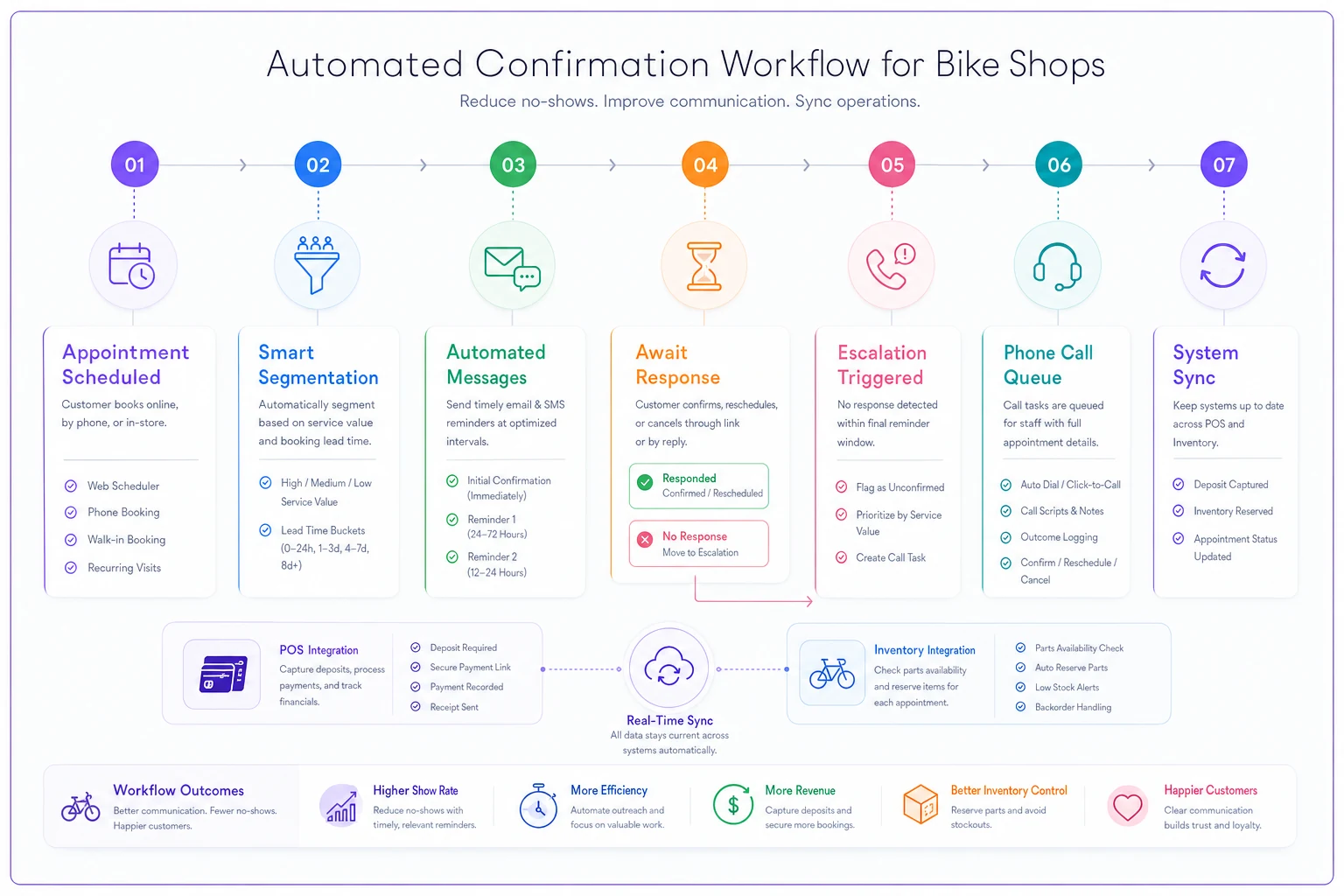
The deeper value comes from pattern learning over time. The platform analyzes your shop's specific no-show patterns and adjusts sequences accordingly. Maybe Tuesday appointments need earlier confirmations than Thursday ones. Maybe brake services have different optimal timing than wheel builds. Good AI-assisted operational software identifies these patterns instead of forcing you to find them manually.
Integration matters more than features. Your confirmation system needs to sync with your POS for deposit processing, your inventory system to track parts availability, and staff scheduling to manage mechanic capacity. Disconnected systems create gaps where no-shows slip through anyway.
Smaller shops sometimes resist automation, thinking it feels impersonal. But customers expect this communication now—they get confirmation texts from dentists, reminder emails from oil change shops, app notifications from restaurants. Not having professional confirmation sequences makes your shop look outdated, not personal.
When Aggressive Confirmation Backfires
Not every shop should implement every strategy. Market dynamics, customer base, and service mix all influence what level of intensity makes sense.
High-end shops with wealthy clientele might find deposit requirements insulting. These customers prioritize convenience above everything—making them jump through hoops could push them to competitors. Focus on premium service touches instead: personal calls from their usual mechanic, VIP scheduling privileges, or complimentary pickup that ensures they actually show.
Shops in tight-knit communities need softer approaches. The aggressive confirmation sequence that works in an anonymous urban market feels pushy in a small town where everyone knows each other. Reputation matters more than policies in those markets.
Emergency-heavy shops—lots of race support, commuter repairs, urgent fixes—can't implement rigid requirements. Someone with a cracked frame showing up tomorrow doesn't have time for deposit processing. Build exception protocols for urgent services while maintaining structure for routine work.
Test incrementally. Don't implement every strategy at once. Start with improved confirmation timing, measure for 30 days, then layer in the next piece. This lets you find what works for your specific market without overshooting and alienating customers.
Reducing bike shop appointment no-shows isn't about finding one magic fix—it's about building a system where multiple small improvements compound into meaningful results. Shops running sub-5% no-show rates didn't get there overnight. They tested, measured, adjusted, and gradually built confirmation sequences that match their operational reality.
Start with the basics: understand your current no-show patterns, implement tiered confirmation sequences based on service value, and add just enough friction to shift behavior without losing customers. The advanced strategies—deposits, serial rescheduler management, peak season adjustments—come after the fundamentals are solid.
Most importantly, recognize that no-shows are rarely intentional. People forget, priorities shift, emergencies happen. Your confirmation system should feel helpful, not punitive. When customers understand these protocols protect everyone's access to service, compliance improves on its own.
The shops seeing the best results combine thoughtful human touchpoints with operational software that handles the repetitive work automatically. Let software manage SMS timing and response tracking while your staff focuses on actual customer relationships. That balance between efficiency and personal service is where good shops pull away from everyone else fighting the same no-show problem.
Your empty service bays represent more than lost revenue—they're missed opportunities to build relationships, develop mechanic skills, and grow your reputation. Start with one improvement this week, measure the impact, then build from there.
Ready to revolutionize your bike shop operations?
Join hundreds of bike shops using Bicyclly to save time, increase revenue, and deliver exceptional customer service.