



The difference between a bike shop that processes 8 repairs a day versus one that handles 40+ isn't the number of mechanics. It's the operational backbone that moves bikes through the pipeline without bottlenecks forming at intake, parts staging, or quality control. Most shops hit their ceiling around 12-15 daily repairs. Not because they lack space or staff, but because their workflow breaks down. Bikes pile up waiting for parts. Mechanics cherry-pick easy jobs. The service manager spends half their day answering "where's my bike?" calls. After working with dozens of shops—from single-mechanic setups to 8-bay operations—the pattern is clear. High-throughput shops don't just work harder. They run fundamentally different systems that prevent the typical failure points from forming in the first place.
The Universal Bike Shop Service Bottleneck Map
Every bike shop service operation follows roughly the same flow: intake → triage → parts staging → mechanic assignment → quality control → customer pickup. But where those steps break determines whether you're running a smooth operation or constantly fighting fires.
In smaller shops (1-2 mechanics), the bottleneck usually forms at intake. The person writing up repairs is also answering phones, helping retail customers, and probably fixing flat tires. Jobs get written up inconsistently. Critical details get missed. By the time a bike reaches the mechanic, they're hunting down the customer for clarification.
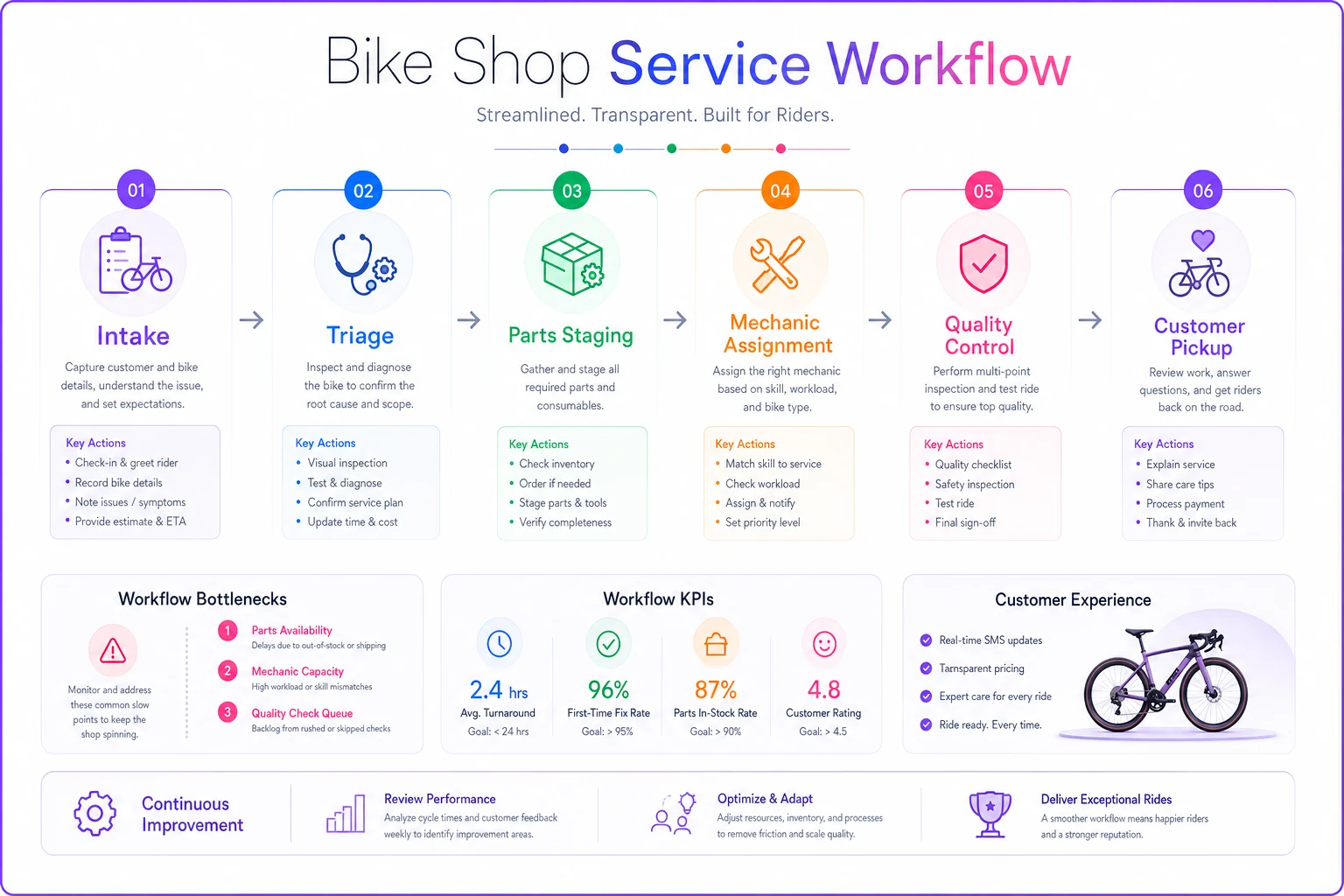
Mid-size shops (3-5 mechanics) typically bottleneck at parts staging. They've solved intake by dedicating someone to service writing, but now bikes sit in limbo waiting for parts. The parts person doesn't know what's priority. Mechanics waste time walking to the parts counter. Special orders get lost.
Larger operations (6+ mechanics) usually choke at mechanic assignment and quality control. With multiple techs working different skill levels and speeds, job routing becomes a nightmare. Fast mechanics get overloaded while slower ones coast. Nobody owns quality control, so callbacks spike.
These aren't separate problems. They're symptoms of running the wrong operational model for your current scale.
Single-Mechanic Operations: The Owner-Operator Reality
Running a one-person service department means you're juggling everything. Most solo mechanics try to handle it all—intake, repairs, parts ordering, customer communication.
Never miss a sale or service appointment again.
Bicyclly helps you manage every sale, repair, and booking with ease and accuracy.
- Unified inventory and sales tracking
- Automated customer notifications
- Service appointment scheduling
No credit card required
This works until you hit about 6-8 repairs daily. Beyond that, the context switching kills efficiency.
The sustainable model for single-mechanic shops revolves around batch processing and structured days.
Dedicate specific time blocks for different functions. Monday mornings for parts ordering. Tuesday and Thursday afternoons for intake. This sounds rigid, but it prevents the constant interruption cycle that destroys productivity.
Your intake process needs to capture everything upfront. Use a detailed checklist that covers not just the requested repair but the bike's overall condition. Note chain wear, brake pad thickness, tire condition—everything. Because calling customers mid-repair to upsell destroys your workflow.
Parts staging happens differently when you're solo. Instead of ordering parts as bikes come in, you batch orders twice weekly. Keep commonly needed items in stock (tubes, cables, brake pads, chains for popular models). For everything else, set customer expectations that parts arrive in 2-3 business days.
The daily workflow looks something like this:
-
8
00-9:00
: Review today's jobs, pull parts from inventory -
9
00-12:00
: Focused repair time (no interruptions) -
12
00-1:00
: Lunch + quick email/phone check -
1
00-4:00
: Continue repairs -
4
00-5:00
: Customer pickups and next-day intake
Your KPIs at this scale focus on utilization and cycle time:
-
Average tickets per day (target
6-8)
-
Same-day completion rate (target
70% for basic services)
-
Parts inventory turns (target
8-10x annually)
This works until you hit about 6-8 repairs daily. Beyond that, the context switching kills efficiency.
Scaling to Multi-Mechanic: The Coordination Challenge
The jump from one to three mechanics changes everything. Suddenly you need real systems for job assignment, parts flow, and quality standards. Most shops fumble this transition because they try to scale the owner-operator model instead of building proper workflows.
With multiple mechanics, role definition becomes critical. You need clearly defined positions:
-
Service Writer/Advisor
Handles all intake, quotes, customer communication. Never touches a wrench.
-
Lead Mechanic
Your most experienced tech who handles complex repairs and mentors others.
-
Junior Mechanics
Handle routine services, basic adjustments, flat repairs.
Service Writer/Advisor: Handles all intake, quotes, customer communication. Never touches a wrench. This person controls your pipeline flow and sets customer expectations. They need to understand repair complexity and mechanic capabilities to promise realistic timelines.
Lead Mechanic: Your most experienced tech who handles complex repairs and mentors others. Also serves as technical advisor during intake for unusual problems. Gets first pick of interesting jobs but also handles the nightmare repairs others can't figure out.
Junior Mechanics: Handle routine services, basic adjustments, flat repairs. Work from a defined list of approved repairs based on skill level. Graduate to more complex work as they prove competence.
Morning standup: 10 minutes reviewing the day's jobs, flagging priority repairs, identifying parts needs. Everyone knows what they're working on before touching a bike.
Jobs get assigned based on complexity matching. Your lead mechanic shouldn't waste time on brake adjustments while a junior struggles with a hub overhaul. Build a complexity matrix:
| Repair Type | Junior | Intermediate | Senior Only |
|---|---|---|---|
| Flat repair | ✓ | ✓ | ✓ |
| Basic tune | ✓ | ✓ | ✓ |
| Brake bleed | ✓ | ✓ | |
| Wheel build | ✓ | ||
| Electrical diagnosis | ✓ |
Parts staging needs its own workflow. Dedicate a parts staging area where bikes wait with their parts kit. When a mechanic finishes a job, they grab the next bike that has parts ready. No searching, no waiting.
KPIs expand to include team metrics:
-
Mechanic utilization rate (target
75-80%)
-
First-time fix rate (target
>95%)
-
Average repair cycle time by category
-
Daily throughput per mechanic
Morning standup: 10 minutes reviewing the day's jobs, flagging priority repairs, identifying parts needs. Everyone knows what they're working on before touching a bike.
The Multi-Bay Independent Shop: Systems at Scale
Once you hit 4+ mechanics and multiple service bays, you're running a production facility. The casual "figure it out as we go" approach leads to chaos.
The organizational structure adds specialized roles:
Service Manager: Owns the entire service operation. Reviews metrics, handles escalations, manages scheduling. Doesn't write service or turn wrenches—purely management and optimization.
Parts Coordinator: Manages inventory, handles special orders, maintains parts staging area. Knows what's coming in, what's backordered, and what alternatives exist. This role prevents mechanics from becoming parts hunters.
Quality Control Tech: Spot-checks completed repairs before customer pickup. Catches the missed details that create callbacks. Usually your most experienced mechanic rotating through this role.
The intake process becomes multi-stage:
-
Quick triage (2-3 minutes)
Service writer identifies repair category, sets rough timeline
-
Technical assessment (5-10 minutes)
Mechanic does thorough inspection, notes all issues
-
Customer consultation
Service writer calls with full quote, gets approval
-
Parts check
Coordinator confirms availability before promising timeline
-
Scheduling
Job gets slotted based on parts availability and mechanic capacity
Daily operations run on structured rhythms:
7:30 AM - Management prep: Service manager reviews previous day's metrics, today's schedule, identifies potential issues
8:00 AM - Team briefing: 15-minute standup covering priorities, parts status, special situations
8:15 AM - 12:00 PM - Morning production block: Focused repair time, no meetings
12:00 PM - Parts coordination: Check afternoon parts arrivals, adjust schedule if needed
1:00 PM - 4:30 PM - Afternoon production block: Continue repairs, begin end-of-day quality checks
4:30 PM - 5:00 PM - Handoff prep: Document incomplete jobs, set up tomorrow's priorities
The physical layout matters more at scale. Establish zones:
-
Intake/holding area for bikes awaiting diagnosis
-
Parts staging zone with bikes ready for repair
-
Active repair bays with dedicated tool sets
-
Quality control station
-
Ready-for-pickup area
The physical layout matters more at scale. Establish zones.
KPI Dashboards That Actually Drive Decisions
Most shops track vanity metrics that sound good but don't drive operational improvements. Revenue per month? Great for the owner, useless for the service manager trying to optimize workflow.
Effective bike shop service operations need real-time visibility into:
Pipeline metrics (checked multiple times daily):
-
Current bikes in each stage (intake/diagnosis/waiting parts/in repair/QC/ready)
-
Age of oldest bike in each stage
-
Number of bikes promised today/tomorrow
-
Parts pending arrival
Efficiency metrics (reviewed daily):
-
Actual vs estimated repair times by category
-
Mechanic utilization (wrench time ÷ total time)
-
Rework rate (bikes returning within 30 days)
-
Parts availability rate (% of jobs starting without parts delays)
Customer satisfaction drivers (tracked weekly):
-
Promise vs delivery accuracy
-
Communication touchpoints per repair
-
Upsell acceptance rate
-
Net promoter score from follow-up surveys
For single-mechanic shops, track this on a simple spreadsheet updated each evening. Multi-mechanic operations need a proper dashboard—whether that's a TV screen showing live stats or an operations platform that pushes updates to everyone's phone.
Make metrics actionable. If average repair time for brake bleeds jumps from 45 to 65 minutes, investigate immediately. Did you switch brake fluid suppliers? Is a mechanic struggling with the new process? Are customers requesting additional adjustments during the service?
Building SOPs That Mechanics Actually Follow
Standard operating procedures fail when they're written like corporate manuals. Mechanics are craftspeople who value expertise and efficiency. Your SOPs need to respect that while ensuring consistency.
Start with the non-negotiables—safety checks, documentation requirements, customer communication points. These become your quality gates that every repair must pass through.
For technical procedures, involve your team in creation. Have your best wheel builder document their process. Let your suspension expert define the fork service checklist. When mechanics help create the standards, they're more likely to follow them.
Structure SOPs as quick-reference guides, not novels:
-
Initial check (2 min)
Tire pressure, brake function, shift through all gears
-
Adjustments (15-20 min)
Brakes (center calipers, adjust pad clearance, check lever travel), Derailleurs (limit screws, cable tension, hanger alignment check), Wheels (true to 1mm lateral, check spoke tension)
-
Lubrication (3 min)
Chain clean/lube, pivot points, cables if needed
-
Final check (2 min)
Test ride if possible, verify all adjustments hold
-
Documentation
Note any issues beyond scope, parts recommendations
Have the tech who owns a specialty area write the checklist and run a trial week so the team sees the SOP in action before it's final.
Keep SOPs living documents. When a callback happens, update the relevant SOP to prevent recurrence. When new tools or techniques emerge, revise procedures to incorporate improvements.
The Quality Control Layer Most Shops Skip
Even experienced mechanics miss things when they're rushing through repairs. The difference between good shops and great ones? Great shops assume mistakes will happen and build systems to catch them.
Quality control isn't about trust—it's about consistency. Baseball teams don't skip catching practice because they trust their fielders. Your QC process serves the same purpose.
For smaller shops, implement peer review. Before a bike leaves, another mechanic does a 60-second safety check: brakes work, wheels are secure, no obvious issues. This catches the "forgot to tighten the stem" mistakes that damage reputations.
Larger operations need formal QC stations. Every 5th bike gets a full inspection. Every high-value or complex repair gets checked. New mechanics have every bike reviewed until they prove consistency.
The QC checklist focuses on common failure points:
-
All bolts torqued properly (spot check with torque wrench)
-
Brakes engage smoothly and stop effectively
-
Shifting hits all gears without hesitation
-
No play in headset, bottom bracket, wheels
-
Test ride reveals no issues (for full services)
-
Work order matches actual work performed
Track what QC catches. If certain issues keep appearing, you've identified a training need or process gap.
Seasonal Workflow Adjustments Nobody Talks About
Bike shop service demand isn't steady. Spring brings the flood of tune-ups. Summer means vacation bikes and kids' repairs. Fall sees the serious riders prepping for next season. Winter becomes project bike season (or dead season, depending on location).
Your operational model needs to flex with these patterns. The spring tune-up rush requires different workflows than winter overhaul season.
During peak season (typically March-July), focus on throughput:
-
Offer express services with limited scope
-
Batch similar repairs together
-
Extend hours but maintain mechanic breaks
-
Pre-stage common parts in larger quantities
-
Implement appointment-only intake to control flow
Off-season shifts to depth:
-
Take on complex restoration projects
-
Schedule mechanic training and certification
-
Deep-clean and reorganize the service area
-
Rebuild inventory for next season
-
Offer detailed inspections and preventive maintenance
Some shops try to maintain the same operational tempo year-round. This burns out staff during peak times and wastes capacity during slow periods.
When Digital Tools Become Necessary (Not Just Nice)
Small operations can run on paper and memory up to a point—usually around 10-12 daily repairs. Beyond that, the mental overhead of tracking jobs, parts, and promises becomes unsustainable.
The progression typically looks like:
-
Phase 1 (1-8 repairs/day)
Paper tickets, manual scheduling, mental tracking
-
Phase 2 (8-15 repairs/day)
Basic spreadsheets, shared calendar, written parts lists
-
Phase 3 (15-25 repairs/day)
Dedicated service writing software, digital work orders
-
Phase 4 (25+ repairs/day)
Full operations platform with automated workflows
The trigger for upgrading isn't just volume—it's when coordination failures start costing money. Missing promised dates, ordering wrong parts, double-booking mechanics. These errors multiply as volume increases.
Modern operational software does more than digitize paper processes. AI-powered platforms can predict repair times based on historical data, automatically flag bikes approaching promised dates, and even suggest optimal mechanic assignments based on skill sets and current workload.
The implementation key? Start with core workflows—intake, job tracking, customer communication. Add capabilities gradually as teams adapt. Forcing a complex system on a crew used to paper tickets guarantees rebellion.
Making the System Stick
Building these operational systems means nothing if they fall apart after two weeks. The shops that maintain high performance share common implementation approaches.
Start small with one workflow improvement. Get it working smoothly before adding the next layer. Trying to revolutionize everything simultaneously creates chaos and resistance.
Involve your team in designing processes. The service writer knows intake pain points better than anyone. Mechanics understand parts staging failures. Use their expertise.
Measure what matters and share results. When mechanics see their efficiency improvements translating to higher throughput (and potentially better pay), they'll protect the system that enables it.
Treat your operations as constantly evolving. The system that works for 15 repairs daily will constrain you at 25. Regular reviews and adjustments prevent the gradual slide back into chaos.
The Path Forward
High-throughput bike shop service operations aren't about working faster—they're about working systematically. Whether you're a solo mechanic dreaming of scaling up or a multi-bay shop fighting daily fires, the principles remain consistent: define clear workflows, assign appropriate roles, track meaningful metrics, and build quality checks into the process.
The shops crushing it aren't necessarily the ones with the most bays or the best mechanics. They're the ones that treat their service department like the production facility it is, with all the structure, measurement, and continuous improvement that implies.
Start with honest assessment. Where does your current operation actually break? Not where you think it might fail, but where bikes actually get stuck, customers actually complain, and mechanics actually waste time. Fix that bottleneck first, then move to the next one.
The seasonal rush will come again. The question is whether you'll handle 20% more bikes with the same chaos, or finally build the operational backbone that lets you scale smoothly.
Ready to revolutionize your bike shop operations?
Join hundreds of bike shops using Bicyclly to save time, increase revenue, and deliver exceptional customer service.