



Your service manager just spent 12 minutes figuring out whether Jake should handle the carbon fork replacement or if Maria should take it since she finished that derailleur hanger alignment early. Meanwhile, two customers are waiting at the counter, and that promised-by-3pm tune-up hasn't even started.
This scheduling chaos costs most 3–5 mechanic shops around $1,800–2,400 monthly in lost throughput. Not from lack of skill or effort — purely from mismatched job assignments that create bottlenecks where experienced techs handle basic adjustments while junior mechanics struggle with complex rebuilds.
The solution isn't hiring more mechanics or fancy scheduling software. You need a dead-simple dispatch matrix that matches repair complexity to mechanic capabilities, plus basic auto-assign rules that eliminate the guesswork. Here's the exact system that helps small shops push 15–20% more repairs through the same number of service bays.
Why Traditional Bike Shop Scheduling Falls Apart
Most shops schedule repairs using some variation of first-come-first-served mixed with whatever the service writer thinks makes sense in that moment. Tom gets the next ticket because he's free. Sarah takes the wheel build because she mentioned wanting practice. The expensive e-bike diagnostic goes to whoever feels confident that morning.
This ad-hoc approach creates three specific operational failures that compound throughout the day.
Your most experienced mechanic spends 45 minutes on brake bleeds that a junior tech could handle in the same time, while that junior tech takes two hours fumbling through a bottom bracket replacement that should take 40 minutes. The work gets done, but inefficiently.
Unclear handoffs create dead zones. When a mechanic finishes early, they grab whatever ticket looks manageable without knowing if someone else already prepped that bike or if specialized tools are tied up elsewhere. These 5–10 minute gaps between jobs add up to hours of lost productivity weekly.
Customer expectations become impossible to manage. Without clear complexity bands and time estimates, your service writer quotes "probably tomorrow" for everything. Some repairs finish in two hours, others take three days. Customers learn not to trust your timelines, which creates more phone calls, more interruptions, and more stress for everyone.
The traditional response — hiring another mechanic — just adds coordination complexity without fixing the underlying dispatch problem. Now you have four people grabbing tickets randomly instead of three.
Building Your Complexity Band Framework
Start by mapping every common repair into one of four complexity bands. This isn't about creating perfect categories — it's about establishing clear boundaries that eliminate 90% of assignment decisions.
Never miss a sale or service appointment again.
Bicyclly helps you manage every sale, repair, and booking with ease and accuracy.
- Unified inventory and sales tracking
- Automated customer notifications
- Service appointment scheduling
No credit card required
Band 1: Basic Adjustments (15–30 minutes)
-
Brake adjustments
-
Derailleur tuning
-
Tire changes
-
Cable replacements
-
Basic safety checks
Any mechanic with 3+ months experience should handle these without supervision. These repairs follow standard procedures with minimal diagnostic work.
Band 2: Standard Services (45–90 minutes)
-
Full tune-ups
-
Brake bleeds
-
Chain/cassette replacements
-
Headset adjustments
-
Basic wheel truing
Mechanics need 6–12 months experience plus specific tool proficiency. These jobs require diagnosis and problem-solving but follow established patterns.
Band 3: Complex Repairs (2–4 hours)
-
Bottom bracket overhauls
-
Fork rebuilds
-
Hub overhauls
-
Full drivetrain replacements
-
E-bike motor servicing
These require 2+ years experience and deep mechanical knowledge. Problems often cascade — a bottom bracket issue might reveal frame damage or compatibility problems.
Band 4: Specialized Work (4+ hours or multi-day)
-
Full rebuilds
-
Carbon repairs
-
Custom wheel builds
-
Warranty diagnostics
-
Insurance estimates
Only senior mechanics or specialists handle these. They require expertise, special tools, and often multiple customer consultations.
Print this matrix and stick it above your service counter. When a bike comes in, the service writer assigns it a band number, not a specific mechanic. This eliminates most scheduling confusion immediately.
Mechanic Skill Tags That Actually Work
You need simple, binary skill tags that answer one question: can this person complete this repair correctly without asking for help?
Jake (3 years experience)
-
Bands
1, 2, 3
-
Specialties
Wheel building, vintage bikes
Maria (18 months experience)
-
Bands
1, 2
-
Specialties
E-bikes, hydraulic brakes
Sam (4 months experience)
-
Bands
1
-
Training
Band 2 with supervision
This isn't about ranking people or limiting growth. Sam knows they're working toward Band 2 clearance. Maria knows she can grab any Band 1 or 2 ticket without checking. Jake handles the complex stuff but doesn't waste time on basic adjustments unless everything else is covered.
Update these tags monthly based on completed work, not arbitrary timelines. If Sam successfully completes five solo tune-ups, bump them to Band 2. If Maria struggles with a particular Band 2 repair, provide training rather than forcing her through it.
Auto-Assign Heuristics for 2–6 Mechanic Shops
You need three simple rules that cover 95% of dispatch decisions.
Rule 1: Highest band available takes highest complexity
When multiple mechanics are free, the most experienced takes the most complex available job. This prevents skill inversions where senior mechanics handle basic work while complex repairs wait.
Rule 2: Overflow rolls downward, never up
If all Band 3 mechanics are busy, Band 3 work waits. It doesn't go to a Band 2 mechanic "to try." This prevents quality issues and rework that destroys your schedule.
Rule 3: Batch similar work when possible
If Jake's already doing a wheel build, give him the second wheel build too. Tool setups and mental context switches eat surprising amounts of time.
These rules work whether you're running two mechanics or six. They eliminate the "who should take this?" paralysis that kills shop flow.
For shops with 4+ mechanics, add one modifier: designate a daily "floater" who handles walk-in adjustments and customer questions. This role rotates daily and pulls from Band 1 and quick Band 2 work only. It keeps your specialized mechanics focused on longer repairs without abandoning counter service.
The Physical Dispatch Board
Digital scheduling falls apart in bike shops because mechanics have greasy hands and customers want to see progress. Build a physical dispatch board that makes assignments visible and obvious.
Get a 4×3 foot whiteboard. Create columns for each mechanic and rows for morning/afternoon slots. Use colored magnets or cards for each complexity band:
-
Green = Band 1
-
Yellow = Band 2
-
Orange = Band 3
-
Red = Band 4
Each repair gets a card with:
-
Customer name
-
Bike description
-
Complexity band
-
Target completion time
-
Special notes (waiting on parts, customer approval needed)
Here's a quick visual to guide how the board should flow.
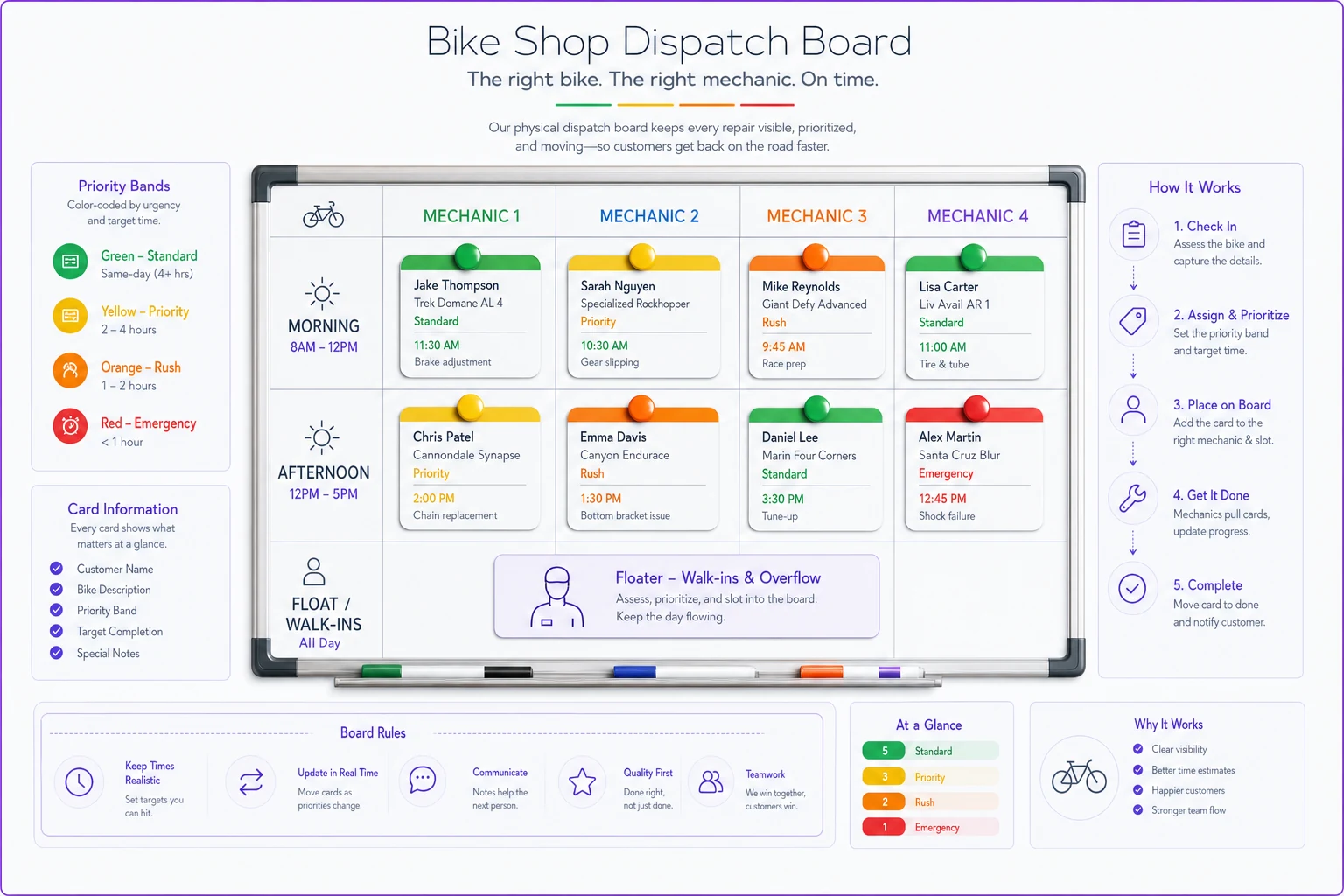
Mechanics grab their next card from their column. Service writers see available slots at a glance. Customers can literally see their bike in the queue. This visibility eliminates half your "when will my bike be ready?" calls.
When a mechanic finishes early, they check for same-band overflow in other columns before moving to lower complexity work. This visual system prevents the "I didn't know Steve needed help" situations that plague most shops.
Printable Shift Planning Templates
Complex scheduling software sounds great until you realize someone needs to update it constantly. These printed templates handle 90% of coordination needs with zero technical overhead.
Daily Assignment Sheet
-
Rows
Each mechanic
-
Columns
2-hour time blocks
-
Cells
Space for 2–3 ticket numbers
Weekly Capacity Planner
-
Total available hours per mechanic
-
Subtract 20% for setup/cleanup/interruptions
-
Divide by average repair time per band
-
This gives you realistic booking targets
A shop with three mechanics working 40-hour weeks has roughly 96 productive hours (120 total minus 20%). If your mix is typically 40% Band 1 (20 min average), 40% Band 2 (60 min), and 20% Band 3 (150 min), you can handle approximately 84 repairs weekly. Book to 85% of this number to maintain buffer capacity.
Skills Matrix Tracker
-
Each mechanic's cleared bands
-
In-progress training
-
Specialty certifications
-
Upcoming skill goals
| Template | Notes |
|---|---|
| Daily Assignment Sheet | Rows: Each mechanic - Columns: 2-hour time blocks - Cells: Space for 2–3 ticket numbers |
| Weekly Capacity Planner | Total available hours per mechanic - Subtract 20% for setup/cleanup/interruptions - Divide by average repair time per band - Gives realistic booking targets |
| Skills Matrix Tracker | Monthly grid showing cleared bands, in-progress training, specialty certifications, upcoming skill goals |
Post this in your break room. Mechanics see advancement paths clearly. You identify training needs before they become bottlenecks. When someone calls in sick, you know exactly which repairs need reassignment versus which can wait.
Common Dispatch Mistakes to Avoid
Even with solid systems, these three mistakes consistently break bike shop workflows.
The Hero Mechanic Trap
Jake's your best mechanic, so naturally, every difficult repair goes to him. Suddenly Jake's overwhelmed, burned out, and becomes your single point of failure. Spread complex work across everyone qualified. If only one person can handle certain repairs, that's a training priority, not a permanent dispatch rule.
Promise Inflation
Service writers want happy customers, so they promise unrealistic timelines. "We'll try to get it done today" becomes "customer expects it today" becomes rushed work and mistakes. Your dispatch rules should drive promises, not the other way around. If Band 3 work has a two-day timeline, that's what customers hear.
The Part-Time Problem
Part-time mechanics complicate scheduling because they're not always available for follow-up questions or warranty issues. Assign part-timers primarily Band 1 and Band 2 work that's likely to be completed in a single shift. Document everything thoroughly so full-time staff can handle any callbacks.
Measuring What Matters
Track three metrics to validate your dispatch system:
Mechanic Utilization by Band
What percentage of each mechanic's time goes to their highest cleared band? If Jake spends 60% of his time on Band 1 and 2 work, you're wasting expertise. Target 70% of time at highest band for senior mechanics.
Completion Time Variance
Track actual versus estimated completion times by band and mechanic. If Band 2 repairs consistently take 30% longer than estimated, adjust your planning. If Maria completes Band 2 work 20% faster than others, investigate whether she's cutting corners or has developed efficient techniques worth sharing.
Rework Rate by Assignment Type
When repairs come back, note who did the original work and whether it matched their skill band. Higher rework on Band 2 assignments might indicate someone needs additional training. Rework on Band 1 suggests rushing or attention issues.
These three numbers tell you whether your dispatch system works or needs adjustment.
Scaling Beyond Manual Dispatch
Manual dispatch boards work perfectly for 2–4 mechanic shops. Around 5–6 mechanics, coordination complexity starts overwhelming the simple visual system. Service managers spend 30+ minutes daily just updating boards and answering "what should I work on next?" questions.
This is where AI-powered operational software starts making sense. Not complex enterprise systems — purpose-built platforms that understand bike shop workflows. Modern operational platforms can automatically match repairs to mechanics based on skill tags, track real-time capacity, and even predict completion times based on historical data.
The key is choosing software that enhances your existing dispatch rules rather than replacing them. Your complexity bands and skill tags become the foundation for algorithmic assignment. The software handles the minute-by-minute coordination while you focus on training, quality, and customer service.
Good operational software learns your shop's patterns. It knows Jake works faster on wheel builds after lunch. It recognizes that Maria's Band 2 completions improve 15% when she's not interrupted by walk-ins. These insights help you optimize schedules without micromanaging.
It eliminates the mental overhead of dispatch decisions. Mechanics check their queue on a screen or tablet. Service writers see real-time capacity when booking repairs. Customers get accurate timeline updates automatically. The same dispatch rules apply, but execution becomes effortless.
Real-World Implementation Timeline
Switching to structured dispatch feels overwhelming, but implementation takes less than two weeks:
Week 1: Classification and Training
-
Monday-Tuesday
Classify all common repairs into bands
-
Wednesday
Create skill tags for each mechanic
-
Thursday-Friday
Test assignments using the new system while maintaining old process as backup
Week 2: Full Deployment
-
Monday
Launch physical dispatch board
-
Tuesday-Wednesday
Refine assignments based on actual workflow
-
Thursday-Friday
Implement batch rules and measure initial metrics
After two weeks, you'll handle 10–15% more repairs with the same team. After a month, customers notice faster turnarounds. After three months, your mechanics report less stress and clearer daily goals.
Who Should Skip This System
Not every shop benefits from structured dispatch. Skip this approach if:
Your shop has one or two mechanics who handle everything equally well. The overhead isn't worth it for true generalists.
You specialize in one type of repair. Triathlon bike shops doing 90% the same service don't need complexity bands.
Your customers value relationship over speed. Some neighborhood shops thrive on "Tom always works on my bike" dynamics that structured dispatch disrupts.
But if you're juggling multiple skill levels, various repair types, and customers who just want their bikes back quickly, this system transforms chaos into flow.
The difference between a struggling service department and a profitable one often comes down to basic operational decisions. How you assign work matters more than how fast anyone works. When every repair lands with the right mechanic at the right time, what felt like a capacity problem reveals itself as a coordination problem — one you've now solved.
Most bike shops accept scheduling chaos as inevitable. They hire more mechanics, extend hours, or turn away work. But operational efficiency isn't about working harder or hiring more people. It's about establishing simple rules that eliminate daily friction.
Your mechanics want clear direction. Your service writers want confident timelines. Your customers want predictable service. This dispatch matrix delivers all three without complex software, expensive consultants, or operational overhauls. Just clear bands, simple rules, and visible assignments that keep repairs flowing and bays productive.
Ready to revolutionize your bike shop operations?
Join hundreds of bike shops using Bicyclly to save time, increase revenue, and deliver exceptional customer service.