


Most bike shops handle trade-ins wrong. Not because they don't know bikes, but because they treat each used bike like a unique puzzle instead of following a systematic process. The result? Inconsistent valuations, bloated reconditioning costs, and bikes sitting on the floor for months eating into whatever margin you thought you had.
Picture this: Customer walks in with their 2019 Trek Domane. Your mechanic eyeballs it, quotes $800 trade value. You spend $240 on parts and 4 hours labor getting it retail-ready. List it for $1,400. Three months later, you drop the price to $1,150 just to move it. After holding costs and staff time, you've made maybe $60 on a bike that tied up $1,040 of working capital for an entire quarter.
The shops that actually make money on used bikes run a rubric. Same evaluation criteria every time. Clear thresholds for what gets refurbished versus parted out. Predetermined margin targets that dictate pricing. No guesswork, no emotion.
Why Trade-In Valuations Go Sideways
Trade-in valuations fail for three predictable reasons.
First, shops confuse retail value with trade value. Your mechanic sees a bike that could sell for $1,200 and thinks offering $700 is reasonable. But that ignores reconditioning costs, holding time, and the reality that used bikes move slower than new inventory. The actual math needs to work backward from your target margin, not forward from perceived retail value.
Second, evaluation happens without structure. Different staff members value the same bike differently because there's no standardized checklist. One person obsesses over cosmetic scratches while another focuses on drivetrain wear. Without consistent criteria, your valuations swing wildly based on who's working that day.
Third, shops ignore velocity in their calculations. A $500 profit on a bike that sits for 4 months is worse than $250 profit on something that moves in 2 weeks. Most shops never factor turnover rate into their valuation model, which means they consistently overpay for bikes that won't move quickly.
The downstream effects compound. Inconsistent valuations lead to unpredictable margins. Staff confusion creates customer friction when different employees quote different values. Without clear data on what actually sells, shops keep taking bikes they shouldn't touch.
Building Your Intake Valuation Template
A functional valuation template needs five components that work together to produce consistent, profitable decisions.
Never miss a sale or service appointment again.
Bicyclly helps you manage every sale, repair, and booking with ease and accuracy.
- Unified inventory and sales tracking
- Automated customer notifications
- Service appointment scheduling
No credit card required
Component 1: Market Reference Points
-
Current new retail price (if still in production)
-
Completed eBay sales for that model/year (last 90 days)
-
Your local market comp prices (other shops, Craigslist, Facebook)
These create your ceiling. You're never beating these prices, so work backward from the lowest of the three.
Component 2: Condition Scoring Matrix
-
Frame/Fork
cosmetic damage, structural integrity, alignment
-
Drivetrain
chain stretch, cassette wear, chainring teeth
-
Wheels
true/round, spoke tension, hub smoothness
-
Brakes
pad life, rotor thickness, hydraulic function
-
Contact Points
bar tape, saddle, grips condition
-
Accessories
computer mounts, bottle cages, racks
Score each zone 1-5. Anything scoring below 3 in any category triggers your reconditioning estimate.
Component 3: Age and Obsolescence Factors
Technology depreciation hits bikes hard. A 5-year-old rim brake road bike lost 60% of its value regardless of condition. Your template needs clear depreciation schedules:
| Bike Type | Year 1 | Year 2 | Year 3 | Year 4 | Year 5+ |
|---|---|---|---|---|---|
| Carbon Road | 65% | 50% | 40% | 30% | 20% |
| Aluminum Road | 60% | 45% | 35% | 25% | 15% |
| Mountain (FS) | 70% | 55% | 40% | 30% | 20% |
| Hybrid/Comfort | 55% | 40% | 30% | 20% | 10% |
| E-Bike | 75% | 60% | 45% | 30% | 15% |
Component 4: Velocity Prediction
Track your actual sales data to predict turnover speed. High-velocity categories (hybrid under $500, kids bikes in spring) can tolerate lower margins. Low-velocity items (high-end road over $3,000, tandems) need higher margins to justify the carrying cost.
Component 5: Instant Deal Breakers
-
Department store brands (unless for parts)
-
Damaged carbon with any structural concern
-
Bikes requiring proprietary parts you can't source
-
Models with known recall issues
-
Anything over 10 years old unless vintage/collectible
Some bikes should never enter your inventory:
The Cost-to-Refurbish Reality Check
Reconditioning costs kill more used bike margins than bad valuations. Shops treat refurbishment like regular service work instead of a profit-protecting operation.
Your reconditioning estimate needs to capture total cost, not just parts. Labor at full rate, opportunity cost of bay time, and the reality that used bike work often reveals hidden problems once you start digging in.
Typical reconditioning breakdown on that hypothetical Trek Domane:
Visible Work:
-
New bar tape
$30 parts + 30 min labor = $55
-
Brake pads
$25 + 20 min = $42
-
New chain
$35 + 15 min = $48
-
True wheels
0 parts + 30 min = $30
Hidden Issues (discovered during work):
-
Bottom bracket creaking
$40 + 45 min = $85
-
Headset play
$35 + 30 min = $65
-
Cable fraying inside frame
$20 + 40 min = $60
Total reconditioning: $385 vs. your estimated $175
This scenario plays out constantly. The solution isn't better estimation—it's building buffers into your model and creating strict go/no-go thresholds before work begins.
Use the multiplier system described below to build realistic buffers into your reconditioning estimates.
Smart shops use a multiplier system. Whatever the initial reconditioning estimate, multiply by 1.5 for bikes under 3 years old, 1.75 for 3-5 years, and 2.0 for anything older. This accounts for the surprise problems that always emerge.
Threshold Rules: Refurbish vs Part-Out vs As-Is
Every used bike that comes through your door should hit one of three paths, determined by clear mathematical thresholds.
Path 1: Full Refurbishment
-
Reconditioning cost < 25% of expected sale price
-
Predicted velocity < 45 days
-
Margin after all costs > 35%
Example: 2022 Specialized Roubaix, excellent condition, $2,800 expected sale, $420 reconditioning, strong local demand. This clears all thresholds.
Path 2: Part-Out
-
Reconditioning cost > 40% of expected sale price
-
OR sum of parts value > complete bike value by 20%
-
OR frame damage but quality components
Example: 2018 Santa Cruz Bronson with cracked chainstay but XTR drivetrain, Fox suspension. Parts value $1,100, complete bike maybe $900 after $600 frame repair.
Path 3: Sell As-Is
-
Reconditioning cost between 25-40% of sale price
-
AND buyer market exists for project bikes
-
AND you can move it within 14 days
Example: Vintage steel road bike, needs everything but frame is pristine. List at $200 "project bike" instead of spending $400 to maybe sell for $550.
Most shops default to refurbishment when part-out or as-is would generate better returns. Track your actual outcomes for 6 months and you'll see the pattern clearly.
Protecting Margins Through the Resale Workflow
Your resale process determines whether that carefully calculated margin actually materializes or evaporates through operational friction.
Start with pricing discipline. Your initial price should be: (Trade value + Reconditioning + Desired margin) × 1.15
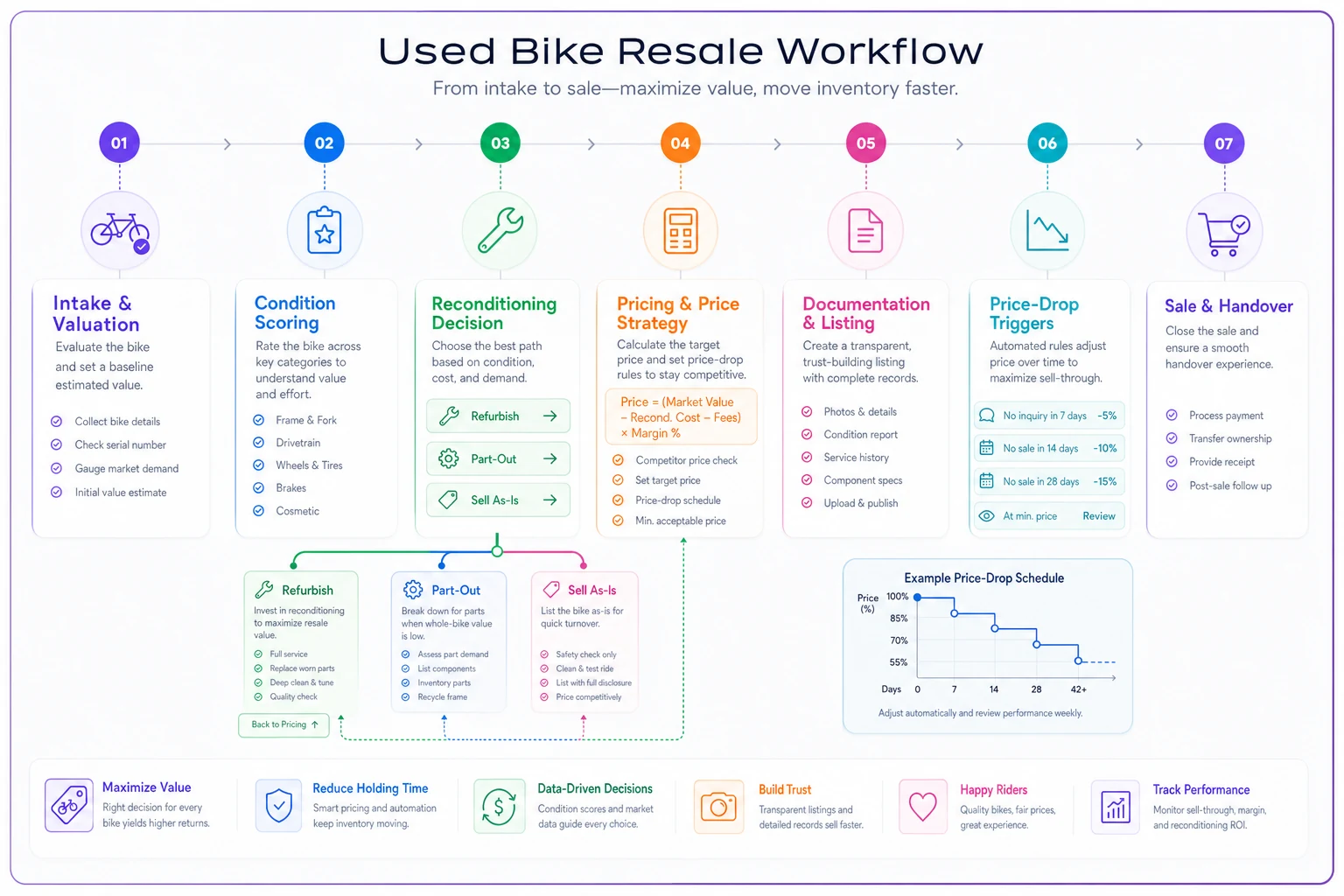
That 15% buffer covers price negotiations, seasonal adjustments, and the reality that some bikes need multiple price drops. But automatic price reduction triggers matter more:
Week 2: Still at full price Week 4: Drop 8% if no serious inquiries Week 6: Drop another 10% Week 8: Evaluate part-out option Week 10: Final 15% reduction Week 12: Part out or wholesale
No exceptions. No "but this bike is special" arguments. The schedule runs automatically.
Documentation protects margins too. Every used bike needs:
-
Detailed photos before reconditioning (CYA for customer claims)
-
List of all work performed with parts costs
-
Test ride notes highlighting any quirks
-
Clear "sold as-is" paperwork for bikes going that route
The shops losing money on used bikes usually skip this documentation, then eat costs when customers complain about issues that existed at purchase.
Here's a visual of the resale workflow to make these triggers and documentation steps clear.
Your sales process needs different treatment than new bikes. Used bike customers negotiate more, expect problems, and comparison shop aggressively. Train staff to lead with the reconditioning work performed, not the bike's features. "We just put $400 of new components on this bike" beats "This has Shimano 105."
When Operational Software Changes the Game
Manual tracking of trade-ins creates blind spots that kill profitability. You might have a gut feeling that used bikes aren't making money, but without systematic data, you can't identify which decisions are causing the problem.
The most successful shops now use AI-powered operational platforms to manage their entire used bike workflow. These systems track every bike from intake through sale, automatically calculating reconditioning costs, monitoring days on floor, and triggering price reductions based on your threshold rules.
Pattern recognition becomes automatic when you digitize this process. The system learns which bikes move quickly in your market, which reconditioning tasks actually increase sale price, and when to push for part-out instead of refurbishment. One shop discovered they were consistently losing money on bikes traded in during winter months—lower quality trades but same reconditioning standards. They adjusted their seasonal intake criteria and increased used bike margins by roughly 20%.
The automation extends into inventory management. Instead of manually checking how long each bike has been sitting, the system alerts you when items hit price-drop thresholds. It tracks which staff members have the best trade-in valuation accuracy. It even identifies which reconditioning tasks correlate with faster sales versus those that just add cost.
But the real value comes from standardization. When every trade-in follows the same evaluation rubric, gets the same systematic pricing, and moves through the same resale workflow, margins become predictable. Staff confusion disappears. Customers get consistent experiences regardless of who helps them.
Making Trade-Ins Actually Profitable
The difference between shops that profit from used bikes and those that don't comes down to systematic execution, not market knowledge.
Your rubric removes emotion from valuations. Your reconditioning thresholds prevent cost overruns. Your resale workflow ensures inventory velocity. Together, they transform used bikes from a customer service offering into a legitimate profit center.
Most shops avoid creating these systems because they seem complex. But the complexity exists whether you acknowledge it or not. Right now it lives in inconsistent staff decisions, emotional pricing calls, and that pile of used bikes in your basement that you'll "eventually get to."
The shops making real margin on trades aren't necessarily better at evaluating bikes. They're better at following their own rules. They treat used bikes like a business unit with its own P&L, not a sideline to their main operation.
Start with the intake template. Track 20 trade-ins through your current process, noting initial valuation, actual reconditioning cost, days to sale, and final margin. The gaps between your assumptions and reality will show you exactly which thresholds need adjustment.
Then implement the workflow. Not partially, not "when convenient," but completely and consistently. The first few months feel rigid, but that rigidity is what protects your margins when someone walks in with a bike that pulls at your heartstrings but not your profit goals.
Used bikes should add 8-12% to your total shop revenue if managed correctly. Most shops see maybe 3%. The difference isn't market conditions or customer base. It's operational discipline applied to a process most shops treat as an afterthought.
Your next trade-in walks through the door tomorrow. Will you evaluate it based on feeling, or will you run it through a system designed to protect your margins? The choice determines whether used bikes become a profit center or continue slowly bleeding cash one well-intentioned bad decision at a time.
Ready to revolutionize your bike shop operations?
Join hundreds of bike shops using Bicyclly to save time, increase revenue, and deliver exceptional customer service.