

You fixed their derailleur three months ago. Great work, quick turnaround, customer left happy. Now they're getting their drivetrain replaced at the shop down the street because you never followed up, never reminded them about chain wear, never built any relationship beyond that single transaction.
This isn't about being pushy or sending spam. It's about understanding that bike service has natural rhythms and touchpoints that most shops completely ignore. Your customers' bikes are degrading right now—chains stretching, brake pads wearing, cables loosening—and they're not thinking about it until something breaks. Then they go wherever is convenient or whoever they remember.
I've watched hundreds of shops track their service tickets meticulously but have zero system for what happens after the customer walks out. They know exactly how many tune-ups they did last month but couldn't tell you how many of those customers came back within six months. That's leaving massive revenue on the table.
The real lifecycle patterns hiding in your service data
Most bike shops think customer lifecycle means "they bought a bike, now they need service." That's maybe 20% of the picture. The actual patterns are more complex and more profitable if you map them right.
Take your basic recreational rider who brings their bike in for a spring tune-up. Traditional thinking says you'll see them next spring. But that's not what happens: they ride hard for three weeks, something feels off, they ignore it for two months, then either bring it in when it gets really bad or just stop riding. You lost them at "something feels off."
The patterns change completely based on rider type. Commuters need service every 8-12 weeks if they're daily riders. Weekend warriors might go 4-6 months. Mountain bikers could need brake bleeds after every muddy season. E-bike riders burn through drivetrain components twice as fast as regular bikes. Each group has different failure points, different service intervals, different price sensitivities.
What kills me is that shops know this intuitively but don't operationalize it. Your senior mechanic can tell you exactly when that customer's chain will need replacing based on their riding style, but there's no system to capture that knowledge and turn it into automated touchpoints.
Three lifecycle stages that actually matter for service revenue
Forget the marketing funnel stuff. For bike service, there are really only three stages that impact your revenue:
Never miss a sale or service appointment again.
Bicyclly helps you manage every sale, repair, and booking with ease and accuracy.
- Unified inventory and sales tracking
- Automated customer notifications
- Service appointment scheduling
No credit card required
| Stage | Window | Description |
|---|---|---|
| Active riders (0-6 months since last service) | 0-6 months | These customers are riding regularly and will need something soon. They're thinking about their bike's performance. A simple check-in or maintenance tip keeps you top of mind. Most shops completely drop the ball here—they assume active riders will remember to come back. They won't. |
| Dormant riders (6-12 months) | 6-12 months | Their bike is probably in the garage with flat tires. They meant to ride more but life got in the way. These aren't lost customers yet, but they're close. A "time to wake up your bike" message in early spring can reactivate half of this group. Miss this window and they become: |
| Lost riders (12+ months) | 12+ months | At this point, they've either found another shop, stopped riding, or their bike needs so much work they're embarrassed to bring it in. Recovery rate here is maybe 15-20% with aggressive win-back campaigns. |
The money is in keeping customers from sliding from active to dormant. Once they're dormant, you're fighting uphill.
Building touchpoint sequences that don't annoy customers
Nobody wants daily emails from their bike shop. But they also don't want to discover their chain destroyed their cassette because nobody reminded them about basic maintenance. The sweet spot is value-driven communication tied to actual service needs.
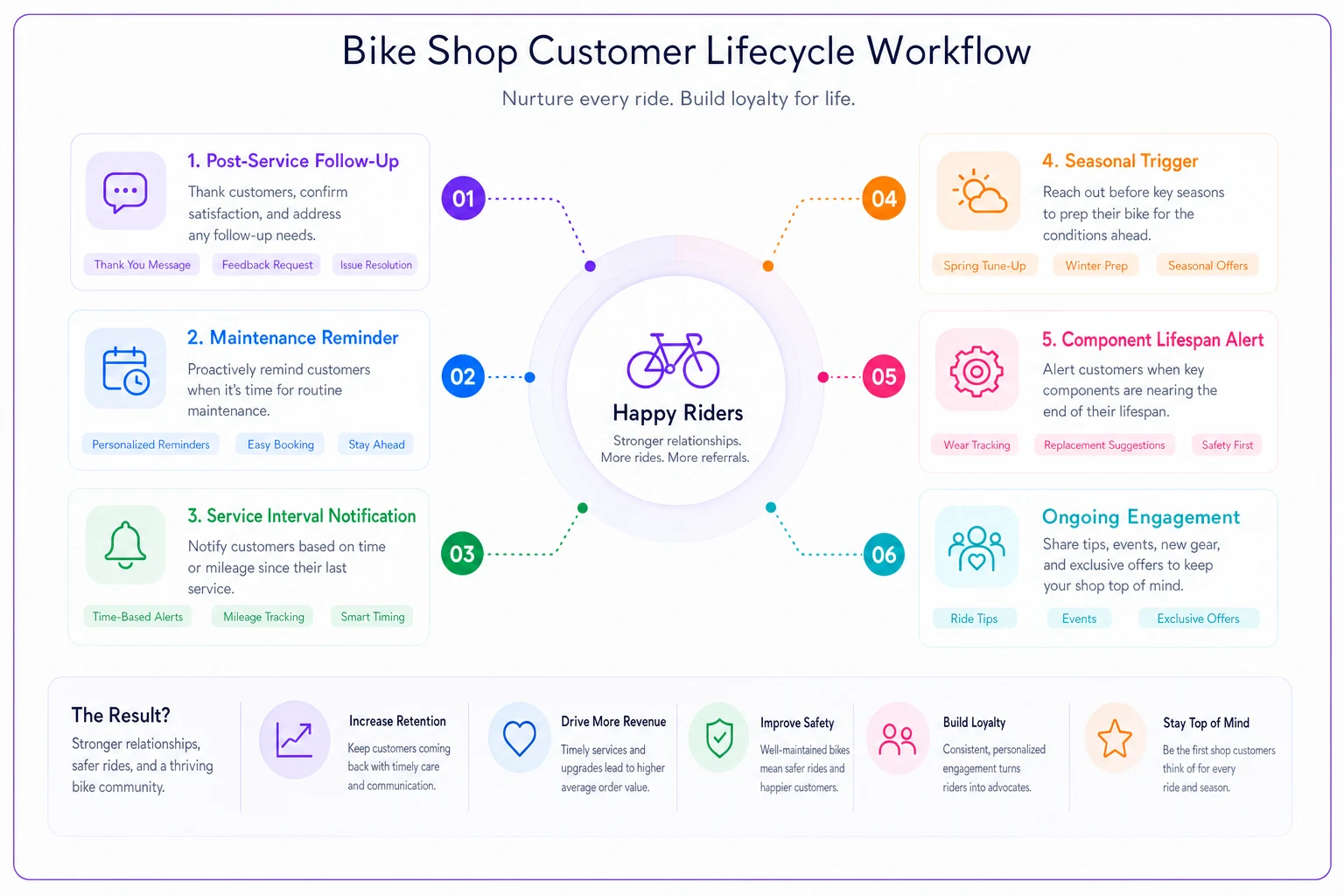
Here's a sequence that works:
Post-service follow-up (3-5 days): Quick check that everything's working well. This catches adjustment issues early and shows you care about quality. Maybe 1 in 10 will have a minor issue that brings them back quickly.
Maintenance reminder (30 days): Based on what you serviced. Just replaced brake pads? Send wet weather braking tips a month later. Did a tune-up? Remind them about chain cleaning. Educational, not salesy.
Service interval notification (60-90 days): For regular riders, this is when stuff starts wearing out. "Based on typical riding, your chain might be approaching 0.5% wear. Quick measurement takes 5 minutes and saves your cassette."
Seasonal trigger (weather-based): First nice weekend of spring? "Perfect weather to check tire pressure and brakes before that first big ride." Rainy season starting? "Time to check those brake pads."
Component lifespan alert (varies): You know that chain has maybe 2,000 miles on it. You know they commute 10 miles daily. Do the math and reach out before it fails.
The timing matters as much as the message. Send a chain check reminder in December when nobody's riding? Useless. Send it in April when they're planning summer trips? That's revenue.
Here's a simple visual of that workflow.
The timing matters as much as the message. Send a chain check reminder in December when nobody's riding? Useless. Send it in April when they're planning summer trips? That's revenue.
Actual revenue impact when you systematize follow-ups
Let me paint you a picture with real numbers. Average shop, maybe 300 service customers per month. Without any follow-up system, you might see 30-40% of them again within six months. That's being generous.
Add basic follow-up sequences and that jumps to 55-60%. Not because you're pestering people, but because you're solving the "I forgot" problem and the "I didn't know I needed that" problem.
Do the math on that. If average service ticket is $85, and you're getting an extra 45-60 customers per month coming back who wouldn't have otherwise, that's roughly $4,000-5,000 in monthly revenue. Just from reminding people their bikes need maintenance.
But the multiplier effect is what most shops miss: customers who come in regularly spend more per visit. They're doing preventive maintenance, not emergency repairs. They're adding accessories, buying consumables, asking about upgrades. A customer on a regular service schedule might spend $400-500 per year. A sporadic customer who only comes when something breaks? Maybe $150.
Why most shops fail at lifecycle management
The biggest reason shops don't do this isn't laziness or not caring. It's that manual tracking is basically impossible at scale. You'd need someone spending hours every week going through service records, calculating intervals, sending individual emails. Nobody has time for that when there are bikes to fix.
Spreadsheets don't cut it either. I've watched shops try to track everything in Excel. It works for about two weeks until someone forgets to update it, then the whole system falls apart. Plus, you can't automate sends from a spreadsheet without serious technical work.
Even shops using booking software usually aren't capturing the right data. They know you got a tune-up on March 15th. They don't know you're a daily commuter who puts 100 miles per week on your bike. They don't know you mentioned wanting to try clipless pedals. They don't know you were worried about brake noise but decided to wait.
All that context determines what follow-up makes sense and when. Without it, you're just blasting generic "time for service!" emails that customers ignore.
The difference between reminder spam and valuable touchpoints
Most shops get this wrong about customer communication: they think it's about selling service. It's actually about being helpful at the right moment.
Bad reminder: "It's been 3 months since your last service. Book now!"
Good reminder: "Quick heads up—with the mileage you typically put on your bike, your chain might be approaching the wear point. Takes 30 seconds to check with a chain checker. Here's how: [link to video]. If you need us to check it, we've got openings Thursday afternoon."
See the difference? One is pushy and generic. The other provides value whether they book service or not. Guess which one builds loyalty?
The best touchpoints feel like insider knowledge, not marketing. Tips for riding in rain before wet season. Reminder to check tire pressure when temperatures drop. Alert about component recalls that might affect their bike. You become their bike expert, not just where they get repairs.
How AI automation transforms lifecycle management
This is where operational software really changes the game for bike shops. Instead of manually tracking hundreds of customers and their service histories, AI automation can analyze patterns and trigger communications automatically.
The system watches for signals: time since last service, type of service performed, seasonal patterns, even weather triggers. When conditions match, it sends the right message at the right time. Not generic blasts, but personalized based on that customer's history and bike type.
More importantly, it learns what works. Maybe your weekend warriors respond better to Saturday morning messages. Maybe your commuters book service most often at month-end when they're planning schedules. The AI picks up these patterns and optimizes timing automatically.
But the real value isn't just automation—it's capturing all that tribal knowledge from your mechanics. When your senior tech says "yeah, that customer's chain will need replacing in about 6 weeks," the system can capture that and create the reminder. All that expertise becomes systematic instead of living in someone's head.
Setting up sequences for different rider segments
You can't treat a carbon road bike owner the same as someone with a $400 hybrid. The service needs, intervals, and psychology are completely different.
Enthusiast roadies: These folks know their bikes need service but procrastinate on booking. They respond to performance messages—"keeping your drivetrain clean adds 5 watts" kind of stuff. Service intervals around 6-8 weeks during season.
Bike commuters: Reliability is everything. They need their bike working Monday morning. Messages about avoiding breakdowns and quick turnaround times work well. Check in monthly during heavy riding months.
Casual/recreational: They forget bikes need maintenance until something breaks. Education is huge here—many don't know what a worn chain looks like. Very seasonal, so time messages around spring and fall.
Mountain bikers: Component wear is brutal. Brake pads, chains, and suspension service drive most revenue. Technical tips and upgrade suggestions work well. Post-ride-season service reminders are golden.
E-bike riders: Different beast entirely. They're often newer riders, less mechanically inclined, and their bikes need different service. Battery care tips, software updates, and motor maintenance messages are unique to this group.
Family bikes/kids bikes: Parents managing multiple bikes, growing kids, seasonal use. Back-to-school bike checks, spring tune-up packages, and growth-based upgrade suggestions work.
The compound effect of consistent touchpoints
Small improvements in bike shop customer retention compound fast. A customer who comes in twice per year versus once isn't just 2x revenue. They're more likely to:
-
Buy accessories during visits (average basket size up 20-30%)
-
Refer friends (regular customers refer 3x more)
-
Buy their next bike from you (60% vs 20% for sporadic customers)
-
Leave positive reviews (happy regular customers are your best marketers)
This momentum builds on itself. Regular customers become unofficial ambassadors. They bring their friends' bikes in. They recommend you on local Facebook groups. They defend your prices when someone complains. But this only happens when you maintain the relationship between visits.
The shops crushing it aren't necessarily fixing bikes better than anyone else. They're just better at staying connected with customers throughout the ownership lifecycle. They understand that a bike purchase or major service is the beginning of a relationship, not a one-time transaction.
When lifecycle management doesn't make sense
Not every shop needs complex lifecycle sequences. If you're a tiny operation doing 50 services per month, you probably know every customer personally. Manual follow-up might work fine.
Also, if your shop is purely transactional (like mobile repair at events), building long-term relationships might not be your model. Some shops thrive on tourist traffic or one-time fixes. That's fine—don't force a retention model where it doesn't fit.
But if you're doing 200+ services monthly and losing track of customers, if you're seeing new competitors grab your regulars, if you're tired of the spring rush followed by dead summers—then you need systems for this.
Common mistakes when implementing touchpoint sequences
Even shops that try to build follow-up systems usually mess up a few things:
Over-communicating early: Excited about the new system, they message customers weekly. Quick way to get unsubscribes and annoyance. Start conservative and increase frequency based on engagement.
Generic messaging: Using the same template for everyone. "Time for service!" doesn't work. A commuter needs different messaging than a weekend warrior.
Bad timing: Sending service reminders in January when nobody's riding (unless you're in SoCal or Florida). Watch your local patterns and adjust accordingly.
Not tracking results: Setting up sequences then never checking if they work. You need to know which messages drive bookings and which get ignored.
Forgetting the human touch: Automation handles the heavy lifting, but personal notes on customer records make follow-ups feel genuine. "How's that new saddle working out?" beats generic templates every time.
Building your first sequence: Start simple
If you're not doing any follow-up now, don't try to build elaborate sequences immediately. Start with one simple flow:
-
Service completed
-
Follow-up in 5 days
"Everything working well?"
-
Maintenance tip at 30 days based on service type
-
Service reminder at 90 days for regular riders, 180 for casual
That's it. Get this working for a month, see what response you get, then add complexity. Maybe add a seasonal trigger. Maybe segment by rider type. But start simple and prove the concept.
Start with the most common service you do and tailor the 30-day tip to that job so it's immediately relevant.
Track everything: open rates, response rates, bookings generated. You'll quickly see what resonates with your customers and what doesn't. That data shapes your more sophisticated sequences later.
What changes as you scale touchpoint systems
Running sequences for 100 customers looks very different from 1,000. At small scale, you can add personal touches, remember individual preferences, customize everything. As you grow, you need more automation but risk losing the personal feel.
Smart shops solve this by creating tiers. Your top 20% of customers (by revenue or visit frequency) get more personalized attention. Maybe they get a call instead of an email. Maybe their reminders reference specific bikes or past conversations.
The middle 60% get solid automated sequences with good segmentation. Still valuable, still relevant, but more systematic. The bottom 20%—sporadic customers or people who haven't been in forever—get broader win-back campaigns.
This isn't about playing favorites. It's about resource allocation. Spending 10 minutes on a phone call with someone who spends $500 annually makes sense. Doing that for someone who got a flat fixed once doesn't.
The infrastructure requirements most shops overlook
You need more than just email software to do this right. You need:
-
Service history tracking (what was done, when, on which bike)
-
Customer segmentation (rider type, frequency, spend levels)
-
Automated trigger capabilities (time-based, weather-based, service-based)
-
Response tracking (who opened, who clicked, who booked)
-
Integration with your booking system (so reminders can include available slots)
-
Mobile-friendly messages (most people check email on phones)
This is where a lot of DIY attempts fall apart. Stitching together five different tools (email platform, spreadsheet, booking system, etc.) creates gaps where customers fall through. You need unified data to make sequences actually work.
Measuring what matters: Retention metrics that drive revenue
Most shops track the wrong metrics. They look at email open rates or total services per month. Those matter, but what really drives revenue is:
Return rate by cohort: Of customers who got service in January, what percentage came back within 6 months? This tells you if your retention efforts work.
Average time between services: Is it shrinking? Good—customers are coming in more regularly. Growing? You're losing touch with them.
Lifetime value by segment: How much do different customer types spend over a year? Two years? This shapes where you focus retention efforts.
Reactivation rate: What percentage of dormant customers come back after win-back campaigns? If it's under 10%, your messaging needs work.
Service upgrade rate: Are customers adding services when they come in? Shows whether your education and touchpoints are building trust.
These numbers tell the real story of whether your lifecycle management works. Revenue might go up for lots of reasons. These metrics isolate the impact of better retention.
Why next quarter is make-or-break for retention systems
Every month you wait to implement proper lifecycle management is literally customers walking out your door forever. They're not leaving because they're unhappy—they're leaving because you're not staying connected.
That customer whose chain you replaced in January? By April, they need derailleur adjustment but don't know it. By July, they're frustrated with shifting. By September, they're at another shop getting a tune-up, telling that mechanic how their bike "hasn't shifted right for months."
You did great work. You just didn't close the loop on the relationship.
The shops that will thrive in the next few years aren't necessarily the ones with the best mechanics or the biggest inventory. They're the ones that understand owning a bike is a journey, not a transaction. They map that journey, identify the key moments, and show up with helpful touchpoints that keep customers engaged.
Manual tracking won't scale. Generic email blasts won't work. You need systematic, automated, but still personal-feeling lifecycle management. The technology exists to do this now in ways that weren't possible even five years ago.
The question isn't whether you should implement retention sequences. It's whether you'll do it before your competition figures out that keeping existing customers is way cheaper than finding new ones. In a market where everyone's fighting for the same riders, the shop that stays connected wins.
The question isn't whether you should implement retention sequences. It's whether you'll do it before your competition figures out that keeping existing customers is way cheaper than finding new ones. In a market where everyone's fighting for the same riders, the shop that stays connected wins.
Ready to revolutionize your bike shop operations?
Join hundreds of bike shops using Bicyclly to save time, increase revenue, and deliver exceptional customer service.