
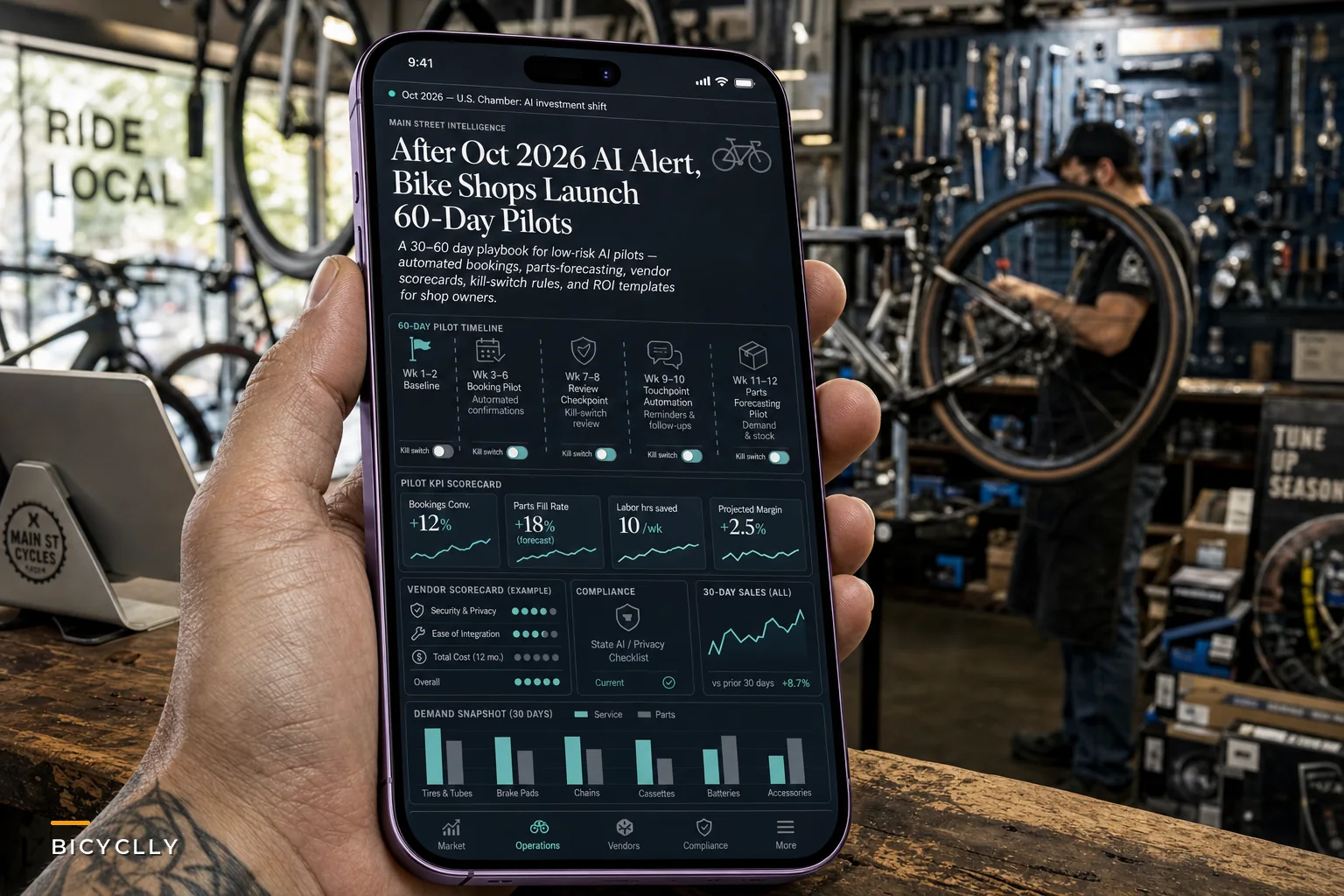

The U.S. Chamber of Commerce dropped its 2026 Empowering Small Business report in early October, and the headline number made the rounds fast: roughly two‑thirds of U.S. small businesses now report using AI in some form, and that usage tracks with faster sales, profit, and hiring. A few weeks later, CNBC was running segments on how AI-related investment is heating up the broader economy. If you run a bike shop, none of that tells you what to do on a Tuesday morning when the schedule's a mess and three riders want their bikes back before the weekend.
So skip the macro cheerleading. The useful question isn't "is AI real" — it clearly is, and your competitors down the road are experimenting whether they talk about it or not. The real question is: what can a shop actually pilot in the next 60 days that lowers risk, protects margin, and doesn't require you to rip out your POS or retrain your whole team?
That's what this covers. Three areas — bookings, parts forecasting, customer touchpoints — and how to run each as a contained experiment you can kill if it underperforms.
Why the adoption curve matters, even for a small shop
The part that's easy to miss in the Chamber's data: the full U.S. Chamber report doesn't say AI makes big companies better. It says adoption correlates with growth across small businesses — the ones with five employees, one location, a seasonal cash crunch. The operational takeaway is simpler than you'd expect: the tools finally got cheap and usable enough that a shop without an IT person can actually run them.
The risk this creates isn't some vague "falling behind on technology" thing. It's more specific. A shop two towns over quietly cuts its no‑show rate, answers booking questions in 30 seconds instead of six hours, and reorders parts tighter — and starts winning the repeat service customer you were counting on. The efficiency gain shows up as their margin and your slow bleed. Not robots. Just a competitor who stopped doing certain things by hand.
But adoption without structure is how shops waste money. Buying an "AI tool" because everyone's talking about it is the same mistake as buying a fancy wheel truing stand nobody's trained on. It just sits there. So the goal is narrow pilots with a clear kill switch.
Start with the booking funnel — it's the easiest win to measure
Scheduling is the right first pilot for one reason: you can measure it cleanly. You already know your no‑show rate, your average time‑to‑respond on booking requests, and roughly how many hours the front counter spends on phone tag. Those are your baselines. Any pilot that touches bookings should move at least one of them or get cut.
Never miss a sale or service appointment again.
Bicyclly helps you manage every sale, repair, and booking with ease and accuracy.
- Unified inventory and sales tracking
- Automated customer notifications
- Service appointment scheduling
No credit card required
What an AI‑assisted booking layer actually does in a shop isn't glamorous. It handles the repetitive back‑and‑forth: answering "do you have a slot Thursday," confirming appointments, sending the reminder sequence, and flagging when a customer replies with something that needs a human (like "my fork is making a weird noise, is that covered?"). The judgment calls still come to you. The typing doesn't.
A two‑mechanic shop handling around 300 service bookings a month, with a no‑show rate hovering near 14%, had a front‑counter person spending maybe two hours a day on confirmation calls and texts during peak season. After piloting automated confirmations and reminders — the kind that nudge twice and ask for a quick reply — no‑shows settled closer to 8–9%, and that counter time dropped by more than half. Nobody got laid off. That person moved to selling accessories at pickup, which is actual revenue instead of admin.
If you want a structured way to think about which events in your shop should trigger automatic actions — a booking confirmed, a part arriving, a bike sitting ready for pickup — the event‑first automation playbook breaks that down in more depth. The short version: don't automate "a task," automate the trigger.
When a booking pilot makes sense
-
Your no‑show rate is above roughly 10% and you can see the revenue leaking
-
Front‑counter staff are visibly drowning during your busy months
-
You already have clean service menu categories (if your booking types are a mess, fix that first — the tool can't guess)
When it's a bad idea
-
You take fewer than 20 bookings a week and the owner handles them personally in two minutes — automation just adds overhead you don't need
-
Your service menu and time estimates are inconsistent, so the system books jobs you can't actually fit
If you take fewer than 20 bookings a week and the owner handles them personally in two minutes — automation just adds overhead you don't need
Parts forecasting: where the money is, and where shops get burned
Bookings are the easy pilot. Parts forecasting is the one that actually moves margin — and also the one most likely to go sideways if you rush it.
The appeal is obvious. Demand forecasting that adjusts reorder points based on real ticket history, seasonality, and lead‑time changes should mean fewer dead SKUs and fewer "we're waiting on the part" delays. For a bike shop, that's chains, cassettes, brake pads, tubes, shift cables — the stuff that stalls a repair when it's not on the shelf.
The mistake shops make is treating the forecast as an answer instead of a suggestion. The model is only as good as your ticket data, and most shops have messy ticket data: inconsistent part naming, services logged under the wrong category, trade‑in parts double‑counted. Feed that in and you get confident nonsense. A forecast that tells you to stock six of something you sell twice a year feels authoritative and quietly ties up cash.
A reasonable pilot: pick your top 30–40 fast‑moving SKUs — the ones that actually stall repairs — and run AI‑assisted reorder suggestions against those only. Keep a human approving every reorder for the first couple of months. Compare the suggestions against what your experienced buyer would've ordered. You're not trusting it yet. You're auditing it.
| Pilot Area | Baseline to Track | What "Working" Looks Like | Kill Signal |
|---|---|---|---|
| Booking automation | No‑show % | No‑shows down 3–5 pts, hours freed | No measurable no‑show change in 6 weeks |
| Parts forecasting | Stockout rate on top SKUs, dead stock $ | Fewer repair stalls, tighter inventory | Suggestions consistently worse than your buyer |
| Customer touchpoints | Response time, review rate | Faster replies, more pickups/reviews | Customers complaining it feels robotic |
Who should NOT start with forecasting
If your POS, inventory, and ticket data don't reconcile cleanly, forecasting is the wrong first pilot. Garbage in. Clean your SKU data first, run bookings as your pilot, and come back to forecasting once your numbers are trustworthy.
Customer touchpoints: automate the follow‑up, not the relationship
This is the area shops get most nervous about, and honestly, the nervousness is healthy. Nobody wants a regular who's been coming in for eight years to get a cold robotic text. The line that matters: automate the timing and consistency of touchpoints, not the relationship itself.
What works well as a pilot:
-
A "your bike is ready" message that fires automatically when a ticket flips to done, instead of whenever someone remembers to call
-
A gentle follow‑up a few weeks after a tune‑up asking how the bike's riding — which naturally surfaces the next service
-
A review request that only goes out after a positive pickup, not blasted to everyone
What doesn't work: trying to automate anything emotional or judgment‑heavy. A warranty dispute, an unhappy customer, a high‑ticket buyer deciding between two builds — those stay human. The shops that do this well use automation to handle the predictable messages, so staff actually have time and energy for the unpredictable ones.
The quiet win here is pickups. Finished bikes sit in the back longer than they should because nobody got around to calling. An automatic ready‑for‑pickup trigger closes that gap, and faster pickups free up bay and floor space you're paying rent on.
A simple 60‑day pilot sequence
Don't run all three at once. You won't be able to tell what's working. Stagger them.
-
Week 1–2 Write down your baselines. No‑show rate, counter hours on confirmations, stockout frequency on your top SKUs, average time‑to‑respond on booking requests. If you can't measure it today, you can't judge the pilot later.
-
Week 3–6 Launch the booking pilot only. Automated confirmations and reminders. Keep humans handling anything that isn't a clean yes/no.
-
Week 7–8 Review. Did no‑shows and counter time move? If not, figure out why before adding anything else.
-
Week 9–10 Add customer touchpoint automation — ready‑for‑pickup and post‑service follow‑up.
-
Week 11–12 Only now, if your ticket data is clean, start the forecasting pilot on your top SKUs with human approval on every reorder.
Each stage has a kill switch. If a pilot doesn't move its baseline in six weeks, stop it. No sunk‑cost loyalty.
A simple visual helps teams remember the order and the checkpoints.
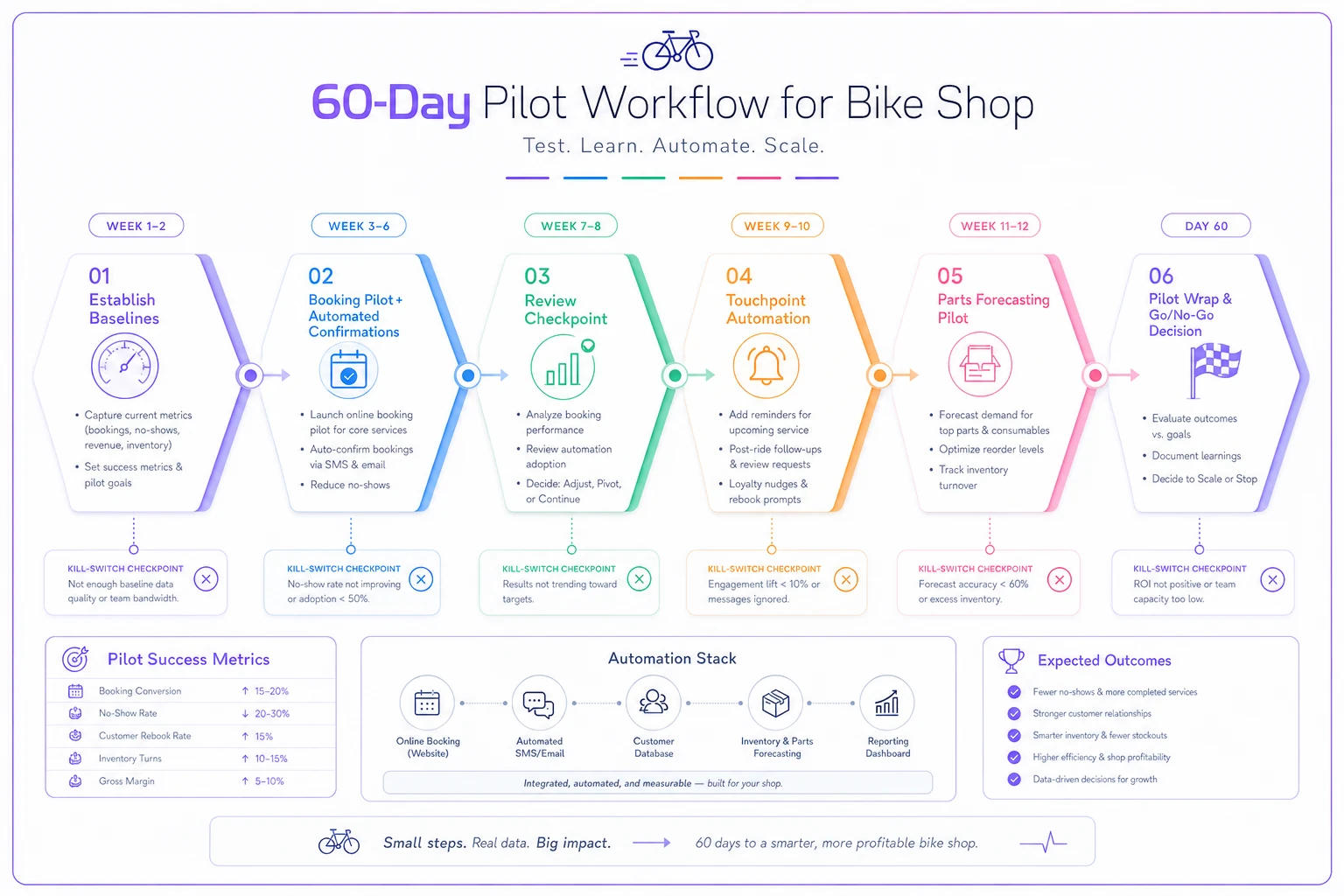
Each stage has a kill switch. If a pilot doesn't move its baseline in six weeks, stop it. No sunk‑cost loyalty.
The governance part nobody wants to think about
One thing the Chamber report flags that's worth noting: the rules around AI, customer data, and messaging are a patchwork that varies by state, and it's shifting. You don't need a compliance department. You do need three basic habits.
-
Know what customer data your tools store, and don't collect more than you use
-
Keep a human in the loop on anything that could go legally or reputationally wrong
-
Tell customers plainly how to reach a real person — automation should never trap someone
The shops doing this well treat data and messaging as something to manage deliberately, not something that just runs in the background. It's not complicated, but it does require someone to actually own it.
A real scenario, start to finish
A small two‑location shop — six staff combined across both stores — was losing time and margin to the usual stuff. No‑shows around 13%. Finished bikes sitting two or three extra days because pickup calls kept slipping. A buyer reordering parts mostly on gut, which meant occasional stockouts on brake pads and chains right when the spring rush hit.
They staggered three pilots over about ten weeks. Bookings first: confirmations and reminders cut no‑shows into the 8–9% range and gave the front counter back a meaningful chunk of each day. Then pickup automation, which trimmed the ready‑to‑collected gap and freed up floor space. Forecasting came last, limited to their 35 fastest SKUs with every reorder still approved by the buyer — the suggestions weren't magic, but after a couple months they were catching seasonal upticks the buyer had been reacting to a week late.
The combined effect wasn't a dramatic revenue jump. It was quieter than that: a few thousand dollars a month in recovered no‑show revenue and tighter inventory, plus staff hours shifted from admin to selling and servicing. That's the realistic shape of these wins — not transformation, just compounding small improvements that actually stick.
The honest bottom line
The macro story — near‑universal small‑business adoption, a wave of AI investment — is real, and it does create competitive pressure. But the right response isn't to panic‑buy an AI platform.
Keep your baselines. Keep humans on the judgment calls. Kill what doesn't work. A shop that runs these experiments carefully ends up in a better spot than one that either ignores the shift or throws money at it blindly. The advantage isn't the technology — it's the discipline of testing small, measuring honestly, and only keeping what earns its place on the floor, same way you'd treat any new tool in the service bay.
Keep your baselines. Keep humans on the judgment calls. Kill what doesn't work. A shop that runs these experiments carefully ends up in a better spot than one that either ignores the shift or throws money at it blindly. The advantage isn't the technology — it's the discipline of testing small, measuring honestly, and only keeping what earns its place on the floor, same way you'd treat any new tool in the service bay.
Ready to revolutionize your bike shop operations?
Join hundreds of bike shops using Bicyclly to save time, increase revenue, and deliver exceptional customer service.