

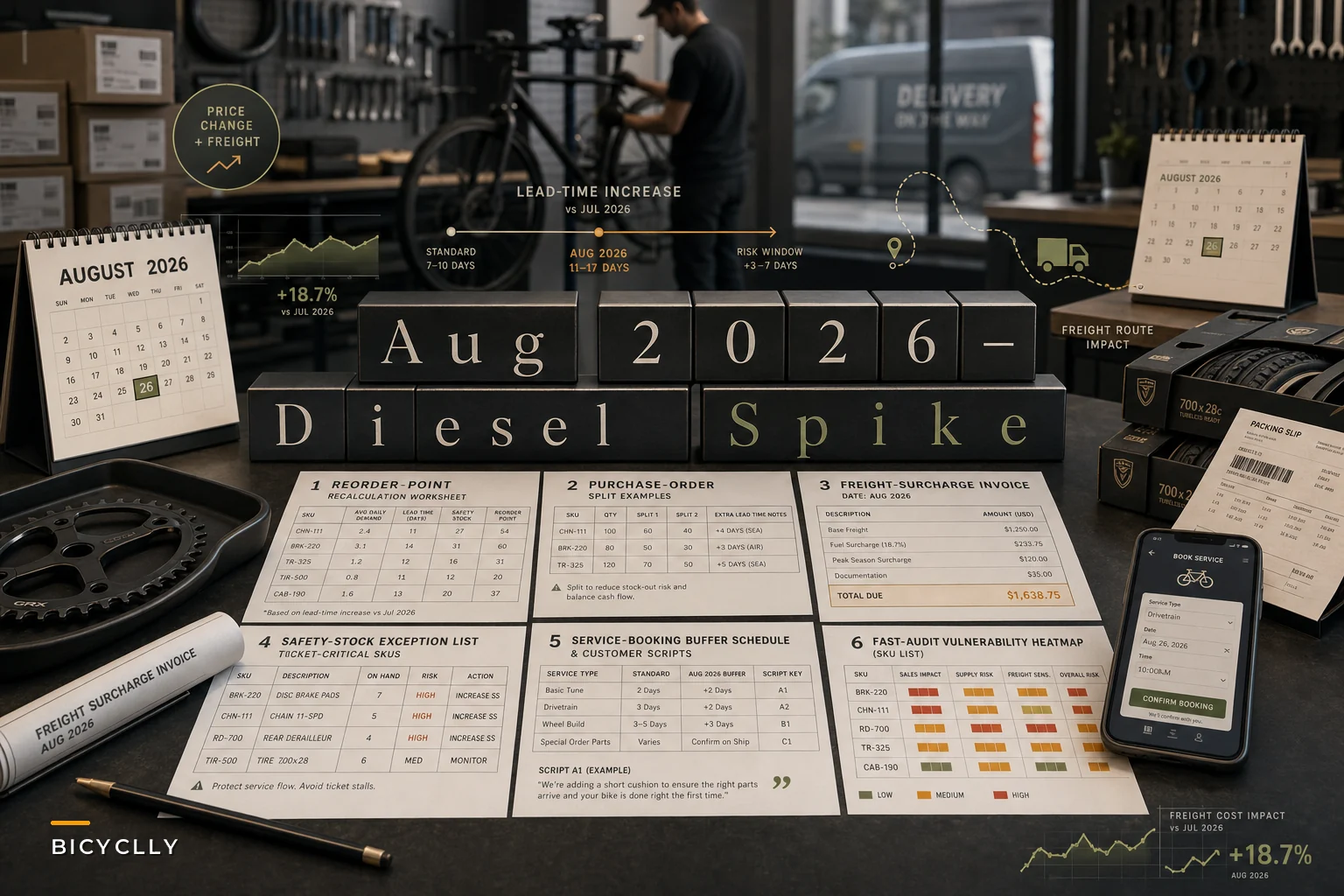

Diesel cracked a number nobody in freight wanted to see. On-highway averages pushed past $5.60 a gallon in the mid-August EIA releases, and FleetOwner reported diesel topped $100 a barrel for the first time as geopolitical shocks piled onto seasonal demand. If you want to track the weekly numbers yourself, the EIA diesel update refreshes every Monday.
For bike shops, this isn't really a fuel story. It's a landed-cost story, and it's hitting during the worst possible window. Late-summer restocks and fall pre-season POs are getting cut and shipped right now. The freight surcharges on those orders will show up on invoices you're already committed to, and parts you expected in five days might now take nine.
So instead of watching oil markets, here are seven things you can actually do between now and next weekend to keep the shop from absorbing the difference quietly.
Start with the invoices you haven't paid yet
Before touching pricing or reorder points, pull the POs that are in transit or unshipped. That's where the damage is still preventable.
When freight spikes hit mid-cycle, shops keep paying surcharges on small orders they could've consolidated a week earlier. A distributor tacking on a $14–$22 fuel surcharge doesn't sting on a $900 order. On a $110 "we're out of 11-speed chains, ship it now" order, that surcharge quietly becomes a 15–20% tax on the line.
Action this week: flag every open PO under your distributor's free-freight minimum and ask one question per order — can this wait 48 hours and ride along with something bigger? Most of the time the answer is yes, and you just clawed back the surcharge.
Reprice freight into your accessory margins, not your labor
The instinct when costs rise is to bump service labor. Resist that this week. Labor pricing is sticky with customers and you probably adjusted it earlier this year already. The freight pain is concentrated in shipped accessories and small consumables, so that's where the correction belongs.
Never miss a sale or service appointment again.
Bicyclly helps you manage every sale, repair, and booking with ease and accuracy.
- Unified inventory and sales tracking
- Automated customer notifications
- Service appointment scheduling
No credit card required
A typical example: a shop buys mid-tier saddles landed around $38 and sells them at $69. Add a fuel surcharge and a lead-time bump and the real landed cost creeps to $43–$45 on the next replenishment. Nobody updates retail. Three months later that "60-something-percent margin" saddle is running in the low 40s and the owner has no idea because the POS still shows the old cost.
The fix is unglamorous but fast:
-
Pull your top 20 accessory SKUs by units sold
-
Update landed cost to reflect the current surcharge reality, not last quarter's
-
Re-check the resulting margin percentage
-
Adjust retail on anything that dropped below your floor
You don't need to touch 400 SKUs. The top 20 usually cover the bulk of accessory volume, and freight hits them all roughly the same way.
Rebuild your safety stock around lead-time volatility, not just fuel cost
The deeper problem the diesel spike exposes isn't the price per gallon — it's variance. A shipment that reliably took five days now takes anywhere from five to eleven depending on how carriers reroute and consolidate loads. That unpredictability wrecks reorder points far more than a few extra dollars of freight ever will.
Safety stock exists to cover demand during lead time. If your lead time just shifted from "five days, reliably" to "five to eleven days, who knows," your old safety-stock math is wrong for every critical service SKU — brake pads, shift cables, tubes, chains, the stuff that stalls a repair ticket when it's out.
A practical way to think about which SKUs need more buffer:
| SKU type | Stalls a ticket if out? | Freight sensitivity | Action this week |
|---|---|---|---|
| Brake pads, cables, chains | Yes | Low unit cost, high urgency | Raise safety stock; multi-source |
| Tubes / tires (common sizes) | Yes | Moderate | Add ~1 week of buffer |
| Premium accessories | No | High (surcharge heavy) | Hold buffer flat, order in bulk |
| Slow-turn boutique parts | Rarely | High | Don't restock reactively; wait |
Most shops miss this: you don't buffer everything — you buffer what stops a repair from being finished today. A customer waiting on their bike doesn't care that a freight delay caused it. They just remember you couldn't hand it back when you said you would.
Pro-tip: Prioritize safety-stock increases for SKUs that repeatedly appear on open repair tickets rather than broad percentage increases across all accessories.
For the fuller version of PO splitting, multi-source rules, and how to structure inbound buying when freight gets ugly, we broke that down in detail in this piece on tight freight markets and diesel costs. This post is the "do it this week" companion to that one.
Add a booking buffer for repairs that depend on shipped parts
This one's about booking, not inventory, and it's the move most shops overlook.
When lead times get volatile, the danger isn't just late parts — it's promised dates you can't hit. A rider drops off a bike Tuesday expecting it back Friday, the derailleur hanger you thought was arriving Thursday slips to Monday, and now you've got an upset customer and a bike blocking your bench.
-
In-stock repairs — book normally, promise your standard turnaround.
-
Repairs needing a common part you'll reorder — add a 2-day cushion to the promised date this month.
-
Repairs needing a special-order part — don't give a date until the part ships. Tell the customer you'll confirm once it's confirmed in transit.
That third bucket is where reputations get damaged. Giving a firm date on a part that hasn't shipped yet, during a freight crunch, is just setting up a broken promise. Being upfront that you'll confirm once it ships actually reads as more professional to most customers, not less.
Here's a simple booking workflow to use this week:
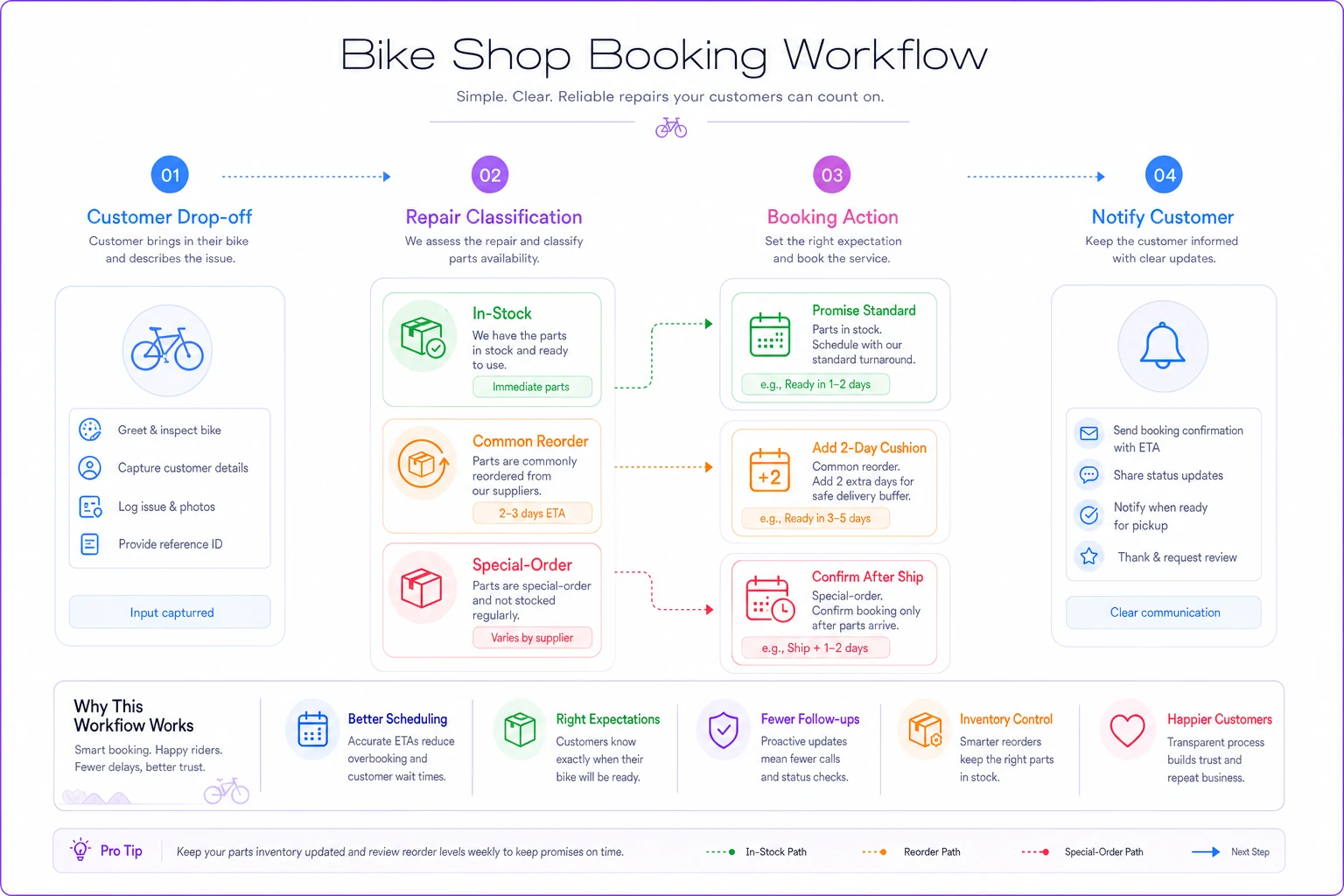
Use this to walk the team through how to set expectations at drop-off and which repairs get a cushion versus those that get a conditional confirmation.
Consolidate suppliers on the margin, but don't over-concentrate
There's a temptation when freight spikes to funnel everything through one distributor to hit free-freight minimums. It works — right up until that distributor's region picks up a carrier delay, and now everything is stuck at once.
The balance that tends to work: consolidate routine replenishment through one or two primary sources to earn the freight breaks, but keep a live secondary source for ticket-critical SKUs. You're not spreading every order across five vendors — that just multiplies your surcharge exposure. You're making sure the parts that stall repairs can come from more than one place.
A simple gut-check for any SKU: if this vendor was two weeks late, would a repair ticket sit unfinished? If yes, that SKU needs a backup source. If no, single-sourcing it to chase free freight is fine.
When these moves make sense — and when to leave things alone
These moves make sense when:
-
A meaningful chunk of revenue comes from shipped accessories and consumables
-
Your repair throughput depends on parts you don't stock deep
-
You're mid-way through booking fall pre-season orders right now
Ease off if:
-
You buy most inventory through local pickup or regional reps with flat freight
-
Your accessory business is small relative to service labor
-
You already carry heavy safety stock and rarely stall on parts
Shops with genuinely deep local supply and low shipping dependence probably shouldn't overreact to any of this. If your distributor's warehouse is 40 minutes away and you pick up weekly, the diesel headline barely touches you. Running through all of these moves would mostly just create busywork.
Keep the cost changes visible instead of buried
The quiet killer here isn't the surcharge itself — it's that the surcharge lands on an invoice, gets paid, and never updates the cost sitting in your system. Three months later margins have drifted and nothing flagged it.
This is where having purchasing, landed cost, and repair-ticket data connected in one place actually earns its keep. Not because software makes diesel cheaper, but because it surfaces the drift before it compounds. AI-assisted operational platforms handle a lot of that watching for you — flagging the SKU that quietly went underwater so you're not manually auditing 300 line items every month. When landed cost updates automatically catch SKUs that fell below your margin floor, or when reorder points shift as lead-time variance climbs, you catch the leak in week one instead of at a quarterly review. The shops that get burned aren't the ones paying surcharges. They're the ones paying surcharges without noticing.
A real scenario
A single-location shop doing roughly $18k–$22k a month in combined retail and service noticed their accessory margin looked thinner heading into late summer but couldn't pin down why. Labor was fine. Bike margins were fine.
When they pulled their top accessory SKUs and re-checked landed cost against the last two invoices, the pattern was clear: fuel surcharges and small-order handling fees had crept into roughly a third of their fast-moving accessories, quietly shaving 4–7 points off margin on those lines. Nobody had updated retail since spring.
They didn't do anything dramatic. They consolidated small reorders to hit free-freight minimums, re-priced about 18 accessories, and added a two-day buffer on repairs waiting on reordered parts. Within a couple of billing cycles the margin drift stopped, and the ready-date complaints that had been trickling in mostly dried up — because they stopped promising dates on parts that hadn't shipped yet.
No heroics. Just catching the leak before peak season made it worse.
Bottom line for this week
The diesel number is the headline, but the real exposure is landed-cost drift, lead-time variance, and booking promises you can't keep. All three are fixable in an afternoon:
-
Consolidate the small POs still in transit
-
Reprice your top 20 accessories against the new landed cost
-
Buffer safety stock on ticket-critical parts, not everything
-
Split booking promises by parts availability
-
Keep a backup source for anything that stalls a repair
Do those five and you've absorbed most of the freight shock without touching labor rates or alarming customers. The shops that struggle over the next month won't be the ones facing higher diesel — everyone's facing that. They'll be the ones who let the surcharges ride into their margins unnoticed while over-promising on parts they didn't have.
Do those five and you've absorbed most of the freight shock without touching labor rates or alarming customers. The shops that struggle over the next month won't be the ones facing higher diesel — everyone's facing that. They'll be the ones who let the surcharges ride into their margins unnoticed while over-promising on parts they didn't have.
Ready to revolutionize your bike shop operations?
Join hundreds of bike shops using Bicyclly to save time, increase revenue, and deliver exceptional customer service.