

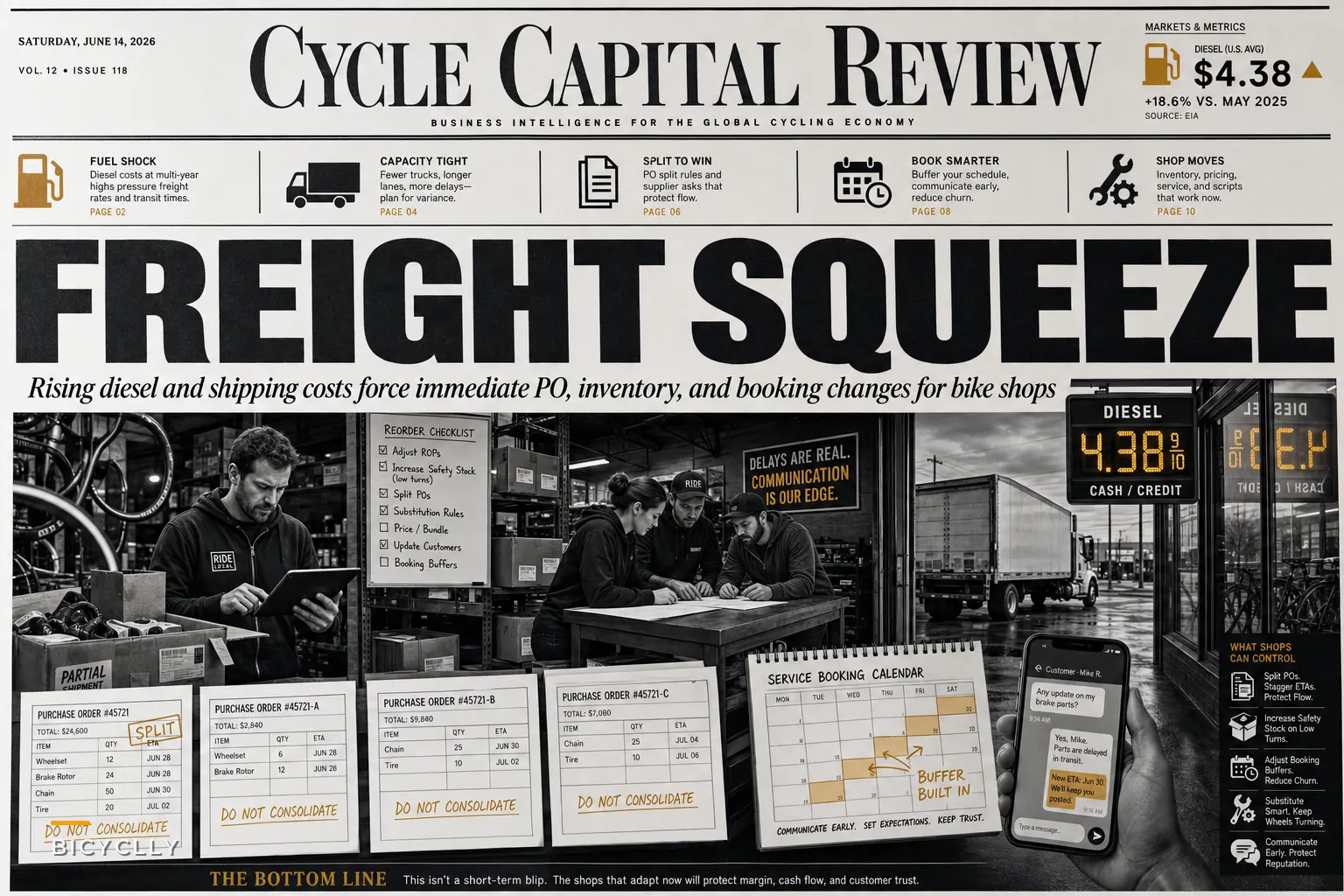

Last week's diesel price spike caught everyone off guard. My distributor in Ohio called Thursday morning to warn about a 15% freight surcharge starting immediately. Then C.H. Robinson's June freight report dropped, showing trucking capacity tightening across North America just as we're heading into peak service season. The timing couldn't be worse — this is when shops need predictable parts flow to handle the summer rush.
The real kicker? This isn't just about higher shipping costs. When freight markets tighten like this, lead times become wildly unpredictable. That Shimano derailleur hanger that usually takes 3 days might show up in 8. Or tomorrow. Nobody knows anymore.
The hidden operational mess of bike shop supply chain disruption
Most shop owners think supply chain problems mean paying more for shipping. That's the easy part to calculate. The harder part is what happens to your entire operation when lead times go from predictable to completely random.
You've got a customer's bike on the stand, mechanic halfway through a derailleur replacement, and suddenly you're waiting on a hanger that might arrive Tuesday. Or Friday. The mechanic moves to another job, but now they've got two bikes partially done. Service tickets pile up. Customers start calling about delays. Your whiteboard becomes a maze of arrows and crossed-out dates.
This cascade happens because bike shops run on tight synchronization between parts availability and service scheduling. Unlike retail where you can just apologize for an out-of-stock item, service work creates physical bottlenecks — bikes taking up stand space, incomplete jobs blocking workflow, mechanics jumping between tasks and losing efficiency.
The whole system breaks when timing becomes unpredictable.
Why standard reorder points fail during freight volatility
Raising your reorder points during supply chain disruption often makes things worse, not better. Sounds backwards, but watch what happens when every shop in town starts panic-ordering to build buffer stock. Distributors get slammed with orders they can't fill, allocation kicks in, and suddenly you're getting 30% of what you ordered, randomly distributed across SKUs.
Never miss a sale or service appointment again.
Bicyclly helps you manage every sale, repair, and booking with ease and accuracy.
- Unified inventory and sales tracking
- Automated customer notifications
- Service appointment scheduling
No credit card required
A shop owner in Colorado told me about their disaster last month. They bumped all reorder points by 40% after getting burned on stockouts. Result? $18,000 in excess inventory of fast-moving items they didn't need, while still missing critical slow-movers for service jobs. Their cash got tied up in tubes and chains while mechanics waited on specific bottom bracket tools and suspension pivots.
The problem is that blanket adjustments assume all parts face equal risk. But freight disruption hits different suppliers and product categories unevenly. Your local warehouse might have mountains of tires while completely out of 11-speed chains. West Coast suppliers might ship normally while East Coast ones face week-long delays.
Dynamic PO splitting based on lead time variance
Instead of raising reorder points across the board, you need to get surgical about purchase order structure. The goal isn't more inventory — it's smarter ordering patterns that adapt to volatile conditions.
Start by tracking actual vs promised lead times for each supplier over the past 30 days. Not just average delay, but the variance. A supplier that's consistently 3 days late is actually better than one that varies between on-time and 10 days late. You can plan around consistent delays. You can't plan around randomness.
-
Orders under $500
single PO, accept the risk
-
Orders $500-1500
split into 2 POs, 3-4 days apart
-
Orders above $1500
split into 3 POs, each 3 days apart
This staggered approach means at least some product arrives predictably. Yes, you pay more in shipping. But that's cheaper than having three bikes on stands waiting for parts while customers get angry.
One quirk we discovered: explicitly tell suppliers NOT to consolidate your split orders for efficiency.
Their warehouse team's instinct is to save you shipping costs by combining orders. During normal times, great. During freight chaos, this defeats the entire purpose of splitting.
Here's a simple workflow visualization of the staggered PO process.
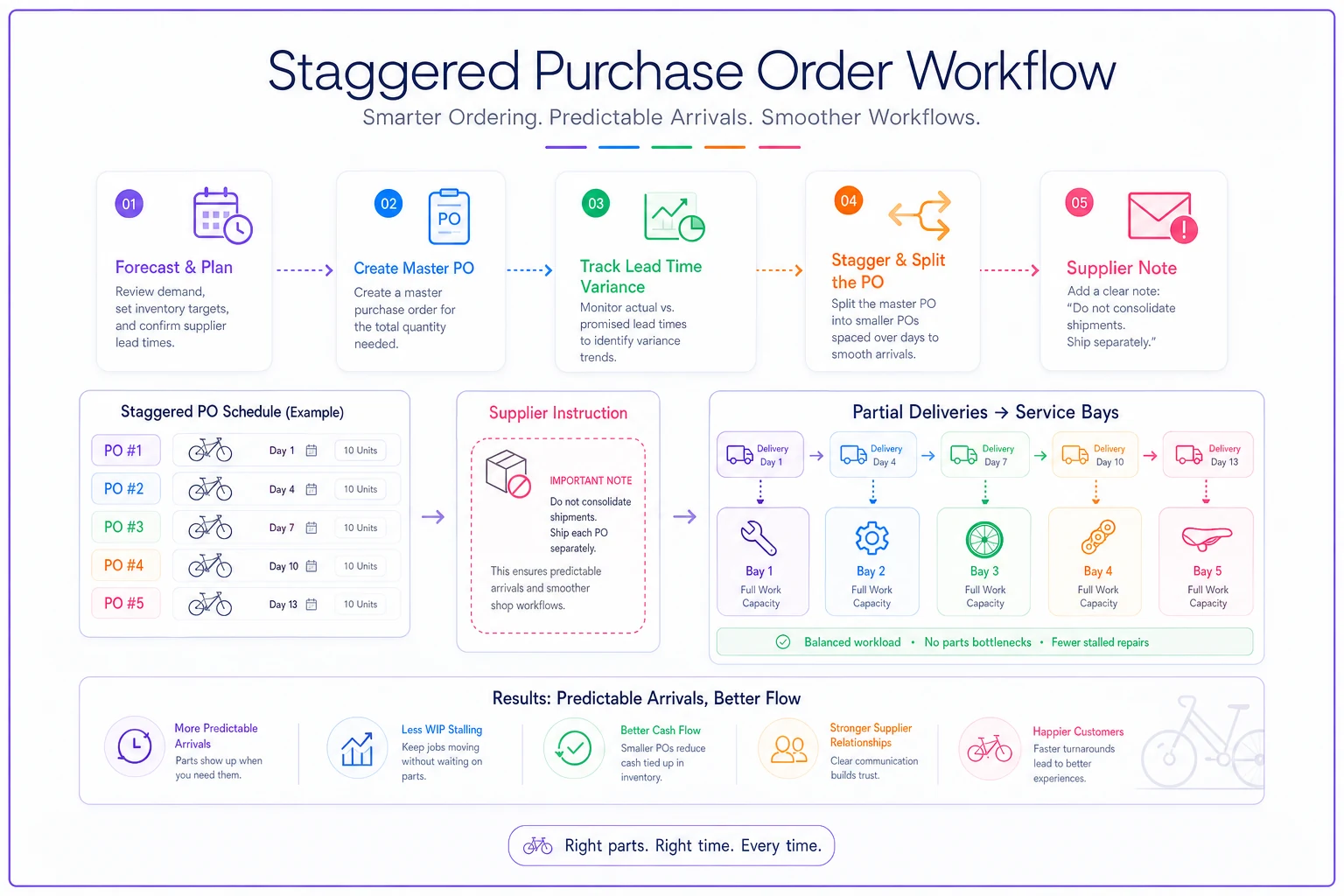
During normal times, great. During freight chaos, this defeats the entire purpose of splitting.
Substitution matrices that actually work
Every shop has a substitution policy. Usually it's some version of "ask the customer if we can upgrade them for free." But when lead times stretch and freight costs spike, you need systematic substitution rules that protect margins while keeping bikes moving through the shop.
Build your substitution matrix around three factors:
-
Customer price sensitivity (budget, mid, premium customer)
-
Functional equivalence (exact match, comparable, upgrade)
-
Margin impact (loss, neutral, positive)
For budget customers on basic repairs, you can often substitute up one tier without pushback if you explain it's about getting their bike back faster. "I can get you back riding tomorrow with this $35 chain instead of waiting until next Thursday for the $25 one." Most take it.
Premium customers are trickier — they chose specific components for a reason. But they also hate delays more than budget customers. Frame it as expertise: "Given the current delays on XT derailleurs, I'd recommend this SLX. Functionally identical for your riding style, and I can have you rolling by Tuesday."
Never automatically substitute down unless the customer explicitly requests it. The reputational damage isn't worth the margin preservation.
Service booking adjustments during volatile freight
When parts availability becomes unpredictable, most shops make the mistake of just adding buffer time to all service quotes. "Tune-ups now take 5-7 days instead of 2-3." This kills conversion rates and frustrates customers who need simple repairs.
Better approach: segment your service menu into stockout-resistant and stockout-vulnerable categories.
Stockout-resistant services (book normally):
-
Basic adjustments
-
Tire changes (if you stock deep)
-
Brake adjustments
-
Chain cleaning/lubing
-
Wheel truing
Stockout-vulnerable services (book differently):
-
Drivetrain overhauls
-
Suspension service
-
Electronic shifting repairs
-
Vintage bike restorations
-
Custom builds
For vulnerable services, modify your booking process. Instead of giving a completion date upfront, book a diagnostic slot first. After diagnosis, you can check real inventory and give an accurate timeline. Customers prefer this honesty over promised dates that slip.
Instead of giving a completion date upfront, book a diagnostic slot first.
This connects directly to strategies for managing supplier delays and customer communication — the key is setting expectations early rather than apologizing later.
The $50 same-day surcharge experiment
Something controversial that actually works: transparent surcharging for speed during supply crunches. A shop in Austin started offering "same-day parts sourcing" for a $50 premium when their normal suppliers showed delays. They'd drive to competing shops, pay retail, and mark it up.
Sounds like it would anger customers, right? Opposite happened. About 30% of customers gladly paid for certainty. The rest appreciated having the option even if they declined. It positioned the shop as problem-solvers rather than victims of supply chain issues.
The key is framing. Don't hide the situation. "Normal delivery would be 6-8 days due to current freight delays. For $50, I can source locally and have you riding tomorrow." You're selling time and certainty, not parts.
Regional supplier diversification without the mess
Everyone says to diversify suppliers, but nobody explains how to do it without creating operational chaos. Multiple vendor accounts, different systems, inconsistent invoicing — it becomes a nightmare fast.
The smart approach: designate primary, secondary, and emergency suppliers by category, not broadly. Your primary supplier might be great for drivetrain components but terrible for wheels. Map this out:
| Category | Primary | Secondary | Emergency |
|---|---|---|---|
| Drivetrain | QBP | J&B | Local retail |
| Wheels | BTI | QBP | Direct brand |
| Tires | BTI | QBP | Local wholesale |
| Tools | Park Tool direct | QBP | Amazon Business |
This focused redundancy means you're only managing multiple relationships where necessary. You're not trying to maintain accounts everywhere for everything.
Cash flow protection during freight spikes
The ugliest part of freight volatility isn't the operational chaos — it's the cash flow squeeze. You're paying 15-20% more in shipping, carrying more buffer inventory, and potentially offering more discounts to smooth over delays. Meanwhile, your prices to customers stay flat because raising them during supply problems looks predatory.
Three moves that help:
First, negotiate net-45 or net-60 terms with suppliers specifically for freight surcharges. Many will separate product costs (normal terms) from freight (extended terms) if you ask. This gives you breathing room.
Second, institute a "freight pooling" system with nearby shops. Instead of everyone paying rush shipping, coordinate weekly consolidated orders. One shop orders Tuesday, another Thursday. You pick up from each other. Saves 40-60% on expedited freight.
Third, pre-sell service packages during slow periods. "Buy 3 tune-ups now, use them anytime this year, save 20%." This generates immediate cash while locking in future work at today's margins.
When freight costs should trigger price adjustments
Nobody wants to be the first shop to raise prices, but at some point the math stops working. The question isn't whether to adjust pricing during bike shop supply chain disruption, but how to do it without losing customers to the shop down the street that hasn't adjusted yet.
Stop thinking about across-the-board increases. Instead, use dynamic pricing based on actual cost impacts. Track your real freight cost per service category. Drivetrain work might be up 8% due to component shipping costs. Brake work might be up 2%. Adjust accordingly.
Communicate changes through cost transparency, not generic "inflation" messaging. Post a simple sign: "Due to current freight surcharges from suppliers, parts-intensive repairs include a temporary 5-8% adjustment. Labor rates unchanged." Customers respect honesty.
Building anti-fragile operations
The bigger lesson isn't about managing through crisis — it's about building operations that get stronger under stress. Every supply chain disruption teaches you which processes break first, which suppliers fold under pressure, which customers value speed over price.
Start documenting these patterns now. Which parts consistently cause service delays? Which suppliers communicated proactively about problems versus leaving you hanging? Which service types can you actually deliver predictably during chaos?
This intelligence becomes your operational advantage. While competitors scramble during the next disruption, you've got playbooks ready. You know to stock deep on derailleurs before summer. You know BTI handles freight spikes better than QBP. You know your top 20 customers will pay rush fees while your weekend warriors will wait.
The shops that thrive through volatility aren't the ones with the most inventory or the best suppliers. They're the ones that turned past disruptions into operational intelligence.
Moving beyond reactive scrambling
According to Reuters, the New York Fed found elevated global supply chain pressure continues through May, suggesting these freight problems aren't ending soon. But that's actually good news for prepared shops. While everyone else burns energy on daily crisis management, you can build systematic advantages.
It's not just about freight costs or lead times. It's about which shops can maintain service velocity when parts flow becomes unpredictable. The ones that figure this out will capture market share from those still running on hope and heroics.
The most successful shops navigating supply chain chaos do three things differently. They embrace dynamic operating rules instead of static policies. They communicate proactively with customers instead of reactively apologizing. And they document everything to build institutional knowledge instead of relying on memory and intuition.
Smart operational software can help coordinate these moving pieces — tracking supplier performance patterns, automatically adjusting reorder triggers based on lead time variance, managing substitution rules, and keeping customers informed about realistic timelines. But the real work is building processes that assume disruption as the default, not the exception.
Your competition is hoping things return to "normal" soon. You should be hoping they don't — because every month of sustained disruption is another month to build operational advantages that persist long after freight markets stabilize. The question isn't whether you can survive supply chain disruption. It's whether you can systematically turn that disruption into competitive advantage.
Your competition is hoping things return to "normal" soon. You should be hoping they don't — because every month of sustained disruption is another month to build operational advantages that persist long after freight markets stabilize. The question isn't whether you can survive supply chain disruption. It's whether you can systematically turn that disruption into competitive advantage.
Ready to revolutionize your bike shop operations?
Join hundreds of bike shops using Bicyclly to save time, increase revenue, and deliver exceptional customer service.