

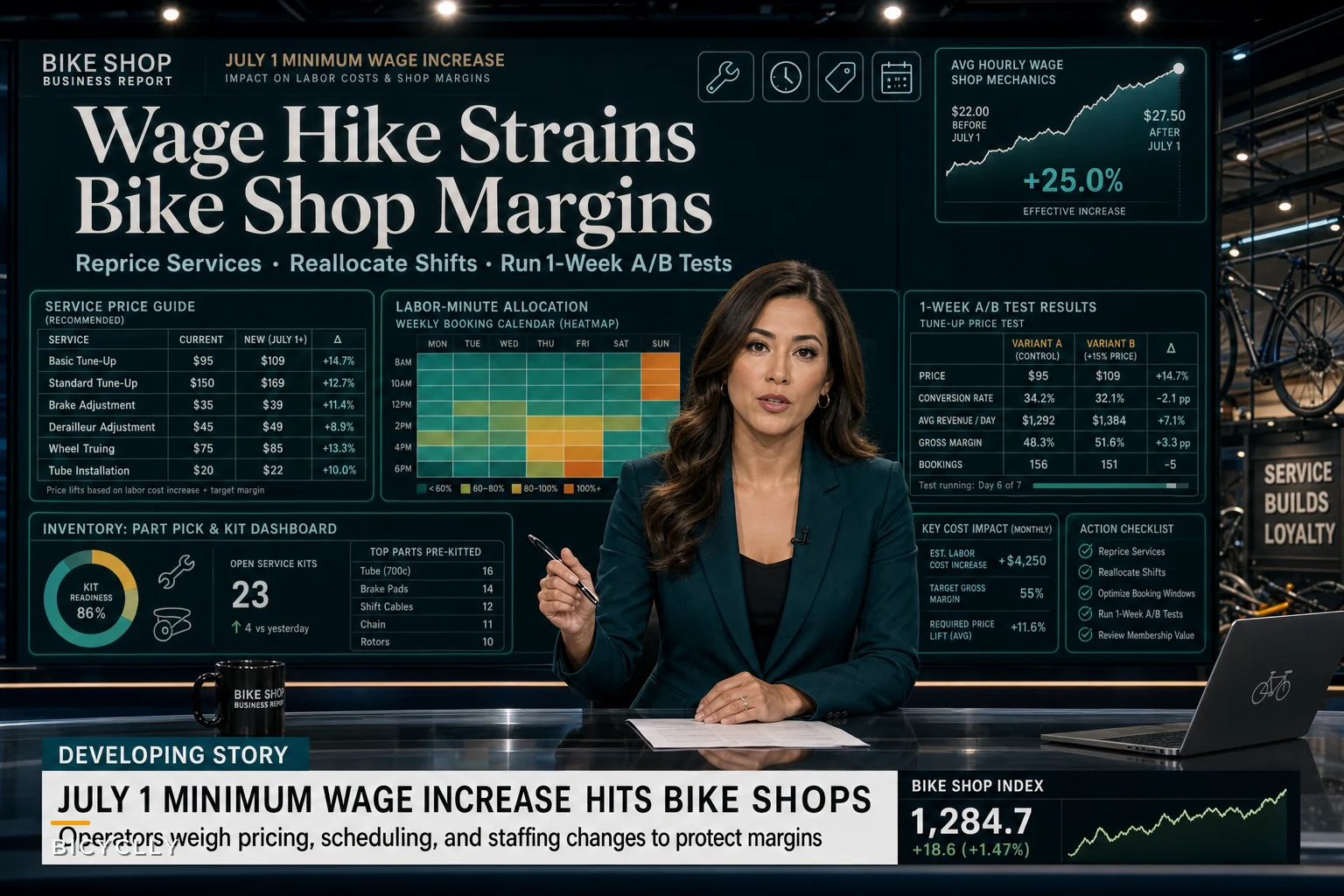

Your lead mechanic just texted you the news article. More than 20 states and cities are raising minimum wage on July 1, and your shop sits right in one of them. The timing couldn't be worse—you're heading into peak summer service season with a labor cost increase hitting every hourly employee on your payroll.
Most bike shops run service departments on razor-thin margins already. A typical tune-up generates maybe $35–45 in labor margin after paying your mechanic. When hourly costs jump by $1.50 or $2.00, that margin shrinks fast. Multiply that across 300–400 tickets per month and you're looking at a serious problem.
The real issue isn't just the wage increase itself. It's that July 1 minimum wage increases expose bike shop pricing structures that were already borderline unprofitable. Those $65 basic tune-ups you've been running since 2019? They're about to cost you money.
Why Mid-Season Wage Increases Hit Bike Shops Harder
Bike shops face a unique challenge with July wage increases. Unlike restaurants that can adjust menu prices overnight or retailers that mark up new inventory, your service pricing is essentially locked in for the season. Customers booked appointments weeks ago expecting certain prices. Membership holders paid upfront for service packages. Mechanics are already scheduled at capacity through August.
The operational squeeze happens at three levels at once. Direct labor costs increase immediately—not just for minimum wage employees but for everyone near that threshold who expects a proportional bump. Fixed-price services and prepaid memberships suddenly operate at lower margins or outright losses. And scheduling efficiency drops because shops often respond to wage pressure by cutting hours, which creates service backlogs at exactly the wrong time of year.
A shop with four mechanics averaging $16–18 per hour faces roughly $320–400 in additional weekly payroll when wages bump up $2. That's around $1,400–1,700 monthly during your busiest season. To put that in context, it's the entire profit margin on about 35–40 full tune-ups.
The knee-jerk reaction is usually wrong either way. Shop owners either panic and immediately raise all prices (losing customers) or absorb the costs hoping to make it up in volume (losing money). Neither works because they ignore the structural problem: the service operation wasn't optimized for efficiency in the first place.
The Hidden Margin Killers Already In Your Shop
Before touching prices, look at where you're already bleeding margin. Most shops lose 15–20% of potential service revenue through operational inefficiencies that get worse when labor costs rise.
Never miss a sale or service appointment again.
Bicyclly helps you manage every sale, repair, and booking with ease and accuracy.
- Unified inventory and sales tracking
- Automated customer notifications
- Service appointment scheduling
No credit card required
Start with your service menu complexity. The average shop offers 12–15 different service options, each with slightly different labor allocations and parts requirements. When wages increase, tracking actual margins on each service type becomes nearly impossible. You end up with some services quietly subsidizing others without realizing it.
Time creep destroys margins faster than wage increases. A 45-minute tune-up that consistently runs 55 minutes costs you an extra $3–4 in labor at new wage rates. Multiply that across your daily ticket count and you're losing hundreds weekly. It compounds when mechanics bounce between different job types instead of batching similar work.
Parts markup is another problem most shops have ignored for years. While labor costs climb, shops keep charging 2018 prices because "that's what customers expect." But parts margins exist to offset labor pressure. A derailleur hanger that costs you $12 should sell for $28–32, not $20. Those extra dollars add up across hundreds of transactions.
Then there's the scheduling black hole—open bays during peak hours, mechanics waiting on parts, overlapping lunch breaks during the midday rush. Higher wages amplify the cost of every one of these inefficiencies.
Immediate Pricing Adjustments That Won't Scare Customers
Smart repricing targets specific services while protecting your volume drivers. Blanket 15% increases across the board will cost you more customers than the margin is worth.
Focus increases on complex repairs where customers already expect to pay more. Overhauls, suspension services, and wheel builds can absorb $10–20 price increases without much pushback. These customers chose your shop for expertise, not price. A $280 overhaul going to $295 won't change their decision.
Leave your basic tune-up price stable but strip it down to true essentials. Move brake adjustments, derailleur tuning beyond basic limits, and anything requiring parts to paid add-ons. You maintain the advertised price while increasing average ticket value. Most customers need at least one add-on anyway.
Create urgency around current pricing. Email your list announcing current service prices honored through July 15 for appointments booked by June 30. This drives immediate bookings at profitable rates while giving you natural cover to adjust prices on later appointments.
Your pricing model needs to account for total labor cost, not just direct service time. Check-in, parts pulling, customer communication, and post-service test rides all count. At new wage rates, a true 45-minute tune-up costs closer to $28–32 in total labor, not the $18–20 many shops assume.
Bundle services to soften the perception of price increases. Instead of raising brake adjustment from $25 to $30, create a "Safety Package" combining brakes, quick release check, and tire pressure for $35. Customers perceive value in packages even when component prices rise.
Scheduling Changes That Preserve Throughput
Higher wages mean you need more revenue per labor hour. The fastest path isn't more customers—it's better scheduling that actually uses the capacity you already have.
Stagger start times. Instead of all mechanics arriving at 9am, spread arrivals from 8:30 to 10am. This ensures coverage during peak drop-off and pickup windows without everyone hitting overtime simultaneously. A three-mechanic shop can save 4–6 overtime hours weekly through staggering alone.
Block scheduling by service type makes a real difference. Dedicate Tuesday mornings to tune-ups only. Batch wheel builds on Wednesday afternoons. When mechanics repeat similar tasks back to back, they move noticeably faster—often 20–25%. At higher wage rates, that speed improvement translates directly to margin recovery.
Here's a simple workflow to visualize the scheduling changes and lanes.
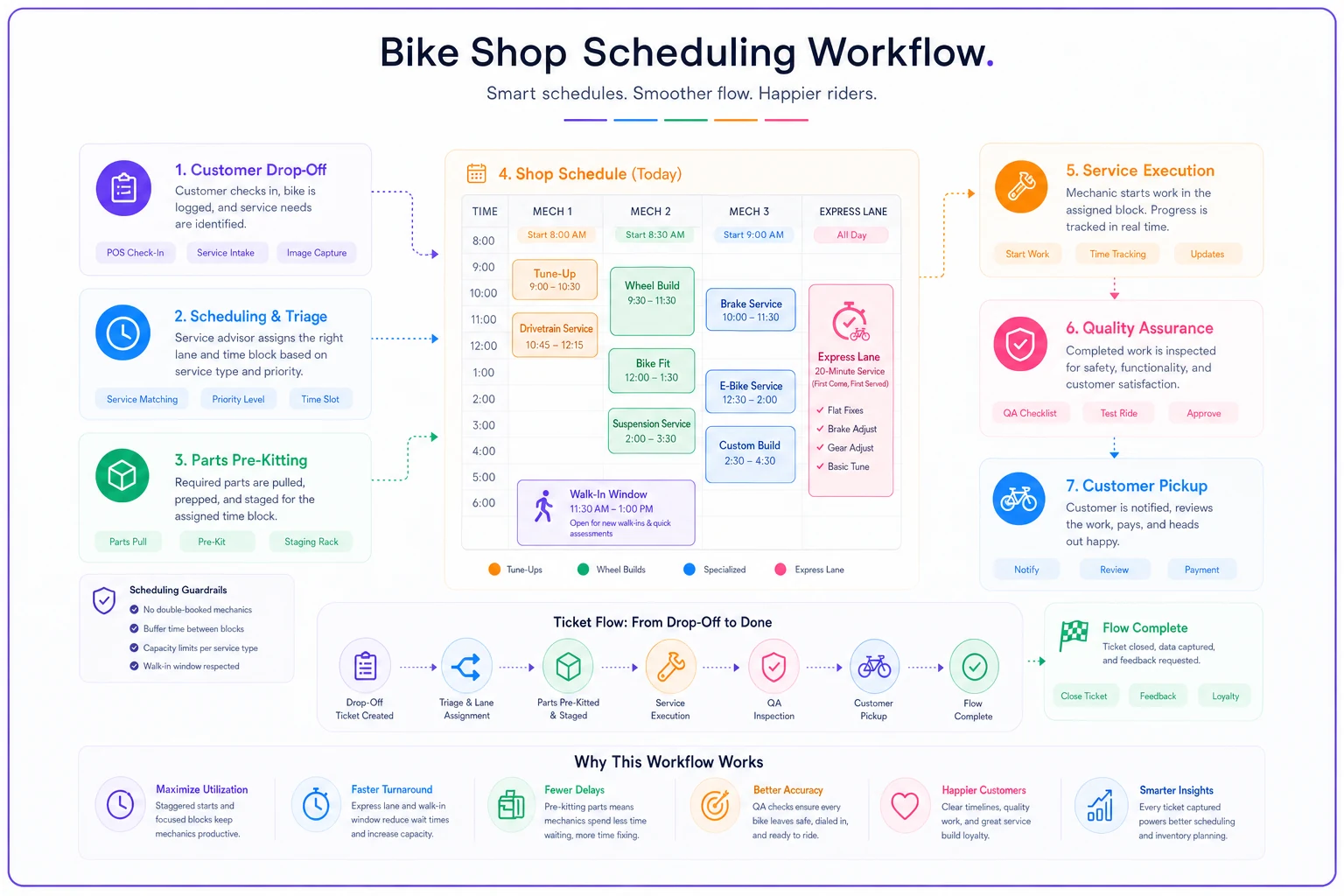
Walk-ins need a defined lane. Every "quick adjustment" that interrupts a scheduled repair costs more money now. Create a dedicated walk-in window—say 4–6pm daily—staffed by one mechanic. Everyone else stays focused on scheduled work.
Your lunch break schedule probably overlaps peak demand. Stagger breaks so you maintain coverage from 11am to 2pm. This might mean adjusted shift times or occasional split shifts, but the revenue capture during those hours justifies the complexity.
Express services deserve their own workflow too. A 20-minute-or-less lane for tubes, quick adjustments, and minor fixes priced at a premium ($15 for a tube change versus $10 standard) with guaranteed fast turnaround. Customers pay for convenience, and you maximize revenue per hour.
Staffing Adjustments Beyond Just Cutting Hours
Cutting hours during peak season usually backfires. You can't cut your way to profitability in July. Instead, restructure roles to get more value from every hour worked.
Split mechanics into specialized roles. Your best diagnostic tech handles all incoming evaluations and quotes. Your fastest wrench focuses on high-volume tune-ups. Your detail-oriented mechanic owns complex rebuilds and warranty work. Specialization improves speed and quality while justifying wage differentiation between roles.
A service writer or coordinator, if you don't already have one, pays for itself quickly. At $15–17 per hour, they free mechanics from customer calls, parts ordering, and scheduling. One coordinator supporting three mechanics typically bumps shop throughput by 25–30%.
Part-time specialists make sense for specific gaps—a weekend tube-and-adjust person, a Thursday evening e-bike tech, a Saturday kids-bike specialist. These roles work well for experienced riders who want flexible hours and let you handle volume spikes without full-time overhead.
Cross-train your sales staff for basic service tasks. Register staff can handle tube installations, basic accessories, and safety checks during slow periods. It reduces service department pressure while keeping sales staff productive. Just keep clear boundaries to avoid skill creep.
The summer intern math changes with higher minimum wages. At $15+, interns need to contribute real value immediately. Focus on second-year students or recent graduates who can handle actual work rather than someone still learning which end of the wrench to hold.
Operational Efficiency Fixes That Offset Higher Labor Costs
Some of these improvements pay for themselves within weeks when labor costs rise.
Parts organization is underrated. Every minute a mechanic spends hunting for a derailleur hanger or specific cable housing costs more now. One weekend of complete reorganization—clear labeling, standard locations, backup stock positions—can save 20–30 minutes daily per mechanic. Not glamorous, but real money.
Pre-kit common services to eliminate parts gathering time. Build tune-up kits with cables, housing, and common replacement parts in labeled bags. Brake service kits with pads, cleaning supplies, and fluid. At higher wages, 5 minutes saved per ticket adds up fast.
Pre-kit your most common tune-ups and brake services into labeled bags so mechanics don't hunt for parts between tickets.
Two-stage quality checks reduce expensive re-dos. A quick mid-service check plus a fast final verification catches problems early when they're cheap to fix. Comeback repairs at new wage rates can erase an entire day's profit margin.
Your special order process probably hemorrhages money too. Consolidate to twice-weekly supplier runs. Charge a handling fee for orders under $50. Set clear communication standards so mechanics aren't repeatedly fielding calls about part arrivals. Small changes that can save 5–8 hours weekly of non-productive time.
Digital service forms and estimates speed everything up. If mechanics are still writing paper tickets, you're burning money on administrative time. Basic service software eliminates 10–15 minutes per ticket in paperwork. At new wage rates, that's $4–6 saved per transaction.
The integration between service scheduling, inventory, and customer communication eliminates duplicate data entry and reduces errors. AI-powered operational software can automatically flag scheduling conflicts, predict parts needs, and suggest optimal batching of similar repairs—the kind of coordination that becomes genuinely valuable when every paid hour needs to count.
The Membership and Package Pricing Trap
Existing service memberships and prepaid packages become a problem when wages jump. That $199 annual tune-up package sold in March now costs more to fulfill than you planned.
For existing memberships, you're stuck honoring original terms. But you can adjust how you deliver. Batch membership tune-ups into specific time blocks optimized for efficiency. Require booking at least a week out. Limit membership services to certain days where you can control workflow.
Stop selling unlimited-service packages. Any all-you-can-eat service model breaks when labor costs spike. Convert to credit-based systems where members buy service credits applicable to any work. Maintains prepayment benefits while protecting margins.
Restructure new memberships around value-adds rather than discounts. Priority booking, extended service hours, free pickup/delivery—these cost little to deliver but justify premium pricing that covers higher labor. Members care about access and convenience, not just a percentage off.
Corporate and group accounts need renegotiation. That fleet maintenance deal with the local university? It's probably underwater now. Approach institutional clients with the data and propose modest adjustments. Most will accept 8–10% increases when the reasoning is clearly explained rather than just announced.
Package pricing should shift toward parts-inclusive deals. Bundle labor and commonly needed parts together at margins that account for wage increases. A "Complete Brake Refresh" at $120 including pads reads better than $45 labor plus $50 parts, even though the total is higher.
Technology and Process Improvements That Scale
When labor gets expensive, productivity tracking becomes essential rather than optional.
Service tracking software lets you see exactly how long each service type takes, which mechanics work most efficiently, and where delays stack up. Most shops discover they've been underpricing certain services by 30–40% once they see actual time data. That's not a minor adjustment—that's a fundamental repricing.
Automated appointment reminders cut no-shows, which waste expensive capacity. A simple text reminder system typically cuts no-shows by around half. At new wage rates, preventing two no-shows weekly saves $50–80 in idle labor.
Parts inventory systems prevent the expensive scramble for missing components. Knowing you're low on brake pads before starting a brake job saves the 15-minute supplier run that now costs $5–8 in wages.
Customer communication platforms reduce mechanic interruptions significantly. Instead of mechanics fielding status calls, automated updates keep customers informed. That alone can save 30–45 minutes daily per mechanic.
Digital inspection forms with photo capability speed up evaluation and approval. Mechanics document issues once, share instantly with customers, get faster approvals. Less back-and-forth, more billable work.
Making July 1 Changes Stick Through September
The hardest part isn't implementing changes—it's maintaining them through the busy season when old habits creep back in.
Start with transparency about the numbers. Show your team exactly how wage increases affect shop economics. Most mechanics genuinely don't realize that a $2 hourly raise might consume the entire margin on basic services. When they understand the math, they're more likely to embrace efficiency improvements rather than resist them.
Phase changes gradually but firmly. Week one: new scheduling blocks. Week two: repriced services go live. Week three: streamlined workflows are mandatory. This prevents overwhelming the team while ensuring real progress.
Track the right metrics. Revenue per labor hour, average ticket value, and service completion time are your north stars now. Post them weekly somewhere visible. Celebrate improvements and address backsliding quickly before it becomes habit.
Customer communication needs careful framing. Don't blame wage increases directly—customers tune out. Emphasize improved service quality, faster turnarounds, better parts availability. Frame price adjustments as investments in the service level they expect.
Weekly 15-minute Monday morning stand-ups to reinforce new processes. Review what's working and what isn't. Keep them short, focused, and action-oriented. These check-ins prevent drift and surface problems before they get expensive.
The 90-Day Margin Recovery Roadmap
Here's your practical checklist for navigating the July 1 minimum wage increase:
Immediate Actions (By June 30):
-
Calculate exact wage impact on your payroll
-
Identify your five least profitable services
-
Email customers about booking current-price appointments
-
Order supplies for parts pre-kitting
-
Schedule all-hands meeting for June 28
Week 1 (July 1–7):
-
Implement staggered mechanic schedules
-
Launch premium express service lane
-
Reprice complex repairs and overhauls
-
Stop selling unlimited service packages
-
Begin daily efficiency tracking
Week 2–3 (July 8–21):
-
Roll out service batching blocks
-
Introduce add-on pricing for basic services
-
Reorganize parts room for faster access
-
Train sales staff on basic services
-
Negotiate institutional account adjustments
Month 2 (August):
-
Analyze service time data and adjust pricing
-
Optimize scheduling based on demand patterns
-
Launch new membership structure
-
Implement digital inspection forms
-
Review and cut unprofitable services
Month 3 (September):
-
Compare margin recovery to targets
-
Fine-tune workflows based on data
-
Plan winter service menu changes
-
Evaluate staffing structure changes
-
Lock in sustainable operating model
Multiple states and municipalities are implementing these changes, and more will follow. The shops that come out of this season in better shape will be the ones that used this as a forcing function to fix operational inefficiencies they'd been tolerating for years.
| Timeline | Actions |
|---|---|
| Immediate Actions (By June 30) | Calculate exact wage impact on your payroll; Identify your five least profitable services; Email customers about booking current-price appointments; Order supplies for parts pre-kitting; Schedule all-hands meeting for June 28 |
| Week 1 (July 1–7) | Implement staggered mechanic schedules; Launch premium express service lane; Reprice complex repairs and overhauls; Stop selling unlimited service packages; Begin daily efficiency tracking |
| Week 2–3 (July 8–21) | Roll out service batching blocks; Introduce add-on pricing for basic services; Reorganize parts room for faster access; Train sales staff on basic services; Negotiate institutional account adjustments |
| Month 2 (August) | Analyze service time data and adjust pricing; Optimize scheduling based on demand patterns; Launch new membership structure; Implement digital inspection forms; Review and cut unprofitable services |
| Month 3 (September) | Compare margin recovery to targets; Fine-tune workflows based on data; Plan winter service menu changes; Evaluate staffing structure changes; Lock in sustainable operating model |
Customers won't abandon you over a 10–15% price adjustment if the quality and reliability stay consistent. They will abandon you if service becomes erratic because you're trying to run the same operation with a fundamentally different cost structure. Make the changes now while industry-wide wage pressure gives you natural cover, and you'll come out with a stronger operation that can handle future cost increases without the same scramble.
The margin protection isn't just about raising prices—it's about restructuring how you deliver service. Every process improvement, scheduling change, and role adjustment compounds over time. Shops still running 2019 operations with 2026 labor costs won't make it through next winter.
Ready to revolutionize your bike shop operations?
Join hundreds of bike shops using Bicyclly to save time, increase revenue, and deliver exceptional customer service.