

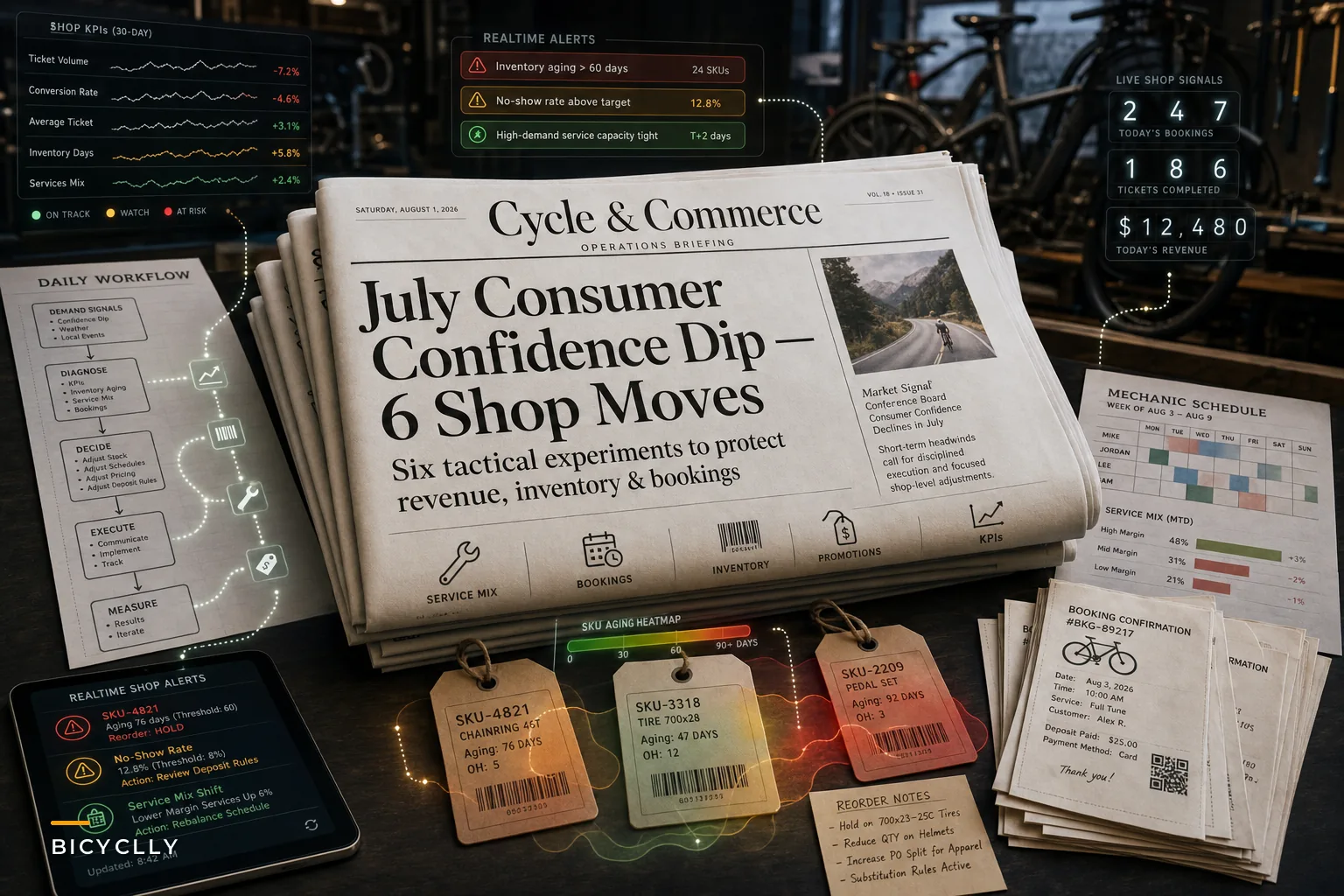

Last week's consumer confidence numbers hit differently if you run a bike shop. The Conference Board reported the index dropped to 90.8 in late July, with households expressing softer views about current business conditions. That's concerning timing—July through September usually drives somewhere between 35 and 40% of annual revenue for most independent shops.
When consumer confidence drops during peak season, riders don't stop riding—they change how they spend. The $3,200 carbon wheelset becomes a "maybe next year" conversation. The full suspension overhaul gets downgraded to basic safety checks. The third bike for the garage stays on your showroom floor another month.
This pattern devastated shops in 2008, then again during the 2020 whiplash between shortages and oversupply. The shops that survived didn't just slash prices and pray. They made specific operational adjustments—inventory, staffing, pricing, booking policies—that let them bend without breaking.
The Real Impact: It's Not About Whether People Buy, It's About What They Buy
The downgrade pattern: Customers still need bikes and service, but they shift down-market. The parent shopping for a teen's bike drops from the $800 hybrid to the $450 model. The weekend warrior postpones the electronic shifting upgrade. The commuter patches tubes instead of replacing tires.
The delay pattern: Non-urgent purchases get pushed out 60-90 days. That backup bike for guests? Later. The fancy computer mount? Not today. The custom paint job? Maybe spring.
The negotiation pattern: Suddenly everyone wants to haggle. Trade-in values become arguments. Service estimates trigger comparison shopping. Even regulars start asking about discounts they've never mentioned before.
Most shops see these patterns hit service bookings first, then accessories, then bikes. The service impact is particularly brutal because labor is your highest-margin revenue stream. When a $350 comprehensive tune-up becomes an $89 safety check, you're not just losing $261 in revenue—you're losing the margin that covers your mechanic's wages for the next three hours.
Move #1: Implement Dynamic Safety Stock Rules Based on Turn Rates
When consumer confidence drops, your standard reorder points become dangerous. That rule about keeping 6 weeks of brake pads? Cut it to 4 weeks for anything turning slower than twice monthly.
Never miss a sale or service appointment again.
Bicyclly helps you manage every sale, repair, and booking with ease and accuracy.
- Unified inventory and sales tracking
- Automated customer notifications
- Service appointment scheduling
No credit card required
Here's an adjustment framework that actually works:
High-velocity consumables (tubes, chains, cables): Maintain current levels but split orders. Instead of ordering 100 tubes monthly, order 25 weekly. The slightly higher shipping cost protects you from getting stuck with inventory if demand drops further.
Mid-velocity parts (tires, brake pads, grips): Reduce safety stock by about 30% immediately. These items have enough margin to handle a stockout, and customers will usually accept alternatives.
Low-velocity accessories (computers, lights, bags): Stop reordering completely until you hit 50% of current stock. These discretionary items will sit longest when confidence drops.
If an item stockouts twice in 14 days, bump the safety stock back up incrementally.
Track your adjustments weekly. If an item stockouts twice in 14 days, bump the safety stock back up incrementally. This responsive approach beats both aggressive cutting (which loses sales) and maintaining the status quo (which ties up cash).
Move #2: Create Price-Point Stepping Stones for Service
Traditional service menus fail when customers get price-sensitive. That gap between your $89 basic tune and $350 overhaul becomes a canyon they won't cross.
-
Safety Check Plus ($45)
Basic safety inspection plus chain cleaning and derailleur adjustment
-
Essential Tune ($125)
Everything from the basic tune plus brake bleed and bearing check
-
Performance Refresh ($225)
Comprehensive tune minus the deep cleaning and cosmetic work
The key insight: customers facing economic uncertainty want to feel responsible, not cheap. These mid-tier options let them maintain their bikes without the guilt of overspending or the awkwardness of choosing the cheapest thing on the menu.
Document what's included at each level in writing. Nothing destroys trust faster than inconsistent service during uncertain times.
Move #3: Shift Mechanic Schedules Toward Higher-Margin Work
Your mechanic labor allocation probably follows demand—more techs during busy Saturday mornings, fewer during slow weekday afternoons. When confidence drops, flip this model to follow margin instead.
-
Brake bleeds
~65% margin
-
Suspension service
~70% margin
-
Wheel builds
~75% margin
-
Flat repairs
~35% margin
-
Cable replacements
~45% margin
Schedule your most experienced techs during the times when higher-margin work typically comes in. For most shops, that's Tuesday through Thursday when serious riders drop off bikes for major service.
One Portland shop restructured their schedule around margin and saw roughly an 18% improvement in per-hour profitability despite 25% fewer total tickets. They scheduled their expert suspension tech exclusively Tuesday through Thursday, marketed suspension service to their email list for those days, and moved junior techs to handle weekend flat repairs and quick adjustments.
Move #4: Implement Graduated Booking Deposits
No-shows and last-minute cancellations spike when consumer confidence wobbles. People book service appointments optimistically, then cancel when the credit card bill arrives.
Same-week bookings: No deposit for services under $150, $25 deposit for everything else. The immediacy suggests real need.
1-2 week advance bookings: $25 deposit for services $150-$300, $50 deposit for services over $300.
3+ week advance bookings: 25% deposit for all services over $150.
This structure filters out aspirational bookings—people hoping they'll have money later—and creates urgency for customers to book closer to when they actually need service.
The part most shops miss: make deposits applicable to any service, not just the one booked. When someone cancels a $350 overhaul but still needs an $89 tune-up, let them apply the deposit. You keep the customer relationship and some revenue versus losing both.
Move #5: Launch Flash Inventory Moves for Aging Stock
Traditional sales—20% off everything—destroy margin and train customers to wait for discounts. Instead, use flash inventory moves targeting specific aging stock with bundles.
-
Identify items aged 90+ days
-
Bundle with high-margin consumables
-
Price the bundle at full consumable price plus 50% of the aged item
-
Run for 72 hours maximum
-
Limit quantities to create urgency
Example: Those three $280 rear racks sitting for 4 months? Bundle each with $70 worth of tubes, tire levers, and patch kits. Price the bundle at $180. The customer feels like they're getting the rack for $110. You're moving dead inventory while maintaining margin on consumables.
A shop in Austin ran weekly flash moves during the 2022 inventory glut and cleared around $47,000 in aging inventory over 8 weeks while holding a 42% overall margin. The discipline mattered—never extending the timeframe, never discounting current stock, always bundling with profitable items.
Move #6: Restructure Your Booking Communications
When confidence drops, customers need more reassurance about spending money. Your standard "appointment confirmed" email doesn't cut it anymore.
Booking confirmation: Include a clear cost range based on their described issues. "Based on your description, most similar repairs run $125-$200. We'll inspect first and call with exact pricing before any work begins."
48-hour reminder: Add value justification. "Your Thursday service appointment is confirmed. Regular maintenance extends component life by 40-60%, saving hundreds in premature replacements."
Day-of message: Emphasize control. "See you today at 2pm! Remember, we'll diagnose first and discuss options before any work starts. No surprises."
This kind of messaging reduced cancellations by roughly 30% for a shop in Denver during their last slow period. Customers need to feel in control when money feels tight.
Why Speed Matters More Than Perfect Strategy
The biggest mistake shops make when consumer confidence shifts is waiting for perfect information. By the time you've analyzed three months of data to confirm the trend, you've already absorbed the damage.
The July confidence numbers are your early warning signal. Shops that move now—adjusting inventory, modifying service offerings, restructuring schedules—will navigate the softness with minimal damage. The ones still debating whether this is temporary will be running clearance sales in October.
The pattern is consistent across every shop I've worked with: responsive beats perfect every time. Your seasonal forecasting models matter less than your ability to adjust quickly when signals change.
The Automation Advantage in Volatile Markets
When market confidence shifts, manual tracking becomes a liability. You need real-time visibility into which SKUs are slowing, which service types are declining, and which customer segments are pulling back—not a report you generate at the end of the week.
Modern operational platforms can track these patterns automatically. They flag when specific items exceed aging thresholds, when service mix shifts toward lower-margin work, when booking patterns change. That kind of real-time visibility lets you adjust faster than competitors stuck with weekly spreadsheets and manual counts.
A simple depiction of that workflow:
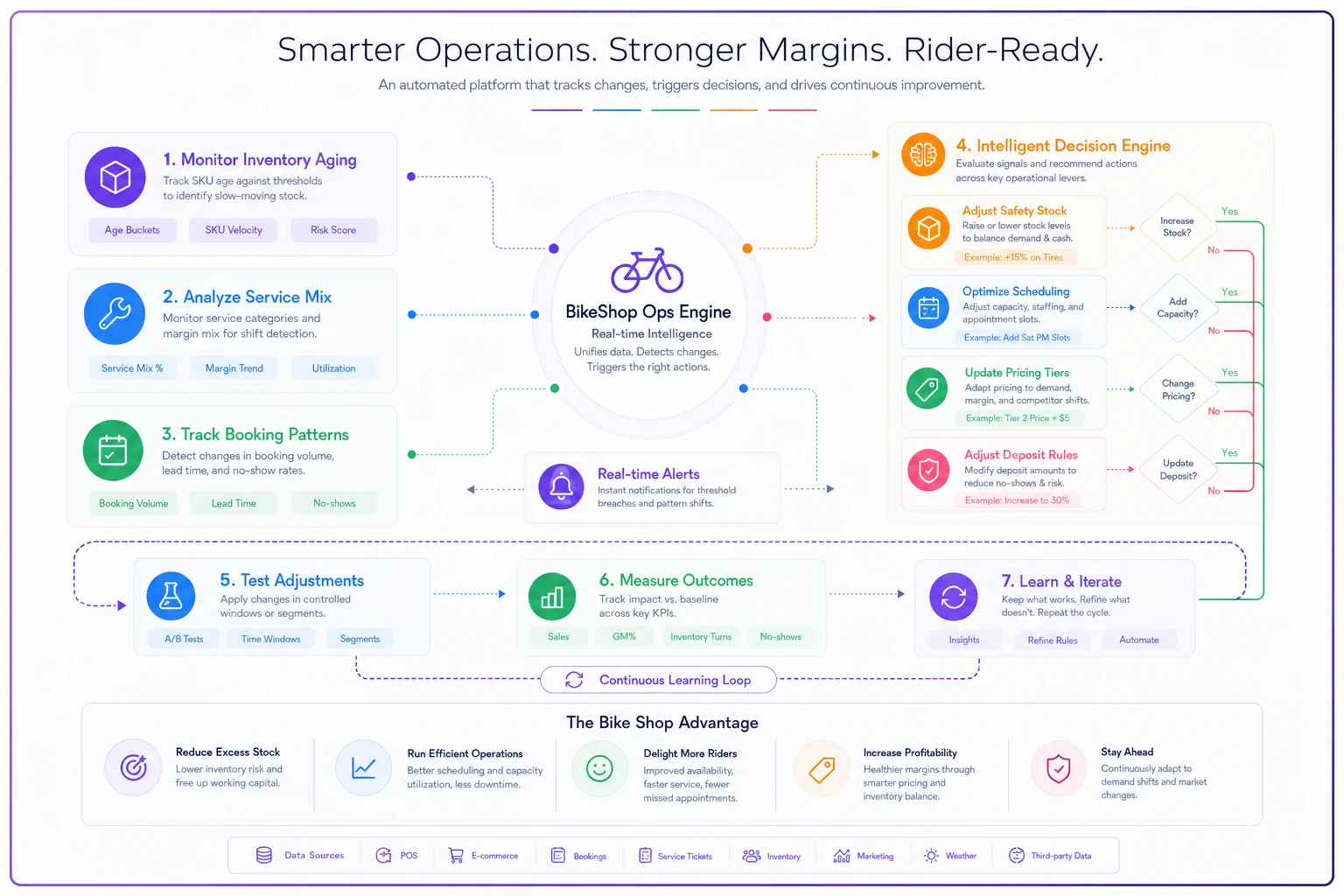
The bigger advantage is the speed of iteration. When consumer confidence drops, you might have 6-8 weeks to find the right adjustment strategy before the damage becomes harder to reverse. Manual testing might let you try two approaches in that window. AI-assisted operational platforms let you test multiple variations—different service promotions across customer segments, different inventory reduction approaches, different deposit structures—and identify what actually works for your specific market before the window closes.
The Next 90 Days
Consumer confidence doesn't reverse overnight. Based on historical patterns, shops should plan for 90-120 days of adjusted operations even if broader indicators improve. Riders who delayed purchases in August won't suddenly splurge in September just because confidence ticks up two points.
Implementation timeline:
| Timeframe | Actions |
|---|---|
| Week 1: | Adjust safety stock levels, implement graduated deposits, restructure service pricing tiers |
| Week 2-3: | Launch first flash inventory moves, shift mechanic schedules toward higher-margin work |
| Week 4-6: | Measure results, refine approaches based on actual customer response |
| Week 7-12: | Standardize what worked, prepare for potential holiday season volatility |
The shops that treat this confidence dip as an operational challenge rather than a crisis will come out stronger. Every adjustment you make now—inventory rules, pricing strategies, booking policies—becomes institutional knowledge for handling future uncertainty.
Consumer confidence will bounce around forever. The shops that survive long-term aren't the ones who panic when it drops or celebrate when it rises. They're the ones who build responsive operations that can adjust quickly without destroying their core business model.
Your customers still need bikes. They still need service. They still want to ride. The confidence numbers just tell you they'll be more careful about how they spend. Meet them where they are, and you'll hold onto relationships and revenue through the volatility.
That's not optimism. That's operations.
Ready to revolutionize your bike shop operations?
Join hundreds of bike shops using Bicyclly to save time, increase revenue, and deliver exceptional customer service.