

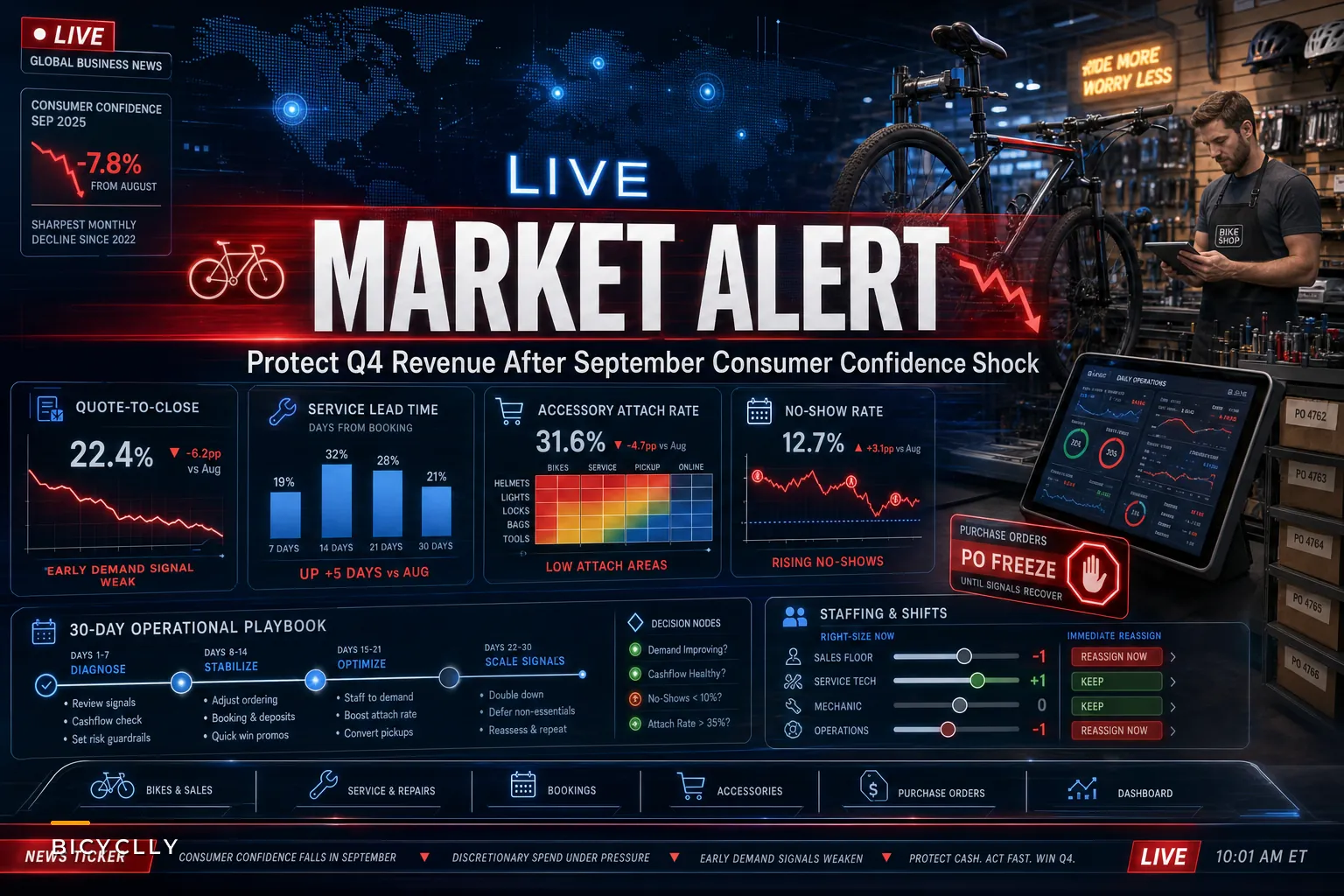

The Conference Board's consumer confidence index dropped to 81.9 in September — the weakest reading since 2014. CNBC's coverage pinned the cause on rising prices and job worries, which is exactly the combination that makes people sit on their wallets heading into Q4.
For a bike shop, that number isn't abstract. It's the customer who was "thinking about" a new gravel bike deciding to ride last season's one more year. It's the rider who normally books a fall overhaul now just topping off tire pressure in the driveway. The index reading itself isn't really the story — what matters is how that pullback shows up in your daily numbers, and whether your shop catches the shift before it quietly drains your December.
This isn't a "cut prices and pray" playbook. A soft‑demand quarter actually rewards shops that get tactical. Below is a 30‑day sequence built for exactly that.
The Real Problem a Confidence Drop Exposes
Most shops don't have a demand problem when confidence falls. They have a visibility problem that was always there and only gets expensive when the margin for error shrinks.
In a strong season, sloppy forecasting and loose booking rules get covered by volume. Enough walk‑ins flow through that nobody notices the dead inventory, the 20% no‑show rate, or the fact that half the service calendar is booked two days out with nothing holding those slots. When discretionary spending tightens, all of that slack disappears at once.
The underlying issue is that most shops are reacting to last month's sales while demand is softening this week. By the time the POS report confirms things are down, you've already over‑ordered holiday accessories, staffed a Saturday for traffic that didn't materialize, and let service bays sit idle because non‑urgent work got deferred and nothing filled the gap.
So the first move isn't promotional. It's shortening the window between "something changed" and "we knew about it."
Days 1–7: Tighten Your Read on Demand
You can't manage a soft quarter on monthly reports. You need a weekly — ideally daily — pulse on a handful of signals that move early.
Never miss a sale or service appointment again.
Bicyclly helps you manage every sale, repair, and booking with ease and accuracy.
- Unified inventory and sales tracking
- Automated customer notifications
- Service appointment scheduling
No credit card required
Watch these four things starting now:
-
Quote‑to‑close rate on bikes over $1,500. This is the first number that softens. People still come in, still ask, still test ride — they just don't pull the trigger. If your close rate on high‑ticket drifts from around 1 in 3 down to 1 in 5, you're watching the confidence drop in real time, weeks before it hits revenue.
-
Service booking lead time. When your calendar quietly shrinks from "booked 8 days out" to "booked 2 days out," non‑urgent work is being deferred. That's your early warning on service revenue.
-
Accessory attach rate per transaction. The first thing nervous buyers drop is the add‑on. If attach slips even a few points, that revenue is already leaking.
-
No‑show and cancellation rate. A soft economy makes people flakier on appointments they were already ambivalent about.
These four signals move before your total revenue does. A shop watching only weekly sales totals is driving by the rearview mirror. A shop watching quote‑to‑close and booking lead time sees the turn coming with two or three weeks to adjust ordering and staffing.
The point isn't the dashboard. It's that the signal reaches you while you can still act.
A simple workflow to monitor these signals daily looks like this:
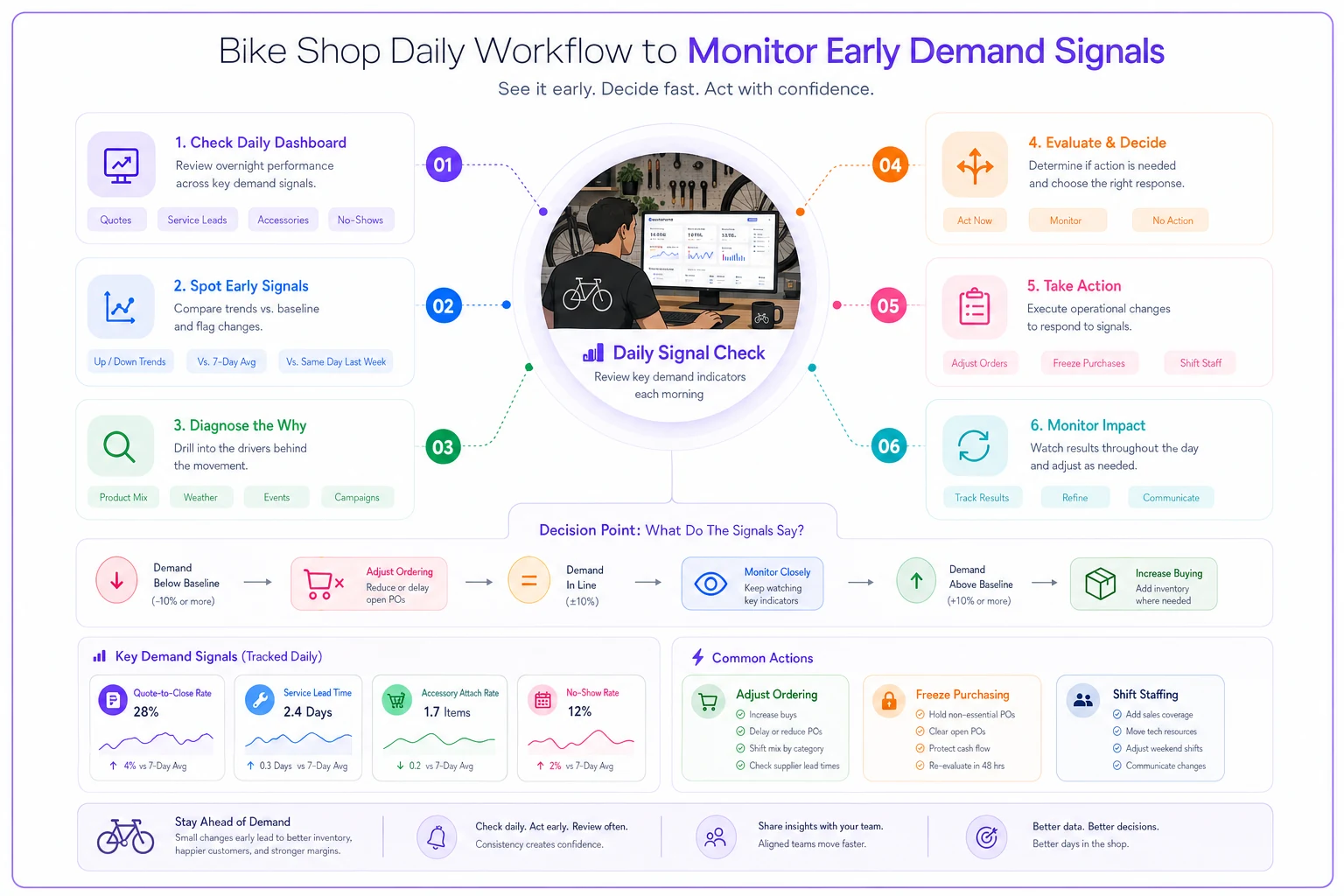
If pulling these numbers means manually scraping your POS and service tickets every Monday, that's a problem worth fixing now. Operational software that surfaces these as a standing weekly view — rather than a report you have to rebuild from scratch each week — is the difference between catching the shift and confirming it after the damage is done. The point isn't the dashboard. It's that the signal reaches you while you can still act.
Days 1–7 (parallel): Stop the Working‑Capital Bleed
While you're tightening your read on demand, freeze your exposure wherever you can.
Confidence drops hit cash twice: slower sales on one side, inventory you already committed to on the other. The shops that get squeezed in January are the ones that kept ordering on autopilot through a softening October.
Three immediate decisions:
-
Pause or trim any open orders for discretionary, high‑ticket, or trend‑dependent stock. Fall accessory reorders, premium apparel, anything that depends on impulse. You can always re‑place it if demand holds. You can't un‑receive it.
-
Protect your fast‑moving consumables and repair parts. Tubes, cables, chains, brake pads, cassettes — the stuff that keeps service revenue flowing. A soft quarter pushes customers toward repair instead of replace, so parts turn may actually hold steadier than bike sales.
-
Reprice stale inventory now, not in December. Every week you hold a bike that isn't moving, you're tying up capital that could be working somewhere else. Mark it before the whole market does.
That second point deserves more attention than it usually gets. In a downturn, the repair side of your shop matters more, not less. The rider skipping a new bike still needs their old one running. If parts availability is thin because you cut safety stock to conserve cash, you'll turn away the one category of demand that's actually holding up. Guard your service supply chain even while pulling back on everything else.
This is also where cash planning has to get sharper than usual. If you're not already running a rolling view of purchases against expected cash, this is the quarter to build one — our 6‑month rolling cash‑flow plan for bike shops walks through how to sequence purchases and staffing against seasonal swings so a soft month doesn't force a fire sale.
Days 8–14: Defend the Service Calendar
Service revenue is your most defensible line in a soft quarter — if you protect the throughput.
The threat isn't that nobody books. It's that a shaky customer books tentatively, then cancels or no‑shows when something else comes up. In a strong season a 15% no‑show rate is annoying. In a soft quarter, 15% of an already‑thin calendar is bays sitting empty with mechanics on the clock.
Booking rules that hold in a soft market
| Service Type | Deposit Rule | Confirmation Cadence | Reschedule Policy |
|---|---|---|---|
| Quick fix / flat / adjustment | None | 1 reminder, day before | Open |
| Standard tune‑up | $20–$30 deposit, applied to ticket | 2 touches (3 days + 1 day) | Free once, then deposit forfeits |
| Full overhaul / high‑ticket | 25–30% deposit | 3 touches + parts‑ready call | Deposit holds the slot |
| Warranty / recall | None | 2 touches | Open |
The deposit isn't about the money. It's about separating real bookings from maybes. A customer who puts $25 down on a tune‑up shows up. The one who booked "just in case" with no skin in the game is the one who ghosts you on a slow Tuesday.
A $25 deposit on tune‑ups typically turns tentative bookings into reliable ones without hurting conversion.
A realistic confirmation workflow looks like this:
-
Booking confirmed at the counter or online
-
Automatic reminder three days out with a one‑tap confirm
-
Second reminder the day before
-
For overhauls, a call the moment parts land so the customer knows the bike is ready
The shops that try to run this manually will see it fall apart within two weeks. A tired front‑of‑house person on a slow afternoon won't make those calls consistently, and the no‑shows you eat are exactly the revenue you can't afford right now.
Operational software that handles the reminder sequence automatically removes the human inconsistency from the equation — shops that run it this way tend to see no‑show rates drop meaningfully within the first few weeks, simply because the follow‑up actually happens every time.
Days 8–14 (parallel): Convert the Hesitant Buyer Without Torching Margin
The mistake shops make the second confidence drops: they blast a 20%‑off storewide sale. That trains customers to wait for discounts, destroys margin on the stuff that was still selling, and does nothing for the person whose real problem isn't price — it's uncertainty.
The hesitant buyer in a soft economy isn't looking for cheap. They're looking for reasons it's safe to spend. Different problem, different fix.
What actually moves a nervous buyer:
-
Trade‑in offers. Lowers the cash outlay and gives them a reason to upgrade now rather than wait. You already have a reconditioning and resale workflow — lean on it.
-
Financing framed as monthly, not total. "$68 a month" lands differently than "$1,800" when someone's worried about job security.
-
Bundled value instead of discounts. Free first‑year service, a free fit session, a parts credit. These protect your headline margin while still giving the customer something tangible.
-
Targeted offers to past customers, not broadcast blasts. The rider who bought from you three years ago is a warmer prospect than a stranger responding to a storewide banner. A quiet email to your service list beats a loud public sale.
A public discount signals desperation and resets everyone's price expectations. A targeted, value‑framed offer to the right segment converts without the collateral damage. One protects margin; the other erodes it across the whole shop.
Days 15–21: Match Staffing to the New Reality
If bookings and traffic are genuinely softer, the schedule you built for a strong September is now wrong. Carrying full staff through thin traffic burns the cash you're trying to protect; cutting too hard means you can't handle the Saturday that does come in.
Use the demand signals from week one to drive this, not gut feel. If quote‑to‑close is down and service lead time has shrunk, you probably have room to trim a shift or two on your weakest days. Shift mechanic hours toward repair work that's holding up and away from assembly bays that are quiet because new‑bike sales slowed.
One pattern worth watching: shops tend to cut their most experienced mechanic's hours first because that's the biggest line item — then they can't turn around an overhaul fast enough and lose the exact high‑ticket service work that carries the margin. Cut the right hours, not just the expensive ones.
If you've tightened the signals, adjusted inventory exposure, and shored up the service calendar, week three is mostly about holding the line and not overreacting to a single bad Saturday. Soft quarters have uneven weeks. Don't rebuild the schedule every time traffic dips for two days.
Days 22–30: Build the Weekly Operating Rhythm
The first three weeks are stabilization. The last week is about making sure you don't drift back to monthly‑report management the moment things feel calmer.
Lock in a 30‑minute weekly review covering:
-
Quote‑to‑close on bikes over $1,500 — up, down, flat?
-
Service booking lead time and this week's no‑show rate
-
Accessory attach rate per ticket
-
Cash position vs. open purchase orders
-
Any stale inventory crossing its reprice trigger
Run it the same time every week. The entire value of the first three weeks collapses if the monitoring stops. A confidence drop isn't a one‑week event — the pullback plays out over a full quarter, and the shops that come through clean are the ones still watching the early signals in December, not just January's closed books.
Operational software helps here not because it does the thinking, but because it keeps the numbers visible without someone having to pull them manually each week. When the review is low‑friction, it actually happens.
A Realistic Scenario
A single‑location shop doing roughly $90k–$110k a month in a normal fall starts seeing it in early October: high‑ticket close rate slides from about 1 in 3 to 1 in 5, and the service calendar that was booked a week out drops to two days.
Instead of waiting for the October P&L, they move. They pause an open order on premium winter apparel and a trend accessory line — freeing up close to $8k in committed cash. They add a $25 deposit on tune‑ups and a three‑touch confirmation sequence, pulling the no‑show rate from around 18% down into single digits over three weeks. They skip the storewide sale and instead email their past‑buyer list a trade‑in‑plus‑financing offer, moving a handful of higher‑ticket bikes that would've stalled on the floor otherwise.
The quarter still comes in softer than last year — that's unavoidable when the whole market pulls back. But the shop protects its cash position, keeps bays full with repair work, and avoids the January scramble of discounting dead stock at a loss. The difference wasn't a magic promotion. It was catching the turn three weeks early and acting on signals instead of waiting for the report.
When This Playbook Doesn't Apply
Not every shop should run the full sequence.
-
If your demand signals are actually holding, don't manufacture a crisis. Cutting staff and pausing orders into steady demand just hands sales to the shop down the street. Watch the signals first; act only if they move.
-
If you're already running tight deposits and weekly reviews, you've done the structural work — your job is to tighten the dials, not rebuild the system.
-
If cash is the binding constraint rather than demand, prioritize the working‑capital moves and the rolling cash plan over the promotional stuff. You can't discount your way out of a liquidity squeeze.
A confidence shock doesn't punish shops for being small or for operating in a soft market. It punishes shops that can't see what's changing until it's already in the books. The ones that get through Q4 in decent shape aren't the ones with the deepest discounts — they're the ones watching the right numbers every week and moving while there's still room to move.
A confidence shock doesn't punish shops for being small or for operating in a soft market. It punishes shops that can't see what's changing until it's already in the books. The ones that get through Q4 in decent shape aren't the ones with the deepest discounts — they're the ones watching the right numbers every week and moving while there's still room to move.
Ready to revolutionize your bike shop operations?
Join hundreds of bike shops using Bicyclly to save time, increase revenue, and deliver exceptional customer service.