



Most bike shops don't fail because they can't sell bikes. They get squeezed because the money going out for pre-season inventory and seasonal hires lands weeks or months before the money coming in from spring sales. The P&L looks fine at year-end. The bank account hits zero in March.
Stop Letting Your Best Sales Month Set You Up for a March Crisis
That gap between when you pay and when you collect is the whole game in a seasonal business. A rolling 6-month cash view — tied directly to your inventory buys and staffing ramps — is the single most useful tool for surviving it.
This isn't a forecasting philosophy piece. It's a working template you can build in a spreadsheet this week, plus the trigger rules that tell you when to actually pull cash levers instead of guessing.
The Specific Trap: The Pre-Season Cash Valley
Here's the pattern almost every four-season shop runs into.
Never miss a sale or service appointment again.
Bicyclly helps you manage every sale, repair, and booking with ease and accuracy.
- Unified inventory and sales tracking
- Automated customer notifications
- Service appointment scheduling
No credit card required
-
Inventory payments coming due from fall POs
maybe $60k–$90k
-
Seasonal staff ramp starting (2–4 people)
$8k–$14k/month in new payroll
-
Normal fixed overhead (rent, insurance, utilities, existing staff)
steady regardless of season
-
Actual sales revenue
the weakest 8–10 weeks of your year
The revenue that pays for all of it doesn't really show up until late April into June. That 6–10 week gap is where shops burn their line of credit or start stretching vendors in ways that hurt their next order.
The mistake isn't overspending. It's that the timing of committed cash outflows was never mapped against realistic inflows before the commitments were made.
Build the Rolling 6-Month Cash Template
A rolling 6-month view beats an annual budget for one simple reason: you re-run it every month, drop the oldest month, and add a new one at the far end. It stays honest because it's never more than a few weeks stale.
You want three layers stacked on top of each other, week by week (or at minimum, by two-week period):
Layer 1 — Committed outflows. Things you've already signed up for. Vendor POs with their actual expected payment dates, payroll, rent, loan payments, tax deposits. Not estimates — commitments.
Layer 2 — Discretionary outflows. Reorders you could delay, accessory buys, marketing spend, any capital purchase. This is your flex budget — the stuff you can throttle.
Layer 3 — Inflows. Projected sales and service revenue, plus any deposits, financing payouts, or receivables. Seasonal shops should build this off last year's weekly pattern, not a flat monthly average — averaging is what hides the valley.
Here's a simplified view of what a two-month slice of the template looks like:
| Period | Committed Out | Discretionary Out | Projected In | Net | Running Cash |
|---|---|---|---|---|---|
| Feb 1–15 | $34,000 | $6,000 | $28,000 | –$12,000 | $41,000 |
| Feb 16–28 | $22,000 | $4,000 | $26,000 | $0 | $41,000 |
| Mar 1–15 | $38,000 | $9,000 | $31,000 | –$16,000 | $25,000 |
| Mar 16–31 | $19,000 | $5,000 | $37,000 | +$13,000 | $38,000 |
| Apr 1–15 | $17,000 | $8,000 | $52,000 | +$27,000 | $65,000 |
| Apr 16–30 | $16,000 | $10,000 | $61,000 | +$35,000 | $100,000 |
The value isn't in the totals. It's seeing that running cash dips to $25k in mid-March — and asking before March whether that's enough cushion, or whether you need to phase a vendor payment or push a discretionary buy back two weeks.
If you already track your inventory this way, this template plugs neatly into the same ticket-driven logic covered in Seasonal Bike Shop Inventory Forecasting: A Compact, Ticket-Driven Playbook. The forecast tells you what to buy; this template tells you when the cash for it actually leaves.
Re-run the rolling view the same day each month and after any large PO to keep the window accurate.
Here's a quick visual of the workflow for keeping the rolling template updated and deciding levers to pull.
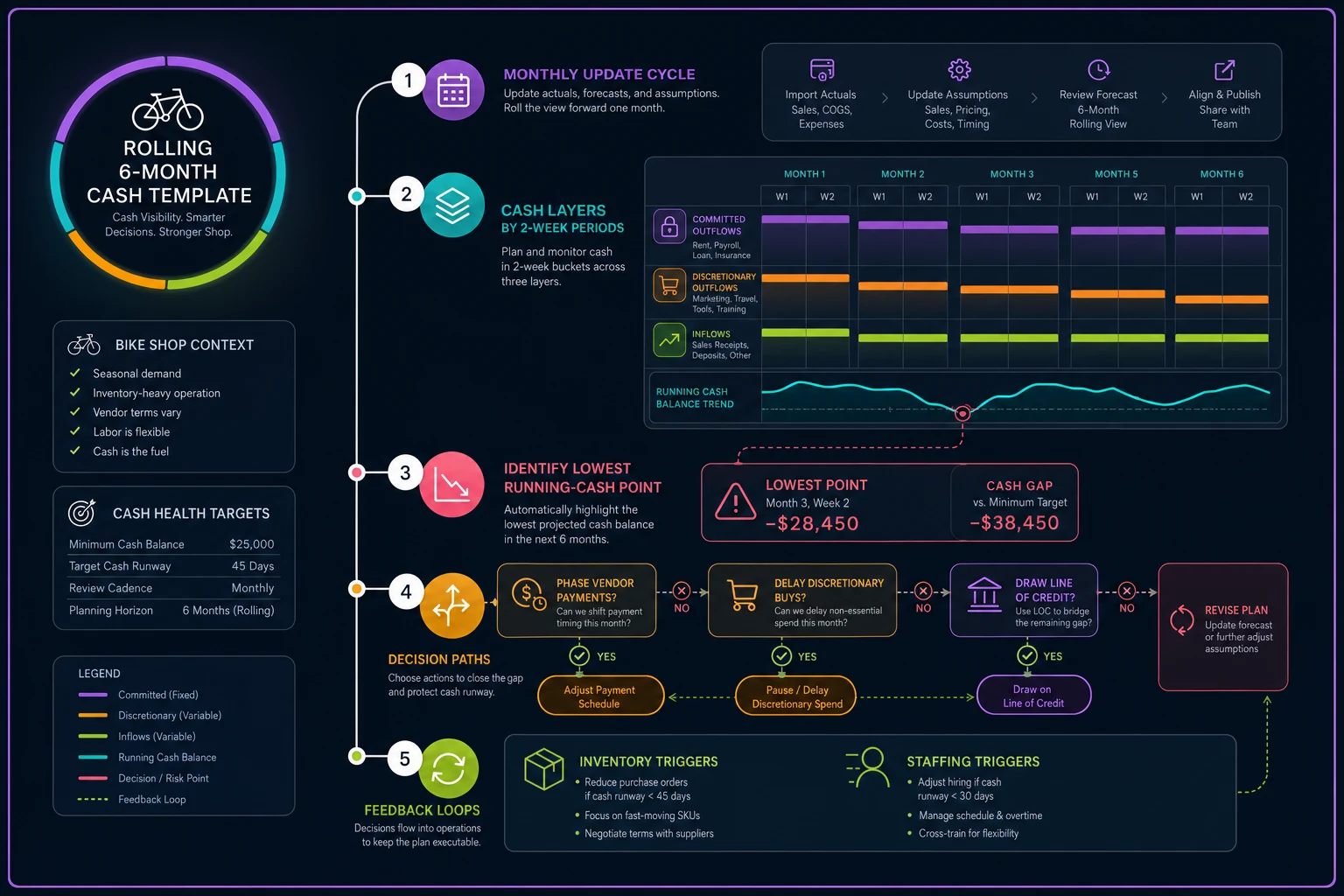
Use the visual to see the decision points where you act before the valley instead of during it.
Vendor Payment Phasing: The Lever Most Shops Ignore
The biggest mistake shops make with pre-season buys isn't the order size. It's accepting whatever ship-and-bill schedule the vendor defaults to, then getting surprised when three invoices hit the same week.
Phasing means deliberately spreading the cash impact of your commitments across the valley instead of letting it clump.
Split large POs by ship date, not just by product. If a vendor can ship half your order in January and half in late February, your net-30 clock starts at two different points. You've just spread a $60k hit into two $30k hits three to four weeks apart.
Negotiate dating on pre-season orders. A lot of suppliers offer seasonal dating — order now, don't pay until April or May — especially on soft goods and accessories. Shops leave this on the table constantly because they never ask. Even shifting $20k of payables from March to May can be the difference between touching your credit line and not.
Rank vendors by flexibility, not just price. A supplier that's 2% more expensive but gives you 60-day dating during your worst cash month may be cheaper in real terms than the "cheaper" one demanding net-15 in February.
-
What's the total commitment and the default payment date?
-
Can it ship in two or more waves to stagger the invoice dates?
-
Is seasonal dating available, and what's the cutoff to request it?
-
Where does each resulting payment land in the rolling template?
-
Does that landing spot keep running cash above your floor?
Set a threshold — anything over $10k, say — and run every PO above it through these questions before you commit.
Temp-Staff Trigger Rules: Ramp on Signal, Not on the Calendar
Staffing the ramp by calendar ("we always hire in March") is what creates payroll pressure during the weakest revenue weeks. Better to tie hiring to leading indicators that actually predict the rush, so you're adding labor cost just ahead of the revenue — not two months early.
-
Service booking lead time. When the next available repair slot pushes past 4–5 days, demand is outrunning capacity.
-
Weekly booked-hours vs. available bench hours. Once booked hours cross around 80% of capacity for two weeks running, you're about to start turning people away.
-
Sales floor traffic on weekends. A jump in Saturday foot traffic usually precedes the sustained rush by a couple of weeks.
So instead of "hire 3 temps March 1," write trigger rules like:
-
Trigger A When service lead time exceeds 5 business days for two consecutive weeks → bring on the first seasonal mechanic.
-
Trigger B When booked service hours exceed 85% of capacity for two weeks → add a second mechanic or extend hours.
-
Trigger C When weekend transactions rise roughly 30% over the trailing 4-week average → add seasonal sales help.
You're spending payroll dollars only once the demand signal is real. In a slow spring, you don't ramp as fast, and you protect cash. In a hot spring, you ramp faster and don't lose sales to a 12-day repair backlog.
One thing to account for: build in training lead time. If a seasonal mechanic needs two weeks to get productive, the trigger has to fire two weeks before you actually need the output. Tie the trigger to the signal, but staff to the lag.
The Monthly Working-Capital Checklist
Run this on the same day every month — first Monday works well. Once the template exists, it should take under an hour.
-
- [ ] Roll the template forward
drop last month, add a new sixth month.
-
- [ ] Update every committed outflow with actual invoice dates, not estimates.
-
- [ ] Reconcile last month's projected vs. actual inflows — where were you off, and why?
-
- [ ] Re-forecast the next 8 weeks of revenue using this year's weekly pattern so far, not last year's.
-
- [ ] Identify the lowest running-cash point in the 6-month window.
-
- [ ] If that low point falls below your cash floor, decide which lever to pull
phase a vendor payment, delay a discretionary buy, or draw the line of credit deliberately.
-
- [ ] Check staffing triggers against current signals — is anything about to fire?
-
- [ ] Confirm no vendor is being stretched in a way that risks your next pre-season order.
Set a cash floor before you need it. For most single-location shops, one month of fixed overhead sitting untouched is a reasonable floor. If the template shows you breaching it, you act early — when you still have options — instead of scrambling the week payroll is due.
Getting your inflow numbers accurate depends heavily on clean books, which is why the reconciliation habit in Turn Tickets into Clean Books: A One-Page Inventory Accounting and KPI Dashboard pairs well here — garbage revenue history makes the whole template lie to you.
A Real Scenario
Single location, around $950k a year, four full-timers plus seasonal help. Historically they placed one big spring PO in November, paid most of it February–March, and hired three seasonal staff on March 1 like clockwork.
Two years ago they hit a wall: mid-March the account dropped to about $8k, they maxed the line of credit, and had to delay a mid-season reorder. That delay cost them real sales in May because they were out of mid-range hybrids during peak weeks.
-
They split the spring PO into two ship waves and asked for May dating on the accessory portion — shifting roughly $22k of payables out of March.
-
They moved from calendar hiring to trigger-based. That first year the rush came late, so their third seasonal hire started three weeks later than usual, saving close to $3k in early payroll with no lost sales.
-
They set a cash floor of one month's overhead and started running the checklist monthly.
The following spring their mid-March low point was around $30k instead of $8k. They didn't touch the credit line, and they had cash on hand to jump on a mid-season reorder that actually made them money. Their sales didn't change much. The timing of their cash did.
When This Is Worth It — and When It Isn't
This level of rigor makes sense if your revenue swings hard by season and you're placing large pre-season commitments against a thin off-season. That's most four-season shops in northern climates.
It's less critical in mild-climate markets with fairly flat year-round demand, or if you buy in small, frequent lots rather than big seasonal drops. In that case a simpler monthly cash check is probably enough — the full rolling template is more machinery than you need.
If you've already leaned on your line of credit two springs in a row, skipping this is a mistake. That's not a one-off — that's a timing problem the template is built to fix.
Seasonal cash flow for a bike shop isn't about selling more or spending less. It's about lining up when money leaves against when money arrives, then giving yourself enough runway to adjust before the valley instead of during it. A rolling 6-month template, phased vendor payments, and staffing that ramps on real demand signals turn the pre-season squeeze from an annual emergency into something you steer through on purpose.
Ready to revolutionize your bike shop operations?
Join hundreds of bike shops using Bicyclly to save time, increase revenue, and deliver exceptional customer service.