

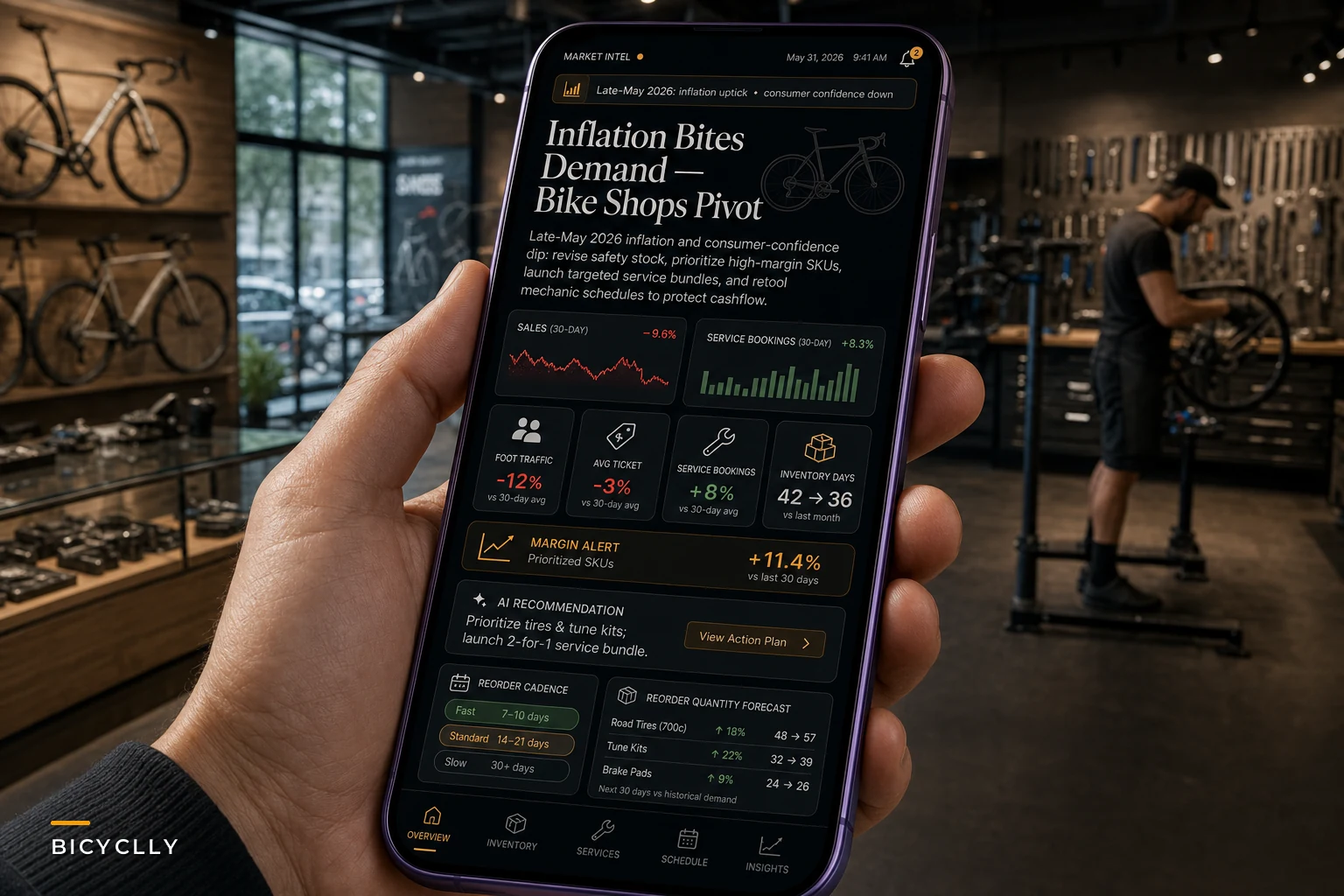

The numbers from late May spell trouble for bike shop owners. Consumer confidence is dropping as inflation worries mount, while core inflation stays stubbornly high. For bike shops heading into peak season, this timing stings.
A shop owner in Denver mentioned something telling—customers who'd normally drop $2,800 on a new gravel bike are suddenly asking about payment plans or walking out to "think about it." His parts costs are up 18% from last year, but raising prices feels like killing whatever foot traffic remains.
This goes beyond adjusting price tags. When inflation hits and consumer confidence drops, everything changes. Customers who do come in behave differently—more haggling, fixing instead of replacing, browsing online while standing in your store.
The real operational damage happening now
Three areas are getting hammered. Parts and accessories margins face pressure from both ends—wholesale costs climbing while customers resist retail prices. Service departments see odd patterns too. Simple tune-ups are up, but nobody wants to spend $400 on a full drivetrain replacement unless the bike literally won't shift.
Inventory creates the worst headaches. Bikes ordered six months ago at higher costs land just as demand softens. Capital sits tied up in metal that won't move while operating expenses climb. One Portland shop has $180,000 in inventory sitting over 90 days—mostly e-bikes and high-end road bikes that seemed safe last fall.
Traditional retail playbooks don't work for bike shops. You can't slash prices and move volume like clothing stores. Your service department creates different dynamics. Customers have emotional attachments to their bikes.
Inventory turns way slower—a good shop might turn inventory 2.5 times yearly under normal conditions. When that drops to 1.8 times, your cash flow dies.
Inventory surgery: what stays, what goes, what never comes in
Start with surgical inventory reduction, not discounting. Bundle dead accessories with service packages instead of blanket markdowns. That $85 helmet sitting eight months? Bundle it with a $150 tune-up for $199 total. You move inventory without training customers to wait for sales.
Never miss a sale or service appointment again.
Bicyclly helps you manage every sale, repair, and booking with ease and accuracy.
- Unified inventory and sales tracking
- Automated customer notifications
- Service appointment scheduling
No credit card required
For bikes, the calculation gets messy:
-
Keep holding - Entry-level hybrids under $600 - Basic kids' bikes - Anything with service attachment rates above 70%
-
Move aggressively now - E-bikes over $4,000 - Carbon road bikes in weird sizes - Last year's mountain bikes with outdated geometry - Boutique brands with no local following
-
Stop ordering completely - Anything with less than 15% margin after shipping - Accessories you can't bundle with service - Bikes from brands offering poor warranty support
Bundle older accessories with service packages to move stock without training customers to wait for sales.
The math on holding versus liquidating: if you're paying 8% annually to finance inventory, holding a $3,000 bike six extra months costs $120. Taking a 25% markdown costs $750 immediately.
Can you move it for 10% off in three months instead? Usually yes, if you're strategic about it.
Service department: your inflation hedge
While retail sales tank during inflation, service becomes more attractive to customers. They keep bikes longer, ride what they have, fix instead of replace. But you need to restructure how you sell service to match this mindset.
Stop selling individual repairs. Start selling service subscriptions and packages. A customer facing a $340 repair bill hesitates. That same customer might buy a $35/month service membership including two tune-ups, priority booking, and 15% off parts.
You solve their budget anxiety while securing predictable revenue. Subscription models work because of consumer psychology during inflation. People hate variable costs when money feels tight. They love predictable monthly expenses they can budget for.
Three shops launched service subscriptions last year—all see 40-45% uptake among regular customers, with average monthly revenue per subscriber around $42.
Structure that's working:
| Tier | Monthly Price | What's Included | Target Customer |
|---|---|---|---|
| Basic | $25 | 2 tune-ups/year, 10% off parts | Casual riders |
| Active | $39 | 4 tune-ups/year, 15% off parts, priority booking | Regular commuters |
| Premium | $59 | Unlimited basic service, 20% off parts, loaner bike | Serious cyclists |
Make the basic tier attractive enough to convert hesitant customers. Make premium profitable enough to subsidize the program.
Pricing tactics that don't scream desperation
Straight discounts train customers to wait. Use conditional pricing that creates urgency without destroying perceived value. The most effective approach combines time-based pricing for service with bundle pricing for retail.
For service, charge less for off-peak scheduling. Tuesday morning dropoff gets 15% discount. Saturday? Full price. This smooths workflow while giving price-sensitive customers options that don't devalue service.
One Austin shop saw Tuesday-Thursday bookings jump 60% while maintaining weekend prices. Win-win.
For retail, bundle structure works magic. Don't discount the bike—discount the second item. Buy a bike, get 30% off any helmet. Buy pedals, get 50% off installation. This protects main margins while moving auxiliary inventory and increasing transaction size.
Private sales beat public ones right now. Email your list with exclusive "inflation fighter" deals not advertised publicly. This maintains price integrity for walk-ins while giving loyal customers reason to buy now.
Keep sales short—48 hours maximum—and segment based on purchase history.
Finding customers who still spend
Not everyone's cutting back. Three segments still spending need different triggers.
The "buy-it-for-life" segment: These customers spend MORE during inflation if convinced they're making smart long-term purchases. They want durability stories, lifetime warranty programs, proof that buying once beats buying twice. Market total cost of ownership, not initial price.
The "fitness replacers": Gym memberships get cut. These people need alternative exercise options. A $2,000 bike looks cheap compared to $150/month gym fees. Hammer this comparison relentlessly.
The "car alternative" crowd: With high gas prices, bike commuting math gets attractive. Someone driving 20 miles daily spends roughly $250/month on gas alone—that's a bike payment. They need safety gear, locks, confidence.
Create commuter packages solving all concerns at once. Messaging must differ completely for each segment. Buy-it-for-life crowd wants technical specs and warranty details. Fitness replacers want health benefits and convenience. Car alternatives want safety features and route planning help.
Labor and scheduling adjustments that preserve margin
Your labor cost runs 35-45% of service revenue. During inflation, that percentage creeps up without careful management. The solution isn't cutting hours—it's restructuring work flow.
Batch similar repairs together. Instead of mechanics jumping between brake adjustments and wheel builds all day, designate time blocks. Monday morning for brake work, Monday afternoon for wheels.
This reduces transition time by about 20%, effectively giving an extra productive hour per mechanic daily. Cross-train sales staff on basic repairs. Not full mechanic training, but enough for flat fixes, brake adjustments, basic derailleur tuning.
This enables while-you-wait service for simple stuff, charging premium for convenience while keeping mechanics focused on complex work. Implement dynamic scheduling based on skill level.
Senior mechanics shouldn't do $30 tune-ups when $400 suspension rebuilds wait. Junior staff handle basic service, senior staff handle complex repairs and custom builds. Most shops don't actually enforce this, leaving money on the table.
Building recurring revenue streams
Physical product retail during inflation is brutal. Recurring revenue is inflation-resistant.
Beyond service subscriptions, three models work for bike shops now. Rental programs for high-end bikes: Instead of trying to sell that $8,000 carbon road bike, rent it for $200/weekend. After 10 rentals, sell it as "demo" for 70% of retail.
You've made $2,000 rental revenue plus $5,600 final sale—better than sitting on it hoping for full price. Corporate service contracts: Local businesses with bike parking are golden. Offer quarterly on-site basic maintenance for employees.
Price it at $500/quarter for up to 50 bikes. Takes one mechanic half a day, costs maybe $150 in labor and supplies, creates customer relationships you wouldn't otherwise have.
Kids' bike subscription service: Parents hate buying bikes kids outgrow yearly. Offer subscription where kids swap bikes as they grow. $30/month, unlimited swaps, basic maintenance included.
Your cost is minimal—recycling trade-ins and donations—but parents love convenience and sustainability.
Technology and systems for margin protection
Manual tracking kills you during inflation because small margin erosions compound invisibly. You need systems flagging problems immediately.
The basics matter more than fancy features. Track service bay utilization hourly. If a bay sits empty two hours, that's $200 lost revenue.
Track parts margin by category weekly. If brake pad margins drop below 40%, you need immediate alerts. Inventory aging reports should run daily with automatic alerts. Anything sitting over 60 days flags for review.
Here's a simple workflow to visualize how these systems tie together.
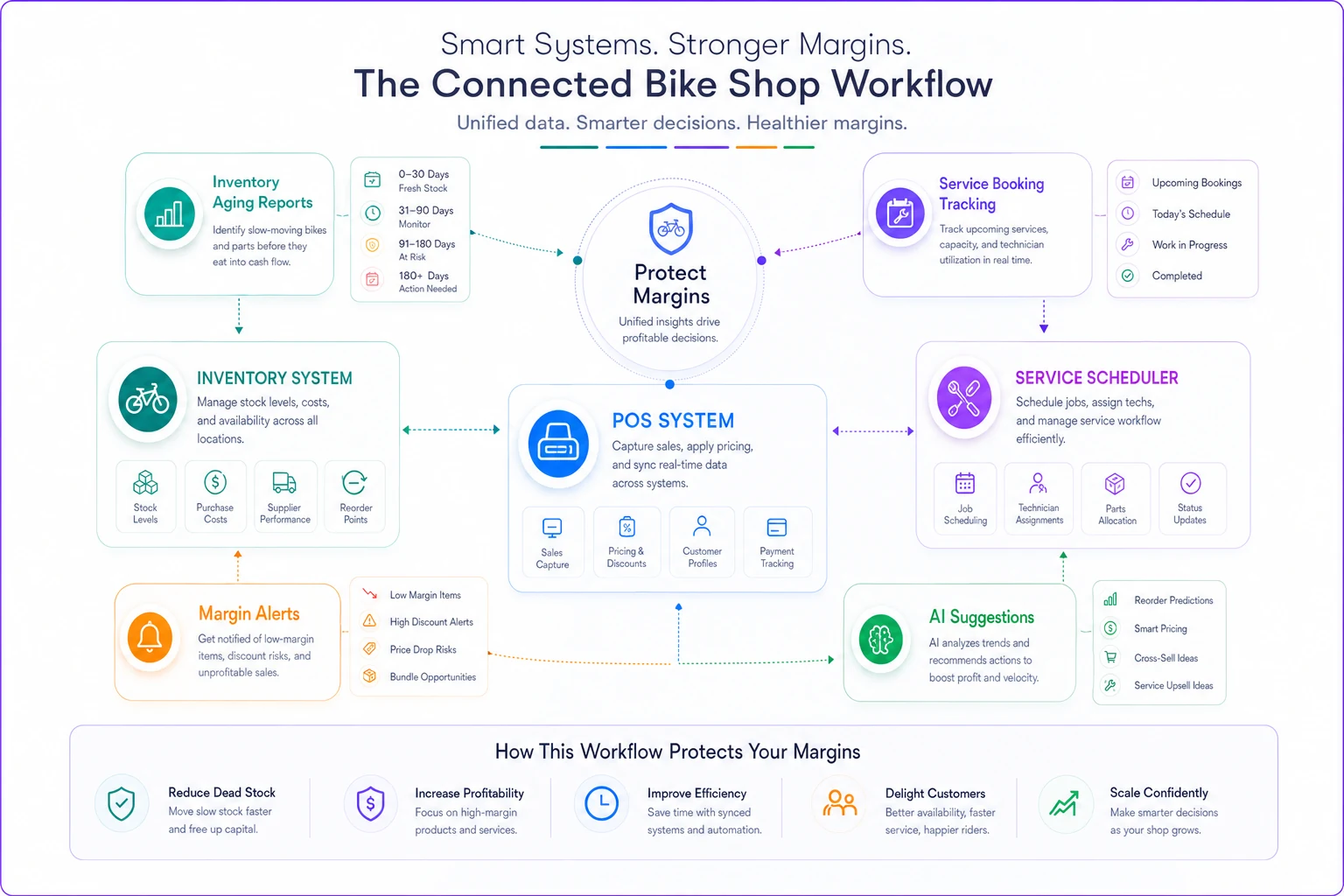
Over 90 days triggers mandatory action—bundle, discount, or return to vendor. This discipline separates shops that survive inflation from those that don't.
Connected to your seasonal forecasting models, adjust future orders based on current demand signals, not just selling through existing stock. If service tickets for certain bike types drop 20%, orders six months out should reflect that.
AI-powered operational software helps by automatically tracking patterns across inventory, service bookings, and sales data. Instead of manually pulling reports, the system identifies margin erosion trends, suggests pricing adjustments, flags inventory needing attention.
It connects dots humans miss—like when tube sales drop but patch kit sales rise, signaling customers repair more than replace.
When things get really tight: crisis moves that work
If cash flow becomes critical, three moves generate immediate relief without destroying long-term value.
-
Convert inventory to service credit. Offer customers 150% value in service credits for new bike purchases. They buy a $1,000 bike, get $1,500 service credits. You move inventory, ensure future service revenue, create stickier customers. The math works because actual service cost is maybe 40% of retail.
-
Partner with local businesses for employee benefits programs. Approach companies offering wellness benefits. Propose bike purchase programs where employees buy through you at 20% off, company covers 10%, employee pays 10% less than retail. You move inventory at decent margins while employees get genuine benefits.
-
Liquidate strategically through alternative channels. Don't slash prices in store. Use cycling forums, Facebook marketplace, eBay for older inventory. You reach price-sensitive buyers who weren't coming anyway, preserving local price integrity.
Each tactic has downsides, but beats closing doors.
Making it through to the other side
Inflation periods end. Consumer confidence recovers. Surviving shops adapt operations without panicking. Balance immediate cash needs against long-term customer relationships.
Thriving shops aren't those with deepest pockets—they recognized early that customer behavior changed and adjusted entire operations to match. They shifted from selling products to selling outcomes, moved from transaction-based to relationship-based revenue, used technology to see problems before they became crises.
Your survival playbook: optimize inventory ruthlessly, restructure service for recurring revenue, price strategically without desperation, find customers still spending, build systems showing problems immediately. These aren't revolutionary ideas, but the difference between knowing and doing separates shops that make it from those that don't.
The current environment is tough. But bike shops have survived worse. Those that make it build operational discipline serving them long after inflation subsides.
Focus on what you can control—inventory turns, service efficiency, customer relationships. Let competitors panic while you execute.
Ready to revolutionize your bike shop operations?
Join hundreds of bike shops using Bicyclly to save time, increase revenue, and deliver exceptional customer service.