



February hits different when you run a bike shop. Your service calendar starts filling up, customers start asking about new models, and somewhere in the back of your mind you know there's a pile of inventory issues waiting to explode right when things get busy.
Why Most Shops Audit Wrong
Traditional inventory counts treat every SKU equally. You count every tube, every bolt, every obscure part number with the same attention. By hour twelve, your team is exhausted, accuracy drops, and you've spent most of your time counting low-value items that turn regularly anyway.
The real damage happens in specific categories. That $450 carbon fork sitting for eighteen months. The pile of mid-range groupsets you bought on closeout that nobody wants. The service parts you thought you had plenty of until three repair tickets come in needing the exact same sealed bearing.
A bike shop pre-season inventory audit shouldn't be about counting everything. It needs to focus on the SKUs that actually destroy your cash flow and operations when they go wrong.
The 2-Hour Focus Method
Instead of counting everything, you audit three specific categories that cause the majority of inventory problems:
Never miss a sale or service appointment again.
Bicyclly helps you manage every sale, repair, and booking with ease and accuracy.
- Unified inventory and sales tracking
- Automated customer notifications
- Service appointment scheduling
No credit card required
Category 1: Top 20 Revenue SKUs These are your bread and butter items. Not necessarily your highest-priced products, but the ones generating the most total revenue. Usually includes popular tire models, chain and cassette combinations for common drivetrains, and whatever brake pads fit the bikes you sold most last year.
Category 2: High-Value Slow Movers Anything over $200 that hasn't sold in 90 days. Wheelsets, groupsets, high-end accessories, carbon components. These items tie up serious working capital and often have miscounts because they move so rarely that nobody notices when the count is off.
Category 3: Critical Service Parts The parts that shut down repairs when you run out. Specific brake bleed kits, common bottom bracket sizes, derailleur hangers for popular models, cable housing ferrules. Running out means angry customers and delayed repairs.
Start with the slow movers while you're fresh — they're the easiest to lose track of because they live in multiple locations.
Most shops can identify and audit all three categories in about two hours with two people.
Finding Your Focus SKUs
Pull your POS data from the last six months. Sort products by total revenue generated, not unit sales or margin percentage. Your top 20 will probably surprise you — it's rarely the flashy stuff.
-
Continental GP5000 tires (3 sizes)
$18,400
-
Shimano chains (105/Ultegra level)
$8,200
-
Basic tune-up parts bundle
$6,800
-
KMC chains (various)
$5,400
-
Park Tool tire levers
$3,200
Those five SKUs alone represent $42,000 in revenue. A miscount here hurts way more than being off on your exotic headset spacer inventory.
For high-value slow movers, filter everything above $200 with fewer than 2 units sold in 90 days. The list builds itself. That $800 carbon wheelset. The $450 electronic shifting upgrade kit. The boutique titanium seatpost. Every shop has these zombies eating up cash flow.
Critical service parts require some manual thinking. Look at service delays from last season — what caused them? Check your emergency orders and see what triggered rush shipping charges. Ask your service manager for their nightmare list. They know exactly which missing parts ruin their day.
The Physical Count Process
Start with high-value slow movers while your brain is fresh. These need the most attention because they're often stored in multiple locations — one on display, one in the back, maybe one in the service area as a loaner.
Create a simple tracking sheet:
| SKU | System Count | Physical Count | Location Notes | Action Required |
|---|---|---|---|---|
| Carbon Fork XR-700 | 3 | 1 | Display floor only | Investigate 2 missing |
| Ultegra groupset | 2 | 2 | Both in lockup | Mark for clearance |
| DT Swiss wheelset | 1 | 0 | None found | Check recent sales |
Count each item completely. Don't just glance at a shelf and assume. That missing $450 fork might be sitting in the service area waiting for a customer who never came back, or it walked out the door months ago and nobody caught it.
A quick visual of the count flow:
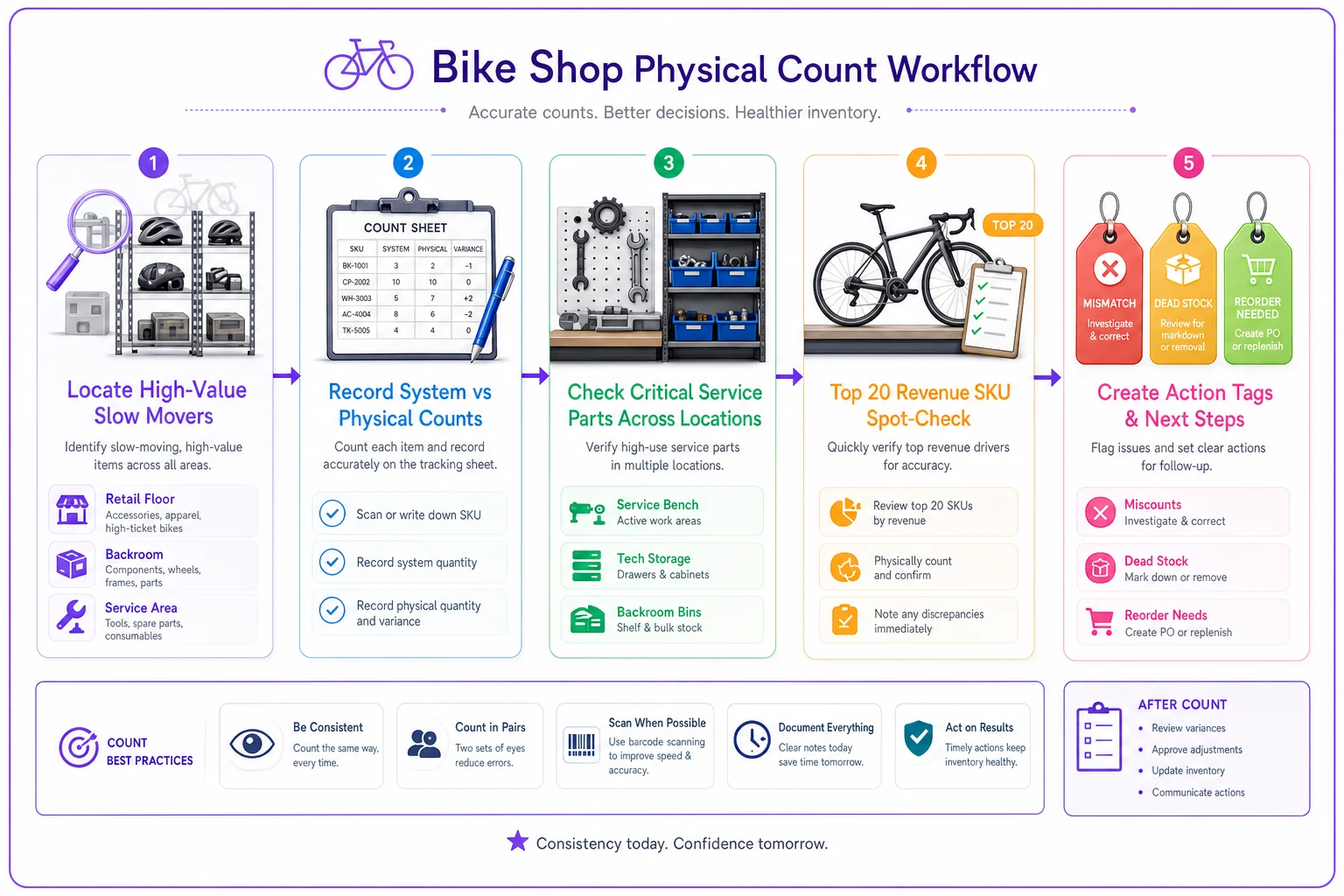
Move to critical service parts next. These usually live in multiple spots — service area, retail floor, overflow storage. The challenge isn't finding them, it's making sure you find all of them. That box of derailleur hangers in the service manager's drawer counts too.
Finish with your top 20 revenue SKUs. By now you've warmed up on the tricky stuff. These high-turn items should match pretty closely, but when they don't, the impact multiplies fast. Being off by 20 units on a $35 tire means $700 in phantom inventory.
Immediate Corrections That Matter
Don't wait until after the audit to act. Fix problems as you find them.
For miscounts: Adjust immediately in your POS. The longer you wait, the more likely someone places an order based on bad data. If you show 10 tubes but only have 2, you need to know before promising them to customers.
For dead stock: Tag it for clearance now. Not next week, not after busy season. Every day that carbon fork sits is another day your money is frozen. Mark it down 30% immediately — 50% if it's been there over a year.
For critical shortages: Place orders before you finish counting. If you're down to one bleed kit for the most common brake system in your area, that's an emergency order, not something to discuss in a meeting next week.
For systematically wrong counts: This signals a process problem. If multiple high-value items show phantom inventory, someone might be stealing. If service parts are consistently off, your mechanics are probably using parts without recording them. These patterns matter more than individual miscounts.
Building Your Reorder Adjustments
The audit data drives immediate purchasing decisions that set up your season. This isn't the full seasonal forecasting method we've covered before, but rather quick adjustments to prevent stockouts on critical items.
Compare your current stock levels against last year's March through May movement:
-
GP5000 tires
Currently 18 units, sold 67 last spring → Order 55 minimum
-
11-speed chains
Currently 8 units, sold 34 last spring → Order 30
-
Brake pads (common)
Currently 12 sets, used 45 last spring → Order 40
Add a 20% buffer for growth and you've got workable numbers. This isn't a precise reorder point calculation, just enough to avoid disasters.
For service parts, focus on variety over depth. Better to have 2 of each critical derailleur hanger than 10 of one type. Your audit probably revealed coverage gaps — fill those first before adding depth to existing stock.
When This Method Falls Apart
Some shops shouldn't use this focused approach. If you're primarily a repair shop with minimal retail, your critical categories look completely different. You might need to audit wear parts and service supplies instead of retail SKUs.
New shops without historical data can't identify their true top performers yet. First-year operations need broader counts to establish baselines. The focused audit works once you actually have patterns to follow.
Shops with consignment inventory need to track that separately. Don't mix consignment bikes or parts into this audit — they require their own process and usually their own software tracking.
Multi-location operations need synchronized counts. Running this audit at one location while the other is blind creates more problems than it solves. Either audit both simultaneously or accept that transfers will throw off your numbers.
The Software Reality
Manual counts on paper work fine for a 2-hour focused audit, but the follow-up actions often fall apart. Adjusting inventory in your POS, generating purchase orders, tracking clearance items — these tasks pile up and get forgotten once the audit ends and things get busy again.
AI-powered operational software handles a lot of this automatically. Instead of manually tracking which items need reordering or which dead stock needs clearance pricing, the system flags these based on your audit results, generates purchase orders, and suggests clearance prices based on item age and seasonality. It also tracks whether those corrections actually happen, which matters more than people realize.
The deeper value shows up in preventing future audit surprises. When inventory counts update in real-time as parts get used in service, when purchase patterns automatically flag slow-moving items before they become dead stock, when reorder points adjust based on actual seasonal patterns — your next audit finds fewer problems to fix. That's the real payoff.
But even without that, a focused 2-hour audit still beats the alternative of counting everything or counting nothing.
Making It Stick
Schedule this audit monthly during slow season, every two weeks as busy season approaches. The process means nothing if it only happens once.
Keep the same focus categories consistent. Don't rebuild the list each time — maintain the same 20 revenue SKUs unless sales data shows a real shift. Track the same slow movers until they sell or get cleared. Monitor the same critical service parts every audit.
Document problems found and actions taken. When you find the same miscounts repeatedly, you've identified a process breakdown. When certain categories consistently run short, you've found a forecasting gap. Those patterns matter more than any individual fix.
Train at least two people on the full process. When only the owner knows how to run the audit, it stops happening the moment things get busy. Your service manager should be able to run this independently, especially the service parts portion.
Most importantly, act on what you find immediately. The shop that discovers problems and fixes them on the spot stays ahead. The shop that writes up a report to review later ends up in the same mess next season.
Your bike shop pre-season inventory audit doesn't need to be perfect or complete. It needs to catch the expensive problems before they hit, fix the counts that matter most, and happen fast enough that you'll actually do it regularly. Two hours of focused counting beats two days of exhaustive inventory that everyone dreads and nobody trusts.
The shops that nail this process enter busy season with clean data, appropriate stock levels, and no nasty surprises. The ones that skip it or try to count everything end up scrambling when that critical part runs out during the first warm weekend of spring.
Ready to revolutionize your bike shop operations?
Join hundreds of bike shops using Bicyclly to save time, increase revenue, and deliver exceptional customer service.