
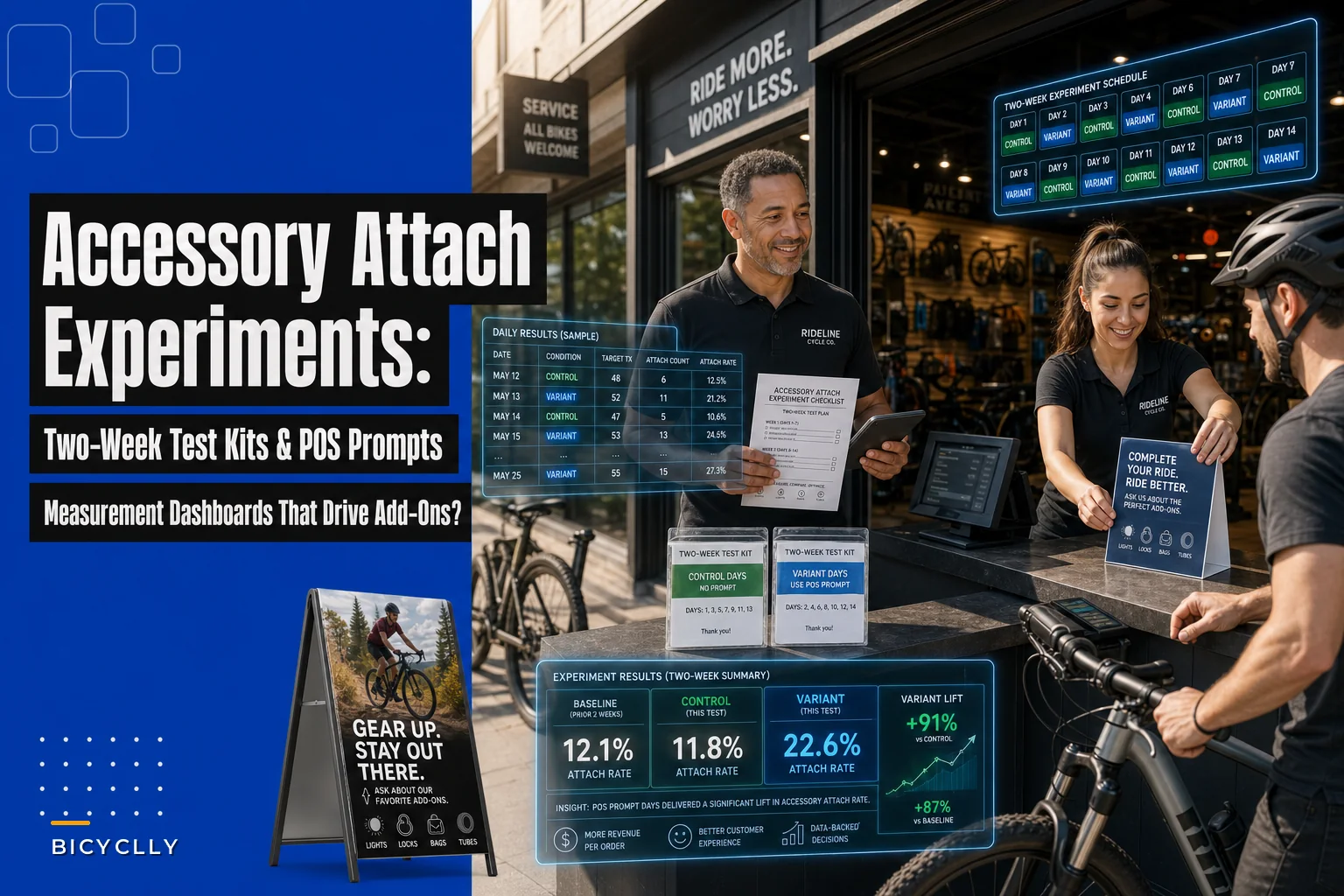

Most attach-rate efforts die the same quiet death. Somebody at a Monday huddle says "we need to sell more lights and bottles," everyone nods, attach rate creeps up for four days, then slides right back to baseline once the fresh guilt wears off. No test structure, no numbers, no way to tell if anything actually worked.
The fix isn't motivation. It's running a proper two-week experiment with a control, a variant, and a dashboard you can actually read. That's what a bike shop accessory attach rate test is supposed to be — not a vibe, a measurement.
Below is a full kit you can steal: what to test, exact POS prompt copy, signage that doesn't get ignored, the dashboard columns that matter, and sample results from a realistic run so you know what "good" looks like before you start.
Why attach rate stalls even in busy shops
Attach rate is rarely a product problem. Your shop already stocks bottles, tubes, sealant, lights, bar tape, and mini-tools. The gap is almost always in the moment of the ask — and that moment is inconsistent from staff member to staff member.
A typical example looks like this: two mechanics, same day. One mentions fresh chain lube on every tune-up handoff and lands it maybe 40% of the time. The other never brings it up because it feels pushy. Shop-wide, the average looks mediocre, and nobody realizes the average is hiding a massive spread between individuals.
-
The prompt depends on whoever's at the counter and whether they're feeling it that day
-
Add-ons get offered at the wrong moment — mid-repair instead of at pickup
-
There's no cue in the physical space to make the item feel relevant
-
Nobody's measuring per-transaction, so there's no feedback loop
You don't fix inconsistency with a speech. You fix it with a scripted, testable prompt that anyone can run the same way — and then you check whether it actually moved the number.
The two-week experiment structure
Two weeks is the sweet spot. Long enough to clear day-of-week noise (Saturdays behave nothing like Tuesdays), short enough that staff stay bought in and you can iterate fast.
Never miss a sale or service appointment again.
Bicyclly helps you manage every sale, repair, and booking with ease and accuracy.
- Unified inventory and sales tracking
- Automated customer notifications
- Service appointment scheduling
No credit card required
The core design is simple: split by day or by register, not by customer. Trying to randomize per-customer at a busy counter is how experiments fall apart. Instead, run the control on some days and the variant on others, or if you have two stations, run control on Register 1 and variant on Register 2.
-
Days 1–3
Baseline capture.
Change nothing. Just record attach rate on your target category. Most shops skip this and regret it — you need a real "before" or your results mean nothing. -
Days 4–14
Live A/B.
Alternate control and variant. Keep everything else identical: same staffing pattern, same product placement, same pricing. -
Day 15
Read the dashboard.
Compare variant days against control days and against baseline.
One rule that saves experiments: change one thing at a time. If you introduce a new POS prompt and new signage and a bundle discount all at once, you'll never know which lever did the work. One variable per two-week cycle.
What to actually test (pick one per cycle)
You've got a handful of high-leverage variables. Test them in sequence, not all at once.
| Variable | Control | Variant | What you're learning |
|---|---|---|---|
| POS prompt copy | No scripted ask | Specific scripted ask at pickup | Does a consistent verbal cue move attach? |
| Timing of ask | Ask during drop-off | Ask at pickup/handoff | When is the customer most receptive? |
| Signage | No counter signage | Targeted "pairs with" card | Does a visual cue prime the ask? |
| Bundle framing | À la carte pricing | "Add for $X" round-number framing | Does price framing reduce friction? |
| Staff attribution | Anonymous ring-up | Attach tracked per staff | Does visibility alone lift performance? |
That last row is sneaky-effective. In a lot of shops, simply showing each person their own attach rate — with no incentive attached — is enough to nudge the number. People compete with themselves once they can see the score.
For a first cycle, start with POS prompt copy. It's the cheapest change and usually the biggest mover.
POS prompt copy that doesn't sound like a used-car pitch
The wording matters more than owners expect. "Do you want to add anything?" gets a reflexive no. The prompts that work are specific, tied to what the customer just bought, and framed around the bike's benefit — not the shop's revenue.
At service pickup (tune-up or repair):
> "I topped off your shifting and cleaned the drivetrain. Your chain's still on the older side though — want me to throw a fresh chain lube in so it stays smooth? It's about [$X]."
At new tube / flat repair:
> "You're all set. Most folks grab a spare tube to keep in the seat bag so a flat doesn't strand you next time — want to add one?"
At bike sale handoff:
> "Two things almost everyone needs day one: a bottle cage and a set of lights if you'll ever ride near dusk. Want me to set those up now so you're covered?"
Notice the pattern. Each one references the specific situation, states the benefit plainly, and includes the price so there's no awkward reveal later. That last part matters — hiding the price until the customer says yes creates distrust and kills repeat asks.
Print these on a laminated card at each register. The goal is that a new hire on day two delivers the same ask as your best salesperson. Consistency is the entire point of the bike shop accessory attach rate test — you're removing the "depends who's working" variable.
Print the prompts on a laminated card at each register so a new hire on day two delivers the same ask as your best salesperson.
Consistency is the entire point of the bike shop accessory attach rate test — you're removing the "depends who's working" variable.
In-store signage that supports the ask
Signage doesn't sell on its own, but it primes the customer so the verbal prompt lands softer. The mistake most shops make is generic signage — "Accessories!" with an arrow. Nobody reads that.
What works is "pairs with" framing placed at the exact decision point:
-
A small card at the tube display
"Riding without a spare? One flat and you're walking. Spare tubes — $[X]."
-
A counter card near the register
"Just got a tune-up? Fresh chain lube keeps your shifting crisp for months. Ask us to add it."
-
A shelf-talker by the lights
"Getting home after dark? Front + rear set, seen from 500 ft."
Keep it minimal. Three targeted signs beat fifteen scattered ones.
If you want to go deeper on placement logic, Merchandising That Fits Your Shop covers planogram rules and product mix for smaller floors — signage and placement work as a pair, not separately.
The measurement dashboard
You don't need special software for this. A spreadsheet works fine for a single cycle. What matters is tracking the right columns and reading them the same way every day.
Minimum columns:
-
Date
-
Control or Variant (which condition ran that day)
-
Target-category transactions (e.g., number of tune-ups, if you're testing chain lube attach)
-
Attach count (how many of those got the add-on)
-
Attach rate (attach count ÷ target transactions)
-
Avg add-on value
-
Staff on shift (so you can spot a person-driven skew)
The one metric people misread: raw add-on dollars. A big Saturday always shows more add-on dollars than a slow Tuesday purely from volume. Attach rate is what you compare — it controls for how busy the day was.
Simple workflow for running the two-week test:
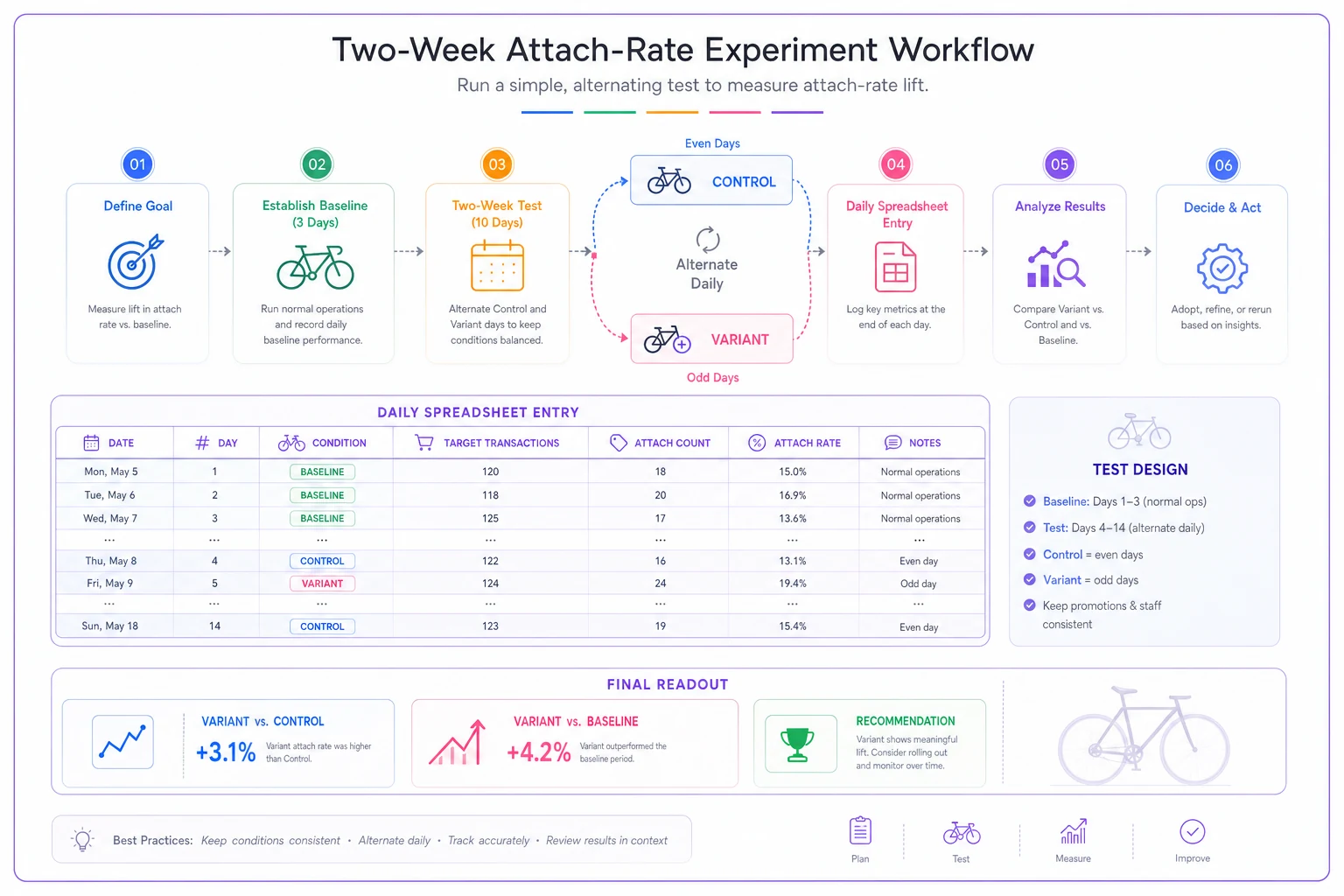
Read it two ways at the end of the cycle:
-
Variant attach rate vs. control attach rate (the clean A/B comparison)
-
Both vs. your Days 1–3 baseline (the sanity check that you actually moved off zero)
If variant beats control and holds across both busy and slow days, you've got a real signal. If it only wins on Saturdays, you probably measured staffing, not your prompt.
A realistic sample run
Here's what a believable two-week chain-lube attach test looks like in a mid-size shop doing decent service volume.
-
Target category tune-ups and repairs, roughly 18–24 service pickups a day
-
Baseline (Days 1–3) chain lube attach around 11% — basically whoever happened to think of it
-
Control days stayed around 12–14%, normal drift
-
Variant days (scripted pickup prompt) climbed to roughly 34–41%
Over the full two weeks, the variant added somewhere around 45–55 extra chain-lube sales the shop wouldn't have made otherwise. At modest margin per unit, that's a few hundred dollars of nearly-pure-margin revenue from a two-week test — and more importantly, a repeatable script that keeps working after the test ends.
The number that surprised the owner wasn't the revenue. It was the spread collapsing. Before the test, one mechanic sat at 40% attach and another at 4%. After the scripted prompt, everyone landed between 30% and 42%. The floor came way up, and that's where most of the gain actually lived.
Extending the same method to pickup and click-and-collect
Service pickup is the highest-intent moment you have — the customer is already paying, already trusting your work. That same logic applies to click-and-collect, where people are physically in the shop grabbing an online order and completely open to a relevant add-on.
The prompt just shifts to fit the moment: "Since you're picking up that helmet — most people grab a mirror or a bell for city riding, want me to add one?"
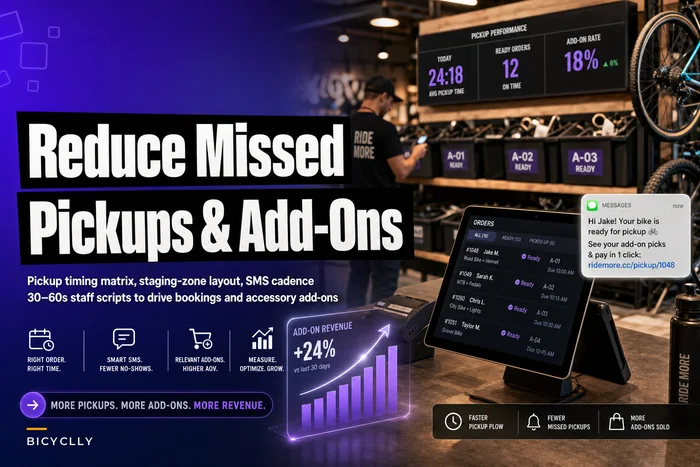
If your pickup flow is loose or add-ons rarely come up at collection, the workflow breakdown in Reduce Missed Pickups and Increase Add-Ons covers structuring that handoff so the ask has a natural home. Run the same two-week A/B on that flow — control days with no scripted ask, variant days with one — and read the same dashboard columns.
When this makes sense — and when it doesn't
Run this when:
-
Your attach rate feels random or person-dependent
-
You have enough daily volume (15+ relevant transactions) to see a signal in two weeks
-
You're willing to hold everything else constant for the run
Skip or delay this when:
-
Volume is too low to see a signal — a shop doing three tune-ups a day needs a longer window, maybe a full month, because daily numbers just bounce around meaninglessly
-
You're mid-chaos on staffing or deep in a seasonal rush and can't keep conditions stable
-
You haven't settled on a single variable — running four changes at once guarantees an unreadable result
Who should not bother: shops that won't keep the winning prompt. If the plan is to run a test, get a nice number, and let it decay back to "whoever remembers," you've wasted two weeks. The experiment only pays off if the winning script becomes the standard handoff and gets built into how new hires are trained.
Making the winner stick
Finding the lift is the easy part. Keeping it is where shops fumble. A scripted prompt that wins in week two decays by month two if nobody reinforces it.
Two things hold it in place. First, bake the winning prompt into your pickup checklist so it's a step, not a suggestion — same as torque specs or a final safety check. Second, keep a lightweight running attach-rate number visible to the team, even just posted weekly. You don't need incentives; visibility does most of the work. When people can see the score, the score tends to hold.
Then start the next cycle. Test signage. Test timing. Test bundle framing. Each two-week run stacks a small, proven lift on top of the last one, and none of them depend on a pep talk — just a control, a variant, and a dashboard you actually read.
Ready to revolutionize your bike shop operations?
Join hundreds of bike shops using Bicyclly to save time, increase revenue, and deliver exceptional customer service.