

Your click and collect orders are bleeding money through a broken pickup process that most shops don't even notice.
Every bike shop starts the same way with online orders – they get excited about the sale, prep the items, send a generic "ready for pickup" email, and wait. Customer shows up whenever, grabs their stuff from whoever's free, and leaves. Transaction complete, right?
Not quite. That pickup moment is the highest-value customer touchpoint you have, and most shops throw it away.
The average bike shop processes somewhere between 40 and 80 click and collect pickups per month. Each one is a customer who already trusts you enough to buy online but chose to come in instead of having it shipped. They're literally standing in your shop with their wallet already open. Yet most shops treat these pickups like an Amazon locker – get them in, get them out, minimize the interaction.
Why Traditional Pickup Workflows Fail
The standard pickup process breaks down in multiple places, and each failure compounds into lost revenue.
First problem: timing chaos. Customers get a "ready for pickup" notification and show up anywhere from 20 minutes to two weeks later. You have no idea when they're coming, so you can't prepare. Items sit on a shelf taking up space, staff scramble when customers arrive, and there's no real opportunity for any meaningful interaction.
Second problem: whoever's available handles it. Could be your newest hire who doesn't know a derailleur hanger from a dropout. Could be your best mechanic getting pulled away from a $400 overhaul to hand someone a $30 bottle cage. Either way, you're wasting expertise or missing opportunities.
Third problem: the handoff takes about 30 seconds. Customer says their name, you grab the bag, they leave. No engagement, no education, no upsell, no relationship. You might as well be a vending machine.
The real issue? These customers are already in buying mode. They already decided to spend money with you and chose to come to your physical location. Instead of building on that momentum, most shops treat them like they're picking up dry cleaning.
Building a Pickup Timing Matrix That Actually Works
Controlling when customers arrive is where the click and collect workflow actually starts. Not suggesting times – actually structuring pickup windows.
Never miss a sale or service appointment again.
Bicyclly helps you manage every sale, repair, and booking with ease and accuracy.
- Unified inventory and sales tracking
- Automated customer notifications
- Service appointment scheduling
No credit card required
Weekday Structure:
-
Morning window
10am–12pm
-
Lunch window
12pm–2pm
-
Afternoon window
3pm–5pm
-
Evening window
5pm–7pm
Weekend Structure:
-
Early window
9am–11am
-
Mid-morning
11am–1pm
-
Afternoon
2pm–4pm
-
Late afternoon
4pm–6pm
The critical part – you don't offer all windows for all orders. Small accessories and consumables get any window. Higher-value items like components or apparel get specific windows when your experienced staff are scheduled. Complete bikes or wheel builds only get windows when your service manager or a senior tech is available.
The psychology matters here. When customers book a specific time, they show up on time. They're mentally prepared to engage. They don't feel rushed because they picked the slot that works for them.
One shop implemented this and saw no-show pickups drop from around 15% to under 3%. Their attachment rate on pickups went from basically nothing to 24% within six weeks.
Staging Zone Layout That Drives Conversions
Your pickup staging area is either working for you or against you. Most shops have a shelf near the register with bags waiting. That's storage, not a staging zone.
A proper staging zone has three distinct areas:
Ready Zone (customer-facing): Visible from the entrance, clearly labeled, organized by pickup time window. Items here are packaged but not sealed – easy to verify and leaves room for add-on conversations.
Prep Zone (behind counter): Where items move about two hours before their pickup window. This is where you attach service recommendations, add promotional materials, and pull any accessories that complement the purchase.
Hold Zone (back room): For items past their window or long-term holds. Keeps your active zones clean.
Keep items accessible until the moment of handoff.
The physical layout drives behavior. When your staging zone is organized by time window instead of customer name, staff naturally start thinking about each window as a cluster of opportunities. They prep pickups together, spot common add-ons, and can suggest complementary items without it feeling forced.
One shop reorganized their staging zone and staff behavior shifted immediately – no formal training required. Instead of grab-and-go, they started pulling items into prep early, adding service cards, and thinking about what else that customer might need.
The layout change was small. The behavioral shift wasn't.
SMS Cadence That Gets Results
Email for click and collect is basically dead. Open rates sit around 20%, and most of those opens happen days later. SMS is different – 98% open rate, usually within a few minutes.
But the cadence matters more than the channel. Here's the sequence that works:
| Message | Trigger | Purpose |
|---|---|---|
| Order Confirmed | Immediately | Book pickup window |
| Ready Notification | Moved to prep zone | Confirm window, offer rescheduling |
| Day Before | 6pm evening prior | Reminder + soft add-on offer |
| Day Of | 2 hours before window | Final reminder + staff intro |
| Missed Pickup | 1 hour after window ends | Reschedule prompt |
| Final Notice | 7 days after ready | Create urgency, offer incentive |
Order Confirmed: "Your order #4521 is confirmed. Book your pickup time: [link]. Reply STOP to opt out."
Ready Notification: "Your items are ready! Your pickup window is tomorrow 3–5pm. Need to reschedule? [link]"
Day Before: "Reminder: Pickup tomorrow 3–5pm. While you're here, we have 20% off chain lube with any pickup. See you tomorrow!"
Day Of: "See you soon! Your items are ready at the front counter. Our tech Sarah can help with any questions about your purchase."
Missed Pickup: "Looks like you missed your 3–5pm pickup. No worries! Book a new time: [link] or reply with when works better."
Final Notice: "Your items are still here! Pick up this week and get 10% off your next service. Book now: [link]"
Each message has a specific purpose beyond just reminding. You're booking appointments, introducing staff, suggesting add-ons, creating urgency. You're not just notifying – you're orchestrating the whole interaction before the customer even walks in the door.
A shop with around 60 monthly pickups implemented this sequence. Same-day pickup rate went from 30% to 75%. Average transaction value on pickups went up $18. That's over $1,000 in additional monthly revenue just from better SMS timing.
The 30–60 Second Conversion Script
Staff need a framework, not something they memorize word for word. But that framework needs to hit specific beats in under a minute.
-
1. Opening (5 seconds) "Hey! You're picking up [item name], right? I'm [name], I actually prepped this for you." – Immediately makes it personal. They prepped it, they care about it.
-
2. Verification with value (10 seconds) "So you got the [specific product] – solid choice. These have been really popular since [relevant context]. Let me grab that for you." – While walking to get the item, you've already validated their purchase.
-
3. Inspection moment (15 seconds) "Here we go. Want to check it out real quick? [Open package] Perfect. Oh, quick question – what bike is this going on?" – Opening the package together creates a moment of shared attention. The question about their bike opens the conversation naturally.
-
4. Relevance bridge (15 seconds) "Nice! [Bike type/model]. Actually, since you're running [related component], you might want to grab [specific complementary item]. We've got them right here, and they're [specific benefit]." – Not a random upsell – directly connected to what they bought and the bike they ride.
-
5. Service hook (10 seconds) "When's the last time you had that serviced? We could take a quick look while you're here, takes 2 minutes." – Even if they say no, you've planted the seed.
-
6. Close with future value (5 seconds) "Cool, you're all set. If you need help installing that, we do free installation on purchases over $50 – just book online." – A reason to come back that costs you nothing.
The magic isn't in the exact words. It's the structure – personal connection, validation, natural question, relevant suggestion, service opportunity, future value. Staff can adapt it to their personality while still hitting the essential beats.
Measuring Attachment Rate Success
Most shops don't track attachment rates on pickups because they don't think of pickups as sales opportunities. Start tracking these:
-
Primary Attachment Rate Additional items purchased during pickup / total pickups
-
Service Booking Rate Services booked during or within 48 hours of pickup / total pickups
-
Return Rate Customers who make another purchase within 30 days / total pickups
-
Window Adherence Customers who arrive within their scheduled window / total scheduled pickups
Set realistic targets. A shop doing nothing might sit at 2–3%. With basic training, you'll hit 10–15%. With the full system running, 20–25% is achievable. Some shops push past 30%.
What matters more than the raw number – track attachment rate by staff member and by time window. One shop found their Saturday morning window had a 40% attachment rate while weekday lunch was under 10%. They adjusted staffing accordingly and the gap closed within a month.
Track weekly, not monthly. Pickup behavior shifts with seasons, weather, and local events. Weekly tracking lets you adjust fast. Share the numbers with staff so they see their own impact.
Common Pickup Failure Points
Even with a solid system, the same failure points keep showing up.
The "too busy" excuse kills more attachment opportunities than anything else. Staff see a line and default to quick transactions. That's backwards – busy times are when customers are most patient. They see you're popular, they're already committed to being there, and they're more likely to browse while waiting.
The "wrong product knowledge" problem happens when scheduling doesn't match expertise to products. Your clothing expert handles a derailleur pickup. Your mechanic handles a nutrition pickup. Neither can add real value. Build pickup windows around staff expertise, not just whoever's free.
"Sealed bag syndrome" is another one. When everything's taped up with a receipt stapled on top, there's no natural opening to engage. Keep items accessible until the moment of handoff.
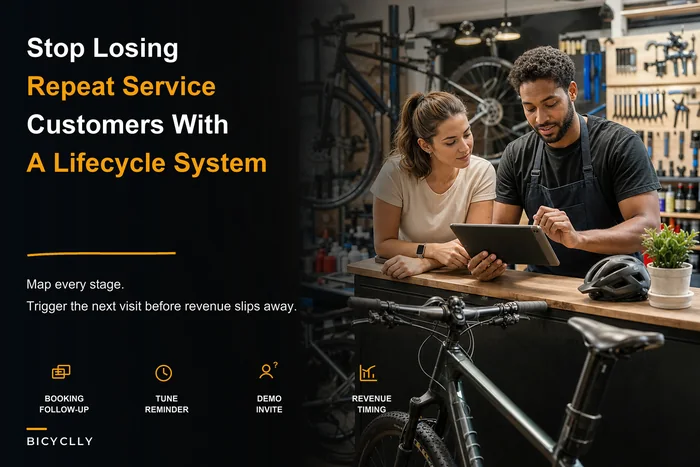
The "one and done" mentality treats each pickup as an isolated transaction instead of part of a customer relationship. Stop Losing Repeat Service Customers: A Lifecycle System for Bike Shops covers this in more detail, but the pickup moment should connect to their broader customer journey – not exist in isolation.
Experiments Worth Running
Start with the "Friday Afternoon Test." For one month, assign your best converter to all Friday 3–6pm pickups. Track attachment rate versus your baseline. This proves the impact of putting the right person at the right time without changing anything else.
Run the "Bundle Card Experiment." For every pickup over $50, include a physical card with a specific bundle offer tied to their purchase. Track how many customers mention or redeem it within 30 days. Tests whether physical prompts outperform verbal suggestions.
Try "Service Window Scheduling." When customers book their pickup, offer them the option to also book a free 5-minute bike check at the same time. Track how many book it and how many convert to paid service. This tests whether pre-scheduled service opportunities outperform spontaneous offers during the handoff.
The "Category Captain Approach" assigns one staff member to own all pickups in a specific category for a week. They become the go-to for that category, learn common questions, and develop add-on strategies that actually make sense for what the customer bought. Rotate weekly and track results by category and person.
None of these require a big process overhaul. They're small, measurable changes that tell you what actually works in your shop.
Technology Integration Without Complexity
A solid pickup workflow doesn't require complex systems, but the right automation makes everything run smoother. An AI-powered operational platform that connects your online orders, SMS communications, and pickup scheduling cuts out the manual coordination that quietly kills most pickup programs.
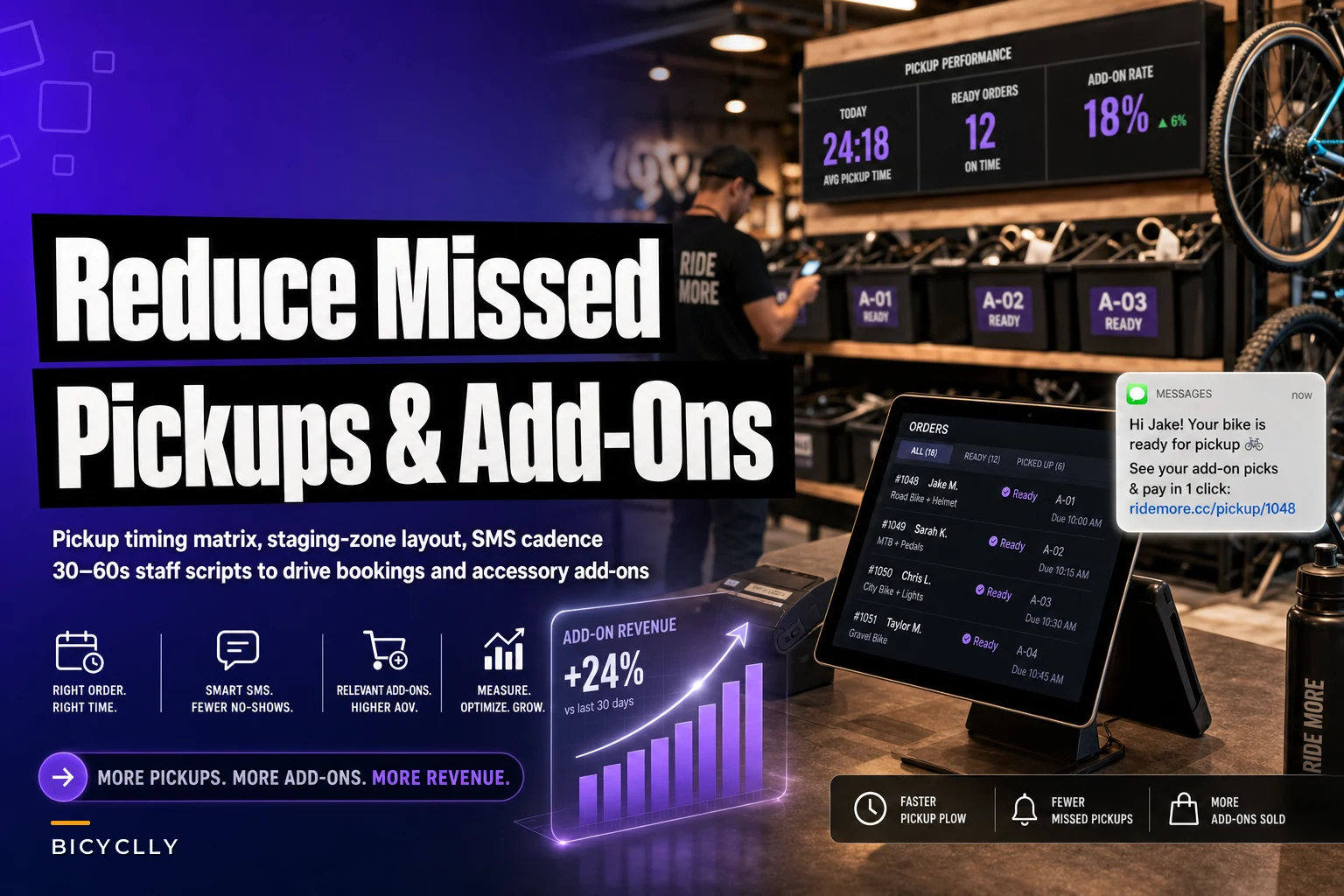
When a customer places an order, they immediately get pickup window options based on your staffing and inventory status. Your prep zone populates automatically based on upcoming windows. Staff get notifications about high-value pickups or customers with service history. The SMS cadence runs itself. Attachment rates track without anyone building spreadsheets.
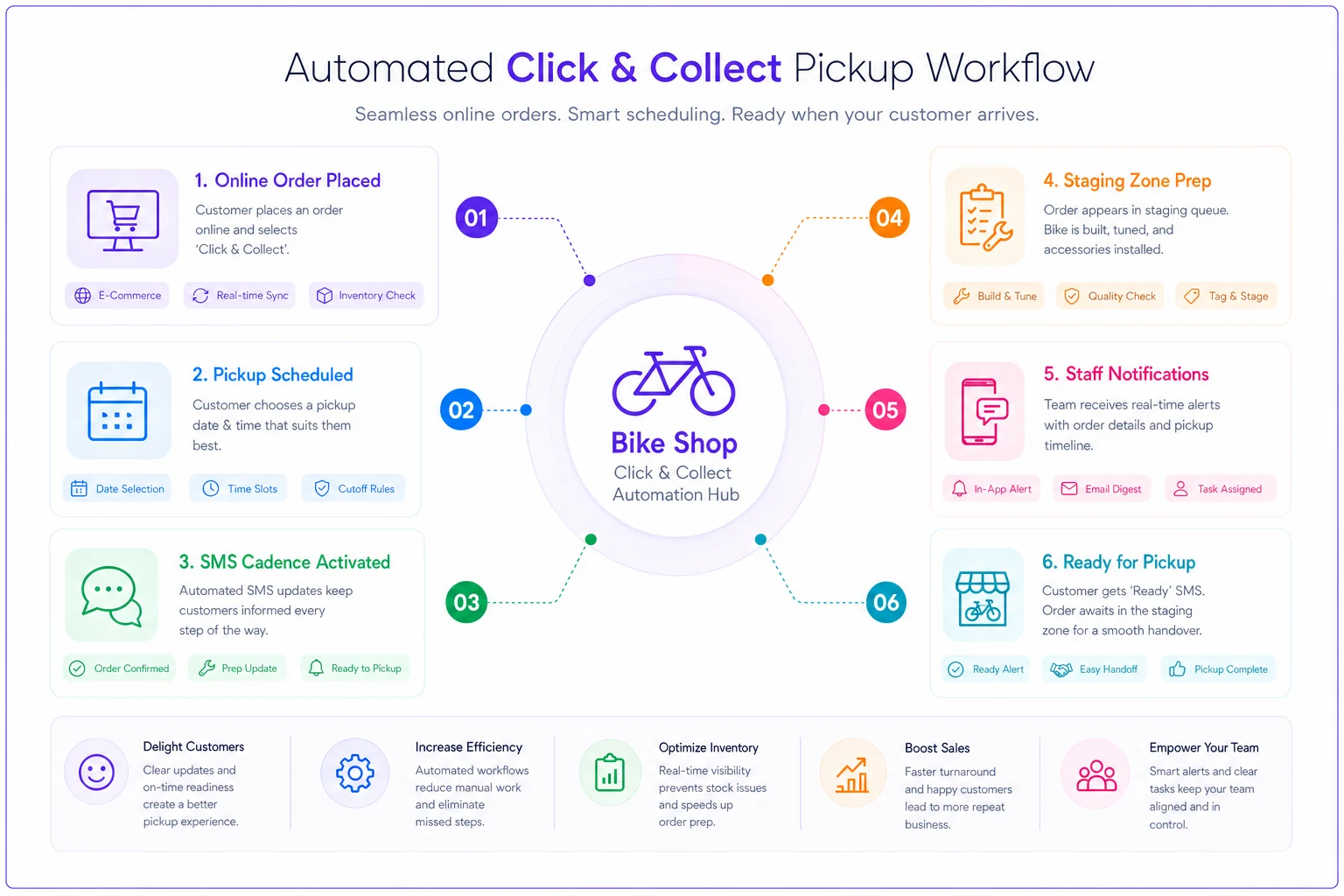
This visual outlines the automated flow from online checkout to pickup completion.
The operational efficiency alone is worth it – no more copying order details or manually sending texts. But the bigger value is consistency. Every pickup follows the process. Every customer gets the full communication sequence. No opportunities slip through because someone was busy and forgot.
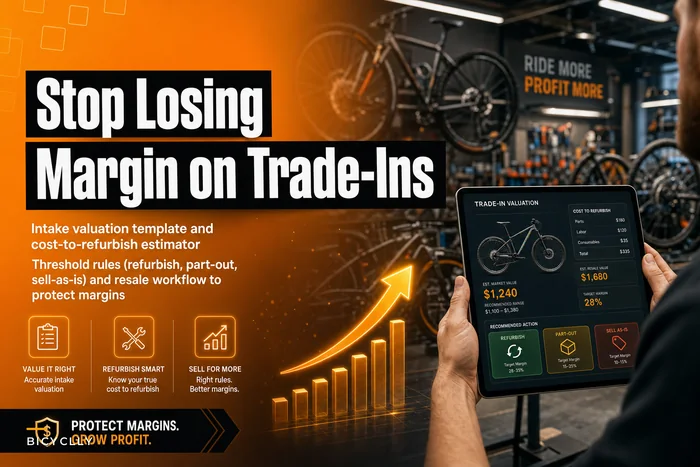
It also makes experimenting easy. Adjust windows, test different SMS messages, try new attachment offers – without rebuilding your whole process each time. Stop Losing Margin on Trade-Ins: Valuation, Reconditioning, and Resale Rules for Shops shows how systematic testing improves margins across the business, and the same principle applies directly to your pickup workflow.
Making Pickup Workflows Sustainable
The biggest risk with any new process is abandonment after the initial excitement fades. Pickup workflows stick when they're easier than the old way, not harder.
Start with just pickup windows. Don't try to implement SMS, staging zones, scripts, and tracking all at once. Get comfortable with scheduled pickups for a couple of weeks. Then add the SMS sequence. Then organize your staging zone. Then train on the script framework. Each layer should feel like a natural next step, not a complete overhaul.
Keep the metrics visible but not overwhelming. A simple view showing this week's attachment rate versus last week is enough to maintain focus without creating pressure. Celebrate wins specifically – when someone has a standout pickup day, make sure the team knows what they did and why it worked.
Build in a short weekly pickup review. Five minutes, tops. What worked? What felt awkward? What opportunities got missed? Keep it specific to pickups so it doesn't turn into a general staff meeting that goes nowhere.
Most importantly, connect pickup performance to something staff actually care about. Whether that's a bonus pool, schedule preferences, or just real recognition, there needs to be a genuine reason to care beyond "it's good for the shop."
The Real Impact on Your Business
A properly executed click and collect pickup workflow turns what most shops see as an operational burden into a genuine profit center.
The math is straightforward. Sixty pickups per month with a 25% attachment rate at $20 average addition is $300 in monthly revenue. Add a 15% service booking rate with $80 average tickets – that's another $720. Over $1,000 in monthly revenue from the same customers already coming in.
The compound effects matter more, though. Customers who have a good pickup experience order online more often. They trust you to have things ready. They book services. They stop being transaction numbers and start being real customers.
Your competition treats online orders like something to process as fast as possible. Treat them as relationship-building opportunities instead. That difference compounds into a real competitive advantage over time, and it's not the kind of thing that's easy to copy once you've built it.
The shops that get this right don't see click and collect as separate from their core business. They see it as part of how modern bike shops operate. Every pickup is a chance to demonstrate expertise, build a relationship, and grow revenue. The question isn't whether to optimize your pickup workflow – it's whether you'll do it before your competition figures it out.
Ready to revolutionize your bike shop operations?
Join hundreds of bike shops using Bicyclly to save time, increase revenue, and deliver exceptional customer service.