

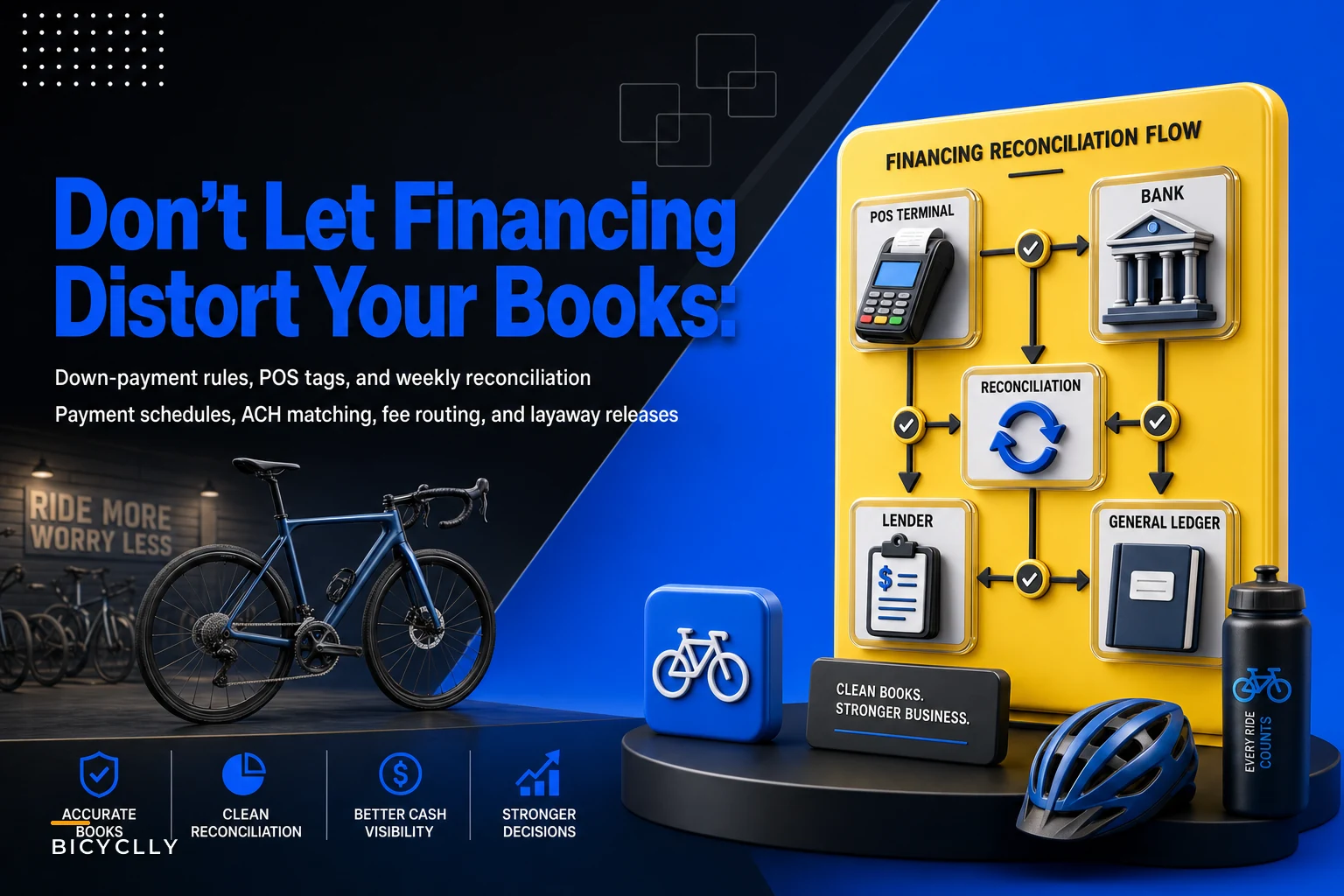

A $6,800 e-cargo bike goes out the door on a 12-month third-party financing plan. Customer signs, lender approves, bike leaves. Your POS rings up $6,800 in sales that day. Feels great — except the shop didn't actually receive $6,800. The lender settles around $6,460 after their merchant fee, and it won't hit your bank account for another three business days. Meanwhile whoever booked the sale tagged it as a normal retail transaction, so your daily revenue looks fat, your bank deposit doesn't match, and your bookkeeper spends 40 minutes hunting for the gap.
Multiply that across a busy spring where you're moving 15–25 financed bikes a month plus a handful of in-house layaways, and your books stop telling you the truth. Revenue looks lumpy, deposits never tie out cleanly, and you can't tell whether a slow month is actually slow or just an artifact of when lenders funded.
This is the specific problem a real bike shop financing policy has to solve — not "should we offer financing," but how do we record it so the numbers stay honest. Below is the operational version: sample payment schedules, down-payment and refund rules, a POS tagging scheme, and a weekly reconciliation routine that keeps financed sales from distorting your revenue recognition.
Why financed sales quietly break your books
The core issue is a timing and identity mismatch. A cash sale is simple: money in, revenue recorded, done. A financed sale splits into pieces that arrive on different days, from different sources, minus fees you never rang up.
-
Day 0 Customer signs, lender approves, bike leaves. POS records full ticket price.
-
Day 0–1 Lender processes the loan and takes their merchant discount — often 3%–8% depending on the promo term, sometimes higher on 0%-interest offers where the shop eats the subsidy.
-
Day 2–4 Net proceeds land in your bank account as a lump ACH, frequently batched with other loans, so one deposit covers three different sales.
Every one of those steps is a place where your recorded revenue and your actual cash drift apart. In-house layaway is worse, because now you're the lender — money trickles in over weeks, but the bike is sitting in limbo.
What tends to happen across a lot of retail-plus-service shops is that owners don't discover the drift until tax time or a bank reconciliation that's suddenly off by a few thousand dollars with no obvious cause. By then the trail is cold.
The revenue recognition trap nobody warns you about
The mistake almost every shop makes: recording the full sale price as revenue on the day the bike leaves, regardless of how the money actually arrives.
Never miss a sale or service appointment again.
Bicyclly helps you manage every sale, repair, and booking with ease and accuracy.
- Unified inventory and sales tracking
- Automated customer notifications
- Service appointment scheduling
No credit card required
For third-party financing, that overstates revenue by the merchant fee. On a shop doing $180k a year in financed bikes at a blended 5% lender fee, that's roughly $9k of "revenue" that was never yours — it's a cost of offering financing and belongs recorded as a fee expense, not silently baked into inflated top-line numbers.
For in-house layaway and deposits, it's the opposite problem. A customer puts $500 down on a $3,200 build. If you ring that $500 as revenue immediately, you've recognized income for a bike you haven't delivered and might have to refund. That $500 is a liability — money you owe back until the bike is handed over — not a sale.
Get these two backwards and you end up with the worst of both worlds: overstated revenue on financed deals, and prematurely recognized revenue on deposits that later get refunded and clawed back out of a future month. Your monthly P&L becomes fiction.
Sample payment schedules that keep the money honest
The fix starts with defining, in writing, exactly how each financing type flows and when revenue is actually earned. Here's a clean reference set for the three most common structures in bike retail.
| Financing type | Down payment | When you get paid | When revenue is *earned* | What to watch |
|---|---|---|---|---|
| Third-party (0% promo) | $0 typically | Net of shop-subsidy fee, 2–4 days after approval | At delivery (bike leaves) | Shop often eats 6%–10% to fund 0% — record as fee expense |
| Third-party (standard APR) | $0–$500 | Net of 3%–5% merchant fee, 2–4 days | At delivery | Fee smaller, but still net it out |
| In-house layaway | 20%–30% required | Installments over 4–12 weeks | Only at final pickup/delivery | Deposit is a liability until then |
A practical in-house layaway schedule that actually holds up:
-
Down payment
25% minimum
at booking (non-refundable admin portion built in — more on that below). -
Equal installments over the agreed term, with a hard rule that the bike is not assembled or reserved as "sold" until the deposit clears.
-
Final balance due at pickup, and only then does the full amount convert from deposit-liability to earned revenue.
-
Auto-cancel trigger if payments lapse past 30 days — releases the bike back to sellable stock and applies your refund rule.
The point isn't the exact percentages. It's that every schedule has a defined "revenue earned" moment, and it's almost never the day the customer signs.
That defined moment is what makes reconciliation tractable. Without it, every deferred sale becomes a judgment call, and judgment calls made in a hurry at month-end tend to go wrong.
Down-payment and refund rules that protect margin
Refunds are where fuzzy policy costs real money. A customer puts $800 down on a custom gravel build, then backs out three weeks later after you've already ordered a non-returnable frame. If your policy says "full refund on request," you eat the restocking loss and whatever labor was already spent.
-
Non-refundable deposit portion carve out a fixed slice of every down payment — commonly $75–$150 or 10% of the deposit, whichever is greater — that covers admin and holding costs and is never refunded.
-
Special-order carve-out any non-returnable ordered parts (custom frames, made-to-order wheels) get deducted from the refund at your actual cost. State this in the signed agreement, not verbally.
-
Time-based sliding scale full refund minus admin portion within 7 days; partial after that once work or ordering has started.
-
Third-party financed refunds must route back through the lender, not as shop cash — otherwise you've handed the customer money while still owing the lender the loan balance. This one burns shops constantly.
That last point is the sleeper. On a financed cancellation, the lender needs a formal credit or reversal. If you refund the customer directly from the till, you're now out the money twice until the lender sorts it out — if they ever do.
The POS tagging scheme that makes reconciliation possible
None of the above matters if your POS records every sale as an undifferentiated "sale." You need tags that separate money by how it arrives and when it's earned. This is the single highest-leverage change most shops can make.
-
Payment channel
CASH/CARD·FINANCE-3P-[lender]·LAYAWAY·DEPOSIT -
Revenue status
EARNED(delivered) vsDEFERRED(deposit/layaway not yet picked up) -
Expected settlement date for financed sales, the date you expect the lender ACH
-
Fee bucket the merchant or subsidy fee amount, tagged separately so it lands in a fees expense line, not netted invisibly
A financed sale then reads: ticket $6,800 · FINANCE-3P-Synchrony · EARNED · settle ~Day 3 · fee $340. Now when the $6,460 ACH lands batched with two other loans, you can match it to the exact tickets it covers.
Map 'fee bucket' tags directly to a fees expense account so lender fees are visible on the P&L.
If you want the deeper structure behind mapping POS categories to accounting lines cleanly, the approach in Turn Tickets into Clean Books: A One‑Page Inventory Accounting and KPI Dashboard for Retail+Service Bike Shops pairs directly with this tagging scheme — the tags are only useful if they route to the right ledger accounts.
The weekly reconciliation routine
Monthly reconciliation is too late for financed sales — by then you've got weeks of unmatched deposits and forgotten fees. A 30–40 minute weekly pass catches drift while the trail is still warm.
-
Pull all financed sales tagged that week and list expected net (ticket minus fee) and expected settlement date.
-
Match lender ACH deposits against those expected nets. Batched deposits get split back to individual tickets using your settlement-date tag.
-
Flag anything unsettled past 5 business days — that's a stuck approval, a lender hold, or a data-entry error. Chase it now, not at month-end.
-
Reconcile deposit/layaway balances confirm every
DEFERREDticket still matches an actual customer balance and hasn't been accidentally recognized as revenue. -
Verify fee bucket totals landed in the fees expense line, so top-line revenue reflects only true earned sales.
-
Release or cancel lapsed layaways per your 30-day rule and adjust the deposit liability accordingly.
The discipline here is treating financed and deferred money as provisional until proven settled. Most shops do the opposite — they assume everything's fine and only look when the bank statement fights them.
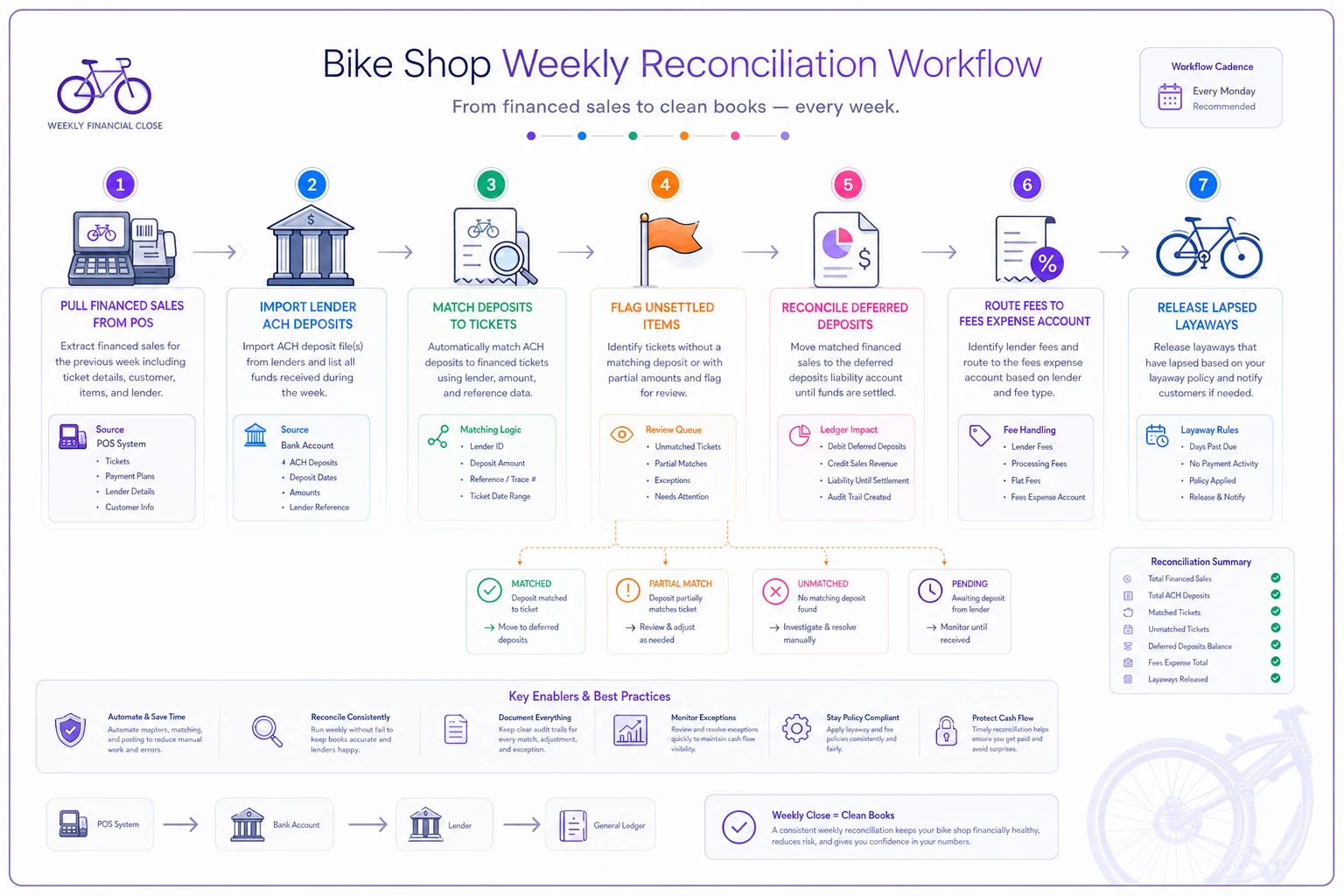
A quick visual you can tape near the register helps clerks follow the same matching steps every week.
A quick reconciliation checklist to keep at the counter
-
[ ] Every high-ticket sale tagged by channel and revenue status
-
[ ] Financed sales list net proceeds, not just ticket price
-
[ ] Lender fees routed to a fees expense line, not buried in COGS
-
[ ] Batched ACHs split back to individual tickets weekly
-
[ ] Deposits held as liability until delivery
-
[ ] Lapsed layaways released and deposits reconciled monthly at minimum
-
[ ] Financed refunds routed through the lender, never the till
Keeping this checklist visible at the point of sale — not buried in a policy doc — is what actually makes it stick week to week.
A real scenario
A single-location shop doing around $1.2M in annual revenue offered financing on e-bikes but recorded everything at ticket price on the day of sale. Their bank rec was off by $2k–$4k most months and their bookkeeper billed extra hours every quarter chasing it. Worse, their spring revenue looked artificially strong, so they over-ordered summer stock based on numbers that included roughly $11k of lender fees they'd never actually collected.
After splitting sales into tagged channels and running a weekly settlement match, the monthly bank discrepancy dropped to near-zero — usually under a couple hundred dollars, and always explainable. The bigger win was quieter: their real financed-sales margin became visible. Turned out the 0%-promo bikes they'd been pushing hardest carried an 8% shop subsidy, making them the least profitable e-bikes on the floor. They shifted financing promotions toward standard-APR terms and recovered a few thousand dollars of margin per quarter.
That margin-by-channel thinking pairs well with the repricing logic in Don't Let Listings Erode Margin: A Channel Decision Matrix and Repricing Rules for New & Used Bikes. Once you can see what each financing channel actually nets you, the decisions about which promos to run get a lot cleaner.
When this level of rigor makes sense — and when it doesn't
When it's worth it: if financed and layaway sales are more than a handful a month, or if e-bikes and high-ticket builds are a growing share of revenue. Once financing crosses roughly 10%–15% of your sales volume, the drift becomes material enough to distort ordering and tax numbers.
When it's overkill: a shop that finances two or three bikes a year through a single lender can get by with a simple manual note and a monthly check — the weekly routine would cost more in time than it saves.
Who should absolutely not skip it: any shop running in-house layaway or deposits. The moment you're holding customer money for undelivered goods, you're carrying a liability, and treating it as revenue is the fastest way to a nasty year-end surprise.
The threshold matters because this stuff takes real time to maintain. Don't build a reconciliation system that's heavier than your actual financing volume requires.
Bringing it together
Financing isn't the problem — recording it like a cash sale is. The two failures that wreck bike shop books are overstating financed revenue by ignoring lender fees, and prematurely recognizing deposits you haven't earned. Both are fixable with clear payment schedules, firm down-payment and refund rules, POS tags that separate money by channel and revenue status, and a short weekly reconciliation pass that treats unsettled money as provisional.
Do that, and your monthly P&L starts reflecting what you actually earned instead of what rang up. When ordering season hits and you're deciding how deep to go on inventory, you'll be working from real numbers — not from a revenue figure inflated by fees you paid to somebody else.
Do that, and your monthly P&L starts reflecting what you actually earned instead of what rang up. When ordering season hits and you're deciding how deep to go on inventory, you'll be working from real numbers — not from a revenue figure inflated by fees you paid to somebody else.
Ready to revolutionize your bike shop operations?
Join hundreds of bike shops using Bicyclly to save time, increase revenue, and deliver exceptional customer service.