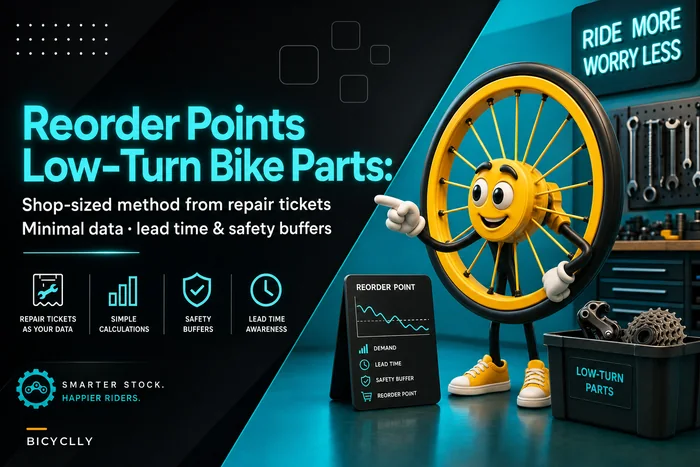



Your mechanic needs a derailleur hanger for a bike sitting in the stand. The main supplier shows three weeks lead time. Your backup vendor has it for 40% more. The customer's expecting their bike tomorrow.
This scenario plays out in bike shops constantly. Not because shops don't understand inventory management, but because the traditional approach to supplier relationships breaks down when you're dealing with hundreds of SKUs, seasonal demand swings, and suppliers who treat small shops as their lowest priority.
Why Traditional Supplier Management Fails Small Shops
Most supplier scorecard systems come from manufacturing or large retail. They track metrics that sound important—on-time delivery percentage, fill rates, quality scores—but miss what actually matters for a 1,200 square foot shop trying to keep four repair bays productive.
The operational issue is granular: brake pads from Supplier A arrive in 3–4 days while chain rings take 8–12 days; some suppliers triple lead times in spring; some won't expedite for small orders. Small shops must adapt per-SKU and per-supplier, not rely on coarse OTIF numbers.
You can't negotiate container loads or priority shipping on $300 orders. Changes like a supplier raising minimum order amounts materially alter reorder math for small shops. Repair-ticket patterns add complexity: different services create different demand patterns and stockout risks.
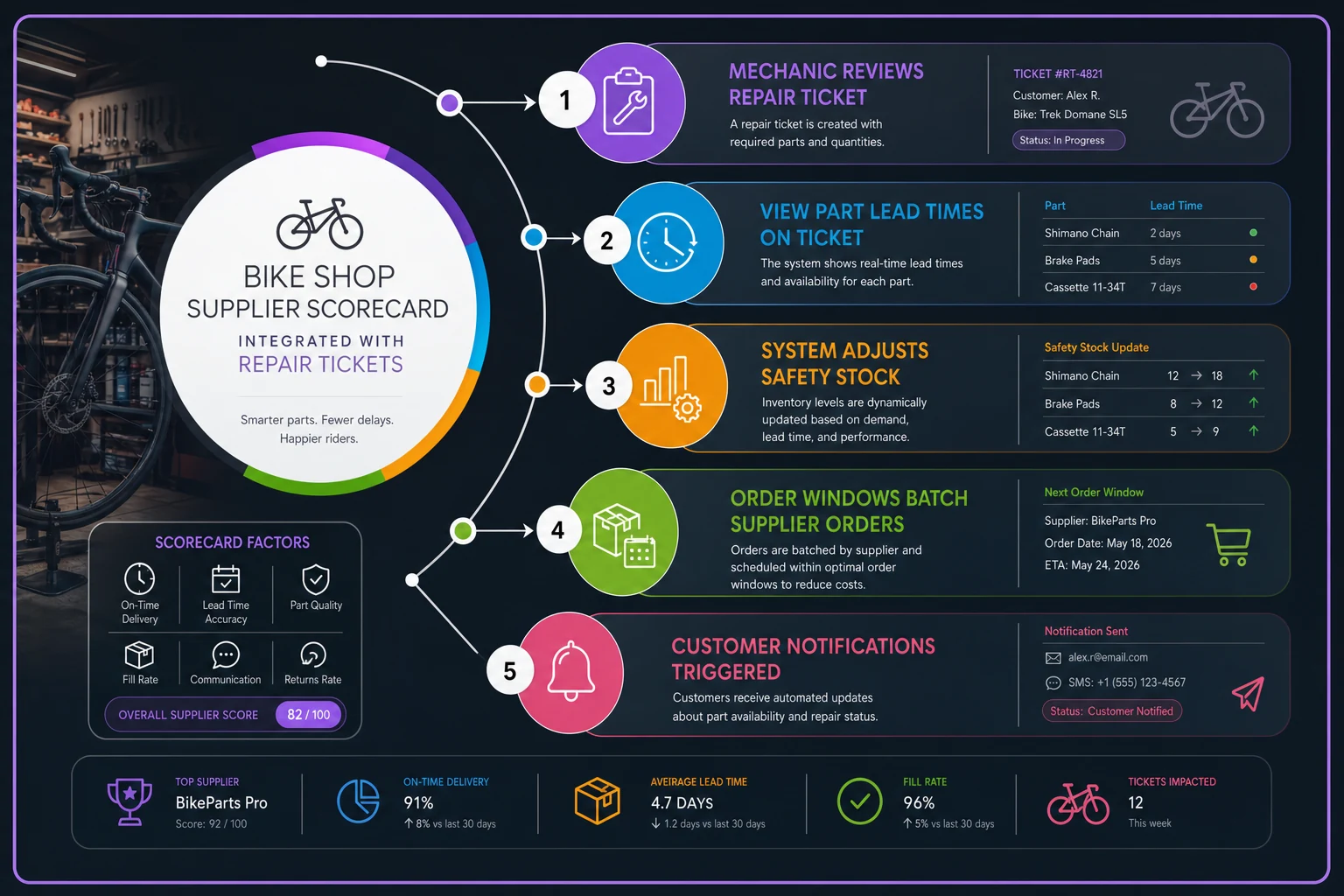
At-a-glance playbook
-
Ticket created — mechanic/service writer adds parts, sets dateneededby, and sets initial promised date.
-
Reserve on-hand — system allocates a soft hold and shows pick-up ETA to mechanic.
-
Demand event — system computes priority, ROP check, and calls Smart Reorder Engine.
-
Reorder decision — parts planner or SRE auto-create PO or suggest split/alternate/expedite.
-
PO routing & split — purchasing sends PO(s) and accepts partial receipts.
-
In-transit tracking — system monitors ETA deviations and escalates if thresholds are exceeded.
-
Receipt & putaway — parts team updates inventory, notifies mechanic, and records lead time for scorecard.
-
Ticket close or reschedule — service writer finalizes scheduling and logs delay/costs into KPIs.
Each state must include a next communication (mechanic, customer, or manager) and an audit-log entry. Label numeric thresholds as sample defaults and calibrate from a 30–90 day baseline.
Never miss a sale or service appointment again.
Bicyclly helps you manage every sale, repair, and booking with ease and accuracy.
- Unified inventory and sales tracking
- Automated customer notifications
- Service appointment scheduling
No credit card required
Ticket‑Driven Reorder: algorithm, inputs/outputs, and pseudocode
Purpose: convert a ticket demand into a deterministic reorder decision that minimizes SLA misses while controlling expedite cost and inventory carrying.
Required demand event fields (minimum):
-
ticket_id
-
part_id (master SKU)
-
qty
-
dateneededby (ticket promise date)
-
ticket_priority (low/normal/high/urgent)
-
ticket_value ($)
-
fulfillment_location (shop or branch)
-
customerpostaldistance (optional)
Decision inputs (system state):
-
onhandqty
-
reserved_qty
-
intransitqty (open POs with ETA)
-
safety_stock (per supplier×category)
-
open_pos (active POs for same SKU)
-
supplieroptions with recent leadtime_stats
-
expeditecostestimate (supplier×shipping method)
-
MOQ, minshipqty, pricethresholdfor_split
-
consolidationwindowhours
Outputs:
-
action (allocate / createpo / createsplitpo / suggestlocal_buy / backorder)
-
chosensupplierid
-
suggestedqtyper_po (one or more PO lines)
-
estimatedetafor_ticket
-
reasoncode (e.g., intransitsufficient, alternatewithinsla, expeditecost_justified)
Pseudocode (evaluate rules top-to-bottom):
If (onhandqty - reservedqty) ≥ qty and ETAfrominventory ≤ dateneeded_by → allocate to ticket and return action=allocate.
Else calculate netavailablebydate = (onhandqty - reservedqty) + sum(intransitqty with ETA ≤ dateneededby).
If netavailablebydate ≥ qty → allocate on receipt; return action=allocatein_transit with ETA.
Else — need new supply. Evaluate prioritized suppliers:
-
If supplier.currentpromisedlead ≤ daysbetween(today, dateneededby) and supplier.availableqty ≥ qty → create_po(supplier, qty).
-
Else if supplier.availableqty ≥ minshipqty and supplierlead ≤ acceptablepartialetaforticket → createsplitpo(supplier, qtypartial=minship_qty) and continue.
-
Else record supplier as candidate for expedite calculation.
Compute cheapestexpedite = min(unitprice + expeditecost) across candidates. Compute costofdelay = ticketvalue * delaydayspenaltyfactor. If cheapestexpedite.expeditecost ≤ costofdelay × expeditethreshold_ratio → create expedited PO.
If no acceptable supplier found → createregularpotoprimary(qty), set ticket state = backordered, and return action=backorder with estimated ETA.
Testing guidance: validate idempotency for duplicate demand events, simulate demand spikes, verify rollback for incorrect PO creates. Include unit tests per branch and integration tests for supplier ETA webhooks.
PO‑Splitting rules, parameterized pseudocode, and worked examples
Goal: meet ticket SLAs by splitting demand into multiple PO lines across suppliers and shipping speeds while minimizing expedite cost and respecting supplier constraints.
Parameters (exposed to users — sample defaults):
-
minshipqty (default
1)
-
MOQhandling (policy
autofilltoMOQ | suggest_alternate)
-
consolidationwindowhours (default
6)
-
pricethresholdfor_split (default 25%)
-
urgentprioritycutoff_hours (default
48)
-
partialreceiptbilling (policy
invoiceonshipment | holdinvoiceuntil_complete)
PO-split pseudocode (per demand D):
-
remaining = D.qty; iterate suppliers in priority order.
-
shipable = max(minshipqty, min(supplier.available_qty, remaining)).
-
If D.ticketpriority == urgent and supplier.lead > hourstodays(urgentprioritycutoffhours) → skip unless supplier can expedite.
-
If supplier.unitprice ≤ cheapestprice*(1+pricethresholdforsplit) OR D.ticketpriority == urgent → createpoline(supplier, shipable).
-
Adjust remaining; if remaining > 0 apply MOQ handling or createbackorderline.
Worked example 1 — urgent ticket (summary):
-
Demand
qty 10, dateneededby = today+24h, minshipqty = 4.
-
Supplier A
avail 2, lead 4 days, $10/unit; Supplier B: avail 6, lead 1 day, $13/unit.
-
Result
PO to B qty 6 (meets urgent need) and PO to A qty 4 for remainder.
Worked example 2 — MOQ case (summary):
-
Demand
qty 3, supplier MOQ = 10; policy = suggest_alternate.
-
Result
suggest alternate supplier with acceptable minshipqty or require manager approval showing landed cost to buy 10.
Billing implications: if partialreceiptbilling == invoiceonshipment, finance receives separate invoices; if holduntilcomplete, AP consolidates invoices. Mark tickets as "partially ready" and notify mechanics which items are available.
Supplier Scorecard appendix (fields, formulas, weights, scoring, thresholds)
Scorecard is by supplier×category. Capture raw values, normalize to 0–100, and combine with weights to produce a 0–100 supplier-category score.
| Field | Description | How to measure |
|---|---|---|
| avgleadtime_days | Mean days from POdate to actualreceipt_date | average(order.receipt_date - order.date) |
| leadtimestddev | Std dev of lead time | sample stddev(order lead times) |
| pctontimeinfull (OTIF) | % of POs delivered on or before promised date and complete | count(ontimeandfull)/count(totalorders) |
| ticketsdelayedweighted | Weighted count of tickets delayed attributable to this supplier | sum(delaydays * ticketvalue) / sum(ticket_value) |
| substitute_rate | % of cases supplier offered acceptable substitute within SLA | count(acceptable_sub)/count(requests) |
| fillrateline | Fraction of line items supplied complete per PO | sum(receivedqty)/sum(expectedqty) |
| responsiveness_score | Measured response time to inquiries/portals | normalize median response_time |
| effectivelandedcost | Unit price + avg shipping per unit + penalty adjustments | compute per PO |
Normalization and weights (example defaults — configure per shop):
-
Normalize each metric to 0–100 (lower lead time → higher score).
-
Example weights
OTIF 30%, avgleadtime (inverse) 20%, leadtimestddev (inverse) 15%, ticketsdelayedweighted (inverse) 15%, substituterate 10%, responsivenessscore 10%.
Scoring formula (example):
score = round(sum(weighti * normalizedmetric_i), 0) // produces 0–100
| Bucket | Score range | Typical action |
|---|---|---|
| Green | ≥ 85 | Primary routing for category |
| Yellow | 70–84 | Secondary routing; monitor and limit critical orders |
| Red | < 70 | Demote; require manager approval for urgent sourcing |
Suggested actions mapped to events:
-
If score drops >15 points in rolling 30 days → alert supplier manager and increase safety stock for their SKUs by +50% (example).
-
If 3 consecutive late POs → auto-demote supplier for affected categories and run supplier review.
Link operational templates and how‑tos: see supplier scorecards that prevent repair delays.
Safety‑stock formulas & worked examples
When to choose: use ticket‑based heuristic for intermittent SKU demand and ticket history. Use statistical (μ, σ, z‑score) when demand is frequent and roughly stationary. See APICS/ASCM guidance: https://www.ascm.org/.
Ticket‑based heuristic (90‑day window) — worked example:
Step 1 — compute daily usage from tickets: ticketsin90 = 45 → μd = 45/90 = 0.5 units/day.
Step 2 — use supplier max lead time (worst observed) as leadtimemax. Example: leadtimemax = 9 days.
Base safety stock = μd × leadtimemax = 0.5 × 9 = 4.5 → round to 5 units.
Step 3 — apply reliability multiplier by supplier bucket (example):
-
Green supplier
multiplier = 1.0
-
Yellow supplier
multiplier = 1.25
-
Red supplier
multiplier = 1.5
If supplier is Red → safetystock = 5 × 1.5 = 7.5 → round to 8 units. ROP = average demand during lead time + safetystock. Example avgduringLT = μd × avgleadtime = 0.5 × 6 = 3 → ROP = 3 + 8 = 11 units.
Statistical method (μ, σ, z‑score) — formulas and example:
Common safety stock formula: safetystock = z sqrt((avgleadtime σdaily^2) + (dailyusage^2 * σlead_time^2)).
-
μ_daily = average daily demand
-
σ_daily = std dev of daily demand
-
avgleadtime = mean lead time (days)
-
σleadtime = std dev of lead time (days)
-
z = z-score for desired service level (e.g., 1.28 for 90%, 1.65 for 95%)
Numeric example (sample): μdaily=0.5, σdaily=0.8, avgleadtime=6, σleadtime=2, z=1.65 (95%). Compute safetystock ≈ 1.65 × sqrt((6×0.8^2) + (0.5^2×2^2)) ≈ 4 units → ROP = avgduring_LT (3) + 4 = 7 units.
Reference: APICS/ASCM and safety-stock formulas (https://www.apics.org/ and https://en.wikipedia.org/wiki/Safety_stock).
Data model & API spec for two‑way integrations
Design principles: keep demand events idempotent, include stable external IDs (ticketid, partid), and support retry/ack semantics for webhooks. Test in staging before enabling auto-PO creation.
| Endpoint | Method | Purpose | Minimal payload (fields) |
|---|---|---|---|
| /api/v1/demand_event | POST | Send a new ticket demand | {"ticketid","partid","qty","dateneededby","ticketpriority","ticketvalue","location"} |
| /api/v1/inventory_snapshot | GET | Get current onhand/reserved/intransit for a SKU | GET params: partid, fulfillmentlocation |
| /api/v1/po_create | POST | Create PO from SRE | {"poid","supplierid","lines":[{"partid","qty","unitprice","shipspeed"}],"createdby"} |
| /api/v1/eta_update | POST (webhook) | Supplier updates ETA for PO | {"poid","lineid","new_eta","status"} |
| /api/v1/receipt_confirm | POST | Confirm receipt and qty | {"poid","lineid","receivedqty","receiptdate","lot_serials":null} |
Sample JSON payload (demand_event) — minimal fields:
{"ticketid":"T123","partid":"SKU-001","qty":2,"dateneededby":"2026-09-15","ticketpriority":"urgent","ticketvalue":420.00,"location":"MainShop"}
Webhook reliability recommendations:
-
Provide idempotency keys on POST create endpoints to avoid duplicate PO creation.
-
Retry policy
exponential backoff up to N attempts (example: 5 attempts over 24 hours).
-
Return explicit HTTP 2xx for accepted events and 4xx for bad payloads.
-
Maintain audit logs of inbound events and outbound actions.
-
Include a source field on events for traceability (e.g., "ticketing_app
v2").
For integration patterns with field service systems, consult the event-first playbook: event‑first automation playbook.
UI/UX requirements and mockup suggestions
Core UI elements (concise, implementable):
-
Ticket overlay
per-line best ETA badge with supplier and risk flag color.
-
Best-source panel
top suppliers with ETA, landed cost, and quick actions.
-
Reorder calculator modal
shows ROP, suggested PO qty, and tradeoff visuals.
-
Exceptions queue
single pane of at-risk tickets and POs with actions.
-
Manager approval modal
cost delta, reason, and one-click approve for thresholds.
-
Audit & timeline
full event timeline per ticket.
Role permissions & approval thresholds (example defaults):
-
Parts Clerk
create PO up to $200 expedite cost without auto-approval off.
-
Parts Planner
approve PO splits and expedites up to $1,000 when tagged urgent.
-
Manager
overrides > $1,000 and non-standard MOQ fills.
Three mockup suggestions (prioritize implementation):
-
Ticket view
right-column per-line supplier ETA and "Make order" shortcut.
-
PO builder
supplier comparison grid with checkboxes to split lines.
-
Exceptions dashboard
sortable rows by days-to-SLA, ticket_value, and supplier risk with bulk actions.
Include quick tooltips explaining example thresholds and a "calibrate to shop baseline" link in the UI.
Implementation 30/60/90 checklist (ops + engineering)
-
Days 0–14
ingest 30–90 days of ticket history, receipts, and POs into staging.
-
Clean master SKU list and map vendor SKUs to master part_id.
-
Compute baseline metrics for top SKUs
avgleadtime, maxleadtime, stddev, ticket_usage.
-
Days 15–30
implement Ticket Reservation Engine (soft/hard hold).
-
Build Smart Reorder Engine skeleton with rule order
allocate → in_transit → alternate → expedite → regular PO.
-
Implement Supplier Scorecard ingestion and daily update job.
-
Days 31–60
build PO-split engine (minshipqty, consolidation_window).
-
Create API endpoints and webhook handlers; integrate with ticketing in staging.
-
Implement exceptions queue UI and manager approval modal.
-
Days 61–90
run unit tests for each decision branch and integration tests simulating ETA misses.
-
Create rollback/mitigation playbook (cancel POs, credit handling).
-
Train front-counter staff and measure success vs baseline targets (reduce parts-related ticket delay rate, reduce expedite spend per ticket).
Test cases to include: idempotent demand_event submission, duplicate PO prevention, partial receipt handling, and ETA deviation auto-escalation. Define rollback steps and notification flows.
ROI / cost‑tradeoff appendix
Model inputs to capture in a spreadsheet:
-
avglaborcostperhour ($)
-
avgmechanictimelostperdelayedticket (hours)
-
avgticketvalue ($)
-
expeditefeeper_order ($)
-
holdingcostpctperyear (%)
-
unitcost, unitvolume, daysofcover
| Scenario | labor $/hr | time_lost/day | expedite fee | cost_of_delay/day (labor) |
|---|---|---|---|---|
| A (small impact) | 30 | 0.5 | 40 | 15 |
| B (high value) | 35 | 2.0 | 120 | 70 |
-
If expeditefee < (costofdelayperticket × dayssaved) → expedite justified.
-
Compute carrying cost
additionalsafetystockunits × unitcost × holdingcostpct/365 and compare to reduced expedite/lost revenue.
-
Example
scenario B — costofdelay/day $70, expedite saves 2 days → prevented cost $140; expedite_fee $120 → expedite justified.
-
Example
safety_stock cost for 2 units at $25/unit and 20% annual holding cost ≈ $0.03/day — small vs expedite cost.
Label numbers as examples and calibrate to your shop. Start spreadsheet templates with columns from the Implementation section and build carrying-cost vs expedite scenarios.
Templates & copy‑paste examples
Supplier×category scorecard CSV header (copy/paste):
Supplier,Category,avgleadtimedays,leadtimestddev,pctotif,ticketsdelayedweighted,substituterate,fillrateline,responsivenessscore,effectivelandedcost
Ticket‑driven reorder input sample row (CSV header + sample):
ticketid,partid,qty,dateneededby,ticketpriority,ticketvalue,location
T123,SKU-001,2,2026-09-15,urgent,420.00,MainShop
PO‑split decision matrix columns (CSV header):
partid,demandqty,primarysupplier,primaryavail,primarylead,secondarysupplier,secondaryavail,secondarylead,minshipqty,pricethresholdfor_split
RFP-style lead time tracker header:
daterequested,part,supplier,price,availability,promiseddate,actualdeliverydate,selected_supplier,notes
These inline CSV headers are sample templates — copy into Google Sheets or Excel and populate with your shop data.
Edge cases & operations policy
-
Returns / RMA
tie RMA to original PO line; do not free reserved inventory until RMA processed.
-
Serialized items
require serial/lot on receipt and prevent substitution without manager approval.
-
Consignment stock
treat as on-hand for reservation but track ownership and reconcile monthly.
-
Emergency local buys
define max markup threshold and require customer consent above threshold.
-
Partial receipts
mark lines as partially ready and notify customer with revised ETA.
-
Warranty and RMAs
route claims to supplier, track credit timelines, and adjust supplier scorecard.
When to escalate — automation spec
Example escalation thresholds (sample defaults — calibrate):
-
ETA deviation
if ETA misses by >25% of promised lead time OR >3 calendar days → create supplier escalation task.
-
Consecutive late deliveries
3 consecutive late deliveries → demote supplier and add +50% safety_stock for affected SKUs.
-
ETA silence
no ETA update within 48 hrs before SLA → auto-trigger local-purchase suggestion and notify service writer.
Automation actions:
-
Auto-flag supplier scorecard and record event.
-
Suggest alternate suppliers and create expedited PO drafts for manager approval.
-
Send templated customer notifications when ticket SLA is at risk.
Reporting & KPIs to watch
| KPI | Definition (how to compute) |
|---|---|
| Parts SLA (days) | average(time from ticketcreation to partin_hand) for tickets that required ordered parts |
| Ticket delay rate | count(tickets delayed by parts)/count(tickets) over period |
| Fill rate per ticket | fraction of ticket lines fulfilled from on-hand or in-transit in time for promised date |
| Expedite spend per period | sum(expedite_fees) |
| Supplier OTIF | count(ontimeandfull)/count(totalorders) |
Expose time-to-part, expedite spend, and delayed-ticket weighted cost queries for calibration and ROI computation.
Where this content links into other playbooks
-
Reorder points for ticket-based method
-
PO-split rules & substitution
avoid service delays from suppliers: PO-split rules & substitution.
-
Automation/webhook patterns
-
Seasonal adjustments and forecasting
-
Freight and consolidation guidance
-
Ops mapping from intake to staging
-
Master SKU rules and data governance
Structured-data snippets (examples)
HowTo schema (minimal example):
{"@context":"https://schema.org","@type":"HowTo","name":"Parts-driven reorder playbook","step":["Create ticket and reserve parts","Run Smart Reorder Engine","Create PO or split PO","Track ETA and receipt","Update ticket and scorecard"]}
SoftwareApplication schema (minimal example):
{"@context":"https://schema.org","@type":"SoftwareApplication","name":"Parts Ops Engine","feature":["ticketreservation","smartreorder","posplitengine","supplierscorecard","exceptionsqueue"]}
Note: validate JSON‑LD with your SEO/schema tool and do not publish until engineering confirms payload fields.
Pro tip
Test every automation rule in staging with synthetic ticket volumes and supplier ETA scenarios; include a one-click rollback that cancels POs created in the last X minutes and reopens demand events for manual review.
Quick tactical start
Fast start recommendation: pick three suppliers and five high-volume SKUs, run the 30‑day ticket-driven safety stock heuristic, and add a simple PO-split rule: urgent orders may be split to secondary if secondary lead ≤ urgentprioritycutoff_hours and price delta ≤ 30%. Monitor for 60 days and tune thresholds.
Acknowledgements, references, and guardrails
-
Inventory and safety stock principles
APICS/ASCM (https://www.ascm.org/).
-
SCOR model basics and safety-stock references
https://en.wikipedia.org/wiki/Safety_stock.
-
All numeric thresholds and examples are sample defaults; calibrate from your shop's 30–90 day baseline.
-
When drafting contract/chargeback language, prepend "sample language – have counsel/procurement review".
-
Pseudocode and API payload samples must be reviewed by engineering and tested in staging with rollback steps.
If you want CSV headers or a prefilled scorecard template, tell us which columns to prefill and we will prepare a staging template (templates contain no customer data).
If you'd like, we can extract the CSV headers and the scorecard weight table into a sheet prefilled with your baseline values for staging use. Tell us which columns to prefill and we'll prepare the template.
Ready to revolutionize your bike shop operations?
Join hundreds of bike shops using Bicyclly to save time, increase revenue, and deliver exceptional customer service.