


Most shops treat a flash sale as a retail event. Discount some overstocked bikes, blast an email Friday morning, watch the register ring. What they forget is that a good promo doesn't just move product — it drags foot traffic, phone calls, and walk-in repair requests into the shop at the exact moment your bench is already booked solid. The sale looks great on paper and quietly wrecks your service turnaround for the next week and a half.
This is a runbook, not a pep talk. Seven steps, ordered the way a weekend actually unfolds, built specifically around the thing that gets sacrificed first: your service SLAs. If you promise 3-day turnaround and a weekend promo pushes that to 9 days, you didn't run a sale. You ran a customer-loss campaign with a discount attached.
Why flash sales break service, not sales
The retail side of a bike shop flash sale is easy — mark stuff down, sell it, done. The failure almost always shows up on the service side, and it happens for a predictable reason: promos generate demand you didn't staff for, and that demand lands in bays you already committed elsewhere.
Here's the mechanism. A weekend discount pulls in a rider who's been meaning to buy a new bike. Great. But that same email also reminds a few hundred people on your list that you exist. A chunk of them show up not for the sale bike, but because their shifting's been off for a month and hey, they were already coming in. Now your service writer is fielding 40% more intake than a normal Saturday, your mechanics are getting pulled off the bench to assemble sale bikes for out-the-door pickup, and the tickets already promised for Monday slide to Wednesday.
The customer who bought nothing but dropped off a tune during your sale weekend? They have no idea there was a promo. They just know you quoted three days and delivered nine. That's the SLA breach that costs you the repeat customer.
A typical example looks like this: a shop moves 14 discounted bikes over a weekend, feels great about the numbers, then spends the following two weeks explaining delays to service customers and eating three or four "we'll comp the labor" recoveries. Net margin on the promo evaporates into apology credits.
Step 1 — Build a staffing plan that protects the bench
Before you set a single price, split your labor into two protected pools: sale-support labor and committed-service labor. These do not overlap. The biggest mistake shops make is treating the whole team as a flexible pool that "we'll just move around as needed." You won't move them around — you'll drown, and the bench loses.
Never miss a sale or service appointment again.
Bicyclly helps you manage every sale, repair, and booking with ease and accuracy.
- Unified inventory and sales tracking
- Automated customer notifications
- Service appointment scheduling
No credit card required
Decide up front how many mechanic-hours you're willing to pull off scheduled repairs. For most small shops the honest answer is close to zero on already-booked tickets. If you've promised Monday delivery on twelve tune-ups, those hours are spoken for. Sale-bike assembly and prep needs its own dedicated person or block.
A workable split for a three-person bench on a promo Saturday:
| Role | Normal Saturday | Promo Saturday | What changes |
|---|---|---|---|
| Service writer / intake | 1 | 1 + floater | Add a floater for phones + intake overflow |
| Committed-repair mechanic | 2 | 2 (untouched) | These hours stay locked to promised tickets |
| Sale-bike prep / assembly | shared | 1 dedicated | Carved out, not borrowed from repair |
| Floor sales | 1 | 2 | Second body handles browsers so writer isn't split |
The dedicated sale-prep person is the whole ballgame. If assembly and out-the-door prep on discounted bikes gets done by the same hands that owe you Monday's tune-ups, your SLA is already dead — you just don't know it yet on Friday.
If you can't add a floater, that's a signal to cap the promo size, not cannibalize the bench.
More on capping in Step 3.
Step 2 — Set up POS promos that don't create checkout chaos
The register is where a smooth sale turns into a 20-minute line, and long lines pull staff off the floor and the bench to help. Every minute your team spends untangling a discount that didn't ring correctly is a minute stolen from intake or repair.
Configure the promo in your POS before the weekend, and test it on a live transaction Thursday. Things that reliably go wrong:
-
Discount applies to the bike but not the attached accessories customers expected bundled
-
Promo stacks with an existing member discount and blows your margin floor
-
Sale price rings but the item still shows full price on the receipt, triggering "wait, that's not right" conversations at the counter
-
Staff manually keying discounts because the automated rule wasn't set up, which introduces error and slows everyone down
Set hard rules in the system: promo can't stack, promo has a floor price it won't drop below, and promo auto-expires Sunday at close so Monday walk-ins don't argue for the weekend price. This is also where a workflow platform earns its keep — if your POS and promo rules live in one system, you set the discount logic once and it enforces itself at every register instead of relying on each staffer to remember the rules on a busy floor.
One underrated move: pre-print or pre-tag the sale bikes with the final out-the-door price including any bundled cage or lock, so the register interaction is a scan, not a negotiation. Speed at checkout directly protects the bench, because a jammed counter is what pulls your mechanic up front to "just help for a sec."
Step 3 — Place stock holds before you advertise a single price
This is the step shops skip and regret. If you advertise "20% off all 2023 gravel bikes" and you've got six in stock, you need to decide right now how many are actually for sale, how many are held for existing customer commitments, and what happens when you sell out two hours in.
Put explicit holds on:
-
Bikes already spoken for by a deposit or a pending build
-
Any unit tied to a trade-in or financing deal in progress
-
Display/demo units you don't actually want to move at the discount
Then set your sellable count and treat it as a hard cap. When it's gone, it's gone — and the promo message should have already told people "while supplies last, limited quantities." Overselling a flash sale means either disappointing walk-ins or, worse, honoring the price on a bike you have to special-order that ships in three weeks and generates a whole new follow-up headache.
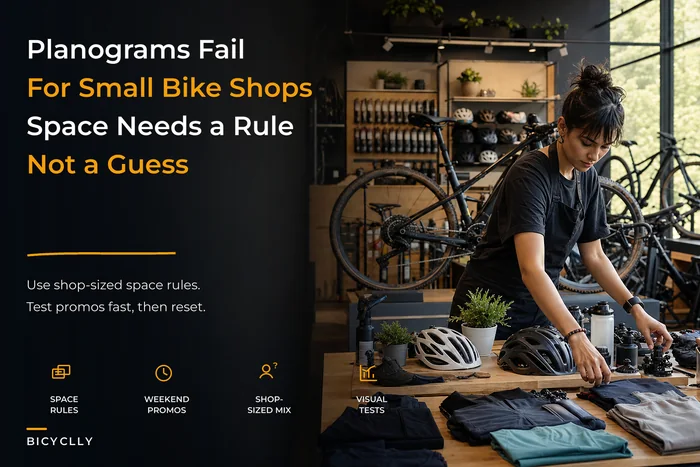
The counting logic here overlaps with broader inventory discipline. If your reorder points and dead-stock flags aren't clean going in, a flash sale exposes it fast. A pre-sale count that catches miscounts before you advertise is worth the hour — the same principle behind fitting your promo to what the floor can actually support, which ties directly into how you structure your product mix and one-week promotion tests.
When capping the promo makes sense: if you can't add staffing for Step 1, cap tighter. A promo you can fully service beats a bigger promo that torpedoes turnaround.
Step 4 — Schedule pickups so the counter doesn't clog
Sold bikes need to leave the shop, and how you schedule those handoffs determines whether your counter stays functional. If fourteen people all show up Saturday afternoon expecting to ride out immediately, and half those bikes still need final assembly and a safety check, you've created a bottleneck that spills onto every other customer in the building.
Two rules fix most of this:
-
Stagger pickup windows. Give buyers a pickup slot — "your bike's ready between 2 and 4 Sunday" — instead of everyone converging at once. This smooths the load on both the prep person and the counter.
-
Never hand off an unfinished bike. A rushed pre-delivery inspection on a discounted bike is exactly how you turn a sale into a warranty visit. The discount doesn't lower the safety bar.
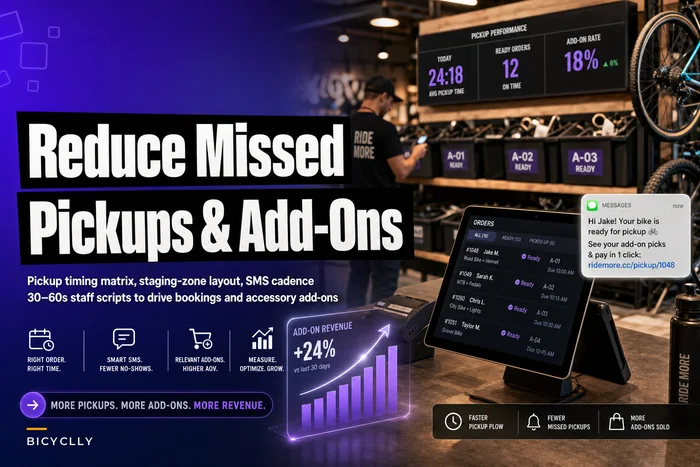
Scheduled pickup windows also open a natural add-on moment — the same mechanics that make click-and-collect work for repairs apply here. If you already run a structured pickup workflow that reduces missed handoffs and drives add-ons, extend it to sale bikes. A staged pickup slot is a better upsell environment than a chaotic Saturday counter, because the customer isn't standing in a line and your staffer isn't rushing.
This illustrates a pickup scheduling workflow you can use to stagger slots and ensure inspections happen before handoff.
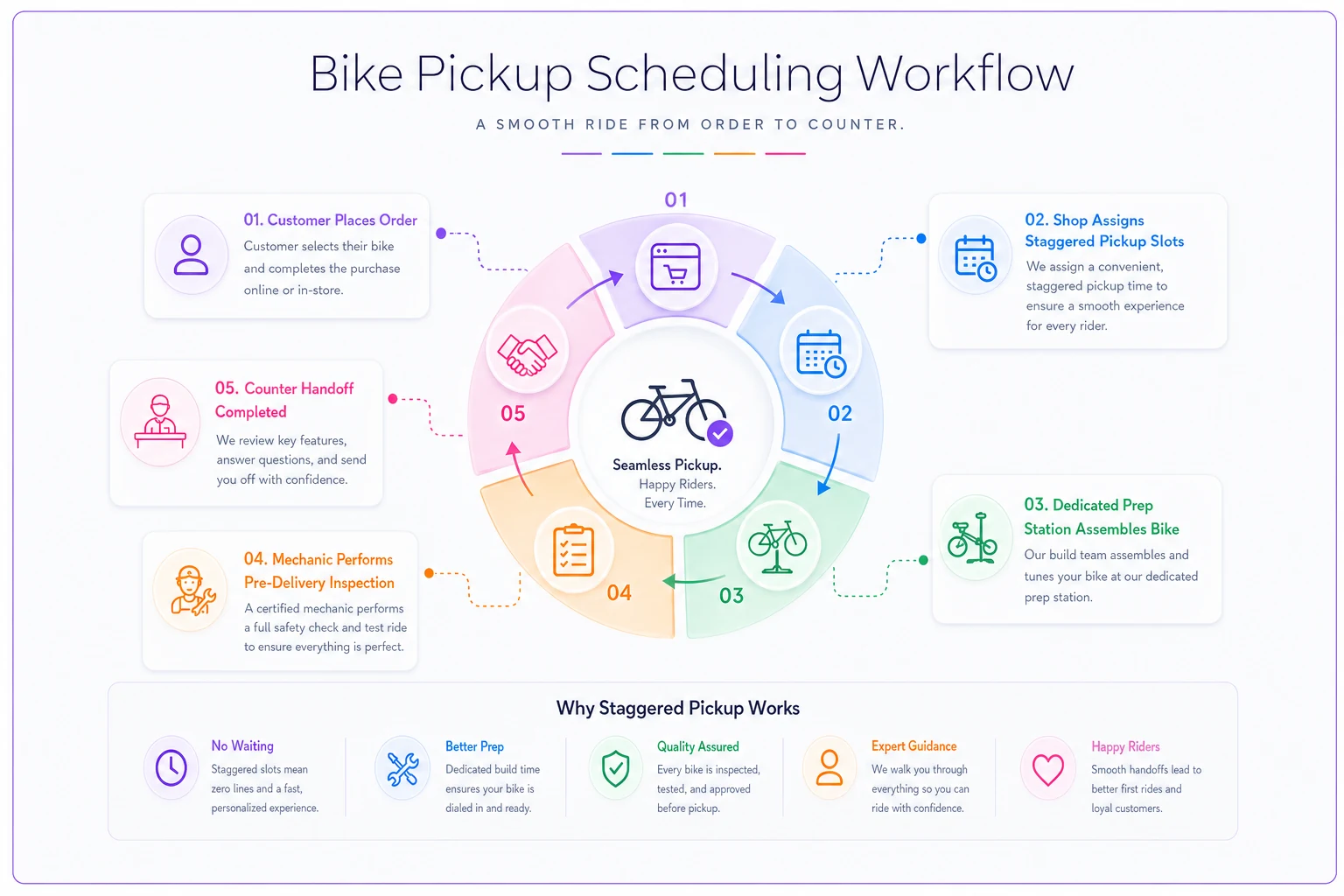
A staged pickup slot is a better upsell environment than a chaotic Saturday counter, because the customer isn't standing in a line and your staffer isn't rushing.
Step 5 — Draw a firm line on fulfillment windows
The promise you make internally, separate from what you tell the customer: no sale activity extends any already-committed service ticket past its SLA.
Write it down before the weekend starts. Something like:
-
Tickets promised before the promo weekend keep their original delivery date, full stop
-
New repair intake during the promo weekend gets quoted with a promo-adjusted turnaround — be honest, if you're slammed, quote 5 days instead of 3
-
Sale-bike assembly has its own fulfillment queue, worked by the dedicated prep person, and does not merge into the repair queue
The honesty in that second point is what saves you. A rider told "we're running a big weekend, so tunes are about 5 days right now" who gets their bike back in 4 is happy. The same rider quoted 3 and delivered in 7 is gone. The turnaround number you say matters more than the one you privately hope for. Under-promise during promo weekends on purpose.
Centralizing these windows in one system helps considerably — when your intake, repair queue, and sale-prep queue all live in the same workflow platform, your service writer can see real capacity at the moment of quoting instead of guessing. That's the difference between a promise you can keep and one you're just hoping to keep.
Step 6 — Run the recovery checklist the moment something slips
Things will slip. A sale bike needs a warranty part, a mechanic calls out, intake runs 60% over forecast. The point isn't to prevent every slip — it's to catch the SLA breach before the customer does and get ahead of it.
Run this checklist Sunday evening and again Monday morning:
-
Pull every open ticket promised for Monday–Wednesday
-
Flag any ticket now at risk of missing its committed date
-
For each at-risk ticket, decide
expedite, or proactively call the customer today
-
Never let a customer discover the delay by showing up — you call first
-
Confirm all sold bikes are either picked up or have a scheduled slot
-
Check that no sale-prep work bled into the committed-repair mechanic's hours
-
Note any promo pricing errors from the register for reconciliation
The proactive call is the whole point. "Your tune's running a day behind because of a busy weekend — want me to hold it for pickup Thursday or squeeze it in tomorrow morning?" costs you nothing and keeps the relationship intact. Silence followed by a blown deadline costs you the customer and the review.
Step 7 — Reconcile before you call the promo a win
Monday afternoon, add up what actually happened — not the top-line revenue, the net after service impact. This is where most shops fool themselves. The register total looks great, the promo gets filed as a success, and the same mistakes get repeated next quarter.
Reconcile four things:
-
Promo margin actual vs. planned — did any discount stack or drop below floor and quietly erode margin per unit?
-
Service SLA breaches — how many committed tickets missed their date, and what did recoveries cost in comped labor or lost repeat business?
-
Prep hour leakage — did sale assembly stay in its own lane, or did it eat committed-repair hours?
-
Register error count — how many manual discount corrections happened, and why?
Real scenario
A two-bench shop ran a weekend clearance on last-season hybrids — moved around 11 bikes, top-line looked like a strong weekend. But service intake ran roughly 50% over a normal Saturday, and because there was no dedicated prep person, both mechanics got pulled to assemble sale bikes. Nine committed tune-ups slipped 3–5 days past their promised dates. The shop comped labor on four of them and lost two regulars who quietly stopped booking.
Next quarter they ran the same size promo with the runbook — one dedicated prep body, committed-repair hours locked, honest promo-adjusted quotes on new intake, and a Sunday recovery call list. Same 11 bikes sold. Zero SLA breaches. The "cost" was one floater's Saturday shift, somewhere around $150–$200. Against four comped labor jobs and two lost regulars, that trade wasn't close.
Who should skip the full runbook
If you're a one-person operation running a tiny three-bike clearance to your email list, this is overkill — just cap the count and don't take on repair commitments you can't hold that week. The runbook earns its complexity once you've got a bench with committed tickets and enough promo volume to pull real foot traffic. The break-even is roughly the point where a promo generates enough walk-in service demand to threaten your existing queue. Below that, keep it simple. At or above it, the seven steps are the difference between a sale that grows the business and one that quietly bleeds your best service customers.
The whole idea is boring on purpose: protect the promises you already made, staff for the demand you're about to create, and check your work before you celebrate. Do that, and the discount weekend stops being a threat to your service reputation and starts being what it should be — a clean way to move stock without spending the next two weeks apologizing.
The whole idea is boring on purpose: protect the promises you already made, staff for the demand you're about to create, and check your work before you celebrate. Do that, and the discount weekend stops being a threat to your service reputation and starts being what it should be — a clean way to move stock without spending the next two weeks apologizing.
Ready to revolutionize your bike shop operations?
Join hundreds of bike shops using Bicyclly to save time, increase revenue, and deliver exceptional customer service.