

Most bike shops run "free basic maintenance nights" and treat them like community service. Nice gesture, zero revenue, and half the time the people who show up already know how to fix a flat. Meanwhile the shop eats two hours of a mechanic's wage, some floor space, and the owner's evening—then wonders why it never turns into anything.
Monetized clinics are a different animal. Done right, a clinic is a paid product with a curriculum, a price, a signup flow, and a follow-up sequence that converts attendees into service tickets and repeat customers. This post walks through how to actually build that—curriculum outlines, pricing bands, the signup and follow-up cadence, and the conversion metrics worth tracking—using a concrete 4-session beginner course as the working example.
The scope here is narrow on purpose. This isn't about "community events" broadly. It's about designing bike shop monetized clinics as a repeatable, measurable product.
The core mistake: treating clinics as marketing instead of a product with a P&L
The reason most clinic programs quietly die is that nobody assigns them a P&L. A "free flat-fix night" has no revenue target, so there's nothing to optimize and nothing to protect when the shop gets busy. It's the first thing cut in April.
Flip it and treat a clinic as a product, and three things change:
-
You can price it, which forces you to define what the customer actually gets.
-
You can measure conversion, which means you know if it's working.
-
You can staff it deliberately, because now it's paying for the mechanic's time.
The "marketing mindset" failure usually looks something like this: a shop runs a free basics night, 12 people show up, the owner is thrilled by turnout, and three weeks later exactly one of them books a tune-up. No follow-up went out. Nobody captured emails cleanly. The clinic "worked" socially and did almost nothing operationally.
The fix isn't complicated, but it does require building the thing like a product from the start.
The working example: a 4-session beginner course
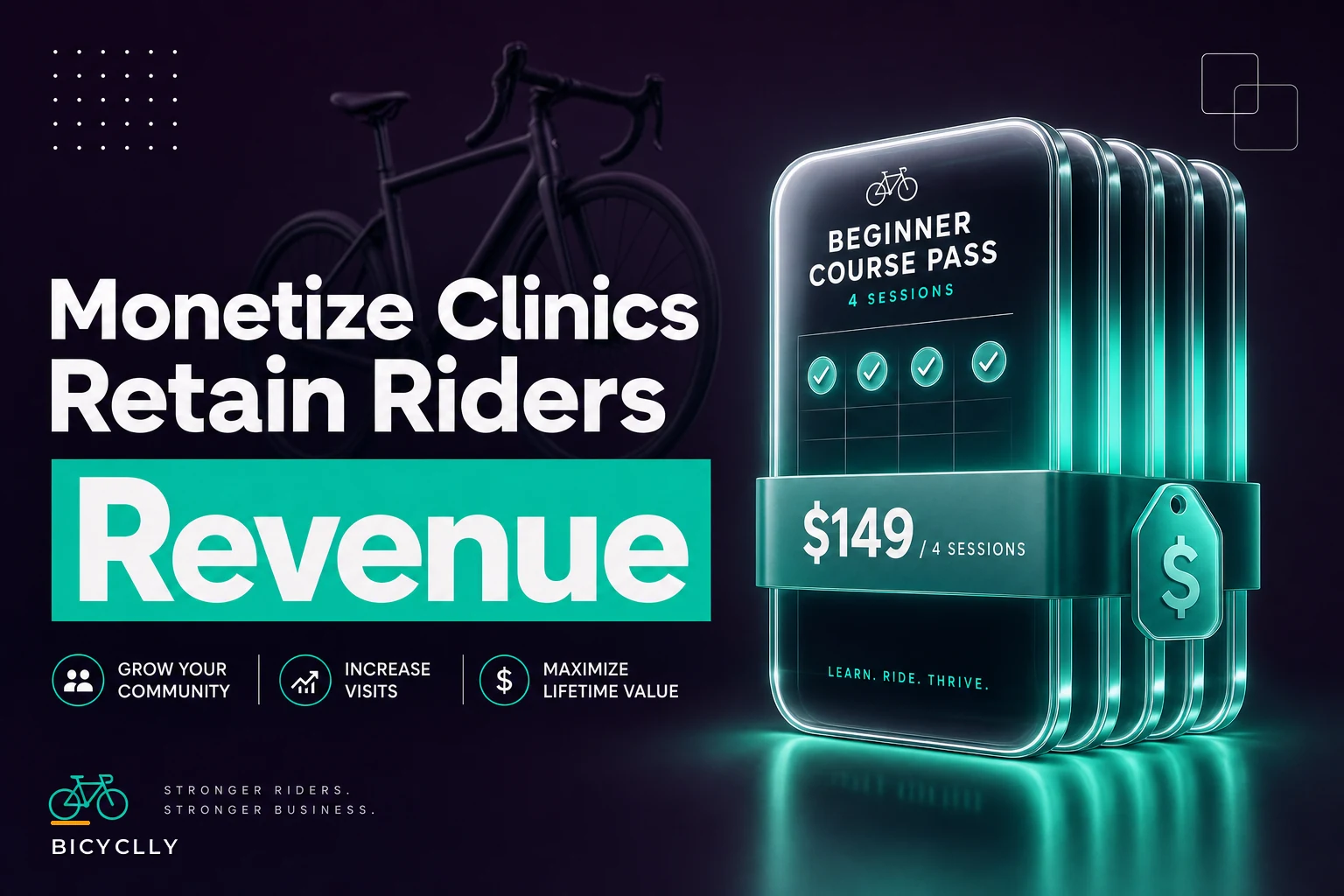
One concrete offering the whole way through keeps the numbers honest. Call it "Wrench Basics: A 4-Week Beginner Course." One two-hour session per week, capped at 8 people, hands-on with their own bikes.
Never miss a sale or service appointment again.
Bicyclly helps you manage every sale, repair, and booking with ease and accuracy.
- Unified inventory and sales tracking
- Automated customer notifications
- Service appointment scheduling
No credit card required
Session 1 — Bike Anatomy, Cleaning, and Pre-Ride Checks
-
Naming parts correctly (so future service conversations are faster)
-
Proper wash/degrease without wrecking bearings
-
The ABC pre-ride check (air, brakes, chain)
-
Homework
clean your bike before Session 2
Session 2 — Flats, Tires, and Tubes
-
Removing/installing wheels without drama
-
Fixing a flat and seating a tire correctly
-
Tubeless overview (enough to know when to come in)
-
Pressure by rider weight and terrain
Session 3 — Drivetrain and Shifting
-
Chain wear checking (and why they'll pay you to replace it)
-
Barrel adjuster tuning for indexing
-
Lubrication done right
-
When shifting problems mean a shop visit, not a driveway fix
Session 4 — Brakes, Safety, and "When to Call the Shop"
-
Pad wear, rim vs. disc basics
-
Cable tension and lever feel
-
The honest talk
what's DIY vs. what needs a mechanic and a stand
-
Graduation, discount card handout, service booking table
That last session matters more than most people account for. The whole course should build trust and simultaneously make it obvious where the customer's skill ends and your service department begins. A well-run beginner clinic doesn't cannibalize service revenue—it teaches customers to recognize problems earlier and bring the bike in before the drivetrain is toast.
Pricing bands: what to charge and why
Underpricing kills clinics as fast as ignoring them. At $10, people no-show without guilt and you signal it's worthless. Here's a pricing framework by clinic type:
| Clinic Type | Format | Price Band | Cap | Notes |
|---|---|---|---|---|
| Single-topic drop-in (flat fix, chain lube) | 60–90 min | $25–$45 | 8–10 | Loss-leader; feeds course signups |
| 4-session beginner course | 4 × 2 hr | $140–$220 | 6–8 | Core revenue product |
| Advanced / discipline-specific (MTB suspension, bikepacking prep) | 2–3 hr | $60–$110 | 6 | Higher-intent, higher-spend customers |
| Women's / new-rider confidence series | 3 × 90 min | $90–$150 | 8 | Strong retention, community-driven |
| Kids / family basics | 90 min | $30–$50 | 6 families | Sells parts + builds future customers |
For the 4-session course, landing around $180 makes sense, and here's the reasoning. At 7 attendees that's roughly $1,260 gross. Your mechanic's loaded cost for 8 hours of instruction plus prep might run $220–$320. Add consumables (tubes, degreaser, cable) at maybe $80. You're netting somewhere in the $850–$950 range on the course itself—before any conversion into service or retail.
One structural tip worth trying: bundle a spend-forward credit into the price.
"$180 course, includes a $40 shop credit." It feels generous, barely dents margin, and dramatically increases the odds they come back and spend—usually well over the $40 credit.
The signup flow that actually captures intent
This is where most shops leak. A clipboard by the register captures maybe half the interested people and none of their contact info in a usable form.
The signup flow should be short and do three jobs: take payment, capture clean contact data, and set expectations.
-
A dedicated signup page (even a simple form) with the curriculum, dates, price, and cap visible. Scarcity is real—showing "6 of 8 spots left" moves people.
-
Payment upfront, not "pay at the door." Prepaid attendees show up. This alone fixes the no-show problem better than any reminder.
-
Bike + skill question at signup ("What bike do you ride? What's the one thing you wish you could fix yourself?"). This gives your instructor material and gives you sales signals.
-
Instant confirmation with what to bring and a calendar add.
-
Tag the customer in your system as a clinic attendee so every downstream message and offer can be targeted.
That last step is the quiet one that pays off. When clinic attendees are tagged, you can measure their service conversion separately from walk-in customers and build follow-up specifically for them.
Follow-up cadence: where the money actually shows up
The clinic revenue is nice. The service and retail conversion is the real prize, and it lives entirely in the follow-up. Here's the cadence worth running for the 4-session course:
-
After Session 2 "You've earned your first flat-fix. Here's 15% off tubes and a floor pump this month." (They now know they need supplies.)
-
Day after graduation Thank-you + the $40 credit reminder + a soft prompt to book a "graduation check" where a mechanic inspects what they learned to maintain.
-
Day 14 Educational, not salesy—one maintenance tip tied to Session 3. Keeps you in their inbox without begging.
-
Day 30 Booking nudge for a first professional tune-up, framed as "the stuff that needs a stand and torque wrench."
-
Day 75 Seasonal check-in tied to whatever's coming (winter storage, spring wake-up).
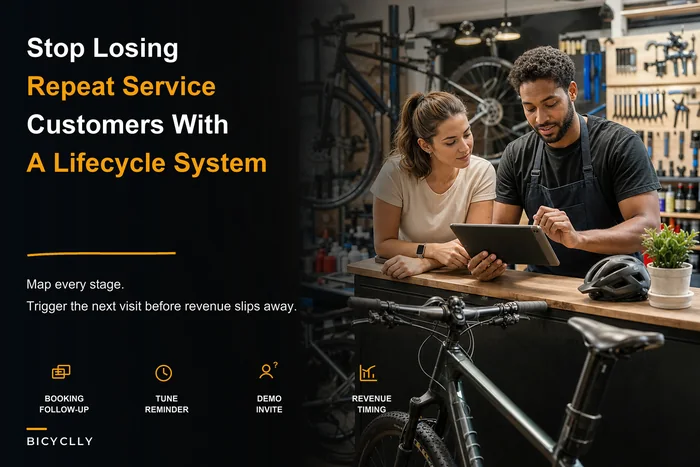
This is essentially a lifecycle sequence applied to a specific customer segment. If you want the broader framework behind keeping these people coming back long after the course ends, it's worth reading how to build a full lifecycle system for repeat service customers—the clinic just becomes the entry point into that system.
One mistake to avoid: front-loading all the selling into graduation night. People just spent four weeks with you. Hit them with a hard pitch and it feels transactional. The drip over 75 days converts far better because it matches when their bike actually needs work.
Conversion metrics you should actually track
If you can't answer these numbers, you don't have a clinic program—you have a hobby.
-
Fill rate seats sold ÷ seats offered. Below 60% and your marketing or pricing is off.
-
Completion rate finished all sessions ÷ enrolled. Below 75% means the course is losing people mid-stream.
-
Service conversion rate attendees who book a paid service within 90 days ÷ attendees. This is the number that justifies everything.
-
Retail attach attendees who make a parts/accessory purchase within 60 days.
-
Revenue per attendee, 90-day total downstream spend ÷ attendees. This is what tells you what a clinic seat is really worth.
A realistic target for a beginner course: service conversion somewhere in the 35–50% range within 90 days, and a 90-day revenue-per-attendee that's often 2–3× the course price once you count service tickets and parts.
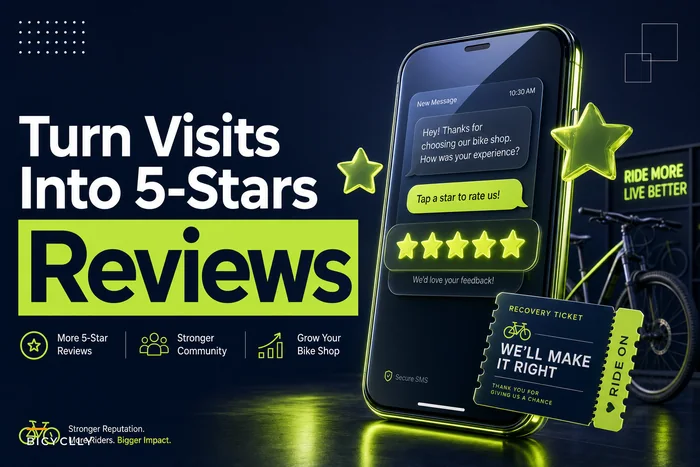
Reviews are part of this too. Clinic grads are your warmest customers, which makes them your best review source—if you ask at the right moment. The same two-step feedback funnel that turns service visits into 5-star reviews works well after graduation night, when goodwill is at its peak.
A real scenario with numbers
A mid-sized shop—one storefront, three mechanics, decent Saturday traffic—was running the classic free basics night maybe once a month. Turnout was fine, revenue was zero, and it always got shelved during peak season.
They restructured into the 4-session beginner course at $180, capped at 7, running two cohorts a month during shoulder season. Numbers over the first few months looked roughly like this:
-
Course revenue
about $2,300–$2,500/month across two cohorts after consumables and instructor time
-
Service conversion
a little over 40% of grads booked a paid service within 90 days
-
Average downstream service ticket from a grad
around $90–$130
-
90-day revenue per attendee (course + service + parts)
landed near $400
The owner's takeaway wasn't the direct course profit—it was that a segment of customers who used to buy a bike and vanish were now on a first-name basis with the mechanics and coming back for tune-ups they'd previously skipped. The clinic wasn't marketing anymore. It was a funnel with a measurable bottom.
When this makes sense—and when it doesn't
When to build a clinic program:
-
You have a mechanic who's genuinely good with people, not just wrenches
-
You have shoulder seasons where bays sit idle and staff has capacity
-
Your customer base skews toward newer riders or families
-
You're already decent at email/SMS follow-up (or willing to get there)
When it's a bad idea:
-
Your shop is slammed year-round and every bay-hour is already booked at full margin—your time is better spent on service throughput
-
You have no way to capture and tag customer contact info, so you can't follow up
-
You'd have to run it yourself as the owner every week and you're already stretched thin
Worth being direct about one thing: shops that can't commit to the follow-up probably shouldn't bother. A clinic with no follow-up cadence is just the old free night with a price tag. The teaching is the easy part. The 75-day nurture is where the return actually lives, and if that piece doesn't get built, the whole thing underperforms.
Getting the operational side to hold up
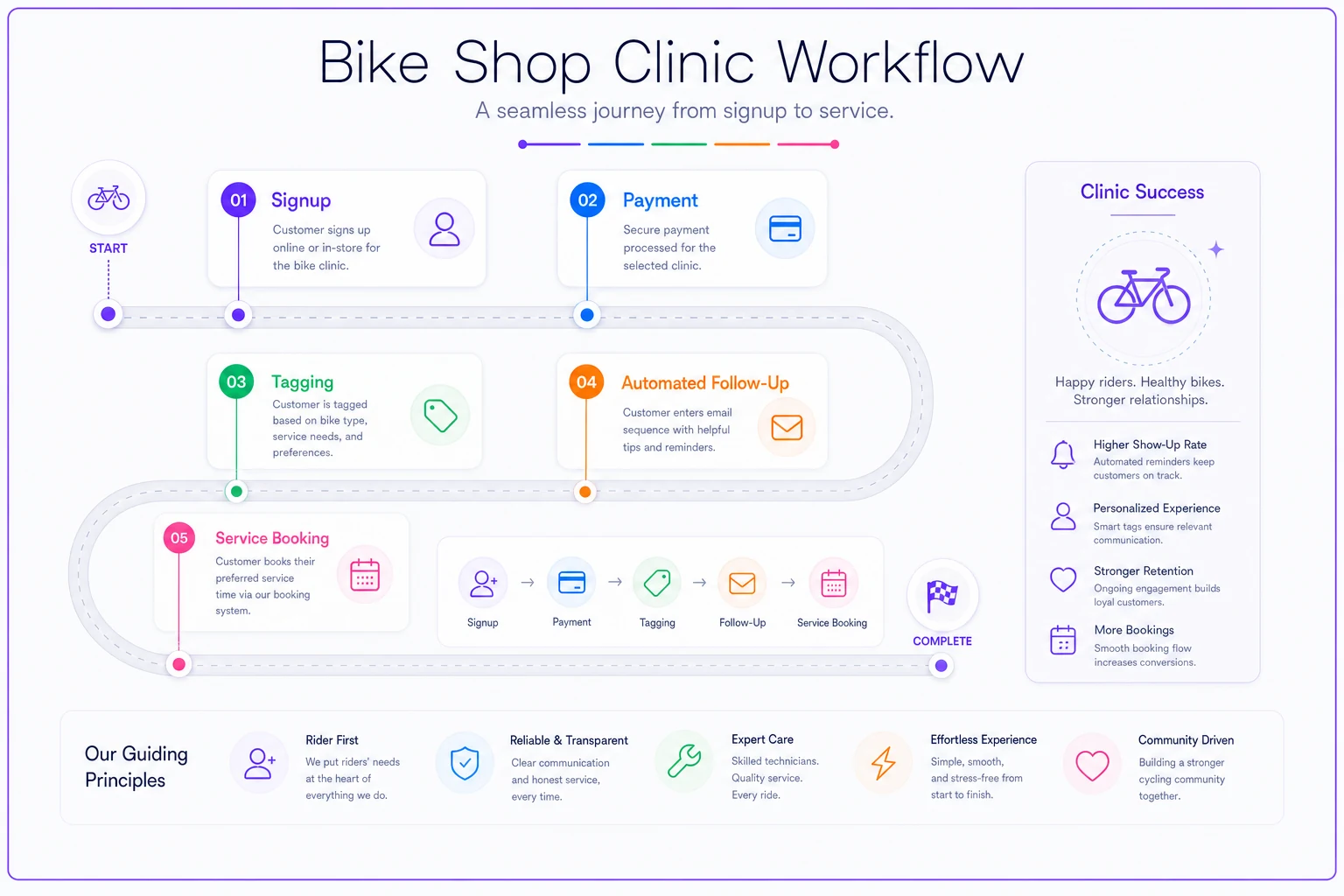
The reason clinic programs fall apart usually isn't the curriculum—it's the coordination. Someone has to hold the signup list, take payment, tag attendees, trigger the right message on the right day, and route grads into booking a service. Do that by hand across two cohorts a month and it becomes a part-time job nobody wants.
Having your scheduling, customer records, and follow-up messaging in one operational system instead of three disconnected tools quietly determines whether the program survives. When signup, tagging, reminder sequences, and service booking all live together, the follow-up cadence runs on its own instead of depending on someone remembering to send the day-30 email. Shop management platforms with built-in automation can handle the drip sequence and attendee tagging so the mechanic can focus on teaching and the service desk on booking—which is the whole point.
Here's the operational workflow at a glance:
The tooling is secondary, though. Get the curriculum tight, price it like a real product, capture intent cleanly at signup, and run the follow-up long enough to match when bikes actually break. Do those four things and a monetized clinic stops being a feel-good evening and becomes one of the more reliable ways to turn casual riders into customers who keep coming back.
The tooling is secondary, though. Get the curriculum tight, price it like a real product, capture intent cleanly at signup, and run the follow-up long enough to match when bikes actually break. Do those four things and a monetized clinic stops being a feel-good evening and becomes one of the more reliable ways to turn casual riders into customers who keep coming back.
Ready to revolutionize your bike shop operations?
Join hundreds of bike shops using Bicyclly to save time, increase revenue, and deliver exceptional customer service.