
You hand a customer their freshly serviced bike. They smile, thank you, roll it out the door. Three weeks later, you check Google and see a 2-star review: "Brakes started squeaking after two days. Had to go to another shop to get it fixed properly."
No call. No chance to make it right. Just a public complaint sitting there for months, pushing away potential customers who see it first when they search for bike repair nearby.
The frustrating part? That brake squeak was probably a quick pad adjustment. Five minutes of work you would've done for free if they'd just said something.
Most bike shops handle post-service feedback completely backwards. They either chase reviews while the customer's still in the parking lot — which feels pushy — or they wait and hope happy customers will leave reviews on their own. They won't. Meanwhile, unhappy customers find plenty of motivation to write detailed complaints online without ever giving you a heads-up.
The anatomy of a bike shop post service feedback system that actually works
A functional feedback system needs to catch problems before they go public while still generating positive reviews from satisfied customers. Sounds obvious. But pulling it off requires specific timing, messaging, and internal triggers that most shops miss entirely.
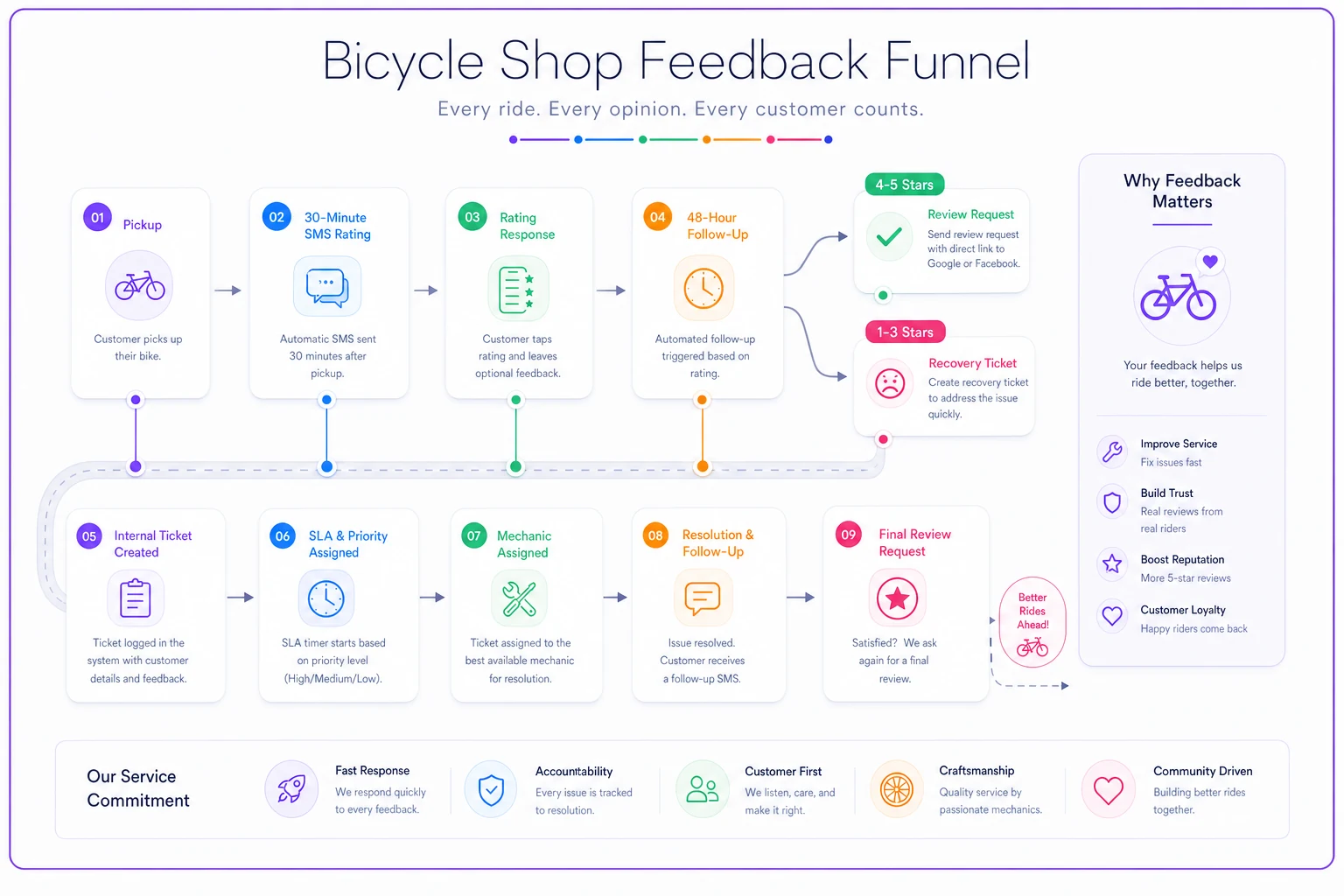
The core structure is deceptively simple: an immediate rating request via SMS, followed by a conditional follow-up 48 hours later. The real work happens in how you handle responses — especially from unhappy customers.
When someone picks up their bike, your system sends an SMS within 30 minutes asking for a simple 1-5 star rating. Not a review — just a rating. This catches them while the experience is fresh but gives them time to actually ride home first.
If they rate 4 or 5 stars, the 48-hour follow-up asks for a Google review with a direct link. If they rate 3 or below, it asks what went wrong and how you can fix it. That response then triggers an internal ticket for your service manager with response requirements based on issue severity.
Where most shops mess up the execution: they treat all negative feedback equally. A "mechanic was rude" complaint needs different handling than "my gears are skipping." One's a coaching opportunity, the other's a warranty callback. Your system needs to route these differently.
The immediate SMS rating: timing, language, and response rates
The first message goes out 30 minutes after pickup. Not instantly — that feels automated. Not the next day — by then, any issues have already frustrated them. Thirty minutes gives them time to ride home, notice if something's off, but still feel connected to the visit.
Never miss a sale or service appointment again.
Bicyclly helps you manage every sale, repair, and booking with ease and accuracy.
- Unified inventory and sales tracking
- Automated customer notifications
- Service appointment scheduling
No credit card required
The message needs to be short and personal-feeling without being manual: "Hi [Name], thanks for trusting us with your [bike type] today! Quick question — how was your service experience? Reply with 1-5 stars: ⭐⭐⭐⭐⭐"
No links, no review requests, no marketing fluff. Just a rating that takes two seconds to answer.
Response rates on this type of message typically land around 40-45% for bike shops, compared to maybe 8-10% for email surveys. People answer texts. They delete emails.
The operational detail most shops miss: segment your rating requests by service type. A $45 flat fix gets different messaging than a $400 overhaul. The parent who brought in their kid's bike needs different follow-up than someone getting their carbon race bike serviced.
For basic repairs under $75, keep it simple. For anything over $200 or involving safety components — brakes, wheels, suspension — add a bit more urgency: "Want to make sure everything's working perfectly on your [bike type]. How'd we do? Reply 1-5 stars."
The operational detail most shops miss: segment your rating requests by service type.
Track response rates by service type, mechanic, and day of week. Patterns show up fast. Maybe Tuesday pickups get lower ratings because your Monday mechanic rushes through final checks. Maybe wheel builds consistently score lower because customers don't understand spoke tension settling is normal.
The 48-hour follow-up: converting ratings into reviews or recovery
Two days later, everyone who responded to the initial rating gets a follow-up. What that message says depends entirely on their score.
For 4-5 star ratings: "Awesome, glad you're happy with the service! Would you mind sharing your experience in a quick Google review? It really helps other riders find us: [direct link]"
Around 30-35% of people who gave you 4-5 stars will actually leave the review when prompted this way. Without the prompt, maybe 2-3% do it organically.
For 1-3 star ratings: "Thanks for the honest feedback. Sounds like something didn't meet expectations — really want to make this right. What happened? Reply here or call [number]."
Most people don't want confrontation. They won't call to complain about minor issues. But when you explicitly ask via text and make it easy to respond, they'll tell you exactly what went wrong.
The key is response speed. When someone tells you their gears are skipping or their brake is rubbing, you need to respond within 2 hours with a specific solution. Not "bring it back sometime." More like: "Can you bring it by tomorrow at 10am? I'll personally check it and make any adjustments needed — should take 15 minutes max."
Script library for detractor recovery based on complaint type
Different complaints need different recovery approaches. A customer disappointed about price needs different handling than someone whose bike isn't shifting right.
For mechanical issues post-service: "That's definitely not right — sounds like [specific component] needs adjustment. Can you bring it by [specific time]? I'll check it immediately, no charge. Should take [realistic timeframe]."
For service delay complaints: "Really sorry about the wait. We had [brief explanation without excuses]. For your next service, I'm adding a priority flag to your account — you'll get the first scheduling slot available."
For price/value concerns: "I understand price is important. Let me explain exactly what we did: [specific list]. For your next service, I can offer [specific discount/add-on] to make up for the frustration."
For staff or communication issues: "That's not our standard at all. I'm personally reviewing this with our team. Can we chat for 5 minutes? Want to understand exactly what happened so we can fix our process."
Each script acknowledges the specific issue, offers a concrete solution, and includes a clear next step. Generic apologies don't fix problems. Specific solutions do.
These recovery conversations often surface systemic issues. Maybe multiple customers complain about the same mechanic's brake adjustments being too tight. Maybe your front desk keeps quoting one-day turnaround when the shop actually needs three days. These patterns only show up when you're actively collecting feedback instead of waiting for public complaints.
Internal ticket triggers and automatic escalation rules
Every piece of feedback needs to create action, not just data. This is where most feedback systems fail — they collect ratings but don't trigger anything operational.
When someone rates 3 or below, your system should automatically create an internal ticket with:
-
Customer name and contact
-
Service performed and date
-
Mechanic who worked on it
-
Exact complaint from the follow-up text
-
Required response time based on severity
Severity levels might break down like this:
Critical (respond within 1 hour):
-
Safety concerns (brakes, wheels, handlebars)
-
Complete service failure (bike won't shift, won't stop, makes concerning noises)
-
Customer threatening a public review or demanding a refund
High (respond within 4 hours):
-
Functional problems (minor shifting issues, brake rub, creaking)
-
Service not completed as promised
-
Significant delay without communication
Medium (respond within 24 hours):
-
Minor adjustments needed
-
Communication gaps
-
Pricing concerns
Low (respond within 48 hours):
-
General experience feedback
-
Suggestions for improvement
-
Minor cosmetic issues
Miss the response window, and the ticket escalates to the owner. This stops complaints from sitting in someone's inbox while the customer gets progressively angrier.
The ticket should also trigger quality checks. If a mechanic gets three similar complaints in a month, that flags a review of their work and potentially additional training. If multiple customers flag the same issue across different mechanics, that's a process problem, not a people problem.
Tying feedback to mechanic performance and shop KPIs
Feedback without measurement is just noise. Your bike shop post service feedback system needs to feed directly into performance metrics that actually drive improvements.
Track each mechanic's average rating, but weight it by service complexity. A 5-star on a flat fix counts less than a 5-star on a full suspension overhaul. This prevents mechanics from gravitating toward easy jobs to boost their scores.
A simple scoring formula:
-
Basic service (under $75)
Rating × 1
-
Standard service ($75–200)
Rating × 1.5
-
Complex service (over $200)
Rating × 2
-
Warranty/redo work
Rating × 0.5
This gives you a weighted performance score that reflects both satisfaction and technical difficulty. A mechanic consistently scoring well on complex jobs is more valuable than one scoring perfectly on basic repairs.
Ratings alone don't tell the full story, though. Also track:
-
Response rate (what percentage of their customers respond to feedback requests)
-
Review conversion (how many 4-5 star ratings become public reviews)
-
Recovery success (how many 1-3 ratings get resolved positively)
-
Repeat rate (do their customers come back for the next service)
These metrics reveal different strengths. Maybe your senior mechanic has lower ratings but an impressive recovery rate — they fix problems when they arise. Maybe your junior mechanic has perfect ratings but low response rates — customers don't feel connected enough to respond.
Pull these metrics monthly into a simple dashboard:
| Mechanic | Avg Rating | Weighted Score | Response Rate | Recovery Rate | Repeat Customer % |
|---|---|---|---|---|---|
| John | 4.6 | 6.9 | 42% | 85% | 73% |
| Sarah | 4.8 | 6.2 | 38% | 60% | 68% |
| Mike | 4.4 | 7.8 | 51% | 90% | 81% |
Mike's raw rating looks worst. But his weighted score is highest because he handles complex jobs. His recovery rate and repeat percentage suggest customers trust him even when things go wrong initially. That's the kind of nuance you miss if you only look at star averages.
Common complaints by service type and seasonal patterns
Different services generate predictable complaints. Knowing these in advance helps you get ahead of issues before they trigger negative feedback.
Tune-ups typically generate complaints about:
-
Shifting not feeling "perfect" (usually cable stretch — normal, but needs explaining)
-
Brakes feeling different (proper adjustment feels strange after riding with worn pads)
-
Things not cleaned enough (expectation mismatch on basic vs. premium service)
Wheel builds consistently trigger:
-
Spoke creaking in the first week (normal spoke settling)
-
Wheel going slightly out of true quickly (needs explaining about tension stabilization)
-
Price shock when custom builds exceed estimates
Suspension service often leads to:
-
"Doesn't feel like it used to" (proper setup feels different than blown-out suspension)
-
Confusion about break-in period
-
Misunderstanding about warranty coverage
Seasonal patterns matter too. Spring tune-ups generate more complaints because bikes sat all winter and customers expect miracles from basic service. They don't realize their cables stretched, chains rusted, and tires dry-rotted during storage. Late summer sees more price complaints as people realize they've spent more on maintenance than planned. December services tend to get more positive feedback — people are just grateful you squeezed them in before the holidays.
Understanding these patterns lets you get ahead of complaints. Add specific language to spring quotes about what basic service includes versus what requires additional work. Train staff to set expectations about suspension break-in during mountain bike season. Small communication adjustments prevent a surprising number of 2-star reviews.
Building review momentum without being pushy
The difference between pushy and persistent comes down to value exchange. Pushy shops ask for reviews as a favor. Smart shops position reviews as helping other riders.
Your 48-hour follow-up for happy customers shouldn't beg. Frame it as community: "Glad your [bike type] is running smooth! Quick favor — would you mind sharing your experience in a Google review? Other [road cyclists/mountain bikers/commuters] in [neighborhood] rely on reviews to find trustworthy shops. [Direct link]"
For customers who don't respond to the first review request, send ONE more follow-up a week later with a different angle: "Hey [name], your [specific service] feedback would really help others know what to expect. Mind dropping a quick review? Even one sentence helps: [direct link]"
After that, stop. Anything more becomes harassment.
But review generation isn't just about asking. It's about creating moments worth reviewing, and that starts with the pickup experience. When someone retrieves their serviced bike, the mechanic who worked on it should do a 60-second walk-through — not a generic "we did the tune-up," but specific details: "Replaced your rear brake pads, they were down to metal. Adjusted your rear derailleur — the B-tension was way off, which is why shifting felt mushy. Your chain's at about 75% wear, so probably good for another few months but keep an eye on it."
That kind of transparency creates review-worthy moments. Customers feel informed, not just serviced. They have something specific to write about beyond "good service, fair price."
The workflow from SMS to review to internal action
Here's how the full sequence plays out in practice.
Below is a visual of the feedback funnel flow.
Tuesday, 2pm: Customer picks up their mountain bike after a $180 suspension service and brake bleed.
2:30pm: Automated SMS goes out: "Hi Tom, thanks for trusting us with your Trek today! Quick question — how was your service experience? Reply with 1-5 stars: ⭐⭐⭐⭐⭐"
2:47pm: Tom replies: "3 stars"
2:48pm: System creates an internal ticket marked High Priority (suspension service + medium rating), assigned to the service manager. SLA clock starts — 4 hours to respond.
3:15pm: Service manager texts Tom: "Thanks for the honest feedback. Sounds like something didn't meet expectations — really want to make this right. What happened?"
3:42pm: Tom replies: "Fork doesn't feel right. Seems harsh compared to before."
3:50pm: Service manager responds: "That's not right at all. Suspension should feel smooth after service. Can you bring it by tomorrow at 10am? I'll personally check settings and adjust. Should take 20 minutes max, no charge."
Wednesday, 10am: Tom brings the bike back. Mechanic discovers rebound was set too fast. Adjusts it, explains the break-in period, has Tom test ride in the parking lot.
Thursday, 2:30pm: Follow-up SMS: "Hi Tom, wanted to check that your suspension feels better after yesterday's adjustment?"
Thursday, 4:15pm: Tom replies: "Much better, thanks for fixing so quickly."
Thursday, 4:16pm: System sends: "Awesome! Would you mind sharing your experience in a quick Google review? It really helps other mountain bikers find us: [link]"
Friday, 11am: Tom leaves a 4-star review mentioning the great follow-up service.
This entire sequence happened automatically except for the service manager's manual responses to understand and fix the problem. The customer lifecycle system you might already have built can integrate directly with this feedback loop, creating a complete picture of each customer's experience over time.
Integration with existing service workflows
A feedback system can't exist in isolation. It needs to mesh with your current service writing, parts ordering, and pickup processes without creating extra work.
Start with your service writing system. When creating a work order, your system should automatically flag customers based on their feedback history. If someone rated you 2 stars last time, that's important context for whoever's writing up their new service. A small gesture — priority scheduling or a minor discount — can start rebuilding trust before they even drop the bike off.
Connect feedback to your parts and vendor management too. If multiple customers complain about premature wear on parts from a specific supplier, that's data worth capturing. Those budget brake pads saving $3 per set might be costing you customers long-term. This kind of pattern feeds directly into your supplier scorecarding process and helps you make smarter purchasing decisions.
Your scheduling system should surface feedback scores when customers call. Someone with a history of low ratings might need extra communication and follow-up to prevent another bad experience. A consistent 5-star reviewer has probably earned some flexibility on rush requests.
The point isn't to discriminate — it's to allocate attention where it's most needed. Some customers need more explanation, more follow-up, more hand-holding to stay happy. Treating every interaction identically doesn't produce consistent results.
Measuring success: review velocity, rating trends, and recovery rates
How do you know if your bike shop post service feedback system is actually working? Track specific metrics over time, not just total review count.
Review velocity measures how many new reviews you generate per month. A healthy shop should see roughly 8-12% of services generate public reviews. If you complete 200 services monthly, you should see 16-24 new reviews. Below that, your follow-up sequences need adjustment.
Rating distribution tells you if you're maintaining quality. A shop with nothing but 5-star reviews looks suspicious. Aim for: 70% five-star, 20% four-star, 8% three-star, 2% one or two-star.
Recovery rate might be your most important metric. What percentage of 1-3 star ratings do you successfully resolve? A solid recovery rate sits above 70%. Below 50% means your recovery scripts and processes need work.
Response lag measures how quickly you respond to negative feedback. Track average time from complaint to first response, then from first response to resolution. Fast response often determines whether someone updates their review or tells friends about the bad experience.
Mechanic variance shows whether quality issues are systemic or isolated. If one mechanic consistently triggers complaints while others don't, that's a training issue. If all mechanics get similar complaints about the same service type, that's a process issue.
A simple monthly dashboard:
| Metric | This Month | Last Month | 3-Month Avg | Target |
|---|---|---|---|---|
| New Reviews | 22 | 18 | 19 | 24 |
| Avg Rating | 4.6 | 4.5 | 4.5 | 4.5+ |
| Recovery Rate | 73% | 68% | 70% | 75% |
| Avg Response Time | 2.3 hrs | 3.1 hrs | 2.8 hrs | <2 hrs |
| Review Velocity | 11% | 9% | 10% | 12% |
These numbers tell stories. Maybe review velocity dropped when you shortened follow-up messages. Maybe recovery rates improved after implementing the new scripts. Maybe ratings dipped during a busy stretch when quality control slipped. The dashboard makes those patterns visible instead of invisible.
Turning the feedback loop into competitive advantage
Most bike shops treat customer feedback as damage control — something to manage when problems surface. A properly structured bike shop post service feedback system becomes a competitive advantage that's genuinely difficult for other shops to replicate quickly.
Every piece of feedback improves your operation. Every recovered complaint builds loyalty stronger than a perfect service ever could. Every positive review makes the next sale a little easier.
The two-step SMS funnel outperforms every other feedback method because it respects customer time while capturing honest responses. The 30-minute initial delay feels thoughtful. The 48-hour follow-up arrives right when customers have formed real opinions about the service.
More importantly, the internal routing and SLA structure ensures feedback drives action, not just reports. When complaints trigger fast responses with specific solutions, customers feel heard. When mechanics see how their work impacts ratings, quality improves. When patterns emerge across multiple responses, you spot systemic issues before they become reputation problems.
The shops still relying on printed comment cards or hoping for organic reviews are playing a completely different game. They're reactive. You're not.
After running this system for six months, you'll have hundreds of data points about what customers actually value, what frustrates them, and what makes them recommend you to others. That intelligence compounds over time in ways that no marketing campaign can replicate.
Who should actually implement this system
This system works best for shops doing at least 150-200 services monthly. Below that volume, you won't generate enough feedback for meaningful patterns. Personally calling customers is more effective until you reach that scale.
You need at least two mechanics to compare performance metrics meaningfully. Single-mechanic shops should focus on the recovery side first — catching problems quickly — before worrying about performance comparisons.
Someone needs to monitor feedback daily. Not weekly, not when they remember — daily. That person needs authority to offer solutions like priority scheduling or small discounts without asking permission first. Delayed responses kill recovery opportunities.
The system pays for itself through retained customers and improved reviews, but it requires upfront investment in setup and training. Budget around $200-300 monthly for SMS costs at 200 services per month, plus whatever your operational software costs to manage the workflow.
Most importantly, your team needs to embrace feedback rather than fear it. Mechanics who see ratings as personal attacks won't improve. Frame feedback as customer input that helps everyone get better — not as performance criticism.
If your shop matches these criteria, implementing a two-step feedback funnel will change how you understand and serve customers. If not, build volume and basic quality controls first. This system amplifies whatever service quality you currently deliver — so make sure that's something worth amplifying.
Ready to revolutionize your bike shop operations?
Join hundreds of bike shops using Bicyclly to save time, increase revenue, and deliver exceptional customer service.