


The moment a bike shop opens its second location, something quietly breaks. It's not sales. It's not staffing. It's ownership — the invisible question of who actually owns what decision across two buildings that can't see each other.
Single-shop owners get away with holding everything in their head. You know which mechanic is fast on hydraulic brakes, which vendor ships late, which regular needs a text when their part comes in. All of that lives in one skull, and it works fine until there's a second building where you're not standing.
Then the cracks show. Store B orders the same dead-stock tires Store A is trying to unload. A warranty dispute gets handled three different ways depending on who's at the counter. Your service manager thinks they own the schedule; you think you do. Nobody's wrong exactly — that's the problem. The authority was never written down, so everyone defaults to their own version of it.
This piece is about governance for indie multi-location shops: how to distribute decision rights, roll out changes without a two-month meltdown, set expectations between stores, and make sure every number on your dashboard has a human name attached to it. No enterprise software required. No org chart with twelve boxes. Just the connective tissue that lets a small-headcount operation behave like one business instead of two shops that happen to share a logo.
Why the Second Location Breaks Things a Single Shop Never Had to Solve
A single shop is a closed loop. Information travels by proximity — someone yells across the floor, you overhear the phone call, you notice the parts bin is low when you walk past it. Coordination is basically free because everyone's in the same room.
The second you split into two buildings, that free coordination disappears and nobody budgets for the replacement. What used to be a glance is now a phone call. What used to be obvious is now a guess. And the failure mode isn't dramatic — it's slow. Decisions get made twice, or not at all. Standards drift apart quietly until a customer who paid $95 for a tune-up at Store A gets quoted $120 at Store B for the same job, and now you're on the phone eating the difference wondering how it happened.
At one location, your operation runs on relationships. At two or more, it has to run on rules. The shops that struggle are the ones that try to scale relationships — the owner tries to be everywhere, texting both managers constantly, personally approving every discount, driving between buildings to break ties. That works for about four months before the owner burns out and the whole thing regresses to two independent shops with no shared spine.
The shops that scale cleanly do something different. They decide, on purpose and in writing, what gets standardized and what stays local. Pricing, warranty policy, and inventory rules get standardized. How a specific mechanic sequences their day stays local. Getting that line right is most of the battle.
Decision Rights: Who Owns What (The RACI Layer)
The tool worth stealing from bigger companies — and honestly, just this one — is RACI. Responsible, Accountable, Consulted, Informed. Ignore the corporate baggage. For a bike shop it collapses into two questions that actually matter: who does the work, and who owns the outcome. Those are frequently not the same person, and confusing them is where multi-location governance dies.
Never miss a sale or service appointment again.
Bicyclly helps you manage every sale, repair, and booking with ease and accuracy.
- Unified inventory and sales tracking
- Automated customer notifications
- Service appointment scheduling
No credit card required
Classic breakdown: your service manager is Responsible for keeping the schedule full, but if nobody is Accountable for turnaround time as a tracked number, then when repairs start running long, nobody feels the heat. Responsibility without accountability produces activity without results. Everyone's busy, nothing improves.
Below is a starter map for common cross-store decisions. Adapt it, but the point is to force yourself to put exactly one name in the "Accountable" column for each row. If you can't, that decision is going to fall through the gap between your two shops.
| Decision / Area | Responsible (does the work) | Accountable (owns outcome) | Consulted | Informed |
|---|---|---|---|---|
| Service pricing & quote consistency | Counter staff | Owner | Both service managers | All techs |
| Repair turnaround SLA | Store service managers | Lead service manager | Techs | Owner |
| Inventory reorder points | Store parts lead | Owner or ops lead | Service managers | Counter staff |
| Inter-store stock transfers | Store parts leads | Ops lead | Both managers | Owner |
| Warranty & goodwill decisions | Counter staff | Store manager (up to $ cap) | Owner above cap | — |
| New hire onboarding | Store manager | Owner | Lead tech | All staff |
| Discount / price override limits | Counter staff | Store manager | Owner | — |
Two things worth calling out. First, notice the dollar caps on warranty and discounts. A manager who can approve a goodwill fix up to $75 without calling you removes a dozen small bottlenecks a week and keeps you off the phone. Above the cap, it escalates. That single rule resolves more inter-store friction than almost anything else on this list.
Second: one name in Accountable. Always. Two names means no name. The most common governance mistake in multi-shop operations isn't giving someone too much authority — it's leaving authority undefined so every ambiguous situation bounces back to the owner. You didn't open a second location to become a full-time referee.
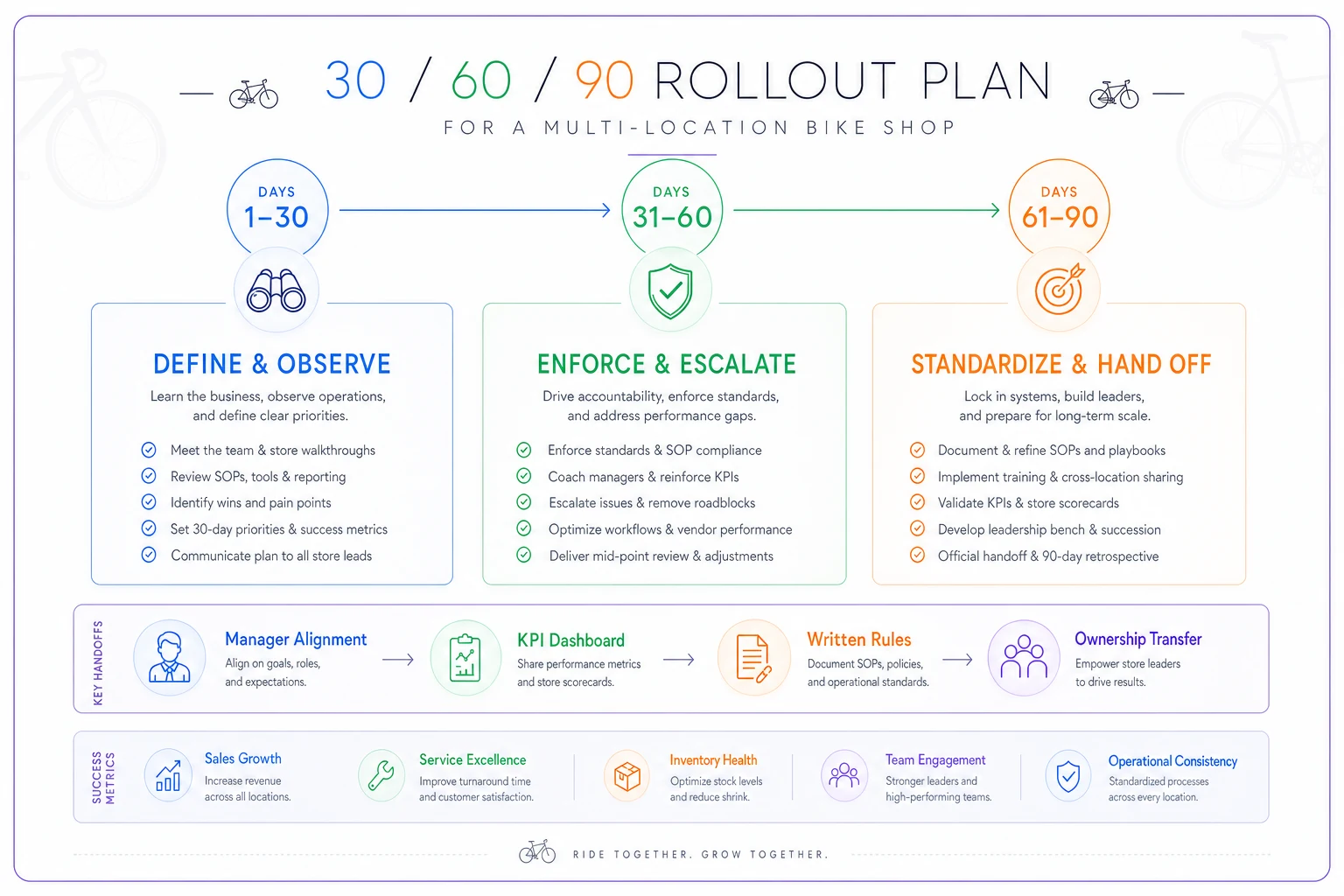
Rolling It Out Without a Two-Month Meltdown: The 30/60/90 Frame
You can't drop a full governance system on your staff in a Monday meeting and expect it to stick. People need to absorb new authority in stages, and you need time to catch the rules that looked good on paper and fall apart on the floor.
-
Days 1–30
Define and observe.
Write the RACI map. Set the dollar caps. Pick the four or five KPIs that actually matter (more on those below). Don't enforce anything hard yet — just make the rules visible and watch where reality disagrees with them. You'll find caps set too low, or a "standardized" price that one location genuinely can't match because of local competition. Log the friction; don't fight it yet. -
Days 31–60
Enforce and escalate.
Now the rules bind. Managers operate within their caps. KPIs get reviewed weekly with names attached. This is the uncomfortable phase — someone will test whether the discount limit is real, whether the turnaround SLA has teeth. Hold the line, but adjust anything that the observation window proved wrong. The goal is a system people trust, not one they resent. -
Days 61–90
Standardize and hand off.
By now the routines should run without you narrating them. This is where you write the actual one-page SOPs for the decisions that kept escalating, and where you formally hand day-to-day accountability to your managers. If you're still breaking ties daily at day 90, something in the RACI is wrong — usually a missing dollar cap or an unnamed owner.
The mistake is skipping phase one. Owners who are excited about the new system jump straight to enforcement, which means they're enforcing rules they haven't stress-tested. The observation window feels slow, but it's what keeps you from writing policy you'll have to reverse in six weeks. For the underlying rhythm and monthly runbook this governance layer sits on, the 30-day operating model for bike shops is worth reading alongside this.
A simple visual helps teams see the handoffs and the progression from observation to enforcement to handoff.
The mistake is skipping phase one. Owners who are excited about the new system jump straight to enforcement, which means they're enforcing rules they haven't stress-tested. The observation window feels slow, but it's what keeps you from writing policy you'll have to reverse in six weeks.
Inter-Store SLAs: The Agreements Between Your Own Buildings
Most owners think of SLAs as something between them and customers. The more valuable ones in a multi-location shop are between your own stores. When Store A needs a part Store B has on the shelf, how fast does that transfer happen? When a customer drops a bike at one location for pickup at another, who owns the handoff?
Without a written expectation, these become resentment engines. Store B's parts lead feels like Store A treats them as a warehouse. Store A feels like Store B never responds. Both are partly right, and the fix is embarrassingly simple: agree on response times and put them somewhere both stores can see them.
A workable inter-store SLA in plain language: a stock transfer request gets acknowledged the same business day and fulfilled within one business day for anything on the shelf. A bike moved between locations arrives at the receiving store with its ticket and notes intact — not a bare frame the counter has to reverse-engineer. A shared customer sees the same history at either location, so nobody re-diagnoses a problem the other store already solved.
That last one exposes the real dependency: inter-store SLAs only work if both locations can actually see the same data. If your stores run disconnected point-of-sale systems, no agreement will save you because the receiving store is working blind. That's exactly what when POS, inventory and accounting don't match gets into — the same data-mapping discipline that keeps your books clean is what makes cross-store service continuity possible.
When inter-store SLAs are worth formalizing: you're regularly moving stock or customers between locations and you've noticed friction or dropped handoffs. When they're overkill: two locations that operate almost entirely independently with separate customer bases and rarely touch each other's inventory. Don't build coordination machinery for coordination that doesn't happen.
Inventory Ownership: Who Can Move What, and Who Eats the Miss
Inventory is where multi-location governance gets genuinely expensive if you get it wrong. Two shops sharing a catalog but not sharing ownership rules will reliably do two dumb things: both order the same slow-moving SKU, and both refuse to give up stock the other location desperately needs.
-
Every fast-moving SKU has a designated home store responsible for reorder points.
-
Transfer requests between stores follow the acknowledged inter-store SLA, not favors and texts.
-
Slow-moving and seasonal stock has one owner who decides whether to hold, transfer, or liquidate — not a committee.
-
When a transfer happens, the cost of moving it — labor, time, the potential lost sale at the source store — is understood before it's approved, not after.
-
Someone is named accountable for total inventory across both stores, so nobody games their individual numbers by offloading dead stock onto the other location.
That last point is subtle but important. When managers are measured only on their own store's inventory turns, there's a quiet incentive to dump aging stock onto the other location and call it a transfer. Suddenly it's Store B's problem, Store A's numbers look clean, and the actual dead stock still exists — it just moved. The fix is one person accountable for the combined picture.
Give one person combined inventory accountability to prevent quiet offloading of dead stock between locations.
Deciding whether to move stock between locations at all is its own calculation. The transfer that seems obviously correct sometimes loses money once you account for the sale you're giving up at the source. The small-shop channel P&L and transfer-cost toolkit walks through how to actually cost these moves instead of guessing.
KPI Ownership: Numbers Without Names Don't Improve
You can have a clean dashboard and still have a business that doesn't improve, because a metric with no owner is just decoration. Every number you track across your locations needs exactly one person accountable for it — not for reporting it, for moving it.
-
Repair turnaround time — owned by the lead service manager. If it drifts past your SLA, that's their number to explain and fix.
-
Service revenue per bay-day — owned by each store's service manager, so idle bays surface fast.
-
Inventory turns / dead stock % — owned by whoever holds combined inventory accountability.
-
Warranty and goodwill spend — owned by store managers within their caps, escalating above.
-
Attach rate on service tickets — owned by counter staff leads, since add-ons live at the register.
What separates working dashboards from decorative ones is review discipline. The numbers get looked at weekly, out loud, with the owner in the room. Not to assign blame — to force the conversation about why a number moved and what the owner is doing about it. A KPI reviewed once a quarter with no named owner is a report. A KPI reviewed weekly with one accountable person is a control.
One honest caution: resist the urge to build the perfect measurement system before you've sorted the ownership. Owners frequently spend weeks perfecting dashboards and zero minutes deciding who's accountable for each line. Reverse that priority. An ugly spreadsheet with clear owners beats a gorgeous dashboard with none.
A Real Scenario: Two Shops, One Owner, Too Many Decisions
Consider a two-location shop — retail and service, maybe eight people across both buildings, somewhere around 320–360 service tickets a month combined.
Before governance, the owner was the entire coordination layer. Every warranty call, every discount, every "should we transfer this," every "why is Store B quoting different prices" — all of it routed through one person driving back and forth. Turnaround times were inconsistent because each service manager ran their own informal system. Dead stock accumulated because both stores reordered independently and neither felt responsible for the aging inventory. The owner was working sixty-hour weeks and the business still felt like it was one bad Saturday away from unraveling.
The fix wasn't software or a new hire. It was a written RACI map, dollar caps on warranty and discounts — managers cleared up to $75 on their own — one named owner for combined inventory, and five KPIs reviewed weekly with the responsible person in the room. Rolled out over a 30/60/90 window so nothing hit people cold.
The improvement over the first quarter was less dramatic than a case study usually makes it sound, and more real for that. The owner's phone stopped ringing for small decisions almost immediately — that was the fastest win. Turnaround times between the two stores converged within about two months once one person actually owned the SLA. Dead stock started shrinking after they stopped double-ordering. Nothing tripled overnight. But the owner got their weeks back, and the business started behaving like one operation instead of two shops sharing a sign.
When This Whole Approach Is Overkill
Governance is a cost. Writing rules, assigning ownership, running weekly reviews — that's overhead, and overhead only pays off when the coordination problem is real.
If you're running a single location, most of this is premature. You still benefit from naming KPI owners and setting a few decision caps, but the full inter-store SLA and inventory ownership machinery is solving a problem you don't have yet.
If you're running two locations that genuinely operate as separate businesses — different customer bases, no shared inventory, no cross-store handoffs — a lightweight version is plenty. Shared pricing and warranty standards so customers don't get whiplash, plus KPI ownership. Elaborate transfer protocols for transfers that never happen aren't worth the paperwork.
Where the full blueprint earns its keep is the messy middle: two, three, or four locations that share inventory, share customers, and can't run on the owner's memory anymore but can't justify an enterprise ERP and a real ops department either. Too big for one skull, too small for corporate machinery — that's the gap this is built for.
The Bigger Picture
The trap most indie owners fall into when they grow is assuming the problem is capacity — more staff, more space, more tools. Sometimes it is. But more often the problem at the second and third location is clarity: who decides, who owns the outcome, who eats the miss when something falls between the buildings.
None of what's above requires software you don't have or a management layer you can't afford. It requires deciding — deliberately, in writing — how authority and accountability flow across locations, then rolling it out slowly enough that it sticks. The shops that scale past one location without losing their minds aren't the ones with the best point-of-sale system. They're the ones where every important decision has a name attached to it, and everyone knows whose name it is.
Get the ownership right first. The tools, the dashboards, the automation — all of that gets dramatically easier once you know who's actually accountable for what. Start there.
Ready to revolutionize your bike shop operations?
Join hundreds of bike shops using Bicyclly to save time, increase revenue, and deliver exceptional customer service.