


Most bike shops don't fail because they lack good mechanics or good products. They fail because the owner is the operating system. Every decision routes through one person, every SOP lives in that person's head, and the moment the shop gets busy enough that the owner can't personally touch every ticket, things start slipping. Turnaround times creep. Reorders get missed. Two people think someone else confirmed the weekend build.
You've probably already written some SOPs. Maybe you've got a torque spec sheet taped to the bench, a checklist for new-bike assembly, and a folder of documents nobody opens. That's the problem. A pile of SOPs isn't an operating model. A bike shop operating model is the thing that decides who runs each SOP, when it runs, how you know it worked, and who makes the call when something's off. Without that connective tissue, documentation just becomes shelf decoration.
This is a walkthrough of how to stitch those pieces into a 30-day adoption pack you can deploy yourself: a RACI so roles are clear, a month-in-the-life calendar so routines actually happen, unified KPI definitions so everyone measures the same thing, and decision gates so problems get escalated before they become fires.
Why "having SOPs" isn't the same as having a system
There's a pattern that shows up in shops doing anywhere from $400k to $1.5M a year. The owner spends a slow January writing procedures — good ones, too, detailed and thoughtful. Then spring hits, the shop floods, and none of it gets used because nobody knows whose job it is to run each step, or when.
An SOP tells you how to do a task. It doesn't tell you:
-
Who owns the outcome vs. who just does the work
-
What day and time the task recurs
-
What number proves it happened correctly
-
What triggers escalation, and to whom
Those four gaps are exactly where operations break at scale. A single-mechanic shop can run on memory and gut feel. A three-bay shop with a service writer, a parts person, and weekend help cannot. The number of handoffs explodes, and every undocumented handoff is a place where a ticket dies quietly.
The shops that scale cleanly aren't the ones with the most SOPs. They're the ones where the SOPs are wired into a rhythm — a set of recurring routines with clear owners and clear checkpoints. That rhythm is what lets an owner step off the floor without the place falling apart.
Start with roles, not tasks: a shop-sized RACI
Before you schedule anything, you need to settle who's accountable for what. RACI is the cleanest tool for this, and it's usually overcomplicated. For a bike shop you only really need to be honest about one distinction: who owns the result (Accountable) versus who does the work (Responsible). Consulted and Informed matter less day to day, but they prevent the "nobody told me" fights.
Never miss a sale or service appointment again.
Bicyclly helps you manage every sale, repair, and booking with ease and accuracy.
- Unified inventory and sales tracking
- Automated customer notifications
- Service appointment scheduling
No credit card required
The mistake most owners make is putting themselves as Accountable for everything. That feels responsible. It's actually what keeps the shop stuck. If you're the only accountable party across service throughput, purchasing, reconciliation, and merchandising, you are the bottleneck — by design.
Here's a realistic starting RACI for a shop with an owner, a service manager/lead mechanic, a parts/inventory person, and a service writer or front-of-house:
| Function | Accountable | Responsible | Consulted | Informed |
|---|---|---|---|---|
| Daily service dispatch & bay load | Service Mgr | Service writer | Mechanics | Owner |
| Turnaround SLA & backlog | Service Mgr | Mechanics | Owner | Front desk |
| Parts reorder & safety stock | Parts person | Parts person | Service Mgr | Owner |
| Weekly POS/inventory reconciliation | Owner | Parts person | Bookkeeper | Service Mgr |
| Customer handoff & follow-up | Service writer | Service writer | Service Mgr | Owner |
| Merchandising & floor resets | Owner | Front desk | — | Service Mgr |
| Monthly KPI review | Owner | Service Mgr | Whole team | — |
Two things worth noticing. First, accountability is spread across four people, not one. Second, the owner is still Accountable for reconciliation and the monthly review — the two things that keep money honest and steer the whole operation. That's the right stuff to keep. Delegate the daily floor churn.
When you build yours, do it in a live conversation with your team, not alone. The disagreements that surface — "wait, I thought you were closing out the tickets" — are actually the most valuable output. Those are the exact gaps that were silently costing you.
Give the shop a heartbeat: the month-in-the-life calendar
A RACI tells you who. The calendar tells you when. Without the when, everything defaults to "when we get to it," which in a busy shop means never.
The idea is to map out a repeating monthly cycle so recurring work stops depending on someone remembering. Think of it in four layers:
Daily (during open hours)
-
Morning dispatch huddle
10 minutes, service manager assigns bays and flags at-risk tickets
-
End-of-day ticket close-out
nothing sits open overnight without a status note
-
Same-day reorder flag for any part pulled below its reorder point
Weekly
-
Monday
review the service backlog and next week's booked load
-
Wednesday
parts reorder run and supplier follow-up on open POs
-
Friday
quick reconciliation spot-check — do POS sales and inventory movement roughly agree?
Monthly (spread across the weeks so it's not one brutal day)
-
Week 1
full POS/inventory/accounting reconciliation
-
Week 2
KPI review with the team
-
Week 3
dead-stock and aging inventory scan
-
Week 4
supplier scorecard update and next-month forecast
Seasonal triggers
-
Pre-season inventory audit, staffing ramp, floor reset
The reason you spread monthly tasks across the weeks is simple: owners who try to do "month-end" all at once during peak season just skip it. A reconciliation that takes six hours in one sitting won't happen in May. The same reconciliation broken into a weekly 45-minute spot-check plus one deeper Week-1 pass actually gets done.
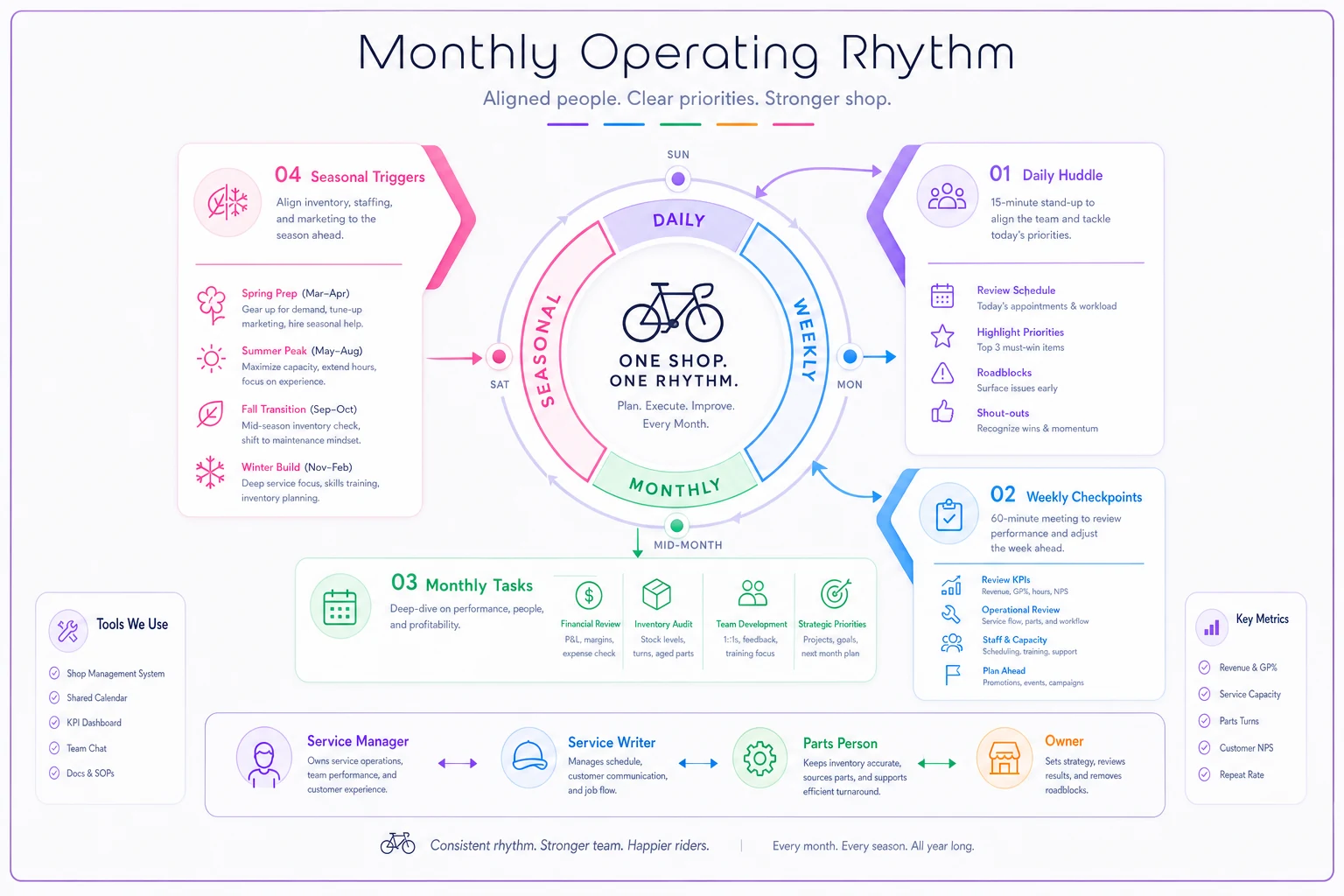
Worth calling out specifically: the shops that hold turnaround times steady through spring are almost always running a real morning huddle. It's ten minutes. It prevents the mid-afternoon discovery that three bikes promised for today haven't been started. If you've read our breakdown on turnaround SLAs and backlog policies, the daily huddle is where that SLA gets protected in practice.
Timebox the morning huddle to 10 minutes and keep it standing to maintain focus.
The reason you spread monthly tasks across the weeks is simple: owners who try to do "month-end" all at once during peak season just skip it. A reconciliation that takes six hours in one sitting won't happen in May. The same reconciliation broken into a weekly 45-minute spot-check plus one deeper Week-1 pass actually gets done.
Speak the same language: unified KPI definitions
Here's a subtle killer. You ask your service manager for "turnaround time" and they say 2 days. Your service writer thinks turnaround means drop-off to pickup. Your mechanic thinks it means wrench-time from when they start the job. The owner thinks it's from booking to pickup. Four people, four different numbers, all called the same thing. Now try to make a decision with that.
Unified KPI definitions aren't about having more metrics. They're about everyone agreeing on exactly what each number counts, so a conversation about performance isn't secretly a conversation about definitions.
For a bike shop, a tight core set looks like this — each one needs a one-sentence definition written down:
-
Turnaround time
hours/days from ticket created to customer notified ready. (Pick the endpoints and never change them.)
-
Bay utilization
booked wrench-hours ÷ available wrench-hours per week.
-
First-time fix rate
tickets closed without a return or rework, as a % of total.
-
Service gross margin
labor + parts revenue minus parts cost and direct labor, per ticket type.
-
Reorder hit rate
% of parts in stock when a ticket needed them.
-
Attach rate
accessory/add-on lines per service ticket.
The discipline is in the definition, not the dashboard. Write each one down, get the team to agree on it, and don't quietly redefine it next quarter because the new version looks better. If you want a deeper structure for wiring these into how the service floor actually runs, the service operations pillar goes through the KPI-to-SOP linkage in more detail.
One more thing most shops get wrong: they track revenue but not the inputs that produce it. Bay utilization and reorder hit rate are leading indicators — they move before revenue does. Watching only revenue is like driving by looking in the rearview mirror.
Decision gates: how to escalate before it's a fire
This is the piece almost every shop skips, and it's the one that separates a system from a to-do list. A decision gate is a pre-agreed rule: when this number crosses this line, this specific person makes this specific call.
Without gates, problems escalate emotionally — someone gets frustrated enough to say something. With gates, problems escalate mechanically, early, before a customer's already angry.
A few worth building:
-
Backlog gate
if open tickets exceed a set threshold (say, more than 3 days of wrench-work queued), the service manager stops taking non-urgent bookings and offers scheduled slots instead.
-
Stockout gate
if reorder hit rate drops below roughly 90% in a week, the parts person triggers a supplier review and considers a second source.
-
Margin gate
if any service type falls below target margin two months running, the owner reviews pricing or process before the next season.
-
Reconciliation gate
if POS and inventory variance exceeds a set dollar or percentage threshold, the owner pauses and investigates before it compounds.
The key is that the number pulls the trigger, not someone's mood. That's what lets you delegate. Your service manager doesn't need to guess whether a backlog is "bad enough" to act on — the gate already decided. That reconciliation gate ties directly into the routines covered in our inventory accounting and KPI dashboard piece, which is worth having open when you're setting your variance thresholds.
A realistic 30-day rollout
You don't deploy all of this at once. Here's how it actually goes in a shop that isn't shutting down for a week to reorganize:
Week 1 — Roles. Sit the team down and build the RACI together. One hour. Post it somewhere everyone sees it. Expect disagreements — that's the point.
Week 2 — Rhythm. Layer in the daily huddle and the three weekly checkpoints. Don't touch the monthly stuff yet. Just get the daily and weekly cadence to stick.
Week 3 — Language. Write the KPI definitions. Start actually recording two or three of them — turnaround, bay utilization, and reorder hit rate are the highest-leverage to begin with.
Week 4 — Gates. Set your thresholds and agree on who acts when each one trips. Run one full monthly reconciliation and one KPI review using the new definitions.
By day 30 you won't have a perfect machine. You'll have a shop running on agreed roles, a repeating calendar, shared definitions, and clear escalation rules. That's the whole model. Everything after that is tuning.
A real scenario
A three-bay shop doing somewhere around $650k a year — owner was also the lead mechanic — kept hitting the same wall every April. Turnaround stretched to 5–6 days at peak, customers grumbled, and the owner was working 60-hour weeks while reconciliation slipped for months at a time. The SOPs existed. Nobody ran them consistently.
They deployed a version of this model over about six weeks. The biggest single change wasn't complicated — it was the morning huddle plus a RACI that moved daily dispatch off the owner's plate onto the service manager. Once the service manager owned bay load with a defined backlog gate, peak turnaround settled back to roughly 2–3 days. The weekly reconciliation spot-check meant year-end books stopped being a nightmare, and one aging-inventory scan surfaced a couple thousand dollars of dead stock that had been sitting there for two seasons.
Nothing about it was revolutionary. Just the difference between having procedures and having a system that actually runs them.
When this makes sense — and when it doesn't
This model earns its keep once you've got more than one or two people and enough volume that handoffs happen regularly. If you're a solo operator doing everything yourself, a full RACI is overkill — you already know who's accountable. Focus instead on a simple weekly calendar and a couple of KPI definitions so that when you do hire, you're not documenting everything under fire.
Where it tends to go wrong: rolling out all four layers in one week during peak season. You'll get resistance, half-adoption, and a team that concludes the new system doesn't work. It works — but it needs the phased rollout, ideally started in a slower month.
And who should skip it entirely? Nobody, really. But the shop chasing a magic dashboard before fixing roles and routines is putting the cart before the horse. Software and dashboards make a working operating model faster and less manual — they don't create one. Get the RACI, calendar, definitions, and gates agreed on paper first. Once those are running, tools that centralize your ticket data, flag reorder points, and surface KPI variances automatically do save real hours — but only because there's a system underneath them to plug into.
Bringing it together
A pile of SOPs is potential energy. An operating model is what converts it into something the shop runs on every day without the owner standing over it. Roles say who. The calendar says when. KPI definitions say what "good" looks like. Decision gates say what to do when it isn't. Wire those four together and you've built something you can actually hand off — which is the only real path to a shop that grows past the limits of one exhausted owner.
Build it with your team, deploy it over 30 days, and tune it every month. No consultant required.
Build it with your team, deploy it over 30 days, and tune it every month. No consultant required.
Ready to revolutionize your bike shop operations?
Join hundreds of bike shops using Bicyclly to save time, increase revenue, and deliver exceptional customer service.