

You know that sinking feeling when a customer calls asking about their bike for the third time this week? Their tone has shifted from patient to annoyed, and you're scrambling through paper tickets trying to figure out where their repair even is in the queue.
Most bike shops handle service promises with gut instinct. Simple tune-up? Tell them 2-3 days. Major overhaul? Maybe a week. But what happens when your lead mechanic calls in sick, or that derailleur hanger arrives bent, or spring rush hits and suddenly you're drowning in 47 repair tickets?
Usually it's chaos. Customers get vague updates. Some repairs sit untouched for days while others jump the line because someone complained loud enough. Mechanics work on whatever's closest or easiest, not what's most urgent. And by the time you realize a customer has been waiting two weeks for a basic brake adjustment, they're already telling their riding group to avoid your shop.
A shop owner in the Pacific Northwest told me this exact story — a loyal customer who'd spent upwards of $4,000 with them over three seasons walked out over a brake job that took eleven days. No explanation. No update. Just silence until the customer finally drove in to pick it up himself.
Why Traditional Service Queues Break Down
First-in-first-out works fine when you're running 5-10 repairs a week. Once you hit 30+ tickets, that simplicity becomes a liability.
Different repair types have wildly different customer tolerance levels. Someone dropping off a winter storage bike in October can wait three weeks without complaint. The commuter who needs their daily ride back? Every hour matters. The racing cyclist with an event this weekend? They'll drive to another shop if you can't guarantee Friday pickup.
Most shops learn this the hard way. They lose their best customers — the daily riders and serious cyclists who actually spend real money — while somehow always having a backlog of low-margin tube changes and rusty chain replacements.
The breakdown happens in predictable stages. First, you start making promises based on hope rather than capacity. Then mechanics start cherry-picking jobs — gravitating toward quick wins or interesting problems while boring repairs sit. Communication falls apart next because nobody really knows where anything stands. Then you hit the death spiral: rushed work leads to comebacks, comebacks eat into new repair time, delays cascade, and you're weeks behind with no clear path out.
Building Your Service Tier Matrix
A proper bike shop service SLA turnaround starts with acknowledging that not all repairs are equal. You need distinct service tiers with clear rules about what goes where.
Never miss a sale or service appointment again.
Bicyclly helps you manage every sale, repair, and booking with ease and accuracy.
- Unified inventory and sales tracking
- Automated customer notifications
- Service appointment scheduling
No credit card required
-
Emergency Tier (Same Day/Next Morning) This catches true urgencies — bikes that customers genuinely cannot function without. Medical transport bikes, delivery rider vehicles, bikes needed for commuting tomorrow morning. Set the bar high. Maybe require a $25 rush fee or cap it at two slots per day. The point isn't to profit off the fee; it's to make sure only genuine emergencies use these slots.
-
Priority Tier (24-48 hours) Your bread and butter customers live here. Regular riders who use their bikes multiple times per week, club members, commuters who can miss one day but not three, parents whose kids ride to school. These repairs get guaranteed turnaround times and proactive communication.
-
Standard Tier (3-5 business days) Most repairs fall here. Weekend warriors, casual riders, standard tune-ups. Your baseline promise — reliable but not rushed.
-
Economy Tier (7-10 business days) Price-sensitive repairs, winter storage prep, bikes that have been sitting in garages for months. Customers choosing this tier get a discount in exchange for flexibility.
-
Project Tier (2-4 weeks) Full restorations, vintage bike overhauls, custom builds. These get scheduled during slow periods and worked on between other jobs.
The real value in this structure isn't the tiers themselves — it's connecting each tier to specific operational rules. Emergency tier repairs get assigned to your fastest mechanic immediately, even if it means pulling them off something else. Priority tier gets worked in specific time blocks — maybe 8am-10am when mechanics are fresh. Standard fills the regular workflow. Economy only gets touched when higher queues are clear.
One shop in Colorado resisted this structure for years. Their lead mechanic thought it was unnecessary overhead. Eighteen months after implementing something close to this, they cut their average turnaround from 6.5 days to just under 4, and their weekend rider segment — the most price-sensitive group they served — started booking ahead instead of shopping around.
Escalation Triggers That Actually Work
Static queues fail because they can't respond to reality. You need automatic escalation triggers that move jobs between priority levels based on actual conditions, not wishful thinking.
Time-based escalation is your foundation. If a Standard tier repair hasn't been touched in 36 hours, it automatically bumps to Priority. If a Priority job misses its promised window, it escalates to Emergency with an automatic manager notification.
Time alone isn't enough, though. You need compound triggers that factor in customer history and repair value. That Standard tune-up for a customer who spent several thousand on a bike last year? After 24 hours untouched, it should jump queues. The Economy brake adjustment sitting for 6 days? Maybe it stays put, but it triggers an automatic courtesy call explaining the delay.
Parts availability creates another escalation pathway. When a repair is waiting on parts, it drops one tier automatically (unless it's already at Economy). But when those parts arrive, it doesn't just return to its original tier — it jumps up one level to compensate for the wait. This prevents the very common scenario where bikes sit for days after parts arrive because nobody remembers they were urgent.
The Compensation Framework Nobody Talks About
What separates professional operations from hobby shops: predetermined compensation triggers that activate automatically, before customers complain.
Most shops wait until a customer is furious before offering anything. By then, trust is already gone. Build escalating compensation tiers instead, triggered by specific failure points.
Level 1: Missed Soft Promise (Original estimate off by 1 day) Automatic 10% service discount applied at checkout. No manager approval needed. Customer gets a text: "Your repair took longer than expected. We've applied a 10% service discount to your bill."
Level 2: Missed Hard Promise (Confirmed pickup date missed) 15% total bill discount plus a $25 credit toward future service. Triggered automatically when a promised date passes without completion.
Level 3: Significant Delay (3+ days beyond original estimate) 25% total bill discount, $50 future service credit, plus priority tier status on their next repair. Manager automatically notified to call the customer personally.
Level 4: Critical Failure (5+ days late or second missed promise) No labor charges — just parts cost. Written apology from the owner. Guaranteed 24-hour turnaround on their next three repairs.
Customers don't actually want free stuff. They want acknowledgment that their time was wasted and evidence you're taking it seriously. A systematic compensation structure shows professionalism, not desperation. A shop manager in Austin put it bluntly: "The moment we started sending automatic delay discounts before customers even asked, our negative reviews basically stopped."
Linking SLA Rules to Daily Dispatch
Your service level promises mean nothing if dispatch doesn't follow them. This is where most shops fail — they create solid policies but mechanics still grab whatever ticket is on top of the pile.
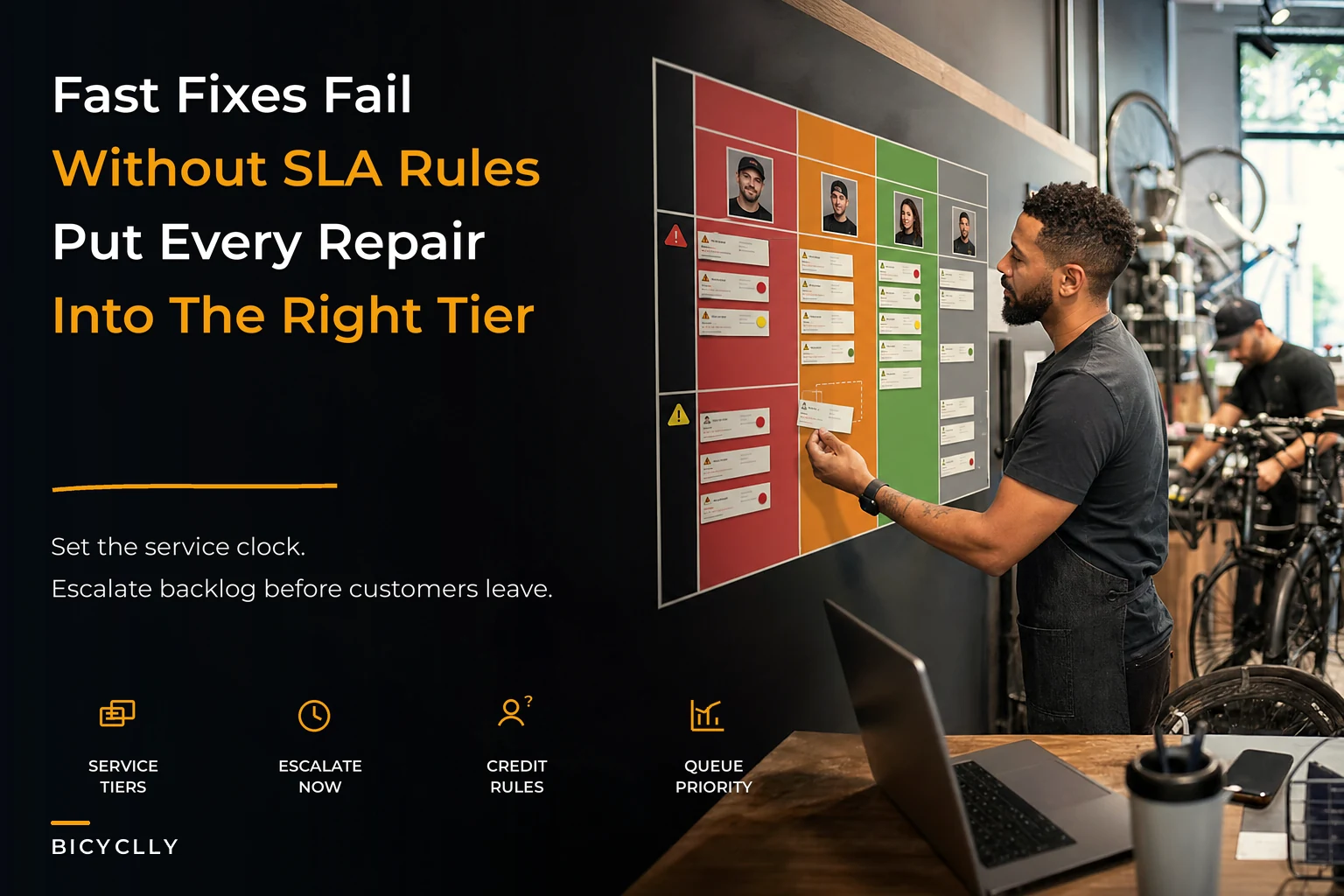
Start each morning with a dispatch board showing jobs sorted by true priority, not arrival order. Color-code by urgency: red for Emergency/overdue, orange for Priority, green for Standard, grey for Economy/Project.
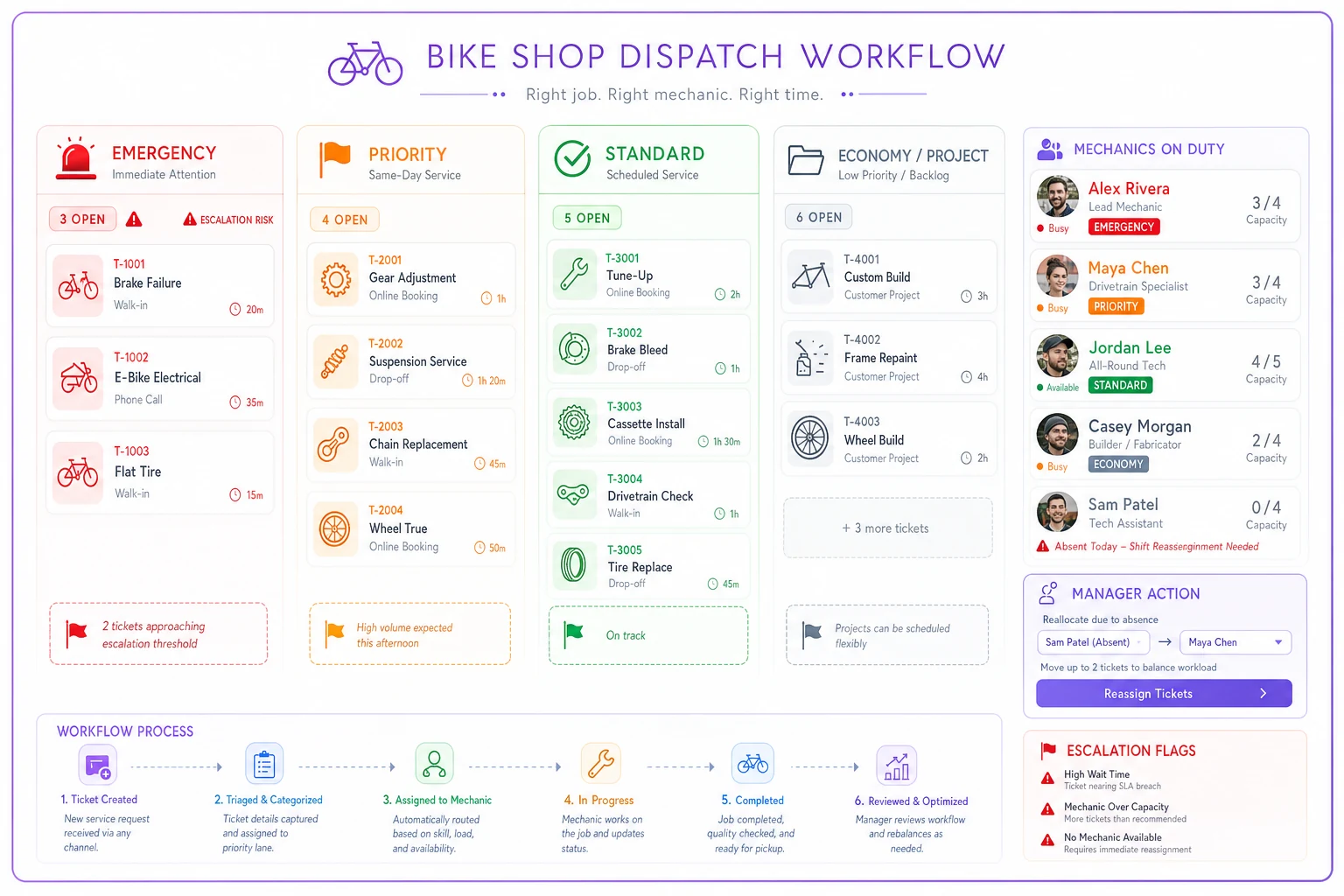
Each mechanic gets assigned tickets based on tier requirements, not preference. Your fastest tech handles Emergency and Priority jobs until those queues are clear. Your detail-oriented tech gets Project restorations. Your solid middle performer owns Standard. Only when higher tiers are clear can mechanics pull from lower ones.
The dispatch board also needs to show escalation warnings. That Standard repair auto-escalating to Priority in 4 hours? Flag it yellow now so someone grabs it before it jumps. The Priority job waiting on parts arriving this afternoon? Pre-stage it so it's ready the moment parts hit.
Some shops resist this structure, claiming it removes flexibility. The opposite is true. When everyone knows exactly what they should be working on, disruptions are actually easier to handle. Mechanic calls in sick? Redistribute their Emergency and Priority tickets first, let Standard and below slide a day. Surprise rush job walks in? You know exactly what gets bumped and by how much.
Communication Templates That Prevent Meltdowns
The difference between a patient customer and an angry one often comes down to proactive communication. But you can't rely on mechanics to remember to call everyone. You need templated messages that trigger automatically based on repair status.
Intake Confirmation (Automatic, immediate) "We've received your [bike make/model] for [service type]. Current estimated completion: [date based on tier]. You'll receive updates as work progresses. Reply RUSH if you need it sooner (rush fees apply)."
Delay Warning (Triggered 24 hours before original estimate) "Your repair is taking slightly longer than expected. New completion estimate: [date]. This delay qualifies you for a 10% service discount, already applied. Reply with questions."
Parts Delay Notice (Triggered when parts ordered) "We need to order parts for your repair. Expected arrival: [date]. Once parts arrive, your repair moves to priority status. No action needed from you."
Ready for Pickup (Triggered on completion) "Your [bike make/model] is ready! Pickup hours: [hours]. Your total: $[amount]. If you can't pickup within 48 hours, reply with a preferred date."
Escalation Alert (Triggered by compensation thresholds) "We sincerely apologize for the delay with your repair. As compensation, we've applied [discount/credit details]. Our manager will call you shortly to discuss priority completion."
Templates create consistency. Customers know they'll get updates. Mechanics don't waste time crafting individual messages. Everything gets documented automatically.
Measuring What Actually Matters
Most shops track the wrong things. They obsess over daily ticket count or total revenue but ignore the numbers that actually predict customer defection.
Your core bike shop service SLA turnaround metrics:
Promise Accuracy Rate: What percentage of repairs finish within the originally quoted timeframe? Anything below 80% means your estimates are optimistic at best. Below 60% means you're actively driving customers away.
| Metric | Target Range |
|---|---|
| Promise Accuracy Rate | 80–90% |
| Tier Violation Rate | Under 5% |
| Escalation Frequency | 10–15% |
| Compensation Cost | Under 2–3% of service revenue |
| Proactive Communication Ratio | 4:1 or better |
| Comeback Rate | Under 3% across tiers |
These numbers aren't gospel. A small-town shop running 15 tickets a week will look different than a city shop running 60. The point is to track the trend, not hit a specific number on day one.
When Good Systems Hit Real-World Chaos
Even solid SLA systems get tested. Spring arrives and suddenly everyone remembers they own a bike. Your lead mechanic quits with no notice. A whole parts shipment arrives damaged. These moments separate professional operations from shops just winging it.
Surge protocols matter here. When ticket volume spikes above capacity, you don't just work faster and hope. You immediately shift to modified tiers: Economy tier closes to new tickets, Standard tier quotes extend by two days, Priority tier requires phone approval, Emergency tier prices increase. This sounds harsh, but customers prefer honest extended timelines to broken promises.
Staff shortages trigger different protocols. Instead of trying to maintain all tiers with reduced capacity, temporarily consolidate. Emergency and Priority merge into "Urgent" with a 48-hour turnaround. Standard and Economy merge into "Regular" with a 7-day turnaround. Projects go on hold. Simpler structure, fewer promises — but ones you can actually keep.
Parts crises require transparent communication above everything else. When supply chain disruptions hit, customers can handle delays if you explain what's happening. What they can't forgive is silence. An automatic parts delay notification — including realistic timelines and alternatives if available — goes a long way toward keeping trust intact.
The Hidden Psychology of Service Expectations
Most shop owners miss this: customers don't actually want everything done immediately. They want predictability and control.
A customer who knows their repair will take exactly 5 days is generally happier than one promised "2-3 days probably" — even if it ends up being 2. The uncertainty itself is the problem.
This should shape your entire SLA structure. Give customers meaningful choices. Let them pick their tier based on their actual needs, not your assumptions. Someone might happily choose Economy for their backup bike if it saves $30, while gladly paying Priority rates for their main ride.
The control element extends to communication preferences too. Some customers want every update, others just want to know when it's done. Build this into intake — a simple checkbox: "Updates: All / Problems Only / Completion Only." Takes five seconds but eliminates a surprising number of frustration points.
Customers also value transparency over optimism. A simple "Currently working on: Tuesday morning drop-offs" status board or website widget tells them more than vague promises ever could. They can see you're working through a logical system, not playing favorites.
Turning SLA Into Competitive Advantage
Most shops view service management as a necessary evil. The smart ones realize it's their biggest differentiation opportunity. Bikes are commodities. Parts are commodities. Reliable, predictable service is rare enough to build a real business around.
Start advertising your guarantees. "Priority repairs completed in 48 hours or they're free" sounds risky, but if your system works, you'll rarely pay out. Meanwhile, every competitor is still saying "we'll call you when it's ready."
Use your SLA data in marketing. "97% of repairs completed on schedule" makes a powerful poster. "Average turnaround: 3.2 days" beats vague promises every time. Real numbers build trust before customers even walk in.
Your service tiers also become natural upsell opportunities. That Economy customer who needs their bike sooner? Offer to upgrade to Priority for $20. The Standard customer worried about timing? Suggest Priority for peace of mind. These aren't pressure tactics when they're backed by real operational differences.
The Automation Advantage
Managing all these moving pieces — tiers, escalations, compensations, communications — sounds overwhelming on paper. It is, if you're trying to track everything manually or in someone's head.
Modern bike shop management platforms can automate the entire SLA workflow. Tickets get automatically assigned to tiers based on customer history and repair type. Escalation triggers fire without anyone watching the clock. Compensation gets applied and documented automatically. Messages go out at the right moments without manual intervention.
The real power isn't just automation — it's consistency. When your service communication is systematized, every customer gets the same quality experience regardless of which mechanic is working that day or how slammed the shop is.
AI-powered dispatch takes this further. It learns that Tuesday mornings trend toward commuter repairs, recognizes which mechanics are faster on brake jobs versus drivetrains, and flags when you'll likely need extra capacity based on ticket velocity. These patterns are invisible when you're managing everything manually. Surfaced automatically, they help you prevent problems rather than react to them.
The data compounds too. Over time you can see exactly where bottlenecks form, which services cause the most delays, which customers generate the most revenue per visit. Gut-feel management slowly gives way to something closer to evidence-based decision-making.
Making It Stick
Creating an SLA system is one thing. Getting your team to actually follow it is another.
Start with just two tiers: Priority (24-48 hours) and Standard (3-5 days).
Start with just two tiers: Priority (24-48 hours) and Standard (3-5 days). Run this for a month. Let mechanics get comfortable with the dispatch rules. Let customers get used to choosing their tier. Iron out the obvious problems before adding complexity.
Next, add your compensation triggers — but make them generous at first. Better to give away some discounts while learning than to set triggers too tight and create arguments at the counter. You can tighten them once you know your true capacity.
Communication templates come third. Start with just three: intake confirmation, delay notice, and ready for pickup. These cover the vast majority of situations. Add others only when specific needs emerge.
Finally, layer in your remaining tiers and escalation rules. By this point your team understands the logic. Customers trust your promises. You have real data showing what turnaround times you can actually achieve.
The whole implementation takes around 90 days. Month one, you're essentially running two systems — the old chaos alongside the new structure. Month two, the new system takes over but still feels awkward. By month three, it's just how you operate. Mechanics dispatch themselves. Customers self-select into appropriate tiers. Problems get caught before they cascade.
The Payoff
A functioning SLA system changes more than just your service department.
Customer complaints drop because most triggers for complaints simply disappear. When repairs finish on schedule and customers get proactive updates, there's not much to complain about. The complaints that remain tend to be about quality, not timing — and that's a much more manageable problem.
Revenue per repair increases through tier upgrades and fewer panic discounts. Customers willingly pay for Priority service when they trust you'll actually deliver. And you stop giving away desperate discounts to angry customers because they rarely get that angry anymore.
Mechanic productivity improves too. When techs aren't constantly interrupted by "where's my bike?" calls, they work through their queue methodically and get more done.
The biggest change, though, is trust. Customers start referring friends because they know those friends will get the same reliable experience. Your reviews shift from complaints about delays to comments about professionalism. You become the shop that actually does what they say they'll do.
That trust compounds slowly. Regular customers learn your system and start self-managing — choosing Economy tier for winter storage, Priority for race prep, scheduling during slower periods because they know they'll get better turnaround. The shop runs smoother because customers become part of the process instead of sources of friction.
The shops that survive the next decade won't necessarily have the best mechanics or the biggest inventory. They'll be the ones that turned service from chaos into something reliable — systems that deliver consistent experiences regardless of daily disruptions. That transformation starts with admitting that "we'll call you when it's ready" isn't good enough anymore.
Ready to revolutionize your bike shop operations?
Join hundreds of bike shops using Bicyclly to save time, increase revenue, and deliver exceptional customer service.