



Most bike shops selling across more than one channel don't have an omnichannel strategy. They have a collection of habits. Someone lists a leftover 2023 model on a marketplace when it stops moving on the floor. A staff member rents out a demo when a customer asks nicely. A trade-in gets photographed and posted to classifieds on a slow afternoon. Each decision is defensible on its own. Together, they quietly erode margin — because nobody is running the numbers per channel, and nobody has written down what happens when a unit needs to move, get rerouted, reprice, or come back.
A real bike shop omnichannel strategy isn't about being everywhere. It's about knowing what each channel actually costs you, having transfer rules that hold up under pressure, and embedding those rules into daily operations so a Saturday-shift employee makes the same call the owner would. That's the whole game. Below is a shop-sized playbook you can run without a finance degree — per-channel P&Ls, worked transfer-cost examples, fulfillment and reroute logic, repricing cadence, and a returns/restock governance matrix.
Why per-channel P&Ls matter more than total store margin
The reason channel decisions go sideways is that shops track profit at the store level, not the channel level. Your books show a healthy blended margin, so nobody questions where individual units are being sold. But blended margin hides the channels that are bleeding you.
A floor sale, a marketplace listing, a rental turn, and a classifieds flip all have completely different cost structures. The sticker price might look similar. The take-home is not. When you don't separate them, you make the classic mistake: moving inventory to the channel that feels easiest instead of the one that actually nets more.
| Line item | Floor sale | Online marketplace | Rental (per season) | Classifieds |
|---|---|---|---|---|
| Sale/revenue | $899 | $899 | ~$540 (est. season revenue) | $820 |
| Acquisition/cost basis | $520 | $520 | $520 (retained asset) | $520 |
| Platform/referral fees | $0 | ~$115 (13%) | $0 | ~$25 |
| Payment processing | ~$26 | ~$26 | ~$16 | ~$20 |
| Fulfillment/shipping | $0 | ~$70 | $0 | $0 |
| Prep/recon labor | ~$40 | ~$40 | ~$60 (season prep + resets) | ~$40 |
| Photography/listing time | ~$8 | ~$18 | $0 | ~$18 |
| Returns/dispute reserve | ~$5 | ~$40 | ~$25 | ~$10 |
| Net contribution | ~$300 | ~$70 | ~-$121 (year 1) | ~$187 |
The floor sale nets four times what the marketplace does on the same unit. The rental loses money in year one and only starts earning after the asset is depreciated and resold. None of this shows up in blended store margin — it only shows up when you build the P&L per channel.
The uncomfortable insight: the channel that feels most modern and scalable — online marketplaces — is frequently your worst per-unit performer once you load in fees, shipping, and dispute reserves. That doesn't mean you abandon it. It means you use it deliberately — for reach, for dead stock, for units the floor can't move — not as a default.
For a deeper mechanical walkthrough of building these comparisons and deciding when a transfer is actually worth it, the small-shop channel P&L and transfer-cost toolkit covers the underlying math in more detail.
Transfer cost: the number that decides every reroute
The most expensive mistake in multi-channel selling is treating transfers as free. Moving a unit from the floor to a marketplace, or pulling a rental to sell it, has real cost — and if the transfer cost exceeds the margin gain, you just paid to lose money.
Never miss a sale or service appointment again.
Bicyclly helps you manage every sale, repair, and booking with ease and accuracy.
- Unified inventory and sales tracking
- Automated customer notifications
- Service appointment scheduling
No credit card required
A worked example. Say a road bike has been on the floor for 140 days at $1,299. You're considering relisting it online where it might move faster.
-
Delisting/repricing labor
~$12
-
New photography for the platform
~$22
-
Listing creation + spec entry
~$18
-
Repackaging/prep for potential shipping
~$35
-
Platform fee at new price ($1,199)
~$156
-
Incremental processing delta
~$9
-
Higher return/dispute reserve
~$45
Total transfer cost: roughly $297.
If moving that bike online saves you 70 days of carrying cost — financing, floor space, seasonal depreciation risk — you might recover $180–$240 over that window. On paper, the transfer still doesn't quite pay for itself. But if the bike is heading into off-season and would otherwise get slashed 30% in three weeks, the reroute suddenly makes sense.
The rule that falls out of this: never authorize a transfer without a transfer-cost number and a comparison against the cost of doing nothing. "Doing nothing" is a real, quantifiable option, and it's usually cheaper than shops assume.
Fulfillment and reroute rules that hold up on a busy Saturday
Rules only work if they're specific enough to run without judgment calls when the shop is packed. Vague guidance like "sell it wherever makes sense" always collapses into "sell it wherever is easiest," which defaults to whatever the last customer asked about.
A reroute decision flow you can post near the service desk:
-
Check age on channel. If a unit has been on the floor fewer than 45 days, it stays on the floor. No reroute discussion.
-
Check margin floor. Every unit has a channel-specific margin floor. If the proposed channel drops net contribution below that floor, it's blocked — even if it moves faster.
-
Run the transfer-cost number. Use a fixed reference card so any staff member gets the same figure.
-
Compare against carrying cost of staying. If transfer cost exceeds projected carrying cost saved, keep it where it is unless a seasonal cliff is coming.
-
Assign fulfillment ownership. Whoever authorizes the reroute owns the listing, the shipping prep, and the response window. No orphaned listings.
-
Set a re-review date. Every rerouted unit gets a date to reassess. Nothing lives on a channel indefinitely without another look.
The pattern worth naming: shops that skip step 5 end up with "zombie listings" — items posted months ago, never sold, never delisted, still showing as available while the physical unit was sold on the floor. That's how you end up canceling an online order and eating a platform penalty because you sold the same bike twice.
Use a fixed reference card so any staff member gets the same transfer-cost figure.
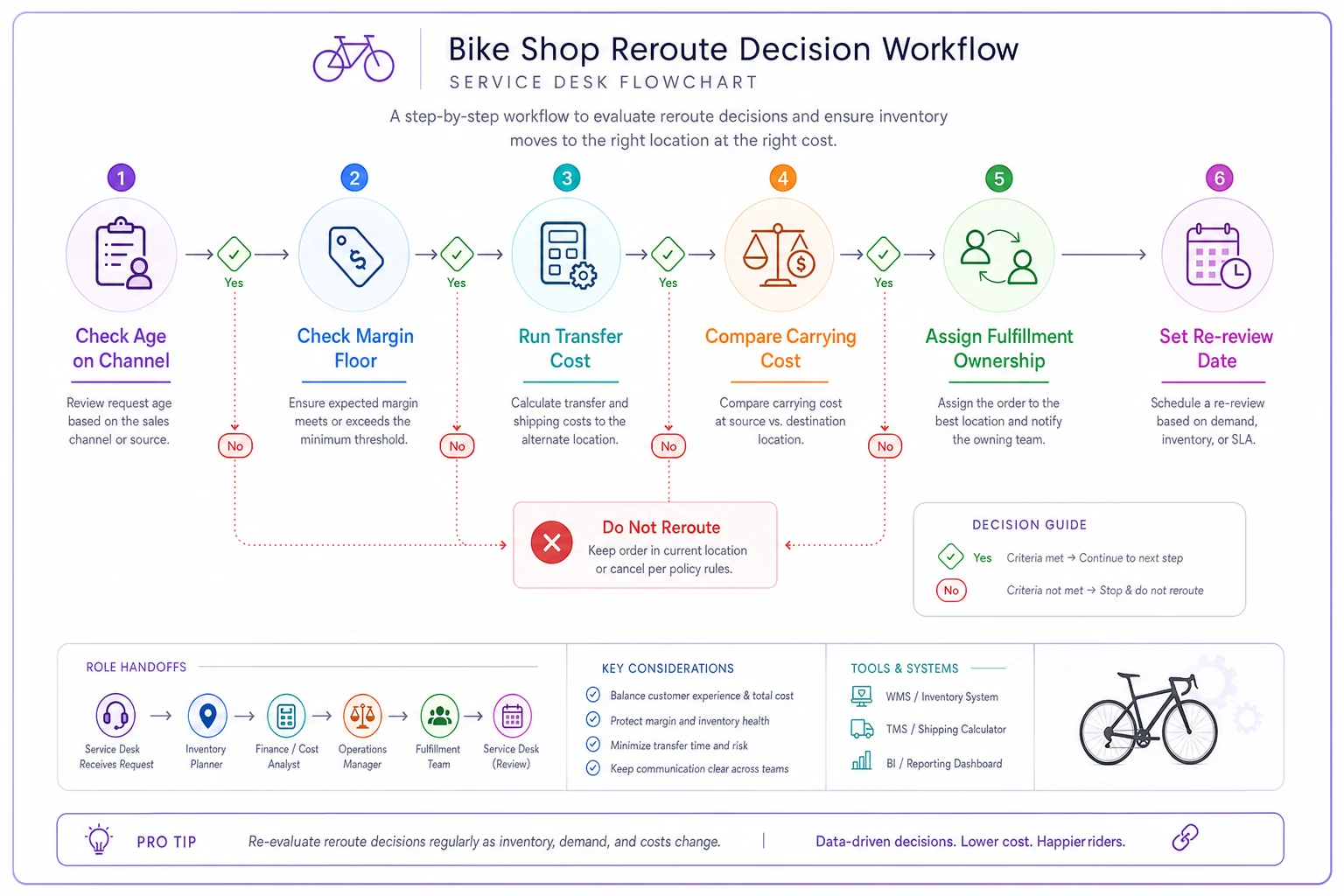
For rentals, the reroute rule needs an extra gate. A rental asset shouldn't be pulled for sale until it's crossed its depreciation breakeven, unless the resale offer clears both remaining book value and the lost future rental revenue. Pulling a profitable rental to make a quick sale is one of the quieter ways shops destroy returns on assets they've already paid to acquire and prep. Once the reroute decision is made, ownership and re-review date get logged before anything moves.
Repricing cadence: the discipline that separates margin winners
Repricing is where most omnichannel setups fall apart, because it's boring and it never feels urgent. So prices drift. A unit sits at its launch price for 200 days while the market moved, or it gets slashed in a panic at season-end when a scheduled step-down would have preserved margin.
-
New bikes review every 30 days against remaining season and inventory age. First markdown trigger at 60 days if below velocity target.
-
Used/trade-in units review every 21 days. These depreciate faster and sit in a more competitive market.
-
Marketplace/classifieds listings review every 14 days, because visibility decays and stale listings get buried.
-
Rentals reprice by season block, not continuously — but audit utilization monthly to catch assets that should be retired and resold.
The mistake isn't discounting too much or too little. It's inconsistency — some units get watched closely while others sit untouched for months. A fixed cadence removes the emotion and the neglect. The goal is a scheduled, rules-based step-down, not a reactive fire sale.
The listing-erosion side of this — how repricing rules interact with channel choice so you're not quietly giving margin away on every relisted unit — pairs well with this cadence. The channel decision matrix and repricing rules for new and used bikes goes deeper on the guardrails that keep repricing from becoming a margin leak.
Returns and restock: the governance matrix nobody wants to build
Returns are where omnichannel margin goes to die. A floor return is simple. A marketplace return involves shipping both ways, a possibly damaged unit, a dispute window, and a decision about whether the returned item goes back to the same channel or somewhere else. Without a governance matrix, every return becomes an improvised negotiation — and improvised negotiations favor the customer every time.
| Return scenario | Restock decision | Channel routing | Approval level |
|---|---|---|---|
| Unused, floor return, <14 days | Full restock | Back to floor | Staff |
| Unused, marketplace return | Restock if resalable | Reroute to floor (not relist online) | Shift lead |
| Used/opened, minor wear | Recon then restock | Used/classifieds channel | Shift lead |
| Damaged in transit | Assess repair cost | Part-out or clearance | Owner/manager |
| Rental return, damaged | Repair + charge deposit | Retain or retire | Owner/manager |
| Warranty/defect return | Supplier claim first | Hold pending resolution | Owner/manager |
The insight buried in that table: returned marketplace units should almost never go straight back onto the marketplace. They've already failed to satisfy one remote buyer, they've absorbed round-trip shipping cost, and relisting them online just risks a second return. Route them to the floor where a customer can inspect in person. Your return rate on that unit drops dramatically.
Trade-ins deserve their own governance line because they're the most commonly mishandled restock category — units get valued once, relisted at the wrong channel, and never reconciled against their true reconditioning cost. If trade-ins are a meaningful part of your mix, the valuation, reconditioning, and resale rules for shops lays out how to keep them from silently eroding margin. Getting this right matters more than most shops expect.
A daily-ops checklist to embed the rules
Rules that live in a binder don't change behavior. Rules that live in a daily checklist do. This is the version you actually run each day so the playbook stops being theoretical:
-
[ ] Review any units crossing an age threshold today (floor, used, or online)
-
[ ] Check for zombie listings — anything sold physically but still live online
-
[ ] Confirm every rerouted unit from yesterday has an owner and a re-review date
-
[ ] Process returns strictly by the governance matrix, no verbal exceptions
-
[ ] Log transfer costs for any reroute authorized (so the numbers stay honest)
-
[ ] Flag any rental past its utilization/depreciation threshold for resale review
-
[ ] Reconcile marketplace order status against physical inventory before end of day
The seventh item is the one most shops skip and most regret. The gap between "what the marketplace thinks you have" and "what's physically on the floor" is where oversells, cancellations, and platform penalties come from. Closing that gap daily is worth more than any single pricing tweak.
It sounds tedious, but it takes maybe ten minutes and it eliminates the class of problems that actually damage customer relationships and platform standing.
A real scenario: the three-channel shop that stopped guessing
A shop running a floor plus an online marketplace and occasional classifieds listings was doing roughly $60k–$70k a month in blended revenue and couldn't figure out why margin felt thin despite strong sales. Everything sold, but the take-home never matched the top line.
When they built per-channel P&Ls, the picture snapped into focus. About 30% of used-bike revenue was flowing through the marketplace at a net contribution near $70 per unit, while nearly identical bikes sold off the floor at $280–$310. Staff had been defaulting to online listings for used bikes because it "felt productive" — but they were quietly moving the highest-margin units through the lowest-margin channel.
They changed three things: used bikes now stay on the floor for a mandatory 30-day window before any online listing, marketplace returns route back to the floor instead of getting relisted, and every reroute requires a logged transfer-cost number. Nothing dramatic. No new hires, no new platforms.
Over the following quarter, blended margin on used units improved by a few points and same-unit oversells dropped to near zero. Revenue barely changed. The money kept changed noticeably — a few thousand dollars a month that had previously been leaking through fees, avoidable returns, and mis-routed inventory.
When this level of structure makes sense — and when it doesn't
When it makes sense: You're running two or more real sales channels, you carry meaningful used and trade-in inventory, and you've noticed the gap between strong sales and weak take-home. Once you cross roughly 150–200 units moving across channels annually, informal habits stop scaling and the rules start paying for themselves.
When it's overkill: If you're a floor-only shop with the occasional one-off online listing, you don't need a governance matrix. You need a good floor and a repricing cadence. Building elaborate channel P&Ls for a single meaningful channel is effort spent where it won't return.
Who should not do this yet: Shops still fighting basic inventory accuracy. If your POS and physical counts don't agree, per-channel P&Ls will just be precise numbers built on bad data. Fix inventory reconciliation first, then layer channel governance on top of a foundation you actually trust.
Pulling it together
An omnichannel operation isn't a marketing posture — it's a set of financial and operational rules that determine, unit by unit, where inventory should live, what it costs to move, when to reprice it, and what happens when it comes back. The shops that do this well aren't the ones on the most platforms. They're the ones who know exactly what each platform costs and have written the rules down clearly enough that a Saturday employee makes the same call the owner would.
Start with the per-channel P&L, because it exposes the channels you've been quietly subsidizing. Add transfer-cost discipline so reroutes stop being free in your head and expensive in reality. Lock in a repricing cadence so margin doesn't drift. Run the returns/restock matrix so the messiest part of multi-channel selling stops being an improvised loss. The revenue may not move much. The money you actually keep almost certainly will.
Ready to revolutionize your bike shop operations?
Join hundreds of bike shops using Bicyclly to save time, increase revenue, and deliver exceptional customer service.