


The carbon gravel bike sits on the stand, fully assembled. Wheels spin true, shifting clicks perfectly through all 12 gears. The mechanic signs off on the build sheet and moves it to the pickup area. Three days later, the customer's back—rear thru-axle came loose on their first gravel ride, and now they're questioning everything about the $4,800 bike they just bought.
This happens constantly every spring. Not because mechanics don't know how to build bikes, but because new bike assembly operates without the same rigor applied to repair work. Service departments run on work orders and checklists, but new bike builds often rely on individual mechanic habits and memory.
The Hidden Cost Structure of Inconsistent Assembly
Most shops track labor hours on repairs down to six-minute intervals, but new bike builds exist in this weird operational blind spot. A shop assembling 15-20 bikes monthly might have three different mechanics using three slightly different processes. One torques every bolt to spec, another eyeballs it based on experience, and the third falls somewhere between.
The economics get ugly fast. A single comeback on a new bike typically costs:
-
45-60 minutes of unplanned bay time
-
Lost opportunity for a $95 tune-up in that slot
-
Potential warranty claim paperwork (another 20 minutes)
-
Customer confidence that takes months to rebuild
More damaging—that customer tells their riding group about the loose axle. In smaller markets where most serious cyclists know each other, one bad assembly experience can redirect thousands in future sales to competitors.
Why Assembly Drifts Without Structure
The typical new bike assembly workflow looks deceptively simple. Bike arrives in box, mechanic builds it when there's downtime, customer picks it up. But this simplicity masks several failure points that compound over time.
Never miss a sale or service appointment again.
Bicyclly helps you manage every sale, repair, and booking with ease and accuracy.
- Unified inventory and sales tracking
- Automated customer notifications
- Service appointment scheduling
No credit card required
Assembly often gets squeezed between repair appointments. A mechanic starts building a bike at 2 PM, gets pulled away for a walk-in flat fix, then rushes to finish before close. Critical steps get abbreviated or skipped entirely—especially the non-visible ones like checking spoke tension or verifying brake pad alignment under load.
Manufacturer documentation varies wildly. Trek provides detailed PDI sheets with torque specs clearly marked. Some direct-to-consumer brands include a single page of broken English and drawings that look hand-sketched. Mechanics default to general knowledge, which works until it doesn't.
Customer handoffs happen wherever the salesperson happens to be when the buyer arrives. Sometimes in the parking lot, sometimes at the register, rarely with any consistent process. The customer rides away not knowing what they should check after their first few rides, what sounds are normal during break-in, or when they should return for their complimentary adjustment.
Building Your Assembly Pipeline
A proper bike shop new bike assembly checklist starts before anyone touches a wrench. The operational framework needs three integrated components: standardized build stations, quality gate documentation, and customer interaction protocols.
Physical Assembly Station Setup
Designate specific stands for new bike assembly, separate from repair bays when possible. This prevents the constant shuffle between repair and assembly work. If space limits you to shared stands, establish time blocks—mornings for assembly when minds are fresh, afternoons for repairs when customer flow peaks.
Stock each assembly station with:
-
Torque wrench set (2-8 Nm, 5-15 Nm, and 10-60 Nm ranges minimum)
-
Digital caliper for checking rotor alignment
-
Spoke tension meter
-
Fresh grease and carbon assembly paste
-
Cable tension gauge for mechanical builds
-
Bleed kit positioned within reach
Keep a dedicated, clearly labeled torque wrench at each station to remove the friction of fetching tools and increase compliance.
It's not just having tools available—it's removing friction from using them correctly. When a torque wrench sits in a toolbox across the shop, mechanics skip torquing "just this once."
The Three-Gate Quality System
Gate systems work because they create natural pause points where quality gets verified before proceeding. For bike assembly, three gates provide sufficient coverage without overcomplicating the process.
Gate 1: Pre-Assembly Inspection
Before any assembly begins, document:
-
Frame condition (photograph any existing marks)
-
Component inventory against spec sheet
-
Serial number recording
-
Special order modifications noted
This gate catches shipping damage, missing parts, and spec discrepancies before labor gets invested. A shop processing $300,000 in new bike sales annually might catch 3-4 significant issues monthly at this gate—problems that would otherwise surface during customer pickup.
Gate 2: Mechanical Completion
After physical assembly but before test ride:
-
Every torque-critical fastener checked against spec sheet
-
Wheel dish and tension verified
-
Brake bed-in procedure completed
-
Derailleur hanger alignment checked
-
Headset and bottom bracket play tested
Document actual torque values, not just checkmarks. When a customer returns with an issue, you need evidence of what was actually done, not just what should have been done.
Gate 3: Test Ride and Final Prep
The test ride isn't just spinning around the parking lot. Create a specific route that includes:
-
Hard braking from 15+ mph
-
Full-range shifting under load
-
Standing climb simulation
-
Rough surface (if possible)
-
High-speed stability check
Post-ride, perform final adjustments and complete customer paperwork package.
Here's a simple visual showing how the three gates fit into the assembly flow.
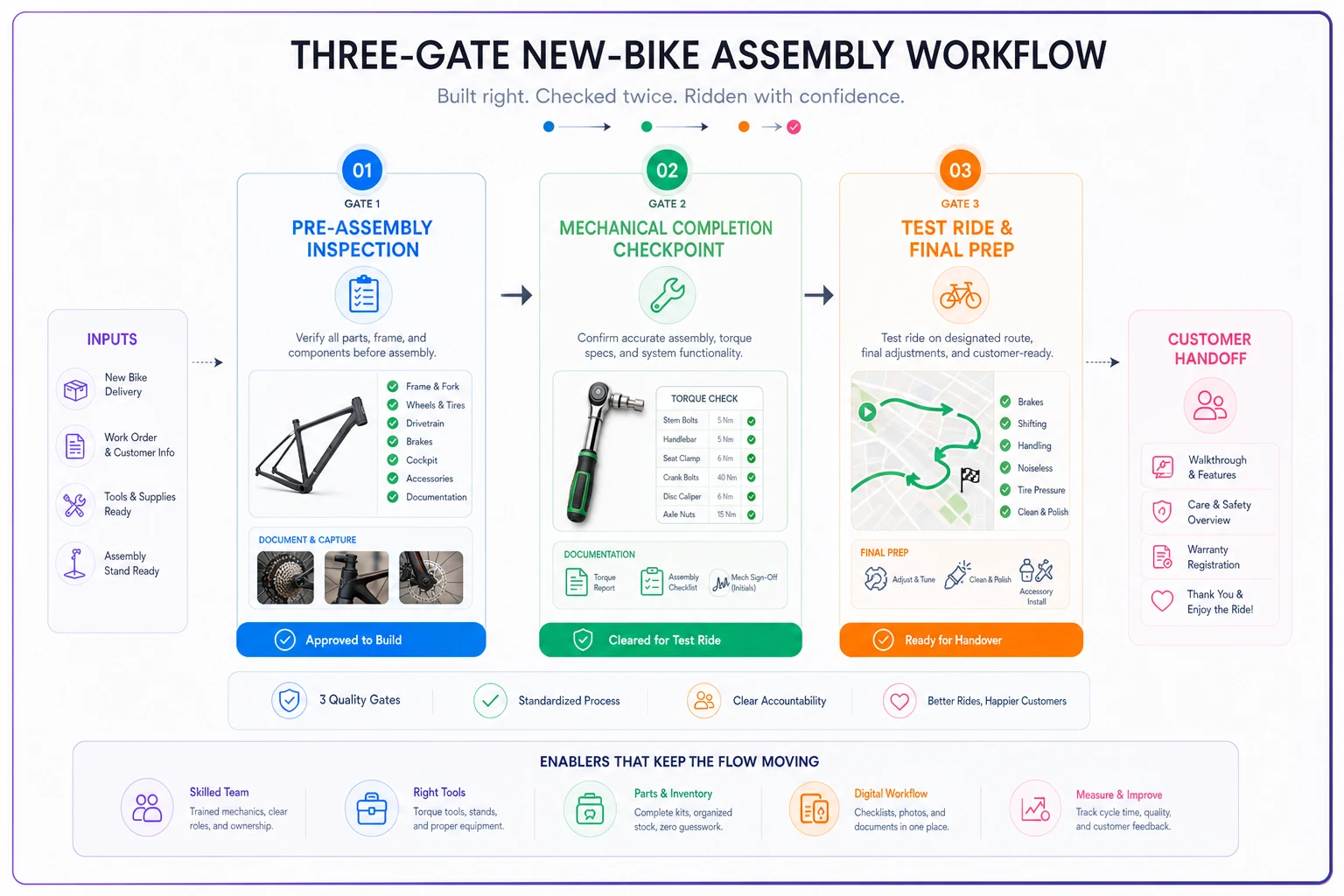
Place this graphic near your assembly stations and digital SOPs so everyone understands the handoffs.
Torque Specifications and Documentation
This is where most shops stumble—they know torque matters but don't systematically track it. Modern carbon frames and components have narrow torque windows. Too loose risks failure; too tight can crack carbon or strip threads.
Create a shop-specific torque database that supplements manufacturer specs:
| Component | Manufacturer Spec | Shop Standard | Notes |
|---|---|---|---|
| Stem bolts (carbon steerer) | 4-6 Nm | 5 Nm | Carbon paste mandatory |
| Seatpost clamp | 5-7 Nm | 6 Nm | Check frame manufacturer override |
| Thru-axles (rear) | 12-15 Nm | 13 Nm | Recheck after test ride |
| Brake caliper bolts | 6-8 Nm | 7 Nm | Blue threadlock on non-removed |
| Bottle cage bolts | 3-4 Nm | 3 Nm | Rivnuts strip easily |
The "Shop Standard" column prevents decision fatigue. Instead of mechanics choosing within ranges, they hit consistent numbers every time. This standardization makes troubleshooting easier—if something loosens, you know exactly what torque was initially applied.
Track torque application digitally when possible. A simple spreadsheet linking bike serial numbers to applied torque values creates an audit trail. When warranty claims arise, you have documentation showing professional assembly to manufacturer specifications.
Customer Handoff Scripting
The delivery moment shapes the entire ownership experience, yet most shops wing it. A scripted handoff ensures consistent information delivery while maintaining personal connection.
The script framework covers five essential areas:
Safety Verification
"Let me show you three things to check before each ride..." Walk them through quick-release/thru-axle security, brake function, and what unusual sounds might indicate. Demonstrate physically—don't just describe.
Break-In Expectations
"During your first 50 miles, you might notice..." Cover normal cable stretch, brake pad bedding, and slight spoke settling. Set expectation that minor adjustments are normal, not defects.
First Service Scheduling
"We've scheduled your complimentary 30-day adjustment for..." Book it immediately, right there during handoff. Open calendar, pick date, send confirmation. This prevents the common scenario where customers forget, miss the window, then feel cheated when charged for later adjustments.
Care Instructions
"For your specific bike, here's what matters..." Carbon frames need different storage considerations than aluminum. Electronic drivetrains have different maintenance schedules than mechanical. Provide written care sheets customized by bike type.
Contact Protocol
"If anything feels different or concerning..." Give them direct service line access, not general shop number. Set response time expectations. Make them feel supported, not abandoned post-purchase.
Technology Integration Without Overcomplication
Modern shops increasingly rely on operational software to coordinate these processes. The right platform can transform assembly from a squeeze-in task to a profit center. Quality bike assembly software tracks build progress through gates, maintains torque records, and triggers customer communications automatically.
When a mechanic completes Gate 2, the system can automatically generate the test ride checklist for Gate 3. When Gate 3 completes, it triggers a customer notification with pickup scheduling options. This automation ensures nothing falls through cracks during busy periods.
Choosing service operations software that understands bike shop workflows matters. Generic task management tools create more friction than they solve. Purpose-built platforms incorporate industry-specific needs like torque tracking, PDI documentation, and warranty claim preparation.
Some shops resist technology integration, viewing it as unnecessary complication. But shops using systematic assembly tracking see roughly 60-70% fewer assembly-related callbacks. That's not just saved labor—it's preserved reputation and customer lifetime value.
When Standardization Makes Financial Sense
Not every shop needs military-grade assembly procedures. The investment in process development, training, and documentation needs to align with volume and risk exposure.
Shops should prioritize assembly standardization when:
-
Assembling more than 10 bikes monthly
-
Selling bikes above $2,000 regularly
-
Multiple mechanics handle assembly
-
Callback rates exceed 5% on new bikes
-
Expanding into carbon or electronic shifting
The math typically works around $150,000 annual new bike revenue. Below that threshold, informal quality control might suffice. Above it, the callback costs and reputation risks justify structured approaches.
Common Resistance Points and Solutions
"My mechanics know what they're doing" remains the most common objection to assembly standardization. And they're usually right—experienced mechanics possess deep knowledge. But knowledge and consistent application are different things.
Frame it as protecting the shop and mechanics from warranty disputes. When a customer claims improper assembly caused component failure, documentation becomes your defense. Without records, it's your word against theirs—and manufacturers often side with customers.
Another resistance point: "This will slow everything down." Initially, yes. Adding gates and documentation might add 15-20 minutes per bike initially. But compare that to the 60-90 minutes spent on each callback, plus the invisible cost of damaged reputation. Most shops find that after two weeks of adjustment, standardized assembly actually runs faster because mechanics stop second-guessing themselves.
Implementation Roadmap
Rolling out assembly standardization requires careful staging. Dumping a 50-point checklist on mechanics Monday morning guarantees failure. Phase the implementation:
Week 1-2: Torque Standardization Only
Start with torque specs. Post them at assembly stations. Require torque wrench use but don't document yet. Let mechanics adjust to consistent specifications.
Week 3-4: Add Gate 1
Introduce pre-assembly inspection. This gate typically faces least resistance because it catches problems mechanics already hate dealing with. Who wants to build half a bike before realizing the derailleur hanger's bent?
Week 5-6: Complete Gate System
Add remaining gates with documentation. By now, mechanics have experienced benefits from earlier phases. They've caught issues at Gate 1 that would've caused callbacks. Buy-in comes easier.
Week 7-8: Customer Handoff Scripts
Train sales staff on delivery protocols. Start with voluntary adoption—let enthusiastic staff demonstrate success to skeptics.
Week 9+: Continuous Refinement
Review callback patterns, adjust procedures accordingly. What seemed important theoretically might prove irrelevant practically, while unexpected issues might demand new checks.
Measuring Success Beyond Callbacks
Assembly standardization impacts multiple performance indicators beyond callback reduction:
Average assembly time stabilizes. Instead of ranging from 45 minutes to 2 hours depending on interruptions, builds consistently complete in 65-75 minutes. This predictability improves scheduling and capacity planning.
Customer satisfaction scores, particularly for first-time buyers, typically jump 15-20% within three months of implementation. New cyclists especially appreciate the structured handoff—it reduces anxiety about maintaining their investment.
Warranty claim approval rates improve. When manufacturers request assembly documentation, you provide comprehensive records instead of scrambling to reconstruct what happened months ago.
Mechanic job satisfaction often unexpectedly increases. Despite initial resistance, many mechanics report reduced stress when clear procedures eliminate guesswork and protect them from blame when issues arise.
The Compound Effect on Shop Operations
Standardized assembly creates ripple effects throughout shop operations. When new bikes consistently leave correctly assembled, service departments spend less time on warranty work and adjustments. This freed capacity can handle more profitable repairs.
Sales staff gain confidence knowing every bike gets built to the same high standard. They stop hedging during sales conversations, no longer worried whether "their" mechanic is working that day.
The shop's overall margin structure improves as labor gets allocated more efficiently. Instead of mechanics jumping between tasks, assembly happens in focused blocks with predictable output.
Standardization builds institutional knowledge. When experienced mechanics eventually leave, their expertise lives on in documented procedures. New hires onboard faster with clear quality gates guiding their development.
Next Steps and Priority Actions
Start tomorrow by picking your worst assembly pain point. If callbacks plague you, begin with torque standardization. If missing parts cause delays, implement Gate 1 pre-inspection. If customer complaints focus on poor explanation, script your handoffs.
Don't try to perfect everything before starting. A basic three-gate system running consistently beats an elaborate 50-point checklist that gets ignored during busy periods. Build momentum with small wins, then expand based on what your specific operation needs.
Document everything, even if it's just paper forms initially. Every bike assembled without documentation is a potential liability. Every bike delivered with comprehensive records is proof of professionalism that distinguishes you from competitors treating assembly as an afterthought.
The shops thriving despite online price pressure aren't just selling bikes—they're selling confidence through superior assembly and delivery experiences. When customers know their bike was built right, explained thoroughly, and backed by systematic quality control, they'll pay the premium and return for service. That's how professional assembly protects both margins and reputation in an increasingly competitive market.
Ready to revolutionize your bike shop operations?
Join hundreds of bike shops using Bicyclly to save time, increase revenue, and deliver exceptional customer service.