


Your inventory walks out the door every day. Not through sales — through the thousand small leaks that drain 2–4% of revenue annually. That missing derailleur hanger. The brake pads that vanished from the service counter. The chain tool someone borrowed and never returned. Each loss feels minor until you do the math and realize it's costing you somewhere between $8,000 and $15,000 a year on typical shop revenue.
The Real Cost of Inventory Leaks in Small Bike Shops
Bike shops face shrink challenges that most retailers don't. Unlike clothing stores where theft is the main concern, your inventory disappears through multiple channels. Parts get used in repairs without being recorded. Demo bikes lose components. Warranty replacements bypass normal inventory procedures. Staff borrows tools that quietly migrate between personal and shop toolboxes.
The financial hit compounds beyond just the lost product. When a missing part forces you to expedite-ship a replacement, you're eating shipping costs on top of it. When mechanics can't find tools, productivity drops. When inventory records become unreliable, you overorder some things and run out of others. One shop owner I know tracked the true cost of shrink — including all those secondary effects — and found it was eating 6% of gross margin. Not 2%, not 3%. Six.
Physical counts reveal the damage but don't prevent it. By the time you find discrepancies during a quarterly count, the trail is cold. You can't identify when items disappeared, who was working, or what broke down. The point is to implement controls that prevent shrink before it happens, while catching issues quickly when they do.
Week 1–2: Lock Down High-Risk Zones Without Disrupting Flow
Start with your most vulnerable inventory — small, expensive items that disappear easily. Cassettes, chains, brake sets, and tools account for disproportionate shrink relative to their footprint. These need physical barriers, not just policies.
Never miss a sale or service appointment again.
Bicyclly helps you manage every sale, repair, and booking with ease and accuracy.
- Unified inventory and sales tracking
- Automated customer notifications
- Service appointment scheduling
No credit card required
Build a parts cage using basic wire shelving units with backs, somewhere in the $200–300 range total. Position it behind your service counter where only service staff can access it. This isn't about distrust — it's about creating accountability. When parts require deliberate retrieval rather than casual grabbing, usage naturally becomes more intentional.
Position the parts cage behind your service counter to balance access and accountability.
Install simple slide-bolt locks on tool drawers and cabinets, about $3–5 each. These aren't high-security solutions. They're psychological barriers that make people pause. One shop found that adding locks to their specialty tool drawer reduced tool loss by around 70% — not because the locks were hard to open, but because mechanics had to consciously decide to unlock it rather than impulsively grabbing what they needed.
A parts ticket system for service area inventory is worth implementing early. When mechanics need parts, they write a quick ticket: what they're taking, which repair order it's for. Takes ten seconds but creates a paper trail. Use a clipboard with pre-printed forms. Basic documentation catches most of the "forgot to ring it up" losses that plague service departments.
For retail floor inventory, focus on sightlines rather than technology. Rearrange displays so high-theft items like lights, computers, and accessories are visible from your main counter. Move expensive pedals and saddles to a locked case or behind-counter display. The goal isn't Fort Knox — it's making casual theft inconvenient enough that opportunists move on.
Week 3–4: Institute Counting Rhythms That Actually Work
Full inventory counts are overwhelming and often inaccurate. Instead, targeted counting cycles catch discrepancies while they're still traceable — and keep the workload manageable.
Start with daily till reconciliation using a blind count method. Your closing employee counts the drawer without knowing what the POS says should be there, records their count on a simple form, then compares it to the system. This catches register errors immediately — incorrect change, missed transactions, whatever. The blind count matters. When employees know the target number, they unconsciously count toward it.
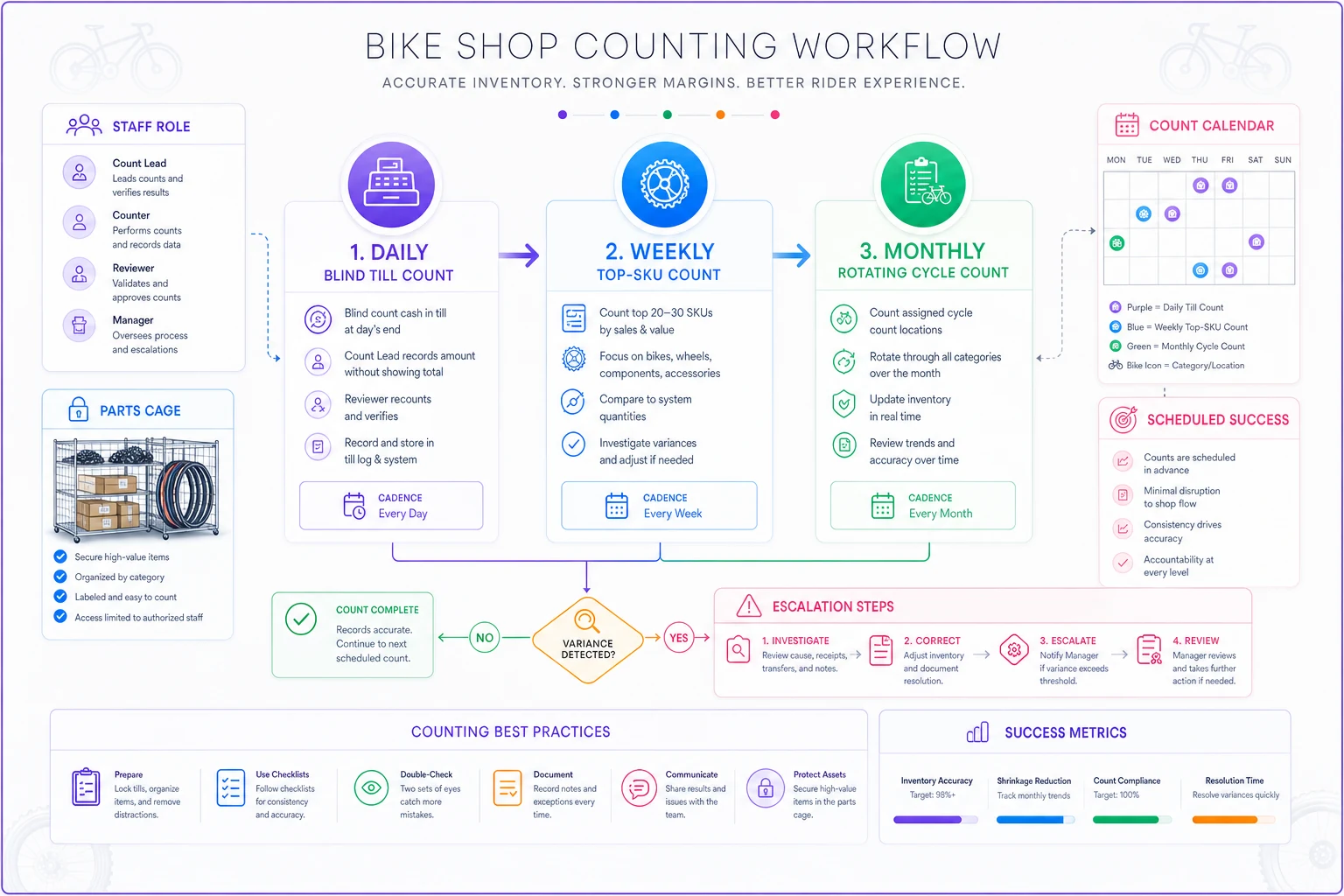
This visual shows the counting cadence and who is responsible at each interval.
| Count Type | Amount | Quantity | Total |
|---|---|---|---|
| $100 bills | |||
| $50 bills | |||
| $20 bills | |||
| $10 bills | |||
| $5 bills | |||
| $1 bills | |||
| Quarters (rolls) | |||
| Other change | |||
| Counted Total | |||
| POS Expected | |||
| Variance |
Set up weekly counts for your top 20 high-shrink SKUs. These are typically small, expensive, frequently handled items. Count them every Monday morning before opening. The consistency matters more than the specific day — when counts happen randomly, discrepancies get blamed on timing. When they're consistent, patterns emerge.
Monthly cycle counts should rotate through different sections. Week 1: tubes and tires. Week 2: chains and cassettes. Week 3: brake parts. Week 4: tools and accessories. Every item gets counted roughly quarterly, but the workload stays manageable — around 30 minutes per count.
The power here is immediacy. When you discover a discrepancy within days rather than months, you can actually investigate. You remember who worked, what repairs happened, whether anything unusual came up. One shop using this approach discovered their overnight cleaning crew was borrowing tools — and they only caught it because weekly tool counts showed items disappearing specifically on Tuesday nights.
Week 5–6: Build Investigation Protocols That Preserve Culture
Finding shrink without handling it properly can destroy morale. Employees feel accused, trust erodes, and shrink often increases as staff stops caring. Clear, consistent investigation procedures keep discrepancies framed as process issues rather than personal accusations.
Create investigation triggers based on variance thresholds:
-
Till variance over $10
immediate review
-
Parts inventory variance over $50
next-day investigation
-
Tool disappearance
same-day team meeting
-
Monthly shrink over 1.5%
formal audit process
Predetermined triggers remove the personal element. It's not about suspecting someone — it's about following established protocol.
Train your team on investigation scripts that keep conversations constructive. Instead of "Did you take this?" try "Help me understand what happened with this chain yesterday — walk me through how you processed it." The focus stays on understanding the process breakdown, not finding blame.
Here's a sample investigation conversation framework: Opening: "I need your help figuring out an inventory discrepancy. Our count shows we're missing [item]. You worked with this yesterday — can you walk me through what happened?" Probing: "What repair orders did you use it for? Did anything unusual happen? Did you need to open a new box? Did anyone else need that part?" Resolution: "Thanks for helping me understand. Let's make sure we're recording these correctly going forward. Here's what I need you to do differently..."
Document investigations consistently using a simple form — what was missing, when it was discovered, who was interviewed, what explanation was given, what process change was implemented. This serves two purposes: it creates accountability and reveals patterns. When three different employees give the same explanation for shrink, you've found a process problem, not a people problem.
Physical Controls Ranked by Impact and Cost
Some controls consistently deliver better returns than others. Here's how they stack up for typical small bike shops:
Highest Impact, Lowest Cost:
-
Parts cage for high-value items ($200–300)
Reduces parts shrink by 40–60%
-
Daily blind till counts (free)
Catches register discrepancies immediately
-
Parts requisition tickets (free)
Documents roughly 80% of service area usage
-
Locked tool storage ($50–100)
Cuts tool loss by 60–70%
Moderate Impact, Moderate Cost:
-
Numbered work order bins ($100–200)
Prevents parts mixing between jobs
-
Check-in/check-out tool board (~$50)
Creates tool accountability
-
Monthly cycle counts (labor cost)
Identifies shrink patterns
-
Security mirrors ($100–150)
Expands sightlines cheaply
Lower Impact, Higher Cost:
-
Camera systems ($500+)
Deters but doesn't prevent shrink
-
RFID tags ($1,000+)
Complex for small operations
-
Electronic article surveillance ($2,000+)
Overkill for most bike shops
Mechanical controls that require human action consistently outperform passive observation systems. A locked drawer that forces someone to find a key prevents more shrink than a camera that might catch them after the fact.
Building Tracking Systems That Stick
The difference between temporary improvement and lasting change is having systems simple enough to maintain when you're slammed. Complex tracking spreadsheets get abandoned during busy weeks. Multi-page audit forms get skipped when you're short-staffed.
Build one-page templates that capture essential information without overwhelming people. A blind count sheet shouldn't require calculations — just spaces to write numbers. A parts requisition slip needs three fields: part, quantity, work order number. Investigation forms should guide the conversation, not require essays.
Your tracking system should answer three questions:
-
What's our current shrink rate?
-
Where is shrink happening?
-
Is it getting better or worse?
A simple monthly dashboard handles this:
| Metric | This Month | Last Month | Target |
|---|---|---|---|
| Till Variance | $_ | $_ | <$50 |
| Parts Shrink % | ____% | ____% | <1.5% |
| Tool Losses | $_ | $_ | <$100 |
| Investigation Count | _ | _ | All triggers |
| Process Changes Made | _ | _ | 1+ |
Trends matter more than absolute numbers. If shrink is declining month over month, your controls are working.
The Reality of Sustaining These Controls
Most shrink prevention efforts fall apart around week 8 when initial enthusiasm wears off and old habits come back. Shops that sustain improvements share a few things in common. They make controls part of opening and closing routines rather than separate tasks. They share shrink numbers publicly. They frame it as protecting everyone's bonus pool, not protecting the owner's money.
One shop owner put it in a way that stuck with me: "I stopped talking about theft and started talking about accuracy. When we frame it as getting our counts right rather than catching thieves, everyone wants to participate."
The most effective reinforcement is making shrink numbers visible and tying them to something employees actually care about. Some shops celebrate improvements with pizza lunches. Others tie quarterly bonuses to keeping shrink under 2%. The specific incentive matters less than creating collective ownership of the problem.
When Physical Controls Aren't Enough
Certain situations require escalation. If shrink persists above 3% despite implementing these measures, you likely have targeted internal theft. If expensive bikes or frames disappear, you need law enforcement involvement. If patterns point consistently to specific individuals, you need HR protocols, not just operational ones.
This is where operational software can fill critical gaps. When manual counts and paper trails become overwhelming, AI-powered platforms can automate cycle counting, flag unusual patterns, and maintain audit trails without adding daily workload. The better systems integrate directly with your POS to flag variances automatically, schedule counts based on risk, and surface investigation triggers — turning shrink prevention from constant vigilance into exception-based management.
Implementation Priorities for Resource-Constrained Shops
If you can't do everything at once, here's the order that makes sense:
-
Week 1 Install physical barriers for high-value items. Even milk crates with padlocks beat nothing.
-
Week 2 Start daily blind till counts. This alone often reduces shrink by 0.5–1%.
-
Week 3 Implement parts tickets for the service department. Aim for 80% compliance, not perfection.
-
Week 4 Begin weekly counts of your top 10 high-shrink items. Focus on items that hurt most when they disappear.
-
Week 5 Create investigation protocols and train staff. Better to have clear procedures for big issues than try to investigate everything.
-
Week 6 Set up the monthly tracking dashboard. You can't improve what you don't measure.
Each layer builds on the previous one. Shops that try to change everything simultaneously usually change nothing permanently.
The Compound Effect of Consistent Controls
Shops implementing these controls typically see shrink drop 30–40% within the first month. By month three, that figure often reaches 50–60% from baseline. More importantly, the culture shifts. When everyone knows inventory is tracked, counted, and investigated, the casual attitude toward "borrowing" parts disappears.
The financial impact extends beyond recovered inventory. When your counts become accurate, you stop over-ordering safety stock. When tools stop disappearing, mechanics stop wasting time searching. When investigations follow clear protocols, you stop losing good employees who feel unfairly suspected.
One shop owner tracked their complete shrink-related costs before and after implementing these controls — reduced inventory loss, lower expedited shipping, improved labor efficiency, better purchasing decisions from accurate counts. They recovered close to $18,000 annually on implementation costs under $1,000.
The shops that successfully control shrink long-term embed these habits into daily operations rather than treating them as temporary initiatives. They maintain consistency even when it's inconvenient. The till gets counted on crazy Saturdays. Parts tickets get written during rush repairs. Investigations happen even when nobody wants to have uncomfortable conversations. That consistency sends a clearer message than any policy document ever will.
Start with the basics: lock up high-value items, count your till blind, and track what leaves your service area. Build from there based on where you're actually losing inventory, not where you assume you might be. Your merchandising strategy won't matter if inventory keeps walking out the door before customers ever see it.
Ready to revolutionize your bike shop operations?
Join hundreds of bike shops using Bicyclly to save time, increase revenue, and deliver exceptional customer service.