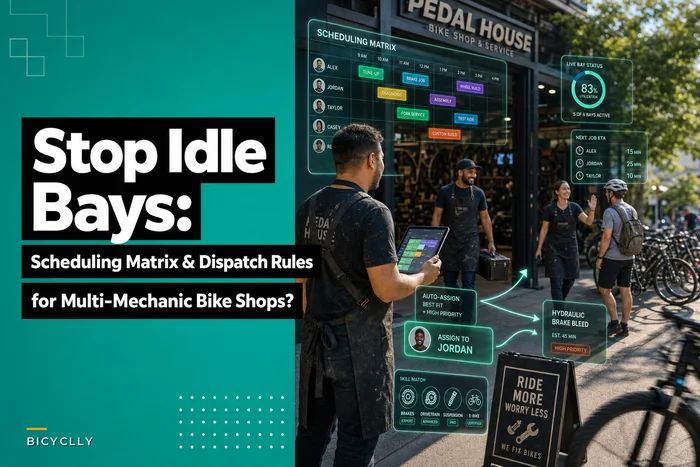


Walk into any bike shop service area during peak season and you'll spot the problem immediately. Your best mechanic is adjusting a derailleur while a junior tech struggles with a bottom bracket overhaul two stands over. Meanwhile, three tune-ups sit untouched because nobody knows who should grab them, and the shop owner has no real sense of whether they need another tech or just better dispatch rules.
This isn't a training problem. It's a systems problem that compounds every single day.
Most bike shops operate with informal skill assignments. "Dave handles the complex stuff, Sarah does tune-ups, Mike floats." But when Dave calls in sick, or Sarah gets promoted, or you hire someone new, the whole system breaks. Experienced techs end up doing basic work, junior techs attempt repairs beyond their skill level, and there's no way to predict how many bikes you can actually push through on any given day.
Why skill-based dispatch fails without structure
The typical progression looks familiar. You start with one mechanic who does everything. Then you hire a second person and split work loosely by complexity. Add a third tech and suddenly nobody's quite sure who should handle what. By the time you hit four or five mechanics, you're running on gut feel and whoever grabs the ticket first.
This creates three cascading problems.
First, you can't forecast throughput. Without knowing which tech level handles which repairs, you have no idea if adding another junior tech will actually increase capacity or just create more bottlenecks. Shops hire their way into worse service delays all the time because they added bodies without understanding their actual constraint points.
Second, pay gets disconnected from value delivery. Junior techs at $18/hour might generate the same ticket revenue as senior techs at $28/hour, depending on what lands in their queue. That creates resentment, turnover, and zero incentive for skill development.
Third, customer experience becomes inconsistent. A basic brake adjustment might take 15 minutes or 45 minutes depending on who grabs it. A complex suspension rebuild might come back perfect or need rework. Customers notice this variance, and it shows up in reviews.
Building a bike shop technician training skills matrix that actually drives operations
The solution isn't complicated, but it requires discipline. You need to map technician capabilities to specific repair types, then use that matrix to drive dispatch decisions, pay bands, and capacity planning.
Never miss a sale or service appointment again.
Bicyclly helps you manage every sale, repair, and booking with ease and accuracy.
- Unified inventory and sales tracking
- Automated customer notifications
- Service appointment scheduling
No credit card required
Level 1 repairs (can be learned in 2 weeks):
-
Flat fixes
-
Basic adjustments (brakes, shifting)
-
Accessory installs
-
Cleaning and lubrication
-
Cable replacement
Level 2 repairs (requires 3-6 months experience):
-
Wheel building and truing
-
Drivetrain overhauls
-
Basic suspension service
-
Hydraulic brake bleeds
-
Headset and bottom bracket service
Level 3 repairs (requires 1+ years and/or certification):
-
Full suspension rebuilds
-
Electronic drivetrain diagnostics
-
Frame modifications
-
Warranty assessments
-
Custom builds
Level 4 specialist work (requires manufacturer training):
-
E-bike motor diagnostics
-
Carbon fiber repair
-
High-end suspension tuning
-
Race prep and custom fabrication
Most shops stop here. They create these categories, maybe even post them on the wall, then drift back to old habits within a week. The matrix only works if it actually drives operational decisions.
Translating skills into dispatch rules
Your dispatch system needs hard rules, not suggestions. When a bike comes in, the intake process should immediately categorize the work and assign it to the appropriate skill level before anyone touches the bike.
Think of it like triage. Every repair ticket gets tagged with required skill level during write-up. Your service advisor needs a simple checklist that maps symptoms to skill levels.
Customer says "bike won't shift right"? That starts as Level 1 but might escalate to Level 2 if it needs a derailleur hanger alignment or cable replacement. Suspicious creak from the bottom bracket? Automatically Level 2. E-bike won't turn on? Straight to Level 4.
The point is removing decision-making from the dispatch process. Work requirements determine the assignment, not whoever happens to be free.
This connects directly to the scheduling matrix concepts we've covered before, but with skill levels as the primary constraint rather than just availability.
Pay bands that reflect actual value delivery
Once you have clear skill levels and dispatch rules, pay bands become math rather than negotiation.
Pull your last 90 days of repair tickets and calculate average ticket value for each repair level. A Level 1 tune-up might average $65 while a Level 3 suspension service averages $240. Factor in completion time and you can calculate hourly value generation per skill level.
Here's what this might look like for a typical shop:
| Skill Level | Avg Ticket Value | Avg Time | Value/Hour | Base Pay Range |
|---|---|---|---|---|
| Level 1 | $65 | 25 min | $156/hr | $16-19/hr |
| Level 2 | $120 | 45 min | $160/hr | $20-24/hr |
| Level 3 | $240 | 90 min | $160/hr | $25-30/hr |
| Level 4 | $380 | 120 min | $190/hr | $32-38/hr |
Notice how value per hour stays relatively flat for Levels 1-3? That's intentional. You're paying for capability and complexity handling, not just speed. Level 4 commands a premium because those skills enable high-margin work competitors can't offer.
Within each band, you can adjust based on efficiency, quality scores, and tenure. But the bands themselves should reflect operational reality, not arbitrary gut calls.
Progression paths that reduce turnover
Clear progression from Level 1 to Level 4 gives technicians an actual career path. But it can't be based on time served or who the owner likes. It needs objective criteria tied to demonstrated skills.
Create specific requirements for each level transition. Level 1 to Level 2 might look like:
-
Complete 200 Level 1 repairs with less than 3% comeback rate
-
Pass hands-on assessment for wheel truing and brake bleeding
-
Shadow a Level 3 tech for 40 hours
-
Complete online training modules for safety and efficiency
Level 2 to Level 3 requires deeper investment:
-
Complete 300 Level 2 repairs with less than 2% comeback rate
-
Obtain Shimano or SRAM technical certification
-
Lead a training session for Level 1 techs
-
Handle customer complaints independently
-
Demonstrate proficiency in suspension service
These aren't arbitrary hurdles. Each requirement builds skills that directly impact shop operations. The shadowing transfers knowledge. The certifications add credibility. The training sessions develop leadership. Most importantly, techs can see exactly what they need to do to move up.
Forecasting throughput based on skill mix
This is where the matrix becomes a real operational tool rather than just an HR document. Once you know what percentage of your work falls into each skill level, you can model staffing scenarios with actual numbers.
Categorize your last 90 days of repair tickets by required skill level. You might find something like 40% Level 1 work, 35% Level 2 work, 20% Level 3 work, and 5% Level 4 work.
At 400 tickets per month, that's 160 Level 1 repairs, 140 Level 2, 80 Level 3, and 20 Level 4.
Now factor in completion times and available hours. A Level 1 tech working 160 hours per month at around 80% efficiency can handle roughly 300+ Level 1 repairs if that's all they're doing. So you need about 0.5 FTE Level 1 capacity just for that tier.
Sketch the staffing model workflow like this:
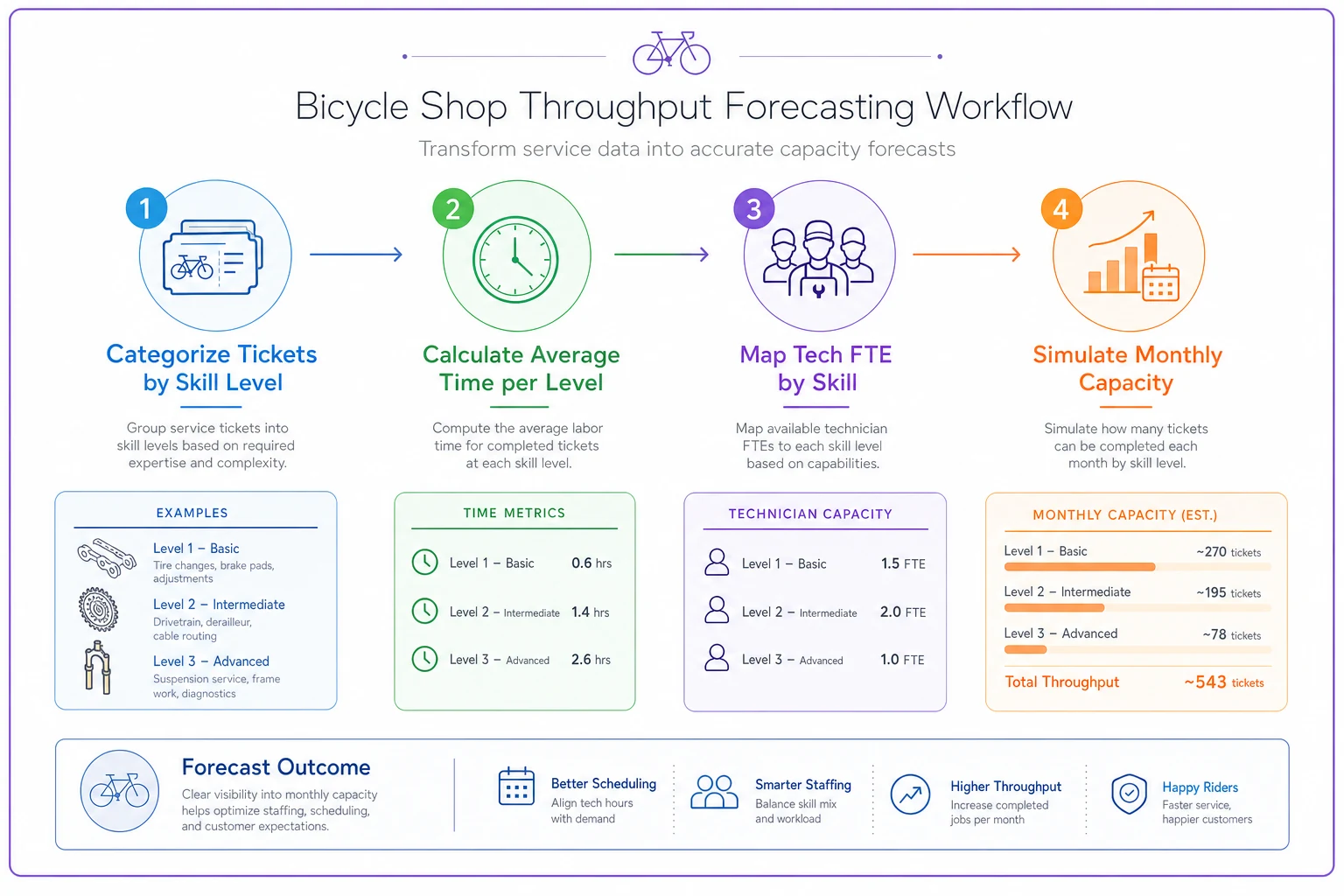
But Level 2 techs can handle Level 1 work when needed. Level 3 techs can handle everything below them. That flexibility matters when you're building the model.
The optimal mix usually isn't hiring to match exact demand at each level. It's creating slight overcapacity at higher levels to absorb surge periods. A shop processing 400 monthly tickets might run with one Level 1 tech, two Level 2 techs handling the bulk of repairs, one Level 3 tech covering complex work and overflow, and a Level 4 specialist splitting time with the sales floor. That gives you 4.5 FTE with built-in progression paths and real surge capacity.
Preventing skill bottlenecks before they happen
The biggest operational risk is losing a high-level tech without a succession plan. Your only Level 4 specialist quits and suddenly you can't service e-bikes. Both Level 3 techs leave and the Level 2s are doing work above their skill level while everything else backs up.
The matrix helps you spot these gaps before they become crises. As a baseline, you should always have at least one tech in active training for the next level up, overlap at critical skill levels so you're never relying on a single Level 3, cross-training for specialized skills, and documentation of shop-specific procedures.
When you see a gap forming, you have three options: train internally, hire externally, or reduce service offerings. Training a Level 2 up to Level 3 might take six months and cost around $3,000 in training investment, but hiring an external Level 3 might run $8,000 more annually. The math usually makes the decision pretty clear.
The hidden profit in proper skill allocation
When you actually implement this system, service capacity becomes predictable. You can tell customers exactly when their bike will be ready based on current queue depth and available skill-hours. No more "probably Thursday, maybe Friday" promises that erode trust.
Labor costs align with value generation. Your highest-paid techs work on your highest-margin repairs. Junior techs build skills on appropriate work instead of creating comebacks on jobs they weren't ready for.
But the biggest gain is eliminated friction. Service advisors stop wasting time figuring out who should handle what. Techs aren't standing around waiting for assignments or clarification. Staffing decisions get made on data instead of instinct.
A shop in Boulder implemented this system and went from an 18% comeback rate to under 4% in three months. Not because they hired better techs, but because work got routed to appropriate skill levels. Their senior tech stopped doing basic repairs and focused on high-margin suspension work. Revenue per labor hour jumped nearly 30%.
Making it work with operational software
Tracking all of this manually becomes a full-time job. Categorizing repairs, tracking tech certifications, monitoring completion times, calculating throughput, adjusting dispatch rules as your team changes — it adds up fast.
AI-powered operational software is what makes a good idea sustainable in practice. The platform can automatically categorize repairs based on service descriptions, track which tech handled what, monitor quality scores, and flag when someone's ready for advancement. More importantly, it can run dispatch automatically, routing work to the right skill level without someone manually checking a spreadsheet every time a ticket comes in.
Use automatic tagging rules at intake to reduce mis-categorized tickets and save advisor time.
The broader service operations structure supports this skills matrix approach, but automation is what keeps it running. Instead of hoping service advisors remember to check skill levels, the system enforces it. Instead of manually running throughput scenarios, you adjust staffing inputs and see projected capacity changes immediately.
When to implement vs. when to wait
Not every shop needs this level of structure right away. Two techs who've worked together for years and communicate well might not need formal dispatch rules.
But you should implement a skills matrix when:
-
You have 3+ techs with varying experience levels
-
Comeback rates are creeping above 5%
-
You can't predict weekly capacity
-
Pay feels arbitrary or unfair to your team
-
You're planning to add staff
-
Customer complaints mention inconsistent service
The longer you wait, the harder it gets. Cultural inertia sets in. Bad habits get entrenched. The informal system that worked with three techs becomes actively destructive with six.
Real numbers from implementation
A shop in Portland with 5 techs implemented this system last spring. Their breakdown:
-
1 Level 1 tech ($17/hour, 6 months experience)
-
2 Level 2 techs ($22/hour average, 2 years experience)
-
1 Level 3 tech ($28/hour, 5 years experience)
-
1 Level 4 specialist ($35/hour, 8 years experience)
Before implementation, they processed roughly 340 repairs monthly with an 8% comeback rate and no clear capacity ceiling. Work got assigned based on who was free, which meant the Level 4 specialist was doing tune-ups while complex repairs sat in queue.
-
Monthly capacity increased to 420 repairs
-
Comeback rate dropped to 3%
-
Labor cost per ticket decreased by around 12%
-
Customer satisfaction scores rose from 4.2 to 4.7
The Level 1 tech had a clear path to Level 2 and hit their certification requirements in month four. The Level 4 specialist stopped doing basic work entirely, freeing up 30% more time for high-margin repairs. Everyone knew exactly what they should be working on.
Conclusion
A bike shop technician training skills matrix isn't about creating bureaucracy. It's about turning chaos into predictable operations. When every repair gets routed to the right skill level, when pay reflects actual value generation, and when techs have visible progression paths, the entire service department runs better.
Shops still running on informal skill assignments and gut-feel dispatch will keep dealing with the same problems: unpredictable capacity, unfair compensation, high turnover, inconsistent quality. Shops with structured skills matrices can forecast demand, optimize labor costs, and actually scale.
The only real question is whether you implement this now while you have breathing room, or later when operational chaos forces your hand. The framework is straightforward. The math works. Stop letting mismatched skills eat your margins and start dispatching based on capability rather than whoever grabbed the ticket first.
A bike shop technician training skills matrix isn't about creating bureaucracy. It's about turning chaos into predictable operations. When every repair gets routed to the right skill level, when pay reflects actual value generation, and when techs have visible progression paths, the entire service department runs better.
Ready to revolutionize your bike shop operations?
Join hundreds of bike shops using Bicyclly to save time, increase revenue, and deliver exceptional customer service.