
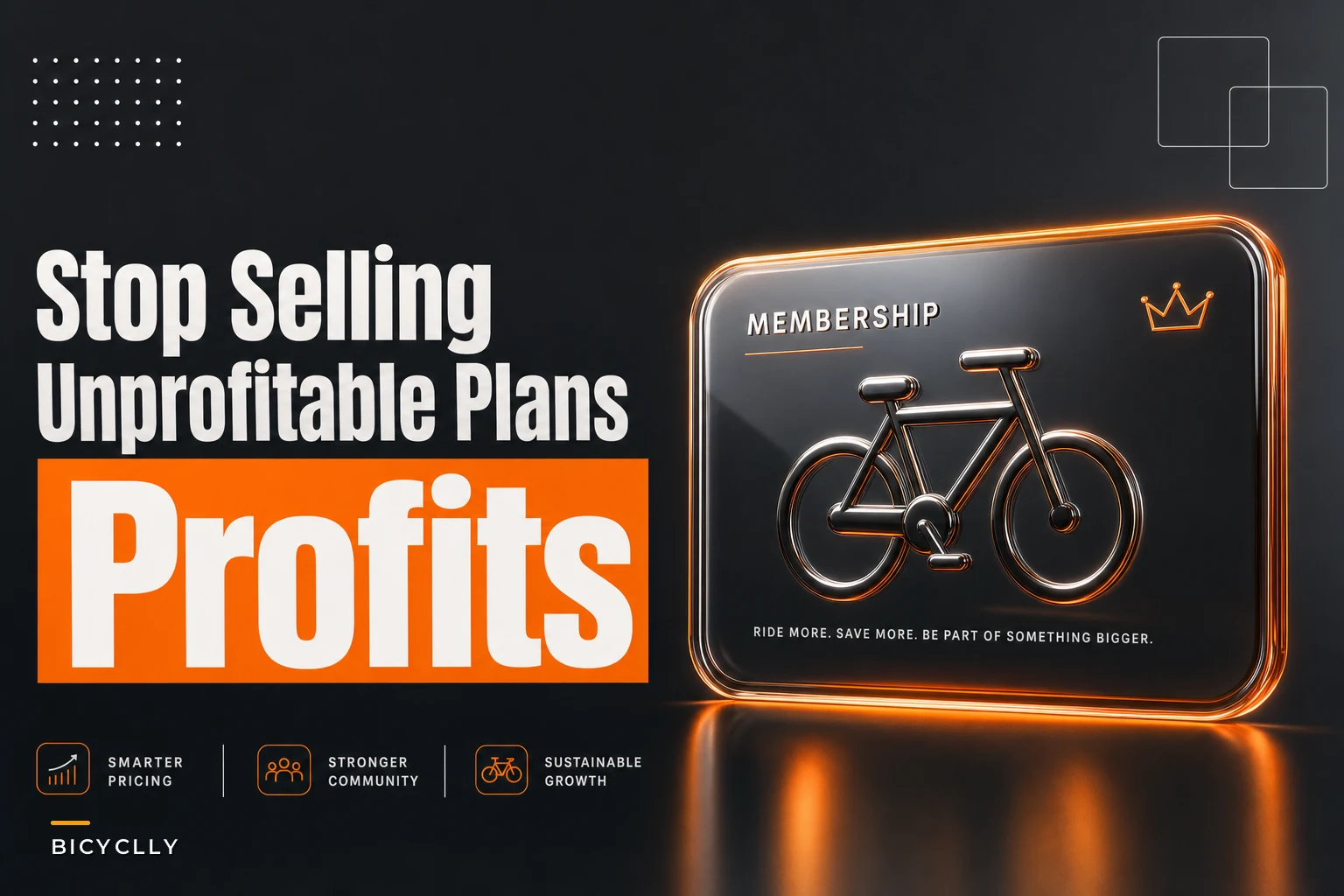

You know that membership program you launched last year? The one with unlimited tune-ups for $199 annually? Pull your actual numbers — you're probably losing money on every member who uses it more than twice.
After tracking real costs across dozens of bike shops running membership programs, the ones making money weren't the ones with the most members. They were the ones who understood their actual service economics and built tiers around customer behavior, not wishful thinking about what riders might want.
The membership math most shops get wrong
Take a basic tune-up membership at $15/month. Sounds reasonable until you map the actual economics.
Your standard tune-up runs $65 with about $8 in consumables and 35 minutes of labor at $28 cost. That's $36 total cost per service. At $15 monthly, you need members to use less than one tune-up every 2.4 months just to break even. Active cyclists during peak season? They're coming in monthly or more.
The real killer isn't the direct loss per service — it's how membership customers change their behavior once they've prepaid. That slight brake rub suddenly becomes worth a trip in. The derailleur that's "mostly fine" gets brought in for adjustment. Visit frequency jumps 40–60% on unlimited plans.
A shop in Denver showed me their membership data from last season. Their "VIP unlimited" tier at $299/year had 47 members. Sounds decent until you look at usage: 18 members used it 8+ times, with one guy hitting 14 visits. Average loss per heavy user ran around $280 annually. The light users who showed up twice couldn't offset that margin bleed.
Three membership tiers that actually work
The Maintenance Tier Price: $12–15/month Includes: Two basic tune-ups per year, 15% off additional services, free safety checks Why it works: Limits high-cost services while providing clear value. Members feel they're getting a deal, and you're not giving away unlimited labor.
Never miss a sale or service appointment again.
Bicyclly helps you manage every sale, repair, and booking with ease and accuracy.
- Unified inventory and sales tracking
- Automated customer notifications
- Service appointment scheduling
No credit card required
The Enthusiast Tier Price: $29–35/month Includes: Four tune-ups, one overhaul credit, 20% off parts, priority booking Why it works: Higher price point captures serious riders who value convenience. The overhaul credit feels premium but most won't actually use it.
The Commuter Package Price: $19/month Includes: Monthly safety check and minor adjustments, two full tune-ups, flat repair coverage Why it works: Targets daily riders who need reliability more than performance. Flat coverage sounds expensive but costs you maybe $12 in labor monthly at most.
Calculating your actual membership margins
Start with your average ticket frequency by customer segment. Pull last year's data and group customers by visit count. You'll typically find:
-
Around 60% visit once or twice annually
-
About 25% visit 3–4 times
-
Roughly 15% visit 5 or more times
For each segment, calculate total service value at rack rate, then apply your actual service margin — usually 55–65% for labor-only services. This gives you profit contribution per customer type.
Now the critical part: model how behavior shifts with membership. Across shops tracked over multiple seasons, expect visit frequency to increase something like this:
-
Light users (1–2 visits)
roughly 50% increase
-
Medium users (3–4 visits)
roughly 30% increase
-
Heavy users (5+ visits)
roughly 20% increase
Your membership price needs to cover that increased visit cost while maintaining at least 20% margin.
Example calculation for a $20/month membership:
| Item | Amount |
|---|---|
| Annual revenue | $240 |
| Expected visits (medium user with membership) | 5.2 visits |
| Cost per basic service | $36 |
| Total service cost | $187 |
| Other benefits cost (discounts, perks) | ~$30 |
| Total cost | $217 |
| Margin | $23 (9.6%) |
Too thin. Bump to $25/month and margin hits $83 (27.5%). That's actually sustainable.
Onboarding flows that reduce churn
The first 60 days determine whether members renew. Most shops sell the membership and then essentially forget the customer exists until renewal time rolls around.
-
Day 1 Membership kit with branded valve caps, a service schedule card, and a member ID tag. Physical items create perceived value beyond the services themselves.
-
Day 7 Email with a short video showing how to book services online, plus a reminder about included benefits. About half of members don't fully understand what they bought.
-
Day 30 Automated text checking if they need their first service, with a booking link. This drives first-service usage up around 40%.
-
Day 45 If nothing's been booked yet, send a "spring bike check" reminder with available slots. Frame it as protecting their investment.
-
Day 60 A thank you email with usage summary and tips for their bike type. Builds habit formation around membership benefits.
Members who use services within the first 45 days renew at more than double the rate of those who wait longer. Onboarding isn't about selling — it's about activation.
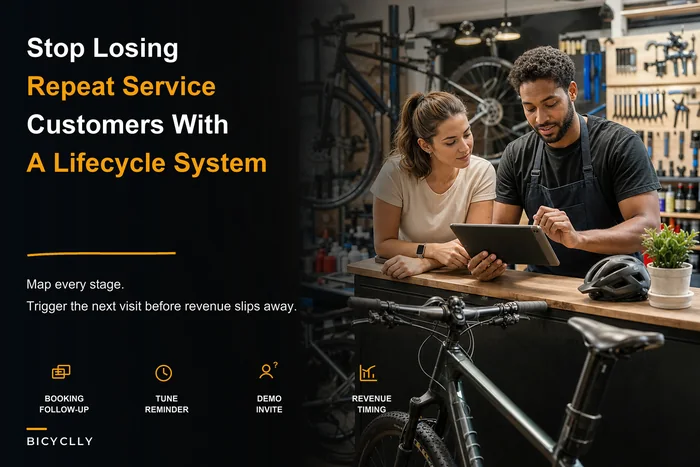
Membership onboarding and renewal workflow
Getting this sequence right matters more than almost anything else in your membership program. The shops that treat onboarding as an afterthought are the same ones wondering why renewal rates are stuck below 40%.
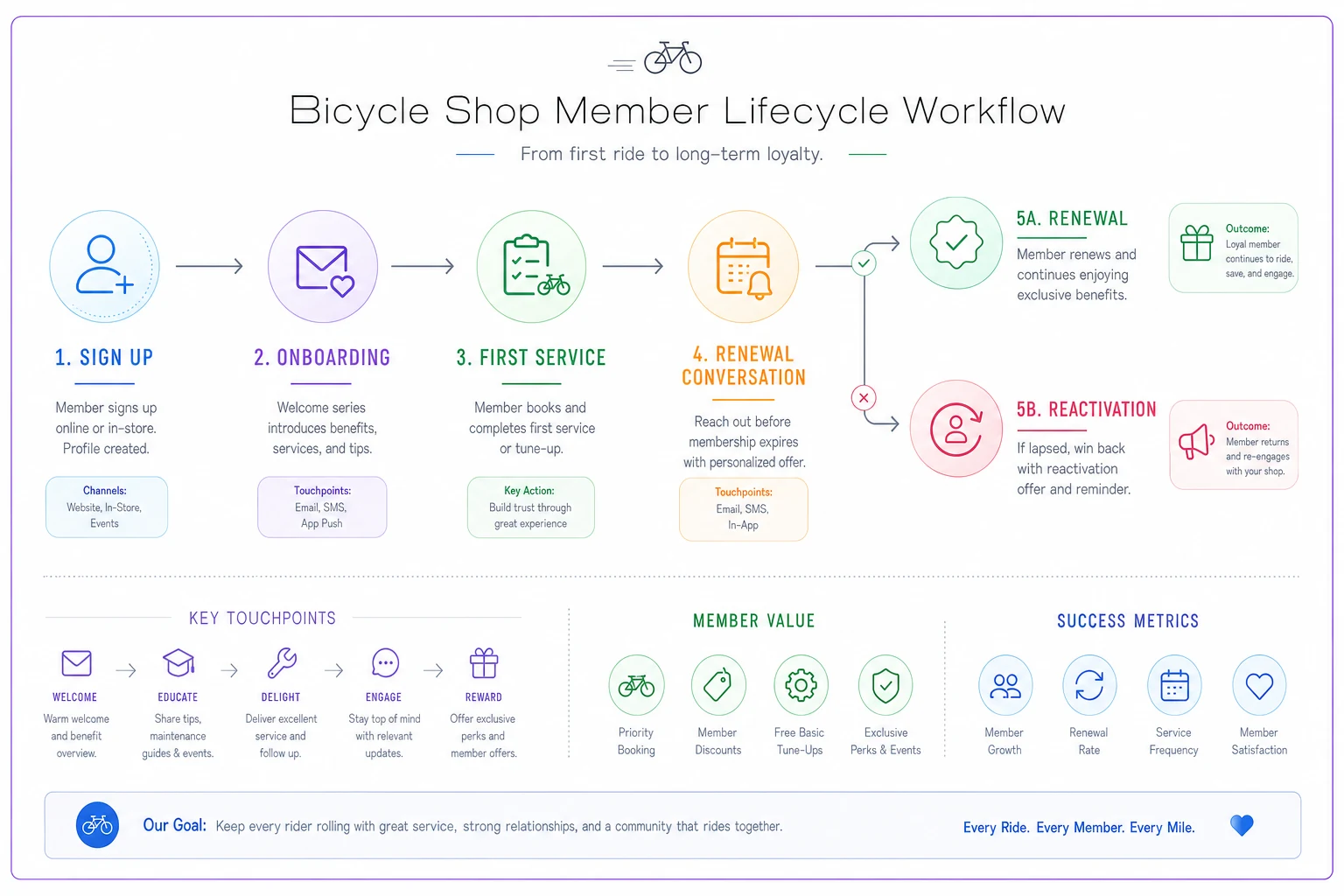
Use this workflow to map each touchpoint and make sure no stage is left to chance.
Sample messaging that converts riders into members
Stop pitching memberships as savings plans. Nobody gets excited about saving money on something they might need. Position around reliability and performance instead.
Bad messaging: "Save 20% on all tune-ups with our membership plan!" Better messaging: "Keep your bike running perfectly all season. Members get priority service, guaranteed 48-hour turnaround, and we track your bike's service history so nothing gets missed."
Here's messaging that actually converts: For commuters: "Never get stranded on your way to work. Commuter members get same-day flat fixes, monthly safety checks, and we'll even store a spare tube just for you." For weekend warriors: "Ride ready every Saturday. Enthusiast members get Friday priority booking, pre-ride checks, and our mechanics learn your bike's quirks for perfect adjustments." For families: "Keep the whole family rolling. Family plans cover up to 4 bikes with shared benefits, kids' bikes grow with them (free size adjustments), and safety checks before every season."
Test your messaging with one question: does it solve a specific problem or just offer a discount? Problems sell memberships. Discounts attract bargain hunters who churn.
Renewal cadences based on usage patterns
Generic annual renewal reminders are wasted opportunity. Smart shops track usage patterns and customize renewal messaging accordingly.
Pull your membership data and you'll typically find three patterns: Heavy users (6+ services/year): These members already know they're getting value. Start the renewal conversation 60 days out with a usage summary showing their "savings." Add exclusive perks for multi-year renewal. Moderate users (3–5 services/year): They're on the fence. Start 75 days out highlighting convenience benefits they've actually used — priority booking, faster turnaround. Offer a tier upgrade trial for renewal. Light users (1–2 services/year): They've probably forgotten they're members. Start 90 days out with a reactivation campaign — remind them of unused benefits, offer a bonus service credit for renewal.
| User Type | Renewal Touchpoints |
|---|---|
| Heavy users | 60, 30, 7 days out |
| Moderate users | 75, 45, 14, 3 days out |
| Light users | 90, 60, 30, 14, 7, 1 day out |
Each message should be different. First touch is a value reminder, middle touches add urgency or bonuses, final touch is expiration warning.
Expected LTV experiments and results
Stop guessing at membership lifetime value. Run controlled experiments to find what actually drives long-term profitability.
Experiment 1: Entry price testing One shop tested $15, $20, and $25 monthly for identical benefits across similar customer segments. Results:
| Price | Initial Conversion | Year-Two Renewal | Avg Annual Profit |
|---|---|---|---|
| $15/month | 47% | 52% | $124 |
| $20/month | 31% | 71% | $198 |
| $25/month | 19% | 78% | $237 |
Higher prices attracted more committed customers who renewed at better rates.
Experiment 2: Pausing vs canceling Offer a seasonal pause option instead of forcing cancellation. One shop that introduced a 3-month winter pause kept around 67% of members who would have otherwise cancelled outright. Lifetime value increased by roughly $340 per saved member.
Experiment 3: Upgrade incentives The best upgrade offer timing wasn't at renewal — it was after the third service use. Conversion hit 23% at that point versus 8% at renewal.
-
Average membership duration (target
18+ months)
-
Service utilization rate (target
3.5–4.5 visits/year)
-
Upgrade/downgrade ratio (target
2:1 or better)
-
Reactivation rate (target
15%+ of churned members)
Track these LTV metrics monthly:
Why tier design determines profitability
Most shops create tiers based on what sounds good in a marketing meeting. Profitable shops design tiers around actual customer behavior segments and margin requirements.
Your tier structure needs natural usage boundaries. If your basic tier includes 4 tune-ups but most members use 2–3, you're leaving money on the table. If your premium tier offers unlimited services but attracts the same customers who'd buy the middle tier anyway, you're just cannibalizing margin.
The sweet spot is three tiers with clear behavior differences: Low tier: Captures price-sensitive customers who want basic protection. Usage cap prevents losses. Price slightly below two services at rack rate. Middle tier: Your profit engine. Priced at roughly 3.5x service value with enough benefits to feel premium. This tier should capture 45–55% of members. High tier: Prestige positioning for heavy users. Price to profit even at high usage. Limited availability creates a sense of exclusivity.
| Structure | Basic | Middle | Premium | Revenue Change | Margin Change |
|---|---|---|---|---|---|
| Old (2 tiers) | 70% at $15 | — | 30% at $35 | baseline | baseline |
| New (3 tiers) | 25% at $12 | 55% at $25 | 20% at $42 | +22% | +34% |
The key wasn't raising prices — it was creating a middle option that matched how most customers actually use services.
Tracking what matters
Your POS probably tracks membership sales. But that's not telling you whether your bike shop service membership plan actually makes money.
-
Cost per service delivered to members vs. non-members
-
Average services per member by tier
-
Contribution margin by tier after all benefits
-
Churn rate by usage level
-
Upgrade/downgrade percentage
-
Reactivation rate of expired members
One shop found that members who hadn't used any services in their first 45 days had an 81% churn rate. They started personally calling those members to help schedule an appointment. Churn dropped to 53% for that segment — not perfect, but meaningful.
Call members with zero usage in the first 45 days to boost activation and reduce early churn.
Build a simple dashboard showing members approaching usage limits, members with zero usage past 60 days, high-frequency users who might need a check-in, and tier migration patterns. That data alone tells you where to focus.
Operational workflows that scale membership programs
Growing from 50 to 500 members breaks most shops' manual processes. You need workflows that scale without piling on administrative burden.
Service booking workflow: Members should book differently than walk-ins. Dedicated booking slots ensure you're actually delivering on the priority promise. Reserve 20–30% of capacity for member bookings. Track member no-show rates separately — they're usually around 40% lower than general customers.
Usage tracking workflow: Manual tracking doesn't hold up past a certain point. Your system needs to automatically flag when members approach usage limits. Set alerts at 75% of included services so staff can discuss upgrades during visits, not after limits are already hit.
Renewal workflow: Automate the basics but personalize the close. Automated emails handle reminders fine, but shops with sub-10% churn typically have staff personally call members two weeks before expiration. That five-minute call saves roughly 3 out of 10 cancellations.
This is exactly the kind of workflow management where AI-powered operational software can eliminate hours of manual tracking. Instead of spreadsheets and sticky notes, you get automated member usage tracking, renewal reminders triggered by actual behavior patterns, and margin analysis that updates in real time as members use services.
Membership programs at scale require systems. The shops that hit 300+ members without operational chaos built the tracking infrastructure before they needed it — not after things started falling through the cracks.
Converting one-time customers to members
Your best membership prospects aren't walking in off the street — they're already in your service queue. Most shops wait until checkout to mention memberships, right after the customer just paid full price.
The conversion window opens during service, not after. While the bike's on the stand, your mechanic notices worn brake pads and a stretched chain. That's the moment membership makes sense — before the customer gets hit with a $180 repair bill.
Train mechanics to plant the seed: "You're looking at new pads pretty soon. Members get 20% off parts like these plus their tune-ups included. Worth considering if you ride regularly."
Not a hard sell. Just awareness. Then at checkout, the service writer can close: "John mentioned you might benefit from membership given how much you ride. Want me to show you how the math works out?"
Conversion rate from this approach runs around 18% versus 3% for cold pitching at checkout. Track which customers to target by analyzing service history — anyone with 3+ visits annually should get membership positioning. Create a simple flag in your system when a customer hits visit three.
The renewal conversation nobody's having
Most shops treat renewal as a yes/no transaction. Three weeks before expiration, call members for a "membership review" — not a sales call, a service call. Ask three questions:
-
How often did you actually use your membership benefits?
-
What services did you need that weren't included?
-
What would make membership more valuable for you?
Based on their answers, you can upgrade heavy users before they realize they're losing money, downgrade light users before they cancel entirely, or add specific benefits that actually matter to borderline members.
One shop added free brake adjustments to their basic tier after multiple members said that's primarily what they needed. Retention jumped 24% for under $4 per member in actual cost.
These conversations also surface operational problems. If multiple members complain about booking difficulty or benefit confusion, you've just identified fixable churn drivers before they become cancellations.
When memberships actually hurt your shop
Not every shop should run a membership program. If you're already booked solid April through September, memberships just complicate capacity planning without adding meaningful revenue.
Memberships work when you have:
-
Excess service capacity in shoulder seasons
-
A customer base concentrated around enthusiast or commuter segments
-
Systems to track usage and profitability
-
Staff trained on member experience delivery
Memberships fail when:
-
You're understaffed and adding member priority makes service worse for everyone
-
Your customer base is primarily seasonal recreational riders
-
You can't track actual usage and costs
-
You're positioning memberships as discount programs instead of value programs
A shop in Minnesota killed their membership program after realizing it was costing them roughly $47,000 annually in lost margin. They had 200+ members but had never properly tracked usage. Heavy users were getting 12+ services on unlimited plans priced at $299. The math never worked — they just didn't see it until the damage was done.
Before launching, run a three-month pilot with 20–30 customers. Track everything. If you can't show positive contribution margin after month two, redesign before scaling.
Building profit into your membership model
The bike shop service membership plan that actually makes money isn't the one with the most members or the highest prices. It's the one designed around your actual operational capacity and customer behavior.
Start with narrow tiers based on real usage patterns. Price for margin at expected usage, not hoped-for usage. Track actual contribution margin monthly, not just membership sales. Build operational workflows before you scale beyond what you can manually manage.
Members who feel valued renew. Members who feel like a number cancel. The shops winning with memberships understand that difference and build their operations around delivering consistent member experiences, not just selling another subscription.
Your membership program becomes profitable when you stop guessing at what might work and start measuring what actually drives margin. Design from data, price from economics, deliver from operations.
Ready to revolutionize your bike shop operations?
Join hundreds of bike shops using Bicyclly to save time, increase revenue, and deliver exceptional customer service.