


Your bike shop supplier scorecard lead time tracking probably looks fine on paper. Orders arrive when suppliers say they will, invoices match, everyone's happy. But your repair bay tells a different story—tickets sitting for days waiting on a single brake pad, customers calling about their "quick tune-up" that's now entering week two, mechanics shuffling between half-finished jobs because parts showed up incomplete.
The disconnect happens because most shops track supplier metrics completely separately from their actual service operations. You measure on-time delivery against what the supplier promised, not against when you actually needed the part to finish a repair. You set safety stock based on general turnover, not on how often that specific supplier blows up your service schedule. You pick vendors based on catalog pricing, not on the total cost of delayed repairs and frustrated customers walking out the door.
The shops that maintain consistent repair turnaround aren't the ones with perfect suppliers. They're the ones who built their supplier management system around actual repair ticket data. They know which suppliers consistently wreck their service schedule, they carry supplier-specific safety stock based on reliability patterns, and they have clear decision rules for when it's worth paying more for a backup source.
Why Generic Supplier Tracking Fails Repair Operations
Most bike shops inherit their supplier scorecard approach from retail operations. Track on-time delivery percentage, monitor fill rates, negotiate volume discounts. That logic makes sense for stocking retail inventory where a week here or there doesn't matter much. Repair operations run on completely different economics.
When a derailleur hanger doesn't arrive for a tune-up, that bike sits on your stand for three extra days. Your mechanic loses productive hours. The customer gets frustrated. You might comp the service or throw in a discount to smooth things over. The next customer's appointment gets pushed. One late part creates a cascade of problems that cost far more than the part itself ever would.
Traditional supplier metrics miss these operational impacts entirely. A supplier can show 95% on-time delivery in your spreadsheet while causing 30% of your service delays. They deliver "on time" according to their promised date, but that date was already three days past when you needed the part. Their fill rate looks solid at 90%, but the 10% they don't stock happens to be the high-turnover items you burn through every week for repairs.
The damage compounds when shops don't connect those dots. You keep ordering from suppliers who technically perform well but operationally destroy your service department. You maintain the same safety stock levels for reliable and unreliable vendors. You don't have clear triggers for when to pay 20% more to a backup supplier to save a repair deadline.
Small shops feel this most acutely. You don't have the volume to command priority shipping or a dedicated account rep. You can't sit on huge safety stocks across every part category. One delayed shipment can wreck your entire week's service schedule. And yet most small shops are using the same supplier tracking methods as operations with ten times the volume and buffer capacity.
Build Your Repair-Focused Supplier Scorecard
The fix starts with restructuring how you measure supplier performance. Track against your repair needs, not their promises. Build supplier-specific operational rules instead of generic benchmarks. Create systematic responses to performance patterns rather than hoping things eventually get better.
Never miss a sale or service appointment again.
Bicyclly helps you manage every sale, repair, and booking with ease and accuracy.
- Unified inventory and sales tracking
- Automated customer notifications
- Service appointment scheduling
No credit card required
Core Metrics Tied to Repair Tickets
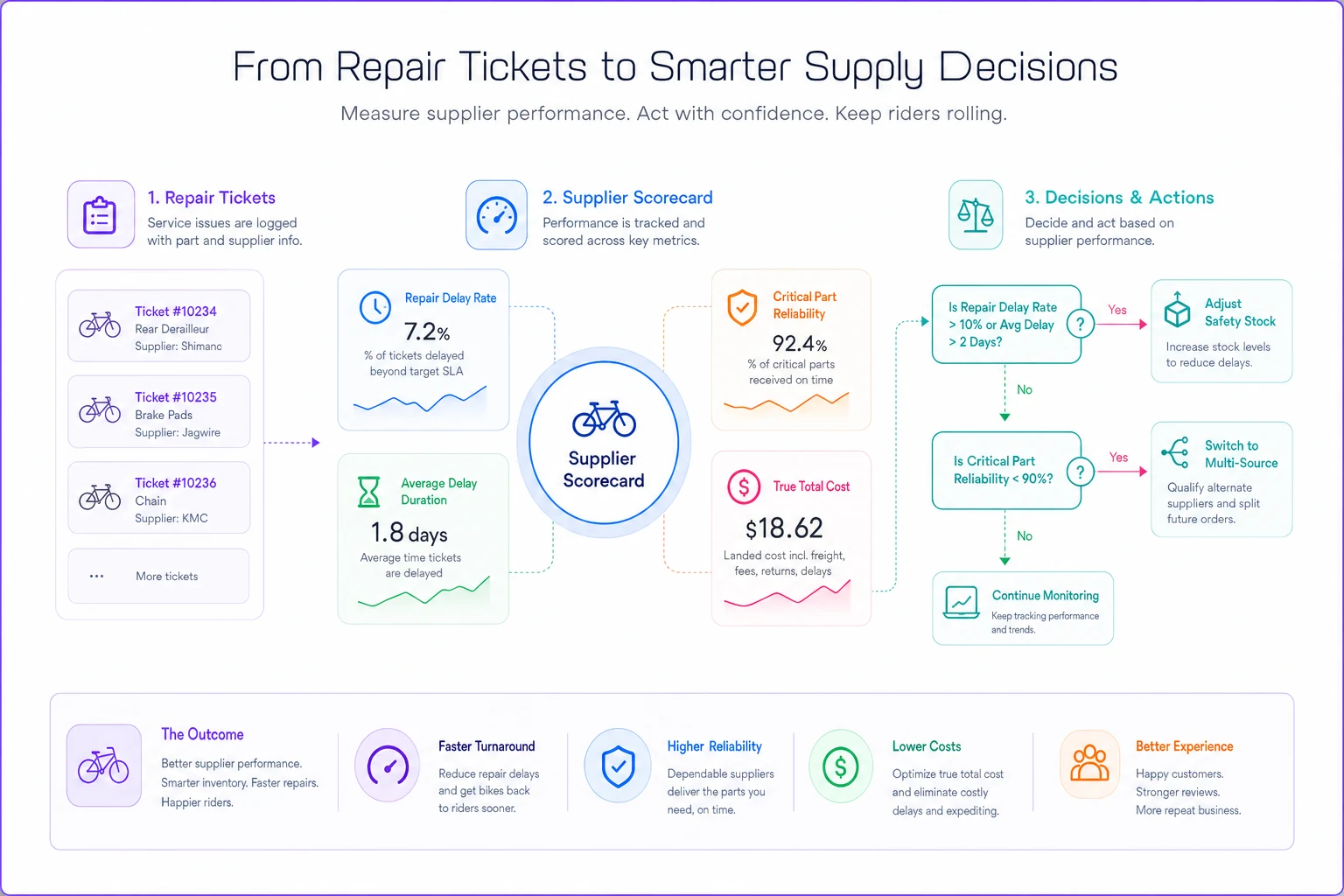
Repair Delay Rate: What percentage of repair tickets experience delays specifically because of this supplier? Track monthly and by part category. A supplier might be solid on chains but consistently unreliable on brake parts.
Average Delay Duration: When this supplier causes a delay, how long does it usually run? Some suppliers miss by a day, others by a week. That difference has a direct impact on your safety stock decisions.
Critical Part Reliability: For your top 20 most-used repair parts, how often does this supplier have them available for next-day delivery? These parts should almost never be the reason a job stalls.
True Total Cost: Factor in expedited shipping charges, lost labor productivity from delays, customer compensation, and any business you lose from people who don't come back.
Track these in a simple spreadsheet—one row per supplier per month. After three months, patterns become hard to ignore. That supplier with great prices suddenly looks a lot more expensive when you factor in the operational chaos they create.
This visual helps make the connection between repair tickets and supplier rules.
Safety Stock Rules by Supplier Reliability
Generic safety stock rules assume all suppliers behave roughly the same. In reality, you need completely different inventory strategies for reliable versus unreliable vendors.
For suppliers with under 5% repair delay rates, standard safety stock is fine. Keep 1-2 weeks of typical usage on hand for common parts. Order when you hit your reorder point. Basic stuff.
For suppliers in the 5-15% delay range, add a delay buffer. Calculate it as: (Average Delay Duration) × (Daily Usage Rate) × 1.5. If they typically delay by 3 days and you use 2 units daily, keep an extra 9 units on hand. That covers most delays without over-investing in inventory.
For suppliers above 15% delay rates, standard approaches stop working. You're either maintaining much higher safety stocks, always dual-sourcing those items, or starting the process of transitioning away—all of which come with tradeoffs.
The key point: safety stock isn't just about demand variability. It's about supplier variability. A reliable supplier delivering a high-turnover item might need less safety stock than an unreliable supplier delivering something you sell once a week.
Multi-Source Decision Matrix
Dual-sourcing sounds smart in theory but gets messy fast. You need clear rules for when splitting orders actually makes sense versus when it just adds complexity without much benefit.
| Matrix Quadrant | Rule |
|---|---|
| High Volume, High Criticality | Always dual-source. Run a 70/30 split between primary and backup. The 30% keeps the backup relationship warm for when you need an emergency order fast. |
| High Volume, Low Criticality | Single source with your most reliable supplier. If performance drops, switch entirely. No reason to complicate ordering for parts that don't affect repair timelines. |
| Low Volume, High Criticality | Dual-source only if the primary supplier exceeds 10% delay rate. Below that threshold, the complexity probably isn't worth it for occasional orders. |
| Low Volume, Low Criticality | Single source, best price, done. These don't impact repairs, so optimize for cost and convenience. |
Review this matrix quarterly. Your service mix shifts over time. What was low-volume last year might be high-volume now if you've started seeing more e-bikes or gravel builds.
Weekly Lead Time Tracker
Most shops check supplier performance monthly or quarterly—which is way too late to prevent service delays. You need a weekly rhythm that catches problems before they pile up.
Every Monday morning, spend about 15 minutes on:
This Week's Repair Schedule: What parts do you need for scheduled repairs? Which suppliers are they coming from? Flag anything dependent on vendors with spotty track records.
Outstanding Orders: What's supposed to arrive this week? What's already late? Which repairs depend on those arrivals?
Lead Time Trends: Are lead times creeping up for any supplier? A supplier can technically maintain on-time delivery by quietly pushing their promised dates out. Watch for that pattern.
Backup Triggers: Based on this week's needs and recent supplier performance, what needs to shift to a backup source? Make those calls Monday, not Thursday when you're already scrambling.
Fifteen minutes. That's it.
Fifteen minutes. That's it. But it's the difference between catching problems early and reacting to them after customers are already upset.
Connect Supplier Performance to Service Operations
Tracking metrics without operational consequences doesn't accomplish much. You need clear protocols that turn numbers into actions.
Automatic Escalation Triggers
When a supplier's repair delay rate exceeds 10% for two consecutive months, trigger a formal review. Not a casual conversation—an actual process with specific steps.
Document the delays with dates, PO numbers, and affected repair tickets. Calculate the true total cost including labor inefficiency and customer impact. Bring that data to the supplier with a clear improvement timeline. If nothing changes within 30 days, start moving volume to backup suppliers.
When a single delay exceeds 5 days, immediately activate your backup supplier for that category. Don't wait to see how things develop. Five days is already pushing most customers past their patience. Pay the premium to maintain your service standards.
Service Scheduling Adjustments
Your service scheduling should reflect supplier reliability. When booking repairs that require parts from unreliable suppliers, build in buffer time upfront. Under-promising and over-delivering is always better than apologizing for delays after the fact.
For repairs requiring parts from suppliers with over 15% delay rates, either add 2-3 days to the standard turnaround, require parts confirmation before booking the appointment, or automatically quote using alternate suppliers even if they cost a bit more.
Build those rules directly into your booking process. Your service scheduling system should flag high-risk repairs before you've already committed to an unrealistic deadline.
Customer Communication Scripts
When supplier delays do hit repairs, how you communicate determines whether you keep that customer. Develop specific scripts based on delay severity:
-
"1-2 Day Delays"
"Quick update on your repair—we're waiting on one part that's arriving tomorrow instead of today. Your bike will be ready by [new date]. The delay won't affect the original quote."
-
"3-4 Day Delays"
"I need to update you on your repair timeline. Our supplier had an unexpected delay with [specific part]. Your bike will now be ready on [date]. Because of the delay, we're taking 10% off the service charge. Would you prefer to pick up on [date] or would another day work better?"
-
"5+ Day Delays"
"I'm calling about a significant delay with your repair. Our supplier has had a major issue with [part]. I have two options: We can wait for the original part, arriving [date], and provide a 20% service discount. Or we can source from another supplier at a slightly higher parts cost but complete the repair by [earlier date]. Which would you prefer?"
Immediate, specific, solution-oriented. Customers tolerate delays better when you proactively reach out and offer real options instead of waiting for them to call and complain.
Practical Safety Stock Implementation
The Three-Tier Approach
Instead of calculating safety stock for hundreds of SKUs, focus on three tiers:
-
Tier 1
Never-Out Items
(roughly 20 SKUs) Tubes, common brake pads, chains, cables—parts that stall multiple repairs weekly if unavailable. For unreliable suppliers, keep 3-4 weeks on hand. For reliable suppliers, 2 weeks is plenty. -
Tier 2
Regular-Use Items
(roughly 50 SKUs) Parts you use weekly but not daily. Specific cassettes, common tires, standard handlebars. For unreliable suppliers, keep 2 weeks supply. For reliable ones, 1 week. -
Tier 3
Everything Else
Order as needed. No safety stock regardless of supplier reliability. The carrying cost isn't worth it for parts you touch once a month.
For a shop running 30-40 repairs weekly, this approach typically requires somewhere in the range of $3,000-5,000 in additional inventory investment. You're not stocking everything—just the parts that actually cause service delays.
Supplier-Specific Storage Zones
Organize your parts room by supplier reliability, not just by part category. Three zones:
Green Zone: Parts from suppliers with under 5% delay rates. Standard reorder points and quantities.
Yellow Zone: Parts from suppliers with 5-15% delay rates. Higher safety stocks, more frequent counts, closer monitoring.
Red Zone: Parts from suppliers over 15% delay rates, or critical items regardless of supplier. These get counted weekly, reordered earlier, and often dual-sourced.
The physical organization makes the reliability issues visible in a way spreadsheets don't. Mechanics quickly learn which bins need backup plans. It prevents the complacency that creeps in when supplier problems aren't literally in front of you.
Dynamic Reorder Points
Static reorder points assume stable lead times, which isn't realistic with a lot of bike suppliers. Use dynamic reorder points that adjust based on recent performance instead.
Base Reorder Point = (Average Daily Usage × Standard Lead Time) + Safety Stock
Dynamic Reorder Point = Base Reorder Point × (1 + Recent Delay Rate)
If a supplier has delayed 20% of recent orders, multiply your standard reorder point by 1.2. This automatically adjusts for deteriorating performance without you having to manually catch it every time.
Update the calculations monthly. Most inventory systems can handle this math, or a simple spreadsheet that feeds your ordering decisions works fine.
Real-World Implementation Story
A shop in Denver was dealing with constant repair delays despite having "good" suppliers by their own metrics. They tracked on-time delivery (92%), order accuracy (95%), and price competitiveness. Everything looked fine on paper.
When they restructured their tracking around repair tickets, the picture changed fast. Their primary supplier was causing 35% of all service delays. Those delays averaged 4 days each. Customer complaints had climbed roughly 40% year-over-year. They were comping around $800 monthly in service discounts just to manage the fallout.
They implemented the tiered safety stock system targeting their biggest supplier problem areas. For their unreliable primary supplier, they bumped safety stock on Tier 1 items from 1 week to 3 weeks—about $2,000 in additional inventory. They set up a backup supplier relationship for critical parts, accepting 15% higher prices in exchange for guaranteed next-day delivery when they needed it.
The weekly lead time tracker started catching issues early. When they noticed their primary supplier's lead times quietly stretching from 3 days to 5 days on brake parts, they proactively shifted 50% of those orders to the backup supplier before any delays hit their service schedule.
Within two months, repair delays dropped to around 8%. Customer complaints essentially disappeared. They stopped burning money on service discounts. The additional inventory paid for itself in retained customers and better mechanic utilization.
The interesting part: their primary supplier never improved. Still delays orders, still has stock issues, still causes problems. But those problems don't cascade into service failures anymore. The shop built resilience through systematic responses instead of waiting for a supplier to get their act together.
Technology and Automation Opportunities
Manual tracking works at lower volume, but as repair work grows, you need systems that automatically connect supplier performance to service operations rather than requiring constant spreadsheet maintenance.
AI-powered operational platforms can monitor which suppliers consistently cause specific types of delays and flag when it makes sense to shift orders to backup sources. They catch lead time inflation before it hits your repair schedule. They calculate true total cost including operational impacts, not just what's on the invoice.
More practically, these systems can coordinate between purchasing and service scheduling. When a part from an unreliable supplier gets pulled for a repair, the system automatically adds buffer time to the service quote. When delays come through, it triggers customer communications and suggests compensation based on how severe the delay is.
The automation removes the mental overhead of juggling supplier relationships while you're also trying to run a shop. Instead of checking multiple spreadsheets and making gut calls, you get clear alerts when something needs attention. Your team stays focused on fixing bikes.
Making It Sustainable
The hardest part isn't building this system—it's keeping it going once the immediate crisis fades. Shops set up solid tracking when delays are killing them, then let it slide as things stabilize.
Sustainability comes from routine, not motivation. Make the weekly lead time review part of Monday morning operations, right after checking the service schedule. Fifteen minutes. Keep it focused on decisions, not analysis.
Set quarterly review triggers based on metrics rather than gut feelings. When any supplier exceeds 10% delay rate—automatic review. When safety stock investment exceeds $5,000—automatic review. When you're using backup suppliers more than 20% of the time—automatic review.
And share the impact with your team. When safety stock prevents a delay, point it out. When the backup supplier saves a customer relationship, acknowledge it. The system only works if everyone understands why it matters, not just the person who built it.
Conclusion
Your bike shop supplier scorecard lead time system shouldn't be an academic exercise in vendor management. It needs to directly prevent repair delays, keep customers happy, and protect your mechanics' productivity. That means tracking metrics that actually matter for service operations, not just purchasing efficiency.
The shops with consistent service quality don't have perfect suppliers. They have systems that assume imperfection and build appropriate buffers. They know which suppliers to trust with critical repairs and which ones require a backup plan. They've turned supplier management from a reactive scramble into something predictable.
Start with basic repair delay tracking. Add supplier-specific safety stock rules for your top 20 parts. Run the weekly lead time review. Those three changes alone will eliminate most of your surprise delays. Build out the multi-source framework and automated triggers as your volume justifies it.
The goal isn't to punish bad suppliers or chase perfect vendors. It's to build an operation that delivers consistent service regardless of what suppliers do. Your customers don't care why their repair is delayed—they want their bike back when you said it would be ready. This system makes it possible to keep that promise, even when suppliers don't keep theirs.
Ready to revolutionize your bike shop operations?
Join hundreds of bike shops using Bicyclly to save time, increase revenue, and deliver exceptional customer service.