

Most bike shops don't think they have a data problem until something forces the issue. A customer asks you to delete their information. A supplier breach email lands in your inbox. A booking platform you've used for three years suddenly updates its terms, and now you're wondering what they've been doing with your customer list.
The uncomfortable truth is your shop is sitting on a surprisingly deep pile of personal data. Phone numbers tied to repair tickets. Email addresses from your newsletter. Home addresses from delivery orders. Payment tokens. Medical-adjacent notes if you do bike fitting ("lower back pain, saddle too far forward"). Photos of serial numbers. Clinic sign-up sheets with names and emergency contacts. Most of this lives in four or five different systems that don't talk to each other, and nobody owns the question of what happens to it.
This article isn't about fear. It's about building a lightweight system — a privacy operating model that fits a 600–1,500 sq ft shop with two to eight people — that keeps you compliant, reduces real risk, and doesn't eat a day of your week. The goal is a defensible bike shop data privacy policy you can actually run, not a 40-page document a lawyer hands you that nobody reads.
Why Data Sprawl Happens in Shops That Never Planned For It
Nobody sits down on day one and decides to scatter customer data across six platforms. It accumulates. You start with a POS. Then you add online booking because phones were eating your front counter. Then email marketing. Then a separate clinic sign-up form on a Google Sheet. Then financing through a third-party lender. Then review requests through yet another tool.
Each of those decisions made sense at the time. But the end state is that a single customer — say, someone who bought a gravel bike, booked two tune-ups, attended a maintenance clinic, and financed the purchase — now exists in five systems, with five copies of their contact info, none of which agree on spelling or opt-in status.
The pattern that keeps showing up: data isn't centralized, so nobody can answer basic questions. Who has this person's data? Did they consent to marketing? When did we collect it? Are we still allowed to keep it? When you can't answer those, you're not non-compliant on purpose — you're non-compliant because the operation never built a place to track it.
This connects directly to how your shop handles data more broadly. If you've already worked through a shop-sized data operating model, privacy is the layer that sits on top: not just is the data accurate, but are we allowed to have it, and for how long.
What Actually Breaks as You Grow
At one location with one person who knows everything, data sprawl is survivable. You're the single point of knowledge. The risk is real but contained.
Never miss a sale or service appointment again.
Bicyclly helps you manage every sale, repair, and booking with ease and accuracy.
- Unified inventory and sales tracking
- Automated customer notifications
- Service appointment scheduling
No credit card required
Then you grow, and the cracks show up fast.
You hire. A new front-counter employee gets full access to every customer phone number and address in the POS. No access tiers, no logging. If they leave on bad terms, you have no idea what they exported.
You add a second location. Both shops use the same booking tool but separate email lists. A customer who opted out at Shop A keeps getting emails because Shop B never got the memo. Opt-out is a legal obligation, not a nicety, and now you've got a compliance gap baked into your structure.
You run clinics and events. Sign-up sheets multiply. Someone collects emergency contacts on paper for a youth ride and those sheets sit in a drawer for a year. If you've built out an event-first automation playbook, event data is exactly the kind of thing that needs a retention rule attached to it, or it just piles up forever.
A customer exercises their rights. Depending on your region — GDPR in Europe, CCPA/CPRA in California, PIPEDA in Canada, and a growing list of US state laws — people can ask you to show them what you have, correct it, or delete it. If your data is scattered across six platforms with no map, fulfilling that request means a panicked afternoon of digging. "We couldn't find it all" is not a defense.
The scale problem is straightforward: manual privacy management works for one person who remembers everything. It collapses the moment knowledge has to be shared, handed off, or audited.
The Four Pillars of a Shop Privacy OS
Think of this as four moving parts that have to work together. Skip one and the others leak.
| Pillar | What It Answers | Common Failure |
|---|---|---|
| Consent | Did we get permission, for what, and can we prove it? | Pre-checked boxes, no timestamp, no record of what they agreed to |
| Retention | How long do we keep each data type before deleting? | "Keep everything forever" by default |
| Access | Who inside the shop can see/export what? | Everyone has admin on everything |
| Vendors | Who processes data on our behalf, and are they safe? | No list, no contracts, no idea |
Most shops have some version of consent (a newsletter checkbox) and nothing else. The whole system has to work as a loop: collect data with clear consent, store it with access controls, keep it only as long as a retention rule allows, and make sure every outside vendor touching it is accountable. A gap in any one pillar makes the others cosmetic.
Consent: Get It Clean, Keep It Provable
The single biggest consent mistake shops make is bundling. Someone books a tune-up, and buried in the booking flow is a pre-checked box that also signs them up for marketing. That's not valid consent under most modern privacy law. Consent has to be specific, informed, and separate from the thing they actually came to do.
Separate your consent into distinct buckets:
-
Service communication (appointment reminders, "your bike is ready") — tied to the transaction, generally allowed as legitimate business need
-
Marketing (newsletters, promotions, sale alerts) — requires explicit opt-in, separately checked
-
Clinic/event participation (photos, emergency contacts, waivers) — collected for that event, with its own purpose stated
-
Bike fit / body data — treat this as sensitive; state exactly why you collect it and how long you'll keep it
> Appointment reminders: We'll text/email you about this repair and when your bike is ready. (Required to complete your booking.) > > ☐ Keep me posted: Send me occasional emails about sales, clinics, and new products. You can unsubscribe anytime. (Optional.) > > We store your contact info to service your bike and manage your account. We don't sell your data. See our full privacy policy at [yourshop.com/privacy]. Questions? privacy@yourshop.com.
> By registering, you agree we may contact you about this event. We collect your name, contact info, and emergency contact solely to run this clinic safely. We'll delete event-specific data within 90 days unless you've opted into our mailing list. Photos may be taken during the event — tell staff at check-in if you prefer not to appear in them.
The part most shops miss: consent you can't prove is consent you don't have. You need the record — when they agreed, what the box said at the time, what they opted into. A screenshot of a pre-checked box from two years ago doesn't cut it. Your booking and POS systems should be capturing a timestamp and the consent state automatically, because nobody is going to log this by hand reliably.
Retention: Stop Keeping Everything Forever
The default state of almost every shop is infinite retention. Customer data from 2016 is still sitting in the POS. Old clinic sheets are in a filing cabinet. Newsletter lists include people who haven't opened an email in four years.
That's a liability, not an asset. Data you don't need is data that can be breached, subpoenaed, or mis-sent. The fix is a written retention schedule — one page, tied to data types, with a defined trigger for deletion.
A workable starting schedule for a bike shop:
| Data Type | Keep For | Why |
|---|---|---|
| Active customer contact + service history | While active + 3 yrs after last visit | Warranty, repeat service, recall contact |
| Transaction/payment records | 7 years | Tax and accounting requirements |
| Marketing list (opted-in) | Until unsubscribe + remove inactive after ~24 mo of no engagement | Reduce stale, unlawful sends |
| Clinic/event sign-ups | 90 days post-event | No ongoing business need |
| Bike fit / body notes | While active customer only | Sensitive; minimize |
| Job applicant data | 6–12 months | Short-term hiring need |
| CCTV footage | 30 days | Security without indefinite storage |
Your payment and transaction retention overlaps with your bookkeeping, so coordinate it with how you handle financial records — the logic in turning tickets into clean books applies here: the ticket drives the record, and the record has a lifespan.
One thing worth internalizing: retention and deletion are two sides of the same rule. If you write "keep for 3 years," you've also committed to deleting at year 3. A retention schedule nobody enforces is just a document. Which is why the monthly hygiene routine below matters more than the policy itself.
Vendors: The Processors You Forgot You Hired
Every tool that touches customer data on your behalf is a "data processor," and you're responsible for them. Your booking platform, email tool, POS, payment processor, review-request service, cloud backup, and that Google Sheet — all of them.
If one of them gets breached, it's your customers' data, and in many jurisdictions it's your obligation to notify people. "Our vendor did it" is not a shield.
Run every current and new vendor through this checklist:
-
[ ] What data do they receive? (Names only? Emails? Payment info? Full history?)
-
[ ] Do we have a Data Processing Agreement (DPA)? Most reputable SaaS tools offer one — find it, sign it, save it.
-
[ ] Where is the data stored? (Country matters for cross-border rules.)
-
[ ] Is it encrypted at rest and in transit? Check their security/trust page.
-
[ ] What's their breach notification commitment? How fast will they tell you?
-
[ ] Can we export and delete data on request? If you can't get data out, you can't fulfill a deletion request.
-
[ ] Do they share/sell data to third parties? Read the actual terms, not the marketing page.
-
[ ] Who has login access on our side? Remove ex-employees immediately.
The quiet failure here: free tools and informal spreadsheets. Paid SaaS platforms usually have DPAs and security pages. It's the Google Sheet with 400 clinic registrants, shared by link, that nobody thinks of as a "vendor" — but it's processing personal data on infrastructure you don't control, with access settings nobody's reviewed in months.
Treat shared Google Sheets as vendors and review access monthly.
This is where consolidating systems earns its keep. When your bookings, service history, and customer records live in one platform with proper access tiers and a signed DPA, the vendor list shrinks and the risk surface shrinks with it. Scattered free tools are where most shops' real exposure lives.
The One-Hour Monthly Data-Hygiene Agenda
A policy is worthless without a cadence. Here's a repeatable 60-minute monthly routine that keeps the whole system honest. Block it on the calendar, assign one owner, and run it like an inventory count.
-
Access review (10 min). Who has login to the POS, booking tool, and email platform? Remove anyone who left. Downgrade anyone who doesn't need admin.
-
Retention sweep (15 min). Pull records that have passed their retention trigger — clinic sign-ups older than 90 days, inactive marketing contacts past 24 months — and delete or archive per the schedule.
-
Consent spot-check (10 min). Pull five recent sign-ups. Confirm each has a clear, timestamped opt-in. If any came in via a pre-checked box or unclear flow, fix the form.
-
Deletion/correction requests (10 min). Process any customer requests received that month. Log what you did and when.
-
Vendor glance (10 min). Any new tools added this month? Run them through the checklist. Any breach notices received? Document the response.
-
Open-loop note (5 min). Write down anything unresolved for next month. One shared doc. Done.
The reason this works at an hour a month is that it prevents the pile-up. Shops that skip the routine end up facing a deletion request or a breach with years of unmanaged data and no map. An hour a month is cheap insurance against a very bad afternoon.
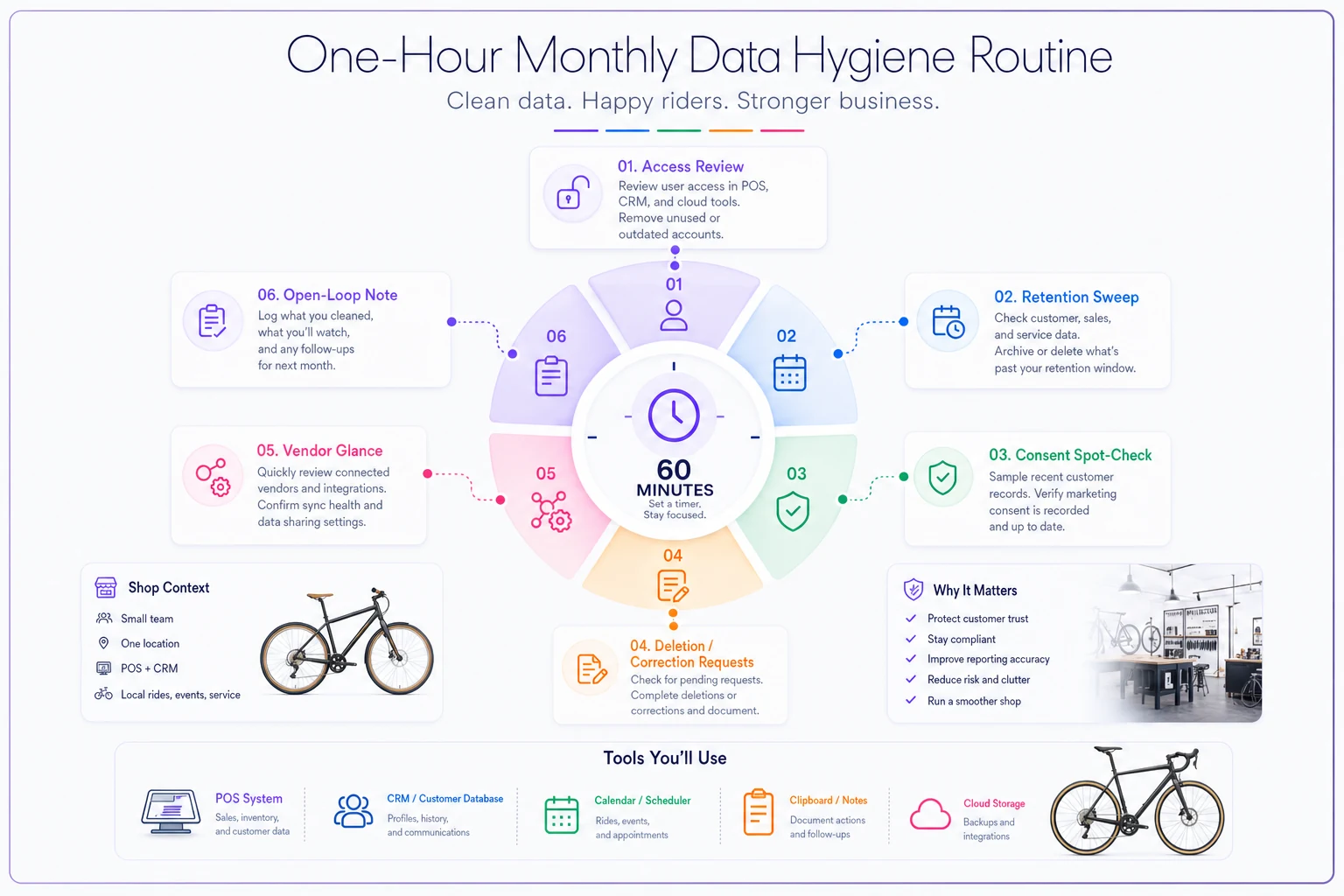
A quick visual of the monthly hour to keep the routine on track.
A Real Scenario
A two-location shop running roughly 300–350 service bookings a month had the typical setup: POS, a separate online booking tool, Mailchimp, financing through a lender, and clinic sign-ups on shared Google Sheets going back about three years.
Then a regular customer — a lawyer, naturally — sent an email asking exactly what data they held and requesting deletion of anything non-essential. It took the owner most of a Saturday to even find all the copies. The customer's info existed in four systems with three different spellings. Two years of clinic sheets listed the person's emergency contact, which nobody remembered collecting.
Nothing legally bad came of it, but it was a wake-up call. They spent about half a day building the basics: a one-page retention schedule, separated consent on the booking form, a vendor list with DPAs pulled from each platform, and the monthly hour on the calendar assigned to the service manager.
The payoff came three months later when a software vendor sent a minor breach notice. Instead of panic, they already knew exactly what that vendor held, who was affected, and what to tell customers. The response took about an hour instead of a lost weekend. The old clinic sheets were already gone — deleted on schedule — so they weren't part of the exposure at all.
The cost of the whole setup was essentially one afternoon plus an hour a month. The cost of not having it would have been measured in days and nerves.
When This Makes Sense — and When It's Overkill
Do this now if: you have more than one employee with data access, you run clinics or events, you use three or more tools that hold customer info, you operate in a region with active privacy law (California, EU, Canada, several US states), or you're planning to add a location. At that point the manual "I remember everything" approach has already quietly broken.
You can keep it lighter if: you're a true one-person operation with a single system and minimal marketing. You still need basic consent and a retention habit, but you don't need the full vendor-DPA apparatus for tools you don't use.
Who should NOT over-engineer this: the shop that reacts to a privacy article by buying a 40-page legal template, filing it, and changing nothing operationally. A policy document with no monthly cadence and no deletion actually happening is worse than nothing — it creates the appearance of compliance while the real data sprawl keeps growing. The operating system beats the document every time.
Bringing It Together
Privacy in a bike shop isn't a legal problem you solve once. It's an operational loop that runs alongside everything else — tied to how you book, how you keep books, how you run events, and how your systems connect as you grow. The shops that handle it well aren't the ones with the longest policy. They're the ones who collect data cleanly, keep only what they need, know exactly which vendors touch it, and spend one honest hour a month keeping the whole thing tidy.
Start with the four pillars, write the one-page retention schedule, run every vendor through the checklist, and put the monthly hour on the calendar with a name next to it. That's a defensible, livable bike shop data privacy policy — one that reduces real risk without turning you into a compliance department. The data was always going to accumulate. The only question is whether you built a place for it to live, and a rule for when it leaves.
Start with the four pillars, write the one-page retention schedule, run every vendor through the checklist, and put the monthly hour on the calendar with a name next to it. That's a defensible, livable bike shop data privacy policy — one that reduces real risk without turning you into a compliance department. The data was always going to accumulate. The only question is whether you built a place for it to live, and a rule for when it leaves.
Ready to revolutionize your bike shop operations?
Join hundreds of bike shops using Bicyclly to save time, increase revenue, and deliver exceptional customer service.