

Most bike shop owners can tell you their gross margin on a full build, their tune-up turnaround time, and roughly what a Shimano group costs this month. Ask them how they decide who to hire, what to pay them, or whether a mechanic is actually improving — and the answer gets fuzzy fast. It's usually some combination of "he seemed solid in the interview," "she's been here a while so she gets a bump," and "I hope they stay another season."
That gap is the whole problem. The service side of a shop lives or dies on labor, and labor is the one part of the operation most owners run on instinct. You've probably built systems for inventory, supplier lead times, reconciliation. The people side deserves the same treatment. Not HR bureaucracy — an actual operating system that connects hiring to pay to development to retention, with numbers you can look at once a month and act on.
This is that system, sized for real indie shops: a two-bay neighborhood shop, a mid-size shop running four to six people, and a growing multi-mechanic operation. The templates are meant to be copied and adjusted, not admired.
Why the people side breaks (and it breaks predictably)
The failure pattern is almost always the same, and it doesn't start with a bad hire. It starts with the fact that nothing about the people function is written down.
When a shop has one or two mechanics, the owner is the system. You know everyone's skills because you trained them. You know who's slow on brakes and fast on wheel builds because you're standing three feet away. Pay decisions happen over a beer. This works — right up until it doesn't.
The break happens at the third or fourth hire. Suddenly the owner can't personally observe everyone. Two mechanics doing the same job are getting paid $4/hour apart for reasons nobody can articulate. A new hire is "training" but there's no definition of what trained means, so they're turning wrenches on customer bikes at week two with no signoff. Somebody quits in July and takes years of undocumented knowledge with them, and the replacement takes four months to get productive because there's no path to follow.
Owners tend to treat each of these as a separate fire — a pay complaint here, a quality slip there, a resignation over there. They're not separate. They're symptoms of the same missing layer: a repeatable way to decide who's good, what good is worth, and how people get better.
The four pieces that actually connect
A people OS for a shop isn't complicated, but the parts have to link together or you just get more paperwork. Here's the chain:
Never miss a sale or service appointment again.
Bicyclly helps you manage every sale, repair, and booking with ease and accuracy.
- Unified inventory and sales tracking
- Automated customer notifications
- Service appointment scheduling
No credit card required
Hiring scorecards define what "good" looks like before you interview, so pay and development have something to attach to.
Pay bands tied to throughput connect what you pay to what a person actually produces, so raises aren't guesswork and your labor cost stays sane.
Mentorship signoffs move people up the pay bands on merit, with documented proof of skill instead of tenure.
A monthly people dashboard tells you whether the whole thing is working before problems turn into resignations.
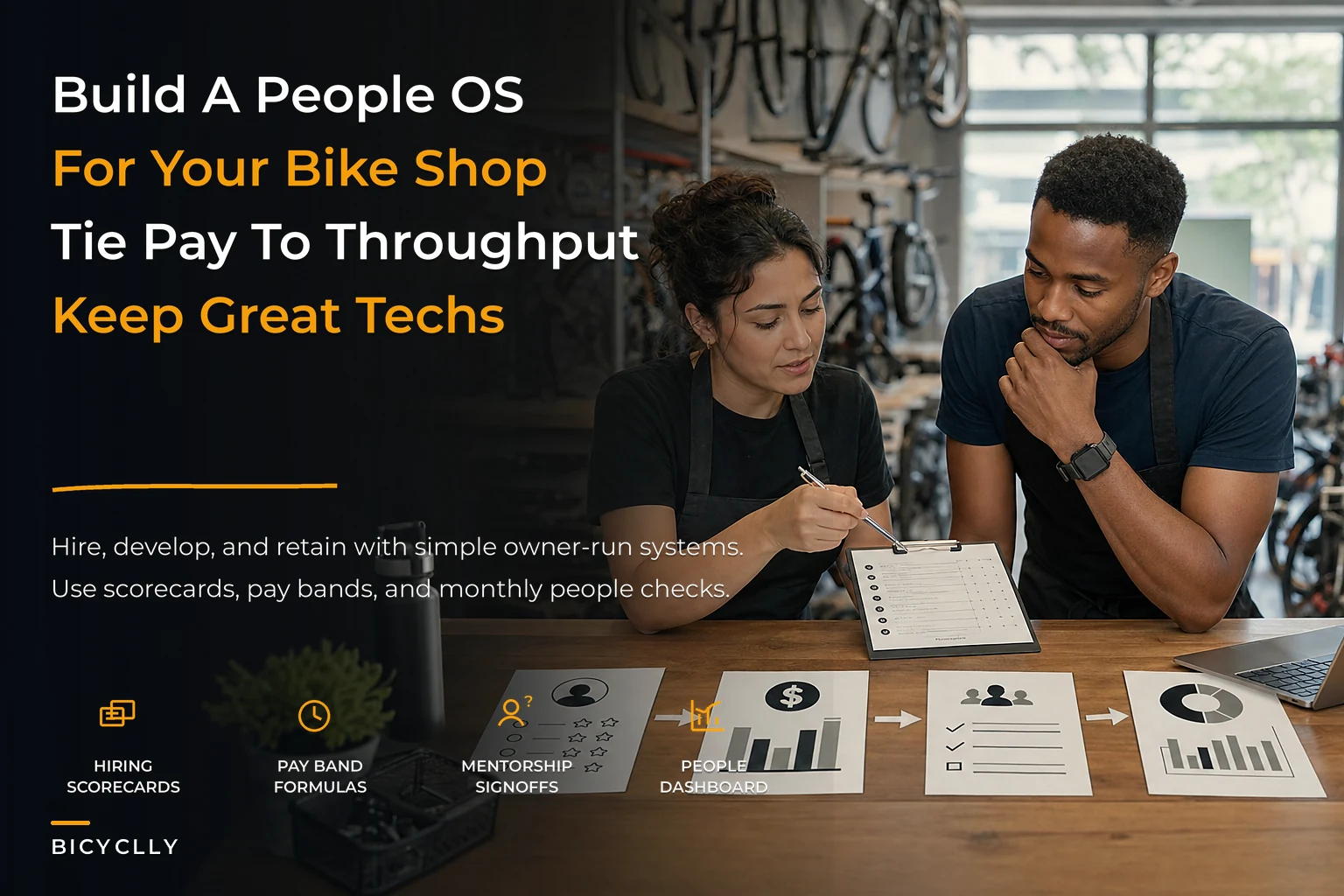
Visualize the chain like this.
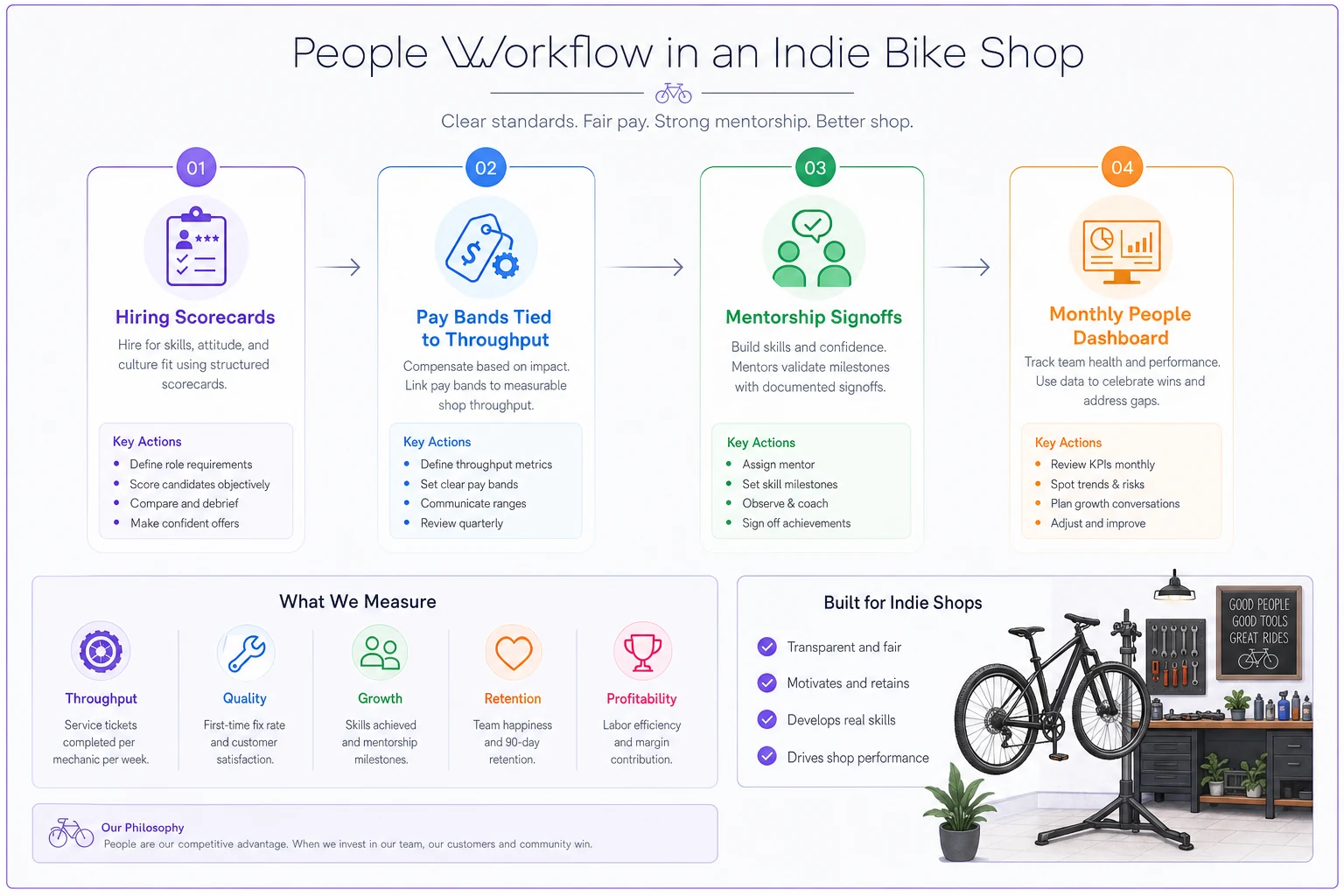
Each piece feeds the next. A scorecard that says "can complete a hydraulic brake bleed unsupervised" becomes a signoff item, which becomes a pay-band trigger, which shows up on your dashboard as capacity you can actually schedule. Skip any link and the chain rusts. Most shops have zero of the four, so let's build them in order.
Piece 1: Hiring scorecards that predict shop performance
The biggest hiring mistake in shops isn't hiring the wrong person — it's not defining the job before you start looking. You end up impressed by someone who rides a lot and can talk components, then discover three weeks in they can't turn tickets fast enough to cover their wage.
A scorecard fixes this by forcing you to write down the four or five things that actually matter for the role, then scoring every candidate against the same list. It sounds obvious. Almost nobody does it.
| Competency | What you're actually measuring | Weight | Score (1–5) |
|---|---|---|---|
| Core wrench skills | Can they demo a brake bleed, wheel true, drivetrain swap live? | 30% | |
| Throughput mindset | Do they think in tickets/hour, or do they gold-plate everything? | 20% | |
| Diagnostic judgment | Given a vague "it clicks," how do they narrow it down? | 20% | |
| Customer handoff | Can they explain a repair without condescending or overselling? | 15% | |
| Reliability signals | Attendance history, references, seasonal availability | 15% |
Two things make this work in practice. First, the live skills demo. Set up a bike with a known issue and watch them work for 20 minutes. You'll learn more than in an hour of talking. Second, the throughput question — a mechanic who does beautiful work at half speed will quietly destroy your service margin, and a scorecard is where you catch that before it's on your payroll.
For a two-person shop, you might only score three competencies and skip the formal weighting. For a larger shop hiring regularly, keep the weights and have two people score independently, then compare. When two interviewers land far apart on the same candidate, that disagreement is usually more useful than either score alone.
Piece 2: Pay bands tied to throughput, not tenure
This is where most owners flinch, because pay feels personal and negotiated. But undefined pay is probably the single biggest driver of resentment and turnover in shops. When people don't know how pay is decided, they assume it's unfair — and often they're right.
-
Band A — Developing Mechanic Handles flats, basic tune-ups, accessory installs. Works under signoff for anything hydraulic or drivetrain-heavy. Roughly the entry range for your market.
-
Band B — Full Mechanic Runs the full common-repair menu unsupervised, hits target tickets/day, handles customer explanations solo. Mid-range.
-
Band C — Lead / Specialist Suspension, hydraulic, complex builds, plus mentors Band A. Top of range, and the person who covers when you're not there.
The connection to throughput is what keeps this financially honest. If your loaded labor cost for a Band B mechanic runs around $30–$34/hour all-in, and your billable service rate sits somewhere in the $95–$110/hour range, you need that person clearing a real number of billable hours per day for the band to make sense. When you tie the band to expected throughput, a raise isn't a favor — it's a recognition that someone moved to a higher-output tier. If you've already built a technician skills matrix, this is where it pays off directly; the same competencies that drive dispatch and throughput forecasting should drive which pay band someone sits in.
A quick worked example. Say a shop has two mechanics both being paid around $28/hour. One only does tune-ups and flats; the other does everything including suspension and covers Saturdays alone. Same pay. The second mechanic knows it, and eventually leaves for a shop that recognizes the difference. Bands would have surfaced that gap a year earlier and given you a reason to close it before it became a resignation letter.
When pay bands are a bad idea
Bands assume you have enough people that consistency matters. If you're a true solo shop with one part-timer, formal bands are overkill — just be transparent about how a raise gets earned. Bands also fail if you set them and never move anyone through them. A band structure with no movement is just a ceiling people resent. The point is a visible path, not a cage.
Piece 3: Mentorship signoffs as the promotion engine
This is the piece almost every shop is missing entirely: a documented way for a mechanic to prove they've earned the next band. Without it, people move up on tenure and vibes, and new hires take forever to become productive because "training" has no finish line.
A signoff is dead simple. It's a checklist of skills, and each one gets signed by a senior mechanic or the owner once the person can do it unsupervised, correctly, at speed. The signature is the whole point — it means someone put their name on "yes, this person can bleed a brake without me watching."
-
- [ ] Completes a full tune-up within target time, quality-checked
-
- [ ] Bleeds hydraulic brakes unsupervised (both major systems you service)
-
- [ ] Diagnoses and resolves a shifting complaint from a vague customer description
-
- [ ] Builds and trues a wheel to spec
-
- [ ] Handles a full customer handoff, including explaining declined work
-
- [ ] Completes a chain/cassette/derailleur replacement at target speed
-
- [ ] Correctly logs parts and labor on the ticket with no reconciliation errors
That last one matters more than people think. A mechanic who does great work but consistently mis-logs parts creates downstream chaos in your inventory and books. Skill signoffs are the right place to bake in the operational habits, not just the wrench work.
The mentorship half is what makes signoffs move fast. Pair every Band A hire with a Band B or C mentor who owns their progression. Give the mentor a small stake in it — a modest bonus when their mentee clears the full signoff, or just formal recognition and a lighter ticket load during active training weeks. When senior people are rewarded for developing others, ramp time for new hires drops noticeably, and knowledge stops walking out the door when someone quits.
Piece 4: The one-page monthly people dashboard
You don't need HR software to run this. You need one page you look at once a month that tells you whether the people side is healthy or quietly drifting. If it takes more than one page, nobody will actually read it — including you.
Here's what belongs on it:
-
Headcount by band — how many people in A, B, C right now
-
Open signoffs in progress — who's mid-ramp and how long they've been there
-
Billable hours per mechanic — actual vs. target, the core throughput number
-
Rework rate — comebacks and warranty redos as a share of tickets, by mechanic
-
Labor cost as % of service revenue — your single best margin-health signal
-
Turnover and tenure — who left, who's approaching a year, average tenure
-
One qualitative note — anything you're sensing that numbers don't show yet
The dashboard's job is to catch drift early. A mechanic whose rework rate is creeping up is telling you something — maybe they're overloaded, maybe they got promoted before they were ready, maybe a signoff got skipped. Someone stuck mid-signoff for four months means the mentorship isn't actually happening. Labor cost climbing past your target while billable hours stay flat means you're carrying capacity you're not selling.
If your shop management platform tracks technician time, export the month once and save the formula so pulling billable hours becomes a two-click task.
Pulling billable hours per mechanic, rework rates, and labor-cost percentages by hand every month is tedious enough that most owners just stop doing it after a few months. Shop management platforms that already track tickets and technician time can surface most of these numbers automatically, so the dashboard becomes a five-minute review instead of a Saturday-afternoon spreadsheet project. The system matters more than the tool, but the right tool is what keeps the system alive past month three.
How this scales as the shop grows
The people OS isn't one-size-fits-all. What you run depends heavily on headcount, and the mistake is either over-building it too early or refusing to build it as you grow.
Two-bay / owner-plus-one shop. You don't need bands or a dashboard. You need a one-page scorecard for the rare hire, a written definition of what "trained" means, and total transparency about how a raise gets earned. The whole system fits on a single sheet of paper.
Mid-size shop, four to six people. Now you need all four pieces, but kept lightweight. Three pay bands, a signoff checklist, monthly dashboard, mentor pairings. This is the size where the system pays for itself fastest, because it's exactly the size where the owner can no longer see everything but hasn't yet added a management layer to compensate. Getting scheduling and dispatch right becomes tightly linked to who sits in which band — the same logic that keeps bays from sitting idle across multiple mechanics depends on knowing exactly what each person is signed off to handle.
Growing / multi-mechanic operation. At this stage you probably need a service manager who owns the dashboard and signoffs, more granular bands (maybe five instead of three), and the people OS wired into your broader operating rhythm. If you already run a monthly operating cadence — and you should — the people review folds neatly into it, the same way the roles and routines in a monthly operating model give the rest of the shop its structure.
A real scenario: the shop that kept losing its second-best mechanic
Consider a mid-size shop running one owner and four mechanics, doing solid service volume through the season. The pattern that broke them: every year or so, their strongest developing mechanic would reach the point of real competence — full menu, could run a Saturday solo — and then leave for a shop offering two or three dollars more an hour.
The owner assumed it was money. It was partly money, but mostly there was no visible path. People couldn't see how to get from where they were to more responsibility and more pay, so the only way up felt like a new employer.
They built the four pieces over about a quarter. Three bands, a signoff checklist tied to band movement, mentor pairings, and a one-page dashboard reviewed at the end of each month. Nothing elaborate — the bands lived in a spreadsheet at first.
Nothing changed dramatically in any single month. But over the following year the shop stopped losing people at the Band A-to-B transition, which had been the consistent leak. Ramp time for new hires dropped noticeably because the signoff gave both the mentor and the new mechanic a concrete list to work through instead of vague shadowing. Labor cost as a percentage of service revenue held steady even as they moved people up in bands, because the increases were matched by real throughput gains they could now actually see on the dashboard.
The owner's own summary was pretty simple: the people side finally felt like the rest of the shop — something you could look at and manage, instead of something you just hoped would hold together.
Where owners get this wrong
A few failure modes worth naming, because they're common and avoidable:
-
Building the paperwork but not moving anyone. Bands and signoffs that never result in a promotion are worse than nothing — they advertise a path and then block it.
-
Letting signoffs get rubber-stamped. If mentors sign off people who aren't actually ready to hit throughput targets, your rework rate climbs and the whole system loses credibility. The signature has to mean something.
-
Tracking the dashboard but never acting on it. A creeping rework number or a stalled signoff is a prompt for a conversation, not just a data point to file away.
-
Copying another shop's bands exactly. Your market wages, your service menu, and your throughput targets are specific to you. Steal the structure, not the numbers.
These aren't hypothetical pitfalls — they're what happens when the system gets built but never actually gets used. The paperwork becomes theater and people see through it fast.
Bringing it together
The people side of a bike shop isn't some soft, unmanageable thing you just get lucky with. It's a system with four connected parts: you define what good looks like before you hire, you pay for actual output instead of years served, you give people a documented path to prove they've earned more, and you watch a single page each month to catch drift before it becomes a resignation.
Start wherever your shop size demands. A two-person shop needs one sheet of paper. A six-person shop needs all four pieces, kept light. The goal isn't HR sophistication — it's turning the least-managed part of your operation into something as legible as your inventory or your service turnaround. Once you can see it, you can fix it. And in a business where labor is the largest controllable cost and the hardest thing to replace, being able to see it clearly is most of the battle.
Start wherever your shop size demands. A two-person shop needs one sheet of paper. A six-person shop needs all four pieces, kept light. The goal isn't HR sophistication — it's turning the least-managed part of your operation into something as legible as your inventory or your service turnaround. Once you can see it, you can fix it. And in a business where labor is the largest controllable cost and the hardest thing to replace, being able to see it clearly is most of the battle.
Ready to revolutionize your bike shop operations?
Join hundreds of bike shops using Bicyclly to save time, increase revenue, and deliver exceptional customer service.