


Most bike shops treat recalls, warranty claims, and safety incidents as interruptions. Something lands in the inbox — a fork recall from a brand, a customer returning with a cracked frame, a mechanic flagging a near-miss on the stand — and someone scrambles. The owner digs through supplier email threads, hunts old invoices, tries to remember which bikes went out with that batch, and improvises a response.
That works until it doesn't. The real exposure isn't the single recall you handle well. It's the pattern of treating every risk event as a one-off — no shared record, no defined owner, no way to show later what you actually did. When a warranty dispute escalates, when an insurer asks for documentation, or when a brand asks how you managed a recall, "we handled it informally" doesn't protect you.
This post is about turning that into bike shop recall and warranty governance that fits on roughly one page and runs inside your normal operations — not a binder nobody opens, but a working system tied to how tickets flow, how parts get tagged, and how your quarterly review actually happens.
Why risk governance quietly falls apart in bike shops
The breakdown is rarely a lack of effort. It's that risk events arrive through five different channels and never land in the same place.
A recall notice comes from a distributor rep over email. A warranty claim starts as a verbal complaint at the counter. A near-miss — a brake lever that failed during a test ride — gets mentioned to the service manager and forgotten by lunch. An RMA gets filed in a vendor portal that only one person has the login for. And the insurance side only surfaces when something has already gone wrong.
Each of these has its own paperwork, its own deadline, its own owner. In a two-person shop, that owner is the same person every time, which means the whole system lives in one head. In a growing shop with three mechanics and a couple of sales staff, it's worse — the knowledge is spread across people who each assume someone else logged it.
Risk documentation isn't missing because people are careless. It's missing because the moment of the event — a busy Saturday, a frustrated customer, a mechanic mid-repair — is the worst possible time to fill out a form. So nobody does. The gap only becomes visible months later when you need the record and it was never created.
The five parts of a working risk OS
A functional risk OS isn't a thick manual. It's five connected components, each with a defined trigger, a defined owner, and a defined place the record lives. On one page, it looks like this:
Never miss a sale or service appointment again.
Bicyclly helps you manage every sale, repair, and booking with ease and accuracy.
- Unified inventory and sales tracking
- Automated customer notifications
- Service appointment scheduling
No credit card required
| Component | Triggered by | Owner | Where the record lives |
|---|---|---|---|
| Recall runbook | Brand/distributor notice | Owner or service mgr | Recall log + customer list |
| Warranty / RMA flow | Customer claim or failed part | Service writer | Ticket + vendor portal ref |
| Insurer-ready claim packet | Injury, property damage, theft | Owner | Incident file |
| Incident & near-miss log | Any safety event, no matter how minor | Whoever witnesses it | Shared log |
| Quarterly risk review | Calendar (every 90 days) | Owner | Review agenda + notes |
The reason this fits on one page is that the detail doesn't live in the overview — it lives in the linked workflow. The overview tells you what triggers what and who owns it. The runbook underneath tells you how.
Here's a simple visual tying the overview to the runbooks.
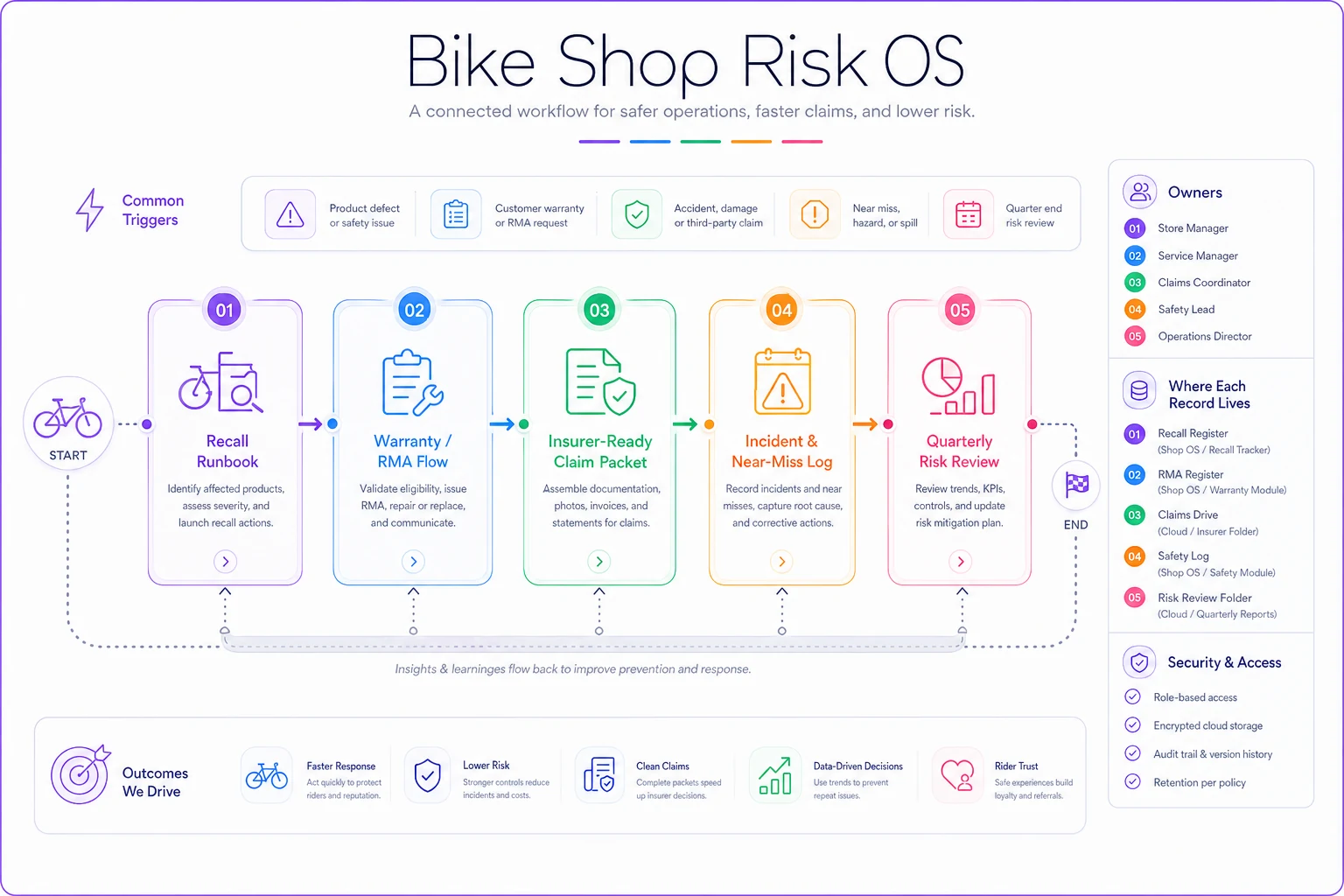
The mistake most shops make is building the detail without the overview. They'll have a warranty process in someone's memory and an incident form buried in a drawer, but nothing that ties the five together or shows, at a glance, what state each open item is in.
Recall runbooks: speed and traceability, not panic
When a brand issues a recall, the clock starts. The shops that handle it well have already answered three questions before the notice arrives: How do we know which units we sold? How fast can we reach those customers? How do we prove we did?
The traceability piece is where assembly discipline pays off months later. If your intake and delivery process already captures serial numbers against customer records — one reason to tie recalls back to how you handle new-bike assembly and PDI quality gates — then a recall becomes a filtered list instead of a frantic archaeology dig through paper invoices.
-
Log the notice — date received, brand, affected models/serials, deadline, hazard description.
-
Pull the affected customer list from serial records and purchase history.
-
Classify urgency — is this a "stop riding immediately" hazard or a "next service visit" fix?
-
Notify customers using a pre-written template per urgency tier, and log every contact attempt.
-
Track remedy status per unit
contacted / scheduled / repaired / unreachable.
-
Close the loop with the brand and keep the completed log.
The step shops skip most often is #4's logging. They call customers but don't record the attempts. Then six months later a brand asks for proof of notification and there's nothing. The log isn't bureaucracy — it's the only thing standing between you and liability for a unit you genuinely tried to reach.
Warranty and RMA flows that don't bleed margin
Warranty is where good intentions quietly cost money. A customer returns with a failed part, the service writer wants to keep them happy, and the shop absorbs the cost of a repair the manufacturer would have covered — because nobody filed the RMA within the vendor's window, or nobody tracked whether the credit ever came back.
A shop processing 15–20 warranty claims a month across drivetrains, hydraulic brakes, and the occasional frame can easily lose a few hundred dollars monthly in unrecovered credits if even a third of those never get properly filed. That's $3k–$5k a year, plus the labor absorbed on top of it.
-
Intake
log the claim against the original sale/service ticket, capture the failure mode and photos.
-
Decision
covered under manufacturer warranty, goodwill, or customer-pay? Document which.
-
RMA
file with the vendor, record the RMA number and the filing deadline.
-
Tracking
follow the part out and the credit back — an open claim isn't closed until the money or replacement arrives.
-
Learn
tag recurring failure modes so your purchasing and your service operations SOPs can respond to patterns.
That last point matters more than people expect. If you're seeing the same hydraulic lever fail across a batch, that's not five isolated warranty claims — it's an early signal of a problem that might become a recall. The log is what lets you see the pattern instead of five unrelated annoyances.
Limited-warranty language
Your own labor and service warranty needs written terms, not verbal promises. What's covered, for how long, what voids it, and what the customer's responsibility is. Shops that run on "we'll take care of you" sound generous until a dispute, when generosity and obligation blur. Clear limited-warranty language — printed on the service invoice and the handoff — protects both sides and keeps goodwill something you choose, not a default you got trapped into.
Incident and near-miss logs: the part everyone skips
The incidents that seriously hurt a shop are usually preceded by near-misses nobody wrote down. A brake that felt soft on a test ride. A wheel that came loose in the parking lot before the customer left. A mechanic who caught a hand on a repair stand.
None of these trigger an insurance call. Which is exactly why they go unrecorded — and why the warning signs disappear.
A near-miss log needs to be brutally easy to use, because it competes with a busy shop floor. Date, what happened, what could have happened, and what was done. Thirty seconds. The entire value is in lowering friction enough that a mechanic actually logs it instead of mentally filing it under "no harm done."
Keep the near-miss entry to one short line (date, brief description, corrective action) so mechanics can log it in under 30 seconds.
What a consistent log gives you over a quarter is a map of where your real risk sits. If three of your last ten near-misses involve rushed final checks under backlog pressure, that's a direct connection to your turnaround policy — the kind of thing covered in building a turnaround SLA matrix and backlog policy. Safety and throughput aren't separate problems. When the shop is slammed, corners get cut, and the near-miss log is where that shows up before it becomes a claim.
Insurer-ready claim packets: assemble before you need them
When something genuinely goes wrong — an injury on a bike you serviced, property damage, a theft — the quality of your documentation in the first 48 hours shapes how the claim goes. That's also the worst possible moment to be figuring out what your insurer wants.
-
Incident date, time, location, and people involved
-
Photos and physical evidence, preserved and dated
-
The full service history of the bike or part in question
-
Witness statements captured while memory is fresh
-
Copies of relevant invoices, warranty terms, and any recall status
-
A timeline of what happened and what you did in response
Shops that recover well from a serious incident can hand their insurer a complete, organized packet instead of a shoebox of receipts and vague recollections. Because your service history is the backbone of most of these packets, the ticket and record discipline you already run is your risk preparedness. You're not building two systems — you're making sure the one you have can be pulled into a claim shape when needed.
The quarterly risk review: governance that actually runs
A risk OS that only activates during emergencies isn't governance — it's reaction with better paperwork. The thing that turns it into a system is a recurring review that forces the logs to be looked at when nothing is wrong.
Every 90 days, roughly an hour, the owner and service manager walk a fixed agenda:
-
Open recalls — anything still unresolved? Any unreachable customers to re-attempt?
-
Warranty claims — what's the filed-vs-unfiled rate? Any credits still outstanding? Any recurring failure modes?
-
Incident & near-miss log — review every entry since last quarter. What patterns emerged? What changed as a result?
-
Insurance & coverage — any gaps given how the business has changed? New services, e-bikes, rentals?
-
One improvement — pick a single thing to tighten before next quarter.
Item #5 is what keeps this from becoming a box-check. One concrete change per quarter — a clearer intake field, a faster recall template, a standing rule that final safety checks never get skipped under backlog — compounds over a year into something genuinely robust.
When this makes sense, and when it's overkill
A single-owner shop doing light service doesn't need all five components running at full formality from day one. The incident log and a basic warranty flow carry most of the value. The full packet templates and quarterly reviews earn their keep once you're carrying multiple mechanics, selling e-bikes, or handling enough volume that no single person can hold everything in their head.
Who should not over-build this: a shop that's genuinely one person, low volume, mostly tune-ups. A five-part governance binder there is effort spent where risk is low. Start with the near-miss log and clear warranty terms, add the rest as you grow.
When it becomes non-negotiable: the moment you add e-bikes, rentals, or a second service bay. Higher-stakes products and shared responsibility are exactly the conditions where informal risk management stops scaling.
A real scenario
A shop with three mechanics, running somewhere around 280–320 service tickets a month plus e-bike sales, kept handling warranty and recalls ad hoc. Over about eight months they absorbed an estimated $4k–$6k in warranty costs that were probably recoverable — mostly claims filed late or never filed because the vendor portal login lived with one person who was out that week. They had no incident log at all.
They put a one-page risk OS in place: a shared near-miss log on the service counter, a warranty flow tied to each ticket with the RMA number and deadline tracked, and a quarterly review on the calendar. Within two quarters, unfiled warranty claims dropped close to zero, they recovered several hundred dollars a month they'd previously eaten, and the first quarterly review surfaced a pattern of rushed final checks during their busiest stretch. They fixed the handoff before it turned into a liability claim. No dramatic revenue jump — just fewer leaks and meaningfully less exposure.
Pulling it together
Risk governance isn't paperwork for its own sake. Recalls, warranty claims, near-misses, and insurance exposure are all the same thing seen from different angles — events where your ability to respond and prove what you did determines whether you absorb the cost or someone else does.
Keep the overview on one page so it actually gets used. Tie each component to the workflows you already run — serial capture at assembly, ticket records in service, backlog policy during your busy stretches. And protect the quarterly review on your calendar the way you'd protect a supplier payment, because that recurring hour is what keeps the whole thing alive instead of quietly rotting back into improvisation the next time something lands in your inbox.
Ready to revolutionize your bike shop operations?
Join hundreds of bike shops using Bicyclly to save time, increase revenue, and deliver exceptional customer service.