


A service ticket touches every part of a repair. The mechanic reads it, the parts person pulls from it, the front desk bills from it, and the customer judges you by what it says at pickup. When it's sloppy, the damage shows up everywhere at once — wrong parts pulled, work redone, invoices argued over at the counter.
Most shops don't have a ticket problem because mechanics are careless. They have a ticket problem because the ticket is a blank box that each person fills out differently depending on how busy they are. The fix isn't more discipline. It's a template that forces the right information in before the bike moves to the next station.
Why free-form tickets quietly cost you money
Walk the bay of any busy shop in April and you'll see the same thing: tickets scribbled into whatever field is open in the POS, half the parts listed as "misc," and a note that says "tune + check shifting." Three people will read that line and picture three different jobs.
It's a predictable pattern. A free-form ticket works fine when the shop is slow and the same mechanic owns the job start to finish. It falls apart the moment work gets handed off — when the person who wrote the ticket isn't the one finishing it, or when a customer calls two weeks later disputing a charge nobody can explain.
-
Pick errors — parts pulled that don't match the actual job, usually because the ticket said "cassette" without a speed, brand, or ratio.
-
Rework — jobs redone because a step was assumed, not written. Bleeding brakes "while we're in there" that the customer never approved.
-
Billing disputes — the invoice at pickup doesn't match what the customer remembers agreeing to, and now your front desk is negotiating instead of collecting.
None of these are dramatic on their own. A $14 mispick here, 20 minutes of rework there, a $30 goodwill discount to end an argument. But add them across 300–400 tickets a month and you're looking at real money leaking out of a department that already runs on thin margins.
Two ticket variants, not one
The single biggest mistake is trying to make one ticket handle everything. A flat-fix and a full suspension overhaul don't need the same fields. Forcing one template on both means the simple jobs feel bureaucratic while the complex ones stay dangerously thin.
Never miss a sale or service appointment again.
Bicyclly helps you manage every sale, repair, and booking with ease and accuracy.
- Unified inventory and sales tracking
- Automated customer notifications
- Service appointment scheduling
No credit card required
Split your tickets into two variants from the start.
Variant A — Quick Tune / Minor Repair
This covers anything priced off the menu and usually done same-day: flat repairs, basic tune-ups, brake adjustments, single-component swaps. The template should be fast. If a mechanic needs more than about 90 seconds to open and read it, it's too heavy for this category.
-
Bike make/model and a one-line condition note at intake
-
The menu job code (so pricing is locked, not improvised)
-
Parts, each with a real SKU — never "misc"
-
One required intake photo
-
Approved-by
who authorized any add-on and when
Variant B — Complex Repair / Overhaul
This is the one that actually protects you. Suspension service, drivetrain overhauls, wheel builds, anything multi-day or over a dollar threshold you set (a lot of shops use $150–$200). These tickets need room for sequencing and sign-off at multiple points.
| Field | Quick Tune (A) | Complex Repair (B) |
|---|---|---|
| Intake condition note | One line | Detailed, per-system |
| Required photos | 1 (overall) | 4+ (overall, damage, serials, teardown) |
| Parts detail | SKU + qty | SKU + qty + source + ETA |
| Labor steps | Menu code only | Itemized steps w/ time estimates |
| Customer approval | At intake | At intake + at any scope change |
| QC sign-off | Mechanic initials | Second-set-of-eyes check |
Each extra field on the complex ticket isn't there to make it longer — it's there because it closes a specific gap where disputes and rework come from. A photo of the serial number means a warranty claim doesn't stall three weeks later. An ETA field on a backordered part means the front desk isn't blindsided when a customer calls asking why their bike's been sitting.
The key point is that neither variant should feel like overkill for the job it covers. If your quick-tune template starts growing extra fields "just in case," it'll get skipped on busy Saturdays — which is exactly when you need it most.
The required-photo checklist
Photos are the cheapest insurance in a service department, and almost nobody uses them systematically. A solid required-photo rule does two things: it documents condition at intake so you can't be blamed for a scratch that was already there, and it creates a visual record of parts and serials that kills warranty and billing arguments later.
-
Overall bike at intake — front and drive-side, taken before it goes on the stand
-
Any existing damage — dents, cracks, worn braking surfaces, bent hangers
-
Serial number — frame and, for e-bikes, the battery and motor unit
-
Teardown state (Variant B only) — how components came apart, especially for suspension and internally-routed cable jobs
-
Finished work (optional but valuable) — a before/after that goes a long way at pickup
Show the intake photos on the register screen during pickup to end disputes fast.
The thing most shops miss: the photo isn't really for you, it's for the conversation at the counter. When a customer says "that chainring wasn't worn, you're upselling me," a date-stamped teardown photo ends the argument in ten seconds. You'd be surprised how often the dispute just evaporates when you turn the screen around.
Standard codes that make tickets readable across the shop
Free-text descriptions are where consistency goes to die. "Tune," "basic tune," "standard tune," and "tune-up" all mean the same job to four different mechanics — but your reporting treats them as four different things, and your parts person can't predict what's needed.
-
Job codes tied directly to your service menu (TUN-1, TUN-2, OVR-1, SUS-SVC, WHL-BLD)
-
Condition codes for intake notes (W = worn, D = damaged, M = missing, OK)
-
Status codes everyone can see at a glance (WAIT-PARTS, WAIT-APPROVAL, IN-PROGRESS, QC, READY)
If you've already built a tiered service menu, your job codes should map straight onto it so the pricing, parts list, and time estimate travel with the code. This is also where a clean ticket starts to feed the rest of your service operations structure and KPIs — you can't measure throughput or first-time-fix rate if every ticket describes the same job three different ways.
POS tagging rules so billing matches reality
The handoff from ticket to invoice is where disputes are born. The job gets done right, but the POS entry gets rushed, and the printed invoice shows a line item nobody can explain.
-
Every part on the ticket maps to a real SKU in the POS. No "miscellaneous parts" line items. If a part isn't in the system, it gets added before the ticket closes, not after.
-
Labor is tagged to the job code, not typed free-hand. The menu code carries the price; nobody is negotiating labor rates at the keyboard.
-
Add-ons get their own line and their own approval tag. If the customer agreed to a new chain mid-repair, that approval is recorded on the ticket and the POS line references it.
-
Discounts and goodwill get a reason code. When you later audit why margin is soft, you want to see whether it's pricing or whether your front desk is discounting to end arguments.
-
The ticket number lives on the invoice. One shared reference number so any dispute can be traced back to the photos and notes in seconds.
A disputed invoice isn't just the money you might refund. It's the time your most senior front-desk person spends untangling it, the customer's eroded trust, and the review that might follow. Slow or messy billing has the same root cause as slow repairs — information that didn't travel cleanly through the process. If your pickup experience keeps generating friction, it's worth looking at how it ties into turnaround SLAs and backlog policies too, because a dispute at the counter often starts with a timeline nobody managed.
A weekly audit routine that keeps the system honest
A template only holds if someone checks that it's being used. The checking doesn't need to be heavy — fifteen to twenty minutes once a week catches drift before it becomes habit.
-
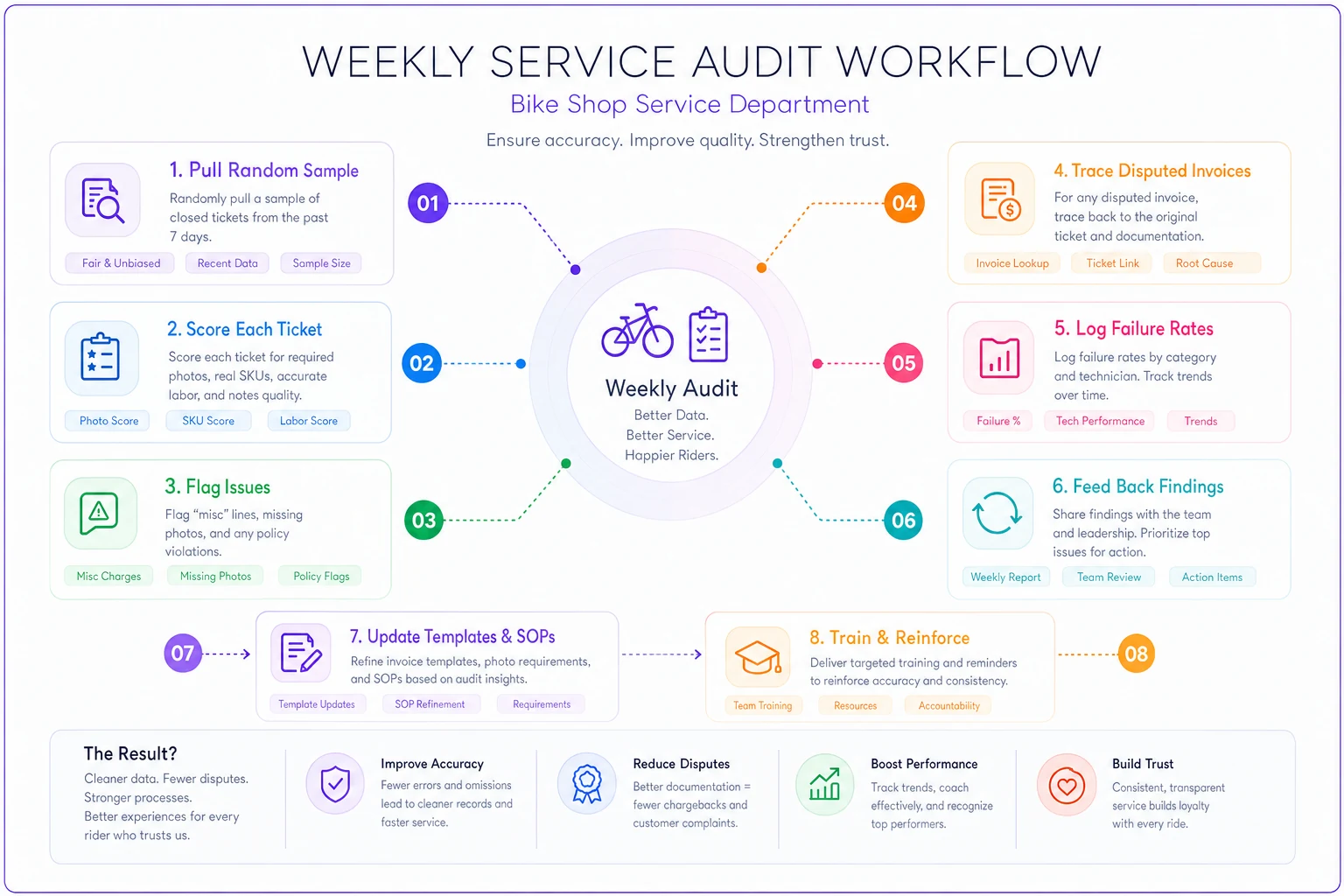
Pull a random sample — 10 to 15 closed tickets from the week, mixing Variant A and B.
-
Score each against three things required photos present, every part has a real SKU, job code matches the work described.
-
Flag every "misc" line and every blank photo field. These are your two highest-value failure points.
-
Trace any disputed invoice from the week back to its ticket. Was the information there and ignored, or was it missing? That tells you whether you have a training gap or a template gap.
-
Log the failure rate. If photo compliance is sitting at 60%, you have a problem the template can't fix on its own — you need a step in intake that won't let the ticket advance without it.
The pattern worth watching: compliance is almost always highest on slow weeks and collapses during the spring rush — exactly when errors are most expensive. If your audit shows a big seasonal swing, that's a sign the quick-tune template is still too heavy to survive a busy Saturday. Trim it.
Here's a simple visualization of the weekly audit workflow.
If your audit shows a big seasonal swing, that's a sign the quick-tune template is still too heavy to survive a busy Saturday. Trim it.
A real scenario
A two-mechanic shop doing somewhere around 350 service tickets a month kept running into the same end-of-month pattern: a handful of billing disputes, a steady trickle of parts pulled wrong, and a few jobs redone each week because an assumed step wasn't written down.
They split their tickets into the quick/complex variants, added the required-photo rule — one photo for quick jobs, four for complex — and eliminated every "misc" parts line by requiring real SKUs. The weekly audit took the service manager about twenty minutes each Friday. After roughly two months, the picture changed in ways they could feel more than measure at first. Mispicks dropped off once parts stopped being vague. Billing disputes went from a regular annoyance to maybe one or two a month, and the ones that did come up got settled in seconds with a photo. The part they didn't expect: intake actually got faster, because the quick-tune template removed the guesswork about what to write.
The rework savings alone — a few redone jobs a week at loaded labor cost — more than covered the twenty-minute Friday audit many times over.
When this is worth doing — and when it isn't
When it makes sense: You've got more than one person touching tickets, you're running enough volume that handoffs happen daily, or you're already seeing disputes and mispicks you can't easily trace. The more hands on a job, the more a standard template pays off.
When it's overkill: A solo operator who does every job start to finish and knows every customer by name doesn't need two variants and a weekly audit. A lightweight checklist is plenty.
Who should hold off: If your service menu itself isn't standardized yet — if your tune-up prices and scopes change bike to bike — fix that first. Ticket templates assume stable job codes underneath them. Building codes on top of inconsistent pricing just locks in the inconsistency. The same logic applies if you're structuring service bundles and recurring plans; the codes need to be settled before the ticket can reference them cleanly.
The quiet payoff
Good ticket templates don't feel impressive. There's no dashboard moment where everyone gasps. What happens instead is that the counter gets quieter — fewer arguments, fewer "let me go check the bike" trips to the back, fewer reorders for parts pulled wrong.
The two-variant split, the photo rule, the standard codes, and the twenty-minute Friday audit all work toward the same thing: making sure the information on the ticket is accurate enough that the next person can trust it without re-checking. That trust is what actually speeds up a service department — not faster wrenching, but less time spent correcting, clarifying, and apologizing. Build the template once, audit it weekly, and the small errors that quietly drain your margins stop finding a place to hide.
The two-variant split, the photo rule, the standard codes, and the twenty-minute Friday audit all work toward the same thing: making sure the information on the ticket is accurate enough that the next person can trust it without re-checking. That trust is what actually speeds up a service department — not faster wrenching, but less time spent correcting, clarifying, and apologizing. Build the template once, audit it weekly, and the small errors that quietly drain your margins stop finding a place to hide.
Ready to revolutionize your bike shop operations?
Join hundreds of bike shops using Bicyclly to save time, increase revenue, and deliver exceptional customer service.