

Most bike shops do more local marketing than they get credit for. There's a Tuesday flat-fix clinic, a booth at the spring gravel race, a Google Business Profile somebody updates when they remember, and a steady trickle of "my buddy said you guys are good" customers. Each piece takes real effort. Almost none of it connects to the service ticket in a way the owner can measure.
So the shop ends up arguing from feelings. The service manager thinks clinics are worth it because people seem engaged. The owner thinks events are a waste because the booth sold two tubes and a bottle cage. Neither can prove anything, because the data stops at the door. Fourteen people came to a clinic, and three weeks later nobody can say whether any of them came back with a bike.
A bike shop local marketing operating system fixes that. It isn't a content calendar or a list of marketing ideas. It ties each community channel to a stage in the customer lifecycle, sets a pass/fail gate at each stage, and gives the owner one recurring meeting where the gates get checked and money and hours get moved around. Below is how it works, where it usually breaks, and the math and worksheets that keep it running.
Where the chain breaks
Shops that think they have a "marketing problem" usually have a plumbing problem. Local marketing data tends to die in the same four places.
Breakpoint 1: No capture at the channel. The event happens, people show up, and nobody leaves with a way to be reached. The clipboard sign-up sheet is the classic version. Maybe a fifth of attendees fill it out, half the handwriting is unreadable, and the sheet ends up in a drawer under the register. The channel worked for the people who came. It produced nothing the shop can use later.
Breakpoint 2: No source on the ticket. A clinic attendee does come back, but the intake person doesn't know that, so the ticket gets written like any other walk-in. The "how did you hear about us" question usually lives on a web form instead of at the service counter, and nobody asks it during a busy Saturday. The customer converted. The channel gets no credit.
Breakpoint 3: No named owner for follow-up. The shop grabbed 30 emails at a demo day. Everyone agrees someone should send a follow-up. Two weeks go by, nobody has, and when the message finally goes out it reads like a newsletter blast instead of a note from someone who actually met them.
Breakpoint 4: No review moment. This one is quiet. Even shops with decent capture and decent source tracking rarely sit down on a schedule and ask which channel moved people forward this month and which didn't. The data piles up, and decisions still get made on gut feel during the March panic.
Owners tend to respond by adding a channel, like a new social account or another sponsorship. That just puts a fifth leaky pipe next to the four already leaking.
Channels aren't interchangeable
The biggest conceptual mistake in small-shop marketing is judging every channel by the same yardstick, usually "did it make sales this week." That's fine for Google Business Profile and terrible for a race-day booth, because the two are working on completely different people.
Never miss a sale or service appointment again.
Bicyclly helps you manage every sale, repair, and booking with ease and accuracy.
- Unified inventory and sales tracking
- Automated customer notifications
- Service appointment scheduling
No credit card required
A workable lifecycle for a bike shop looks something like this:
-
Local rider
rides in your area, doesn't know you or doesn't think of you
-
Known contact
you have a way to reach them and know roughly what they ride
-
First ticket
paid for service or a meaningful purchase
-
Repeat
second service ticket inside 12 months
-
Core customer
three or more tickets, buys their next bike from you
-
Advocate
sends you people
| Channel | Where people enter | Stage it should push them to | What "working" looks like | Most common failure |
|---|---|---|---|---|
| Events (races, demo days, rides, festivals) | Local rider | Known contact | High capture of reachable contacts at a reasonable cost per contact | Judged on same-day sales, so it always looks like a loss |
| Clinics (flat fix, brake basics, e-bike care) | Known contact or local rider | First ticket | A decent share of attendees book service within ~60 days | Fun session, no next step offered at the end |
| Google Business Profile | Local rider with a problem right now | First ticket | Profile actions turn into new-customer tickets | Nobody asks the source, so it gets credited as "walk-in" |
| Referrals | Arrives already trusting you | First ticket, then fast to repeat | Referred customers repeat at a higher rate than average | No referral field anywhere, so it's invisible |
A few things fall out of this table that shops usually miss.
Events are a list-building channel. If you go into a demo day expecting it to fill the service bench, you'll kill it within two seasons. If you expect reachable contacts who later convert through clinics and follow-up, you can actually measure whether it's doing that.
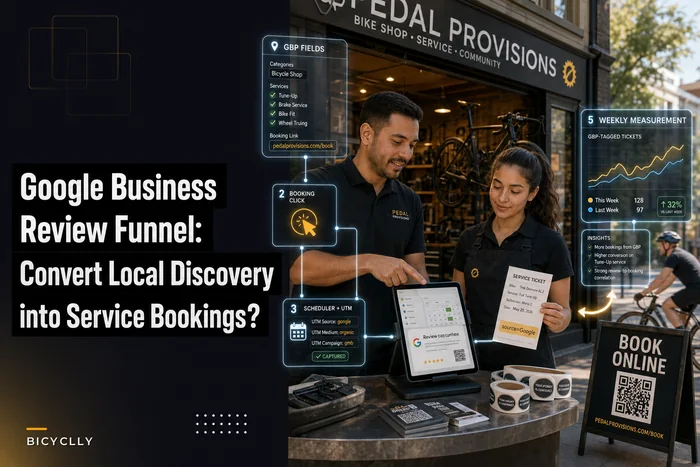
Google Business Profile is the opposite, almost purely bottom-of-funnel. Someone typing "bike repair near me" has a bike that's broken or about to be. The work is conversion: photos of the service area, accurate hours, a current review stream, and an easy way to call or book. Building that review stream is covered in the Google Business and review funnel guide for service bookings, so I won't repeat it here. For this system, GBP gets judged on new-customer tickets, not impressions.
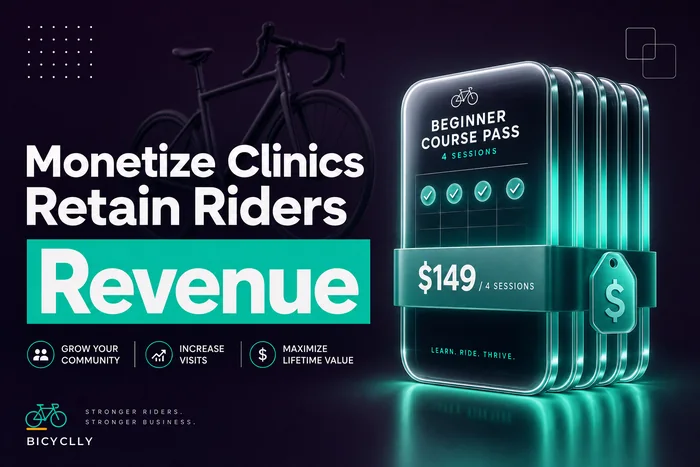
Clinics are the bridge, and they're the channel most likely to have the right audience and the wrong ending. Someone who spends an evening learning to adjust their brakes has told you they care about their bike. If the session ends with "thanks for coming," you've wasted the best moment you'll get. Curriculum and pricing so clinics pay for themselves is its own topic, covered in the monetized clinics playbook. What matters here is that the clinic has a defined handoff into a first ticket.
Referrals skip stages. A referred customer often arrives already at "I trust you," so they're cheap to convert and tend to stick. They're also the hardest to see unless you deliberately record them.
KPI gates: lead → ticket → LTV
A gate is a pass/fail number at the boundary between stages. The rule: don't put more money or hours into a channel until it passes the gate before the one you care about. If an event isn't capturing contacts, arguing about its lifetime value is pointless. Fix capture first.
These are the four gates that matter for a single shop. The ranges are starting targets for a typical independent shop, and your own baseline after a couple of months matters more than any of them.
Gate 1: Capture rate (reachable contacts ÷ people engaged) For clinics you should get most attendees, something like 70–85% if signup is part of registration. For events, "people engaged" means people who actually stopped and talked, not foot traffic walking past the tent. 20–30% of real conversations is decent.
Gate 2: Lead-to-first-ticket (contacts with a paid ticket within the window ÷ contacts captured) Use a 60-day window for clinics and a longer one, about 6 months, for events. Clinics in the 25–40% range are healthy. Events will be much lower, often single digits, and that's expected.
Gate 3: Repeat rate (first-ticket customers with a second ticket inside 12 months) This tells you whether a channel brings in people who stick or people who were just bargain hunting. Referrals usually lead here. Discount-driven event promos often trail badly.
Gate 4: 24-month gross margin per acquired customer, by source This is the LTV gate, measured in gross margin instead of revenue. A customer who buys a $4,000 e-bike at a 28% margin and never returns can be worth less than a commuter who comes in five times for $90 tune-ups at 60%+ labor margin. Revenue-based LTV flatters bike sales and hides service.
Small shops have small numbers. One clinic produces a handful of first tickets, which is too few to judge anything. So pool by quarter and look at "all clinics, Q2" as one cohort, not "the June 11 clinic." Single events swing wildly and say almost nothing on their own.
Gates need owners too. Capture rate belongs to whoever runs the event or clinic. Lead-to-first-ticket belongs to whoever owns follow-up, usually the service manager. Repeat rate is shared between service quality and the post-visit sequence. LTV is the owner's number. When a gate fails and nobody owns it, the review meeting turns into a shrug.
The conversion math, worked through
Most shops skip this part, and it's where the decisions actually get made. Below are worked examples for each channel, then a worksheet you can copy.
A clinic
A shop runs a two-hour beginner brake-and-shifting clinic on a weeknight.
-
14 people attended; 11 gave contact info on the registration form (79% capture, passes Gate 1)
-
Within 60 days, 4 of those 11 paid for service (36%, passes Gate 2)
-
Average first ticket
about $118, at roughly 60% gross margin → around $280 in margin
-
Cost
two staff for about 2.5 hours each at a loaded ~$26/hr (~$130), plus parts for demos, snacks, and printed handouts (~$35) → around $165
On first tickets alone, the clinic netted somewhere around $115 in margin. Fine, not exciting. The better part comes later. Two of the four came back within the year for something bigger, a drivetrain replacement and a fitting plus brake upgrade, worth another $300+ in margin between them. So the 12-month picture is a few hundred dollars of margin from one weeknight, plus four people who now think of you first.
Cost per known contact: $165 ÷ 11 ≈ $15.
A race-day booth
Same shop, spring gravel race, 9-hour day.
-
3 staff × 9 hours ≈ 27 hours at ~$26/hr ≈ $700, plus entry/vendor fee, tent, and some swag ≈ $250 → ~$950 total
-
About 38 contacts captured via a QR code raffle for a free tune-up
-
3 first tickets within 60 days, about 7 within 6 months, averaging maybe $95
Judged on Gate 2 and margin, the booth loses money, and not by a little. Seven tickets at ~$95 is around $665 in revenue, maybe $400 in margin, against $950 in cost.
But the booth's job was to build the list. Cost per known contact: $950 ÷ 38 ≈ $25, versus $15 at the clinic. So the real question isn't whether to kill events. It's whether the event list converts as well as the clinic list once it's pushed through a clinic invite. If those 38 contacts get invited to the next beginner clinic and five show up, the event is feeding the clinic, and the two should be judged as one system.
This is the point where most shops kill their events, based on Gate 2 math that was never the event's job.
Google Business Profile
GBP math is mostly about attribution. A small shop in a mid-size town might see something like 130–150 calls, 200+ direction requests, and around 90 website clicks off the profile in a busy month. You can't trace all of those to tickets, and you don't need to.
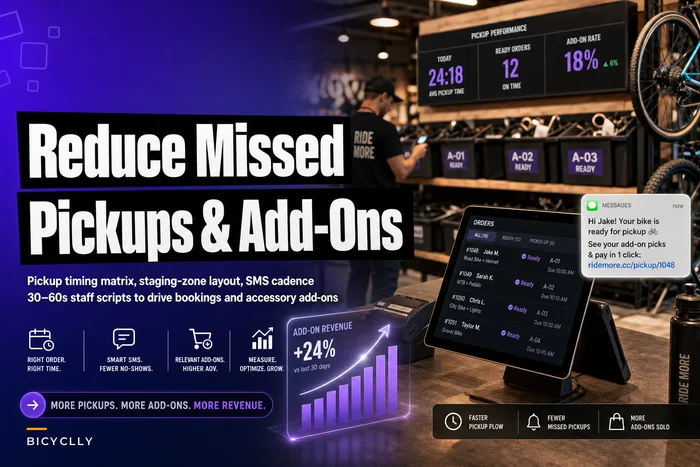
What you need is the source question at intake. If 40-ish new-customer tickets a month cite Google, and the profile work (photo updates, review responses, Q&A, hours) takes around 4 staff hours a month, GBP is easily your cheapest first-ticket channel, a few dollars per ticket. The weak gate is almost always repeat rate. Search customers are transactional by default, so the post-visit experience does the heavy lifting. A clean pickup handoff is one of the biggest levers, and it ties into the click-and-collect pickup workflow. Pickup is the last in-person moment you get to book the next visit.
Referrals
Referrals look small in volume, maybe 6–10 new customers a month for a busy shop, but they tend to have the best repeat rate and the highest 24-month margin per customer. The work is making them visible. Add a "who sent you?" field at intake and a simple thank-you for the referrer, like a credit on their next service.
Once you can count referrals, you can see which customers are advocates, and that list is worth more than any event list.
The monthly worksheet
Here's the worksheet with a sample month filled in. Copy the structure, use your own numbers.
| Line | Clinics | Events | GBP | Referrals |
|---|---|---|---|---|
| A. People engaged | 31 | ~120 conversations | ~430 profile actions | — |
| B. Contacts captured | 24 | 34 | — | — |
| C. Capture rate (B ÷ A) | 77% | 28% | — | — |
| D. First tickets in window | 8 | 2 | 41 | 7 |
| E. Lead→ticket (D ÷ B) | 33% | 6% | ~10% of actions | — |
| F. Total channel cost (labor + hard cost) | ~$340 | ~$900 | ~$110 | ~$70 in credits |
| G. Cost per contact (F ÷ B) | ~$14 | ~$26 | — | — |
| H. Cost per first ticket (F ÷ D) | ~$43 | ~$450 | ~$3 | ~$10 |
| I. Avg first-ticket gross margin | ~$70 | ~$55 | ~$62 | ~$80 |
| J. Payback on first ticket (I ÷ H) | 1.6× | 0.1× | 20×+ | 8× |
| K. Repeat rate (trailing 12 mo, pooled) | fill quarterly | fill quarterly | fill quarterly | fill quarterly |
| L. 24-mo margin per customer (pooled) | fill semi-annually | fill semi-annually | fill semi-annually | fill semi-annually |
Lines K and L don't get filled in monthly. There isn't enough data, and pretending otherwise leads to bad calls. Monthly, you watch the top of the sheet. Quarterly and twice a year, you look at the bottom.
Also, don't read the events column in that sample month as "events are dead." Two tickets from 34 contacts is exactly what a list-building channel looks like before the clinic invites have had time to work.
How a contact moves through the system
The worksheet only works if the data behind it is real, and that depends on the weekly workflow, not the monthly review. This is how it should run in a shop with an owner, a service manager, and a couple of mechanics.
-
Registration. A rider signs up for a clinic online or at the counter. Registration collects name, phone or email, what they ride, and a checkbox for service reminders. The source tag ("clinic – brakes – June") gets attached right then, not later.
-
The ask at the end. Whoever's running the clinic offers a specific next step: a discounted safety check, a reserved slot the following Saturday, or a printed card with a booking link that carries the clinic code. It isn't a hard sell. It's "if anything we covered tonight sounds like your bike, here's how to get it looked at."
-
Follow-up inside 48 hours. A named person sends a short note that mentions what they ride and the session they sat in on. Not a newsletter. With a template, a batch takes a couple of minutes.
-
Intake. When that person shows up for service, the intake screen either already knows them because the contact exists with a source tag, or the intake person asks and records the source. It carries onto the ticket.
-
After pickup. The review request and the next-service reminder go out.
Step 4 is the highest-leverage habit in the whole system, and it falls apart the moment the counter gets busy unless it's a required field.
For step 5, the two-step feedback funnel is worth setting up, because those reviews feed straight back into GBP. Clinic attendees become reviewers, and reviewers make the bottom-of-funnel channel convert better.
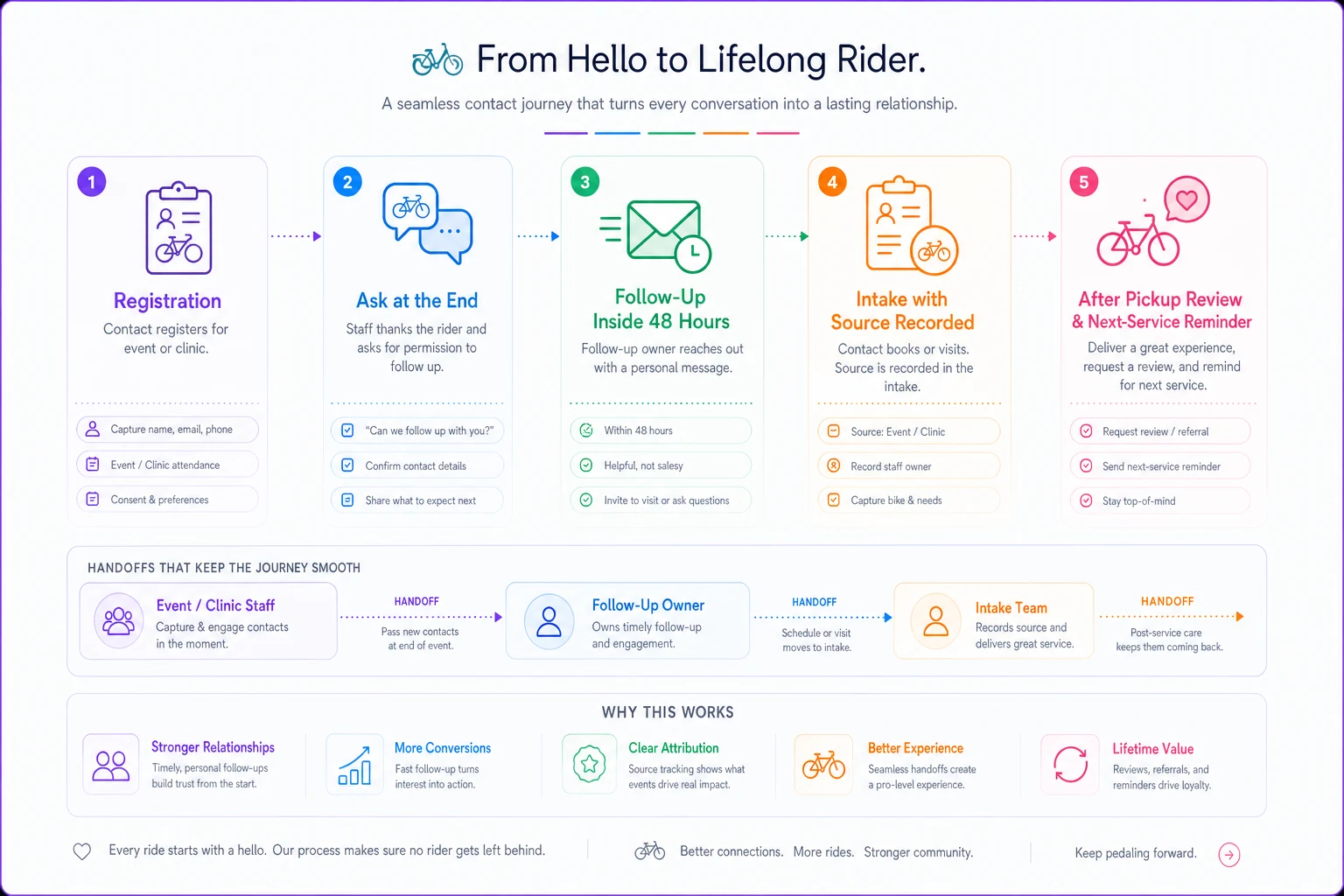
None of this is complicated. It's four or five handoffs between people who are all busy doing something else, and one dropped handoff breaks the attribution chain.
Experiment templates that work with small numbers
Once the gates are in place you'll want to test things. Should clinics end with a booked slot or a coupon? Is a free tune-up raffle a better capture tool than a giveaway? The trap is running experiments like a big e-commerce company, with small tweaks and quick reads. A shop with 30 clinic attendees a month will never detect a 5% lift. The noise swamps it.
-
Test big swings, not tweaks. "Reserved Saturday slot vs. nothing" is testable. "Blue card vs. green card" is not.
-
Run for 6–8 weeks minimum, or a fixed number of contacts (say 40+), whichever comes later.
-
Only one experiment per lifecycle stage at a time. If you change the clinic ending and the follow-up message in the same month, you won't know which one did anything.
-
Set the kill rule before you start, not after you see the results.
Here's a one-page template:
EXPERIMENT CARD Name: e.g., "Clinic ends with reserved Saturday check slot" Channel: Clinics Stage targeted: Known contact → First ticket Gate metric: Lead-to-first-ticket, 60-day window Baseline (last 2 qtrs): ~30% What would count as a real change: needs to move to ~40%+ to matter at our volume Change being tested: Last 5 min of clinic = offer of 3 reserved 20-min check slots the following Saturday, booked on the spot Duration / sample: 8 weeks or 45 attendees, whichever is later Cost cap: ~$0 hard cost; ~1 hr/week of bench time held back Kill rule: If Saturday slots go unfilled 3 weeks running, stop Owner: Service manager Decision date: [first monthly review after sample is reached] Result: __ Decision: Keep / Kill / Modify
In this kind of test, the reserved-slot ending usually beats a coupon ending, because a coupon gets lost and a booked slot is a commitment. The risk is that it eats bench time in peak season, which is why the cost cap lists bench hours and not dollars. Bench hours are the real currency in a service shop, and experiments that ignore them cause trouble in the service department two weeks later.
The monthly owner review
This meeting is what makes everything else stick. Keep it short, hold it at the same time every month, and end it with decisions, not observations. First Tuesday of the month works, 60–90 minutes, owner plus service manager plus whoever runs events and clinics.
-
Data check (10 min). Before looking at any results, check whether the data is trustworthy. What share of new-customer tickets this month had a source recorded? If it's under about 80%, the first decision of the meeting is fixing intake, and everything else gets treated as rough.
-
Gate 1 and Gate 2 review by channel (15 min). Walk the top half of the worksheet. For each channel, note pass/fail on capture and lead-to-ticket against your own baseline.
-
Capacity check (10 min). Compare first tickets generated against bench capacity for the coming month. If the bench is already booked 10 days out, more first-ticket marketing makes things worse. Shift effort toward list-building and off-peak bookings.
-
Experiment readout (10 min). Any experiment that hit its sample size gets a decision: keep, kill, or modify. No "let's give it another month" unless the sample genuinely isn't there yet.
-
Next month's calendar (15 min). Confirm which clinics and events are happening, who owns capture at each, and who owns the 48-hour follow-up.
-
Allocation decision (10 min). Move hours or dollars between channels based on what passed and what failed. Write the decision down in one line.
-
Quarterly add-on. Every third month, fill in repeat rate and pool cohorts. Twice a year, fill in 24-month margin per customer by source. These are the meetings where channels actually get cut or doubled.
The usual way this meeting dies is that it becomes a report-out. Everyone shares numbers, everyone nods, nothing changes. If it ends without at least one written allocation decision, it didn't really happen.
Setup checklist before your first review
Most of this system comes down to a handful of small habits that either exist on day one or never get built. Before you hold the first review, go through the list below and be honest about which ones are actually in place, not which ones you plan to do.
-
Every clinic and event registration captures a contact and a source tag at signup, not later
-
The service intake screen has a required source field ("how did you find us / who sent you")
-
Each upcoming clinic and event has one named person responsible for capture
-
One named person owns the 48-hour follow-up for every captured contact
-
A follow-up template exists for clinic attendees and a separate one for event contacts
-
Event contacts have a default next step (invite to a clinic), not a service discount
-
Referral thank-you mechanism exists and is recorded somewhere visible
-
The worksheet lives in one place, and the person preparing it knows where every number comes from
-
The review is on the calendar for the next six months, not just next month
If you only fix two, make them the source field at intake and the named follow-up owner.
Nobody has all nine checked on the first pass, and that's fine. If you only fix two, make them the source field at intake and the named follow-up owner. Those break the chain most often, and the review meeting is mostly useless without them.
What changes as the shop grows
Owner-operated, one bench. The owner runs clinics, sends follow-ups, and writes tickets. Attribution is easy because one person remembers everything, which is exactly the danger. The data lives in the owner's head and disappears the day they hire help. Even at this size, write the source on the ticket.
Two or three mechanics plus a service manager. Breakpoint 2 shows up hard here. The person who met someone at the clinic isn't the person who writes their ticket, so source tracking has to become a system field, not a memory. Follow-up ownership gets murky too, because "someone should email them" is now true for four people. Shops that handle this well usually give the service manager the follow-up queue and nothing else marketing-related.
Capacity becomes the constraint. Somewhere in this phase, a shop with working local marketing runs into its own bench. In April and May, good clinics and a strong GBP profile can push the backlog past two weeks, and then turnaround complaints start hurting the reviews that were feeding GBP in the first place. The fix is seasonal. In peak months, marketing shifts toward capture and off-peak booking, like reserving October overhauls in May. Most shops run the same calendar all year and then wonder why spring feels like drowning.
Multiple locations. Each location needs its own worksheet, because community channels are hyper-local. A clinic that converts well at a downtown commuter shop may flop at a suburban MTB-heavy location, and pooling them hides that. The owner review becomes a roll-up, and the per-location reviews move to the store managers.
Real scenario: cutting events in half and getting more customers
Business: Independent two-bay shop in a college town, roughly $550k–$650k annual revenue, service around 40% of gross margin.
Problem: The owner said yes to nearly every community request: race sponsorships, campus bike fairs, charity rides. That added up to around 26 events a year. Staff were burned out by August and nobody could say what the events produced. Capture was a clipboard. Source tracking at intake was nonexistent. Clinics ran occasionally, whenever someone had energy, with no follow-up.
What changed: They ran the worksheet for one quarter before cutting anything, just to get a baseline. Capture at events came in around 15–20% of real conversations, and almost none of those contacts were ever followed up. They cut down to 11 events, keeping the ones where capture was decent and the crowd matched their customer base. Mostly that meant commuter and campus events, not elite races. The freed-up staff hours went into a monthly beginner clinic with a reserved-slot ending, and event contacts got invited to clinics by default.
-
Event capture rate
~18% → around 40% after switching from clipboards to a QR raffle for a free safety check
-
New service customers attributable to community channels
around 9 a month → somewhere around 19–22 a month
-
Staff hours on events and clinics combined
down by close to a third
-
Source recorded on new-customer tickets
basically zero → around 85%
Outcome: The obvious win was more customers for less effort. The less obvious one was that the owner finally had a reason to say no to event requests, because each one could be checked against cost per contact. The spring backlog got less brutal too. Some clinic attendees got nudged into fall overhaul bookings in the shoulder months, instead of everyone showing up the first warm weekend in April.
When this makes sense
It earns its keep when you're already running at least two community channels and can't tell which one works. It also fits if you have someone, even part-time, who can own follow-up, or if your service bench has some slack for part of the year. Shops with a seasonal swing get extra value, because the system helps shift demand into slower months instead of piling more onto peak.
It also makes sense if you're about to hire a service manager or open a second location. Building attribution habits before the team grows is much easier than bolting them on afterward.
When this is a bad idea
If your bench is booked out three weeks year-round and you can't add capacity, more first-ticket marketing is the wrong problem. Fix throughput first. Measuring your way to customers you can't serve just produces angry reviews.
Adopting the full system all at once is also a bad idea if nobody will run the monthly review. A half-built version with no review is just extra data entry, and staff will resent it, fairly. Start with source on the ticket and one channel's worksheet, and expand once the review habit exists.
Who should NOT do this
Very small shops where the owner is the only mechanic and does a handful of community things a year probably don't need the full worksheet. A source field on tickets and a quarterly gut check is plenty.
Shops that mostly sell parts online, or sell bikes with minimal service, will find the lifecycle stages don't fit well. Repeat service is the backbone of the LTV gate here. Without it, the math points toward different channels entirely.
Where software fits, and where it doesn't
You can run all of this in a spreadsheet and a shared inbox, and for the first few months you probably should. It forces you to understand where each number comes from.
A spreadsheet usually stops being enough at Breakpoints 2 and 3: source tags that don't make it from registration to ticket, and follow-ups that slip when the shop gets busy. That's where operational software with some AI automation genuinely helps. A clinic registration creates a contact that the POS recognizes at intake. A follow-up draft gets generated from what the person rides and which session they attended, ready for someone to approve and send. The worksheet fills itself from tickets instead of someone rebuilding it the night before the review. Some platforms will also flag gate misses, like an event whose contacts haven't been followed up after three days, so the problem surfaces before the monthly meeting instead of during it.
What software won't do is decide that your race booth is a list-building channel, or run the review meeting for you. Those calls are still yours.
Getting started without boiling the ocean
If this feels like a lot, don't start with the whole lifecycle. Start with two things: a required source field at service intake, and a capture-plus-follow-up routine for your next clinic. Run that for one quarter. You'll have real numbers for Gate 1 and Gate 2 on at least one channel, and a sense of how often the intake field actually gets filled in on a busy Saturday. That second number usually tells you more about your operation than any marketing metric.
After that quarter, add events with their own capture target and invite those contacts to clinics. Then layer in GBP and referral tracking, then the monthly review. By the end of the second season, you'll be deciding where to spend community hours based on evidence instead of whoever argued loudest at the staff meeting. In most shops, that means fewer events, better clinics, and a service bench that fills a little more evenly through the year.
After that quarter, add events with their own capture target and invite those contacts to clinics. Then layer in GBP and referral tracking, then the monthly review. By the end of the second season, you'll be deciding where to spend community hours based on evidence instead of whoever argued loudest at the staff meeting. In most shops, that means fewer events, better clinics, and a service bench that fills a little more evenly through the year.
Ready to revolutionize your bike shop operations?
Join hundreds of bike shops using Bicyclly to save time, increase revenue, and deliver exceptional customer service.